.svg)
Why Trial Experience Matters When Choosing an Accident Lawyer

Look for a lawyer who has tried cases like yours, not just settled them. Ask who would take your case to court, how they would prove fault and the full cost of your injuries, and what you could owe under the fee agreement. A lawyer ready for trial gives an insurer a reason to take your claim seriously, though no lawyer can promise a fast or fair offer. According to the American Bar Association, trial preparation is a core component of effective civil litigation.
I'm Anthony Shapero, managing partner at Liss, Shapero & Mitnick. My years litigating injury cases, including earlier work defending insurers, shape how I approach the work of accident trial lawyers: prepare for court while pursuing a fair settlement.
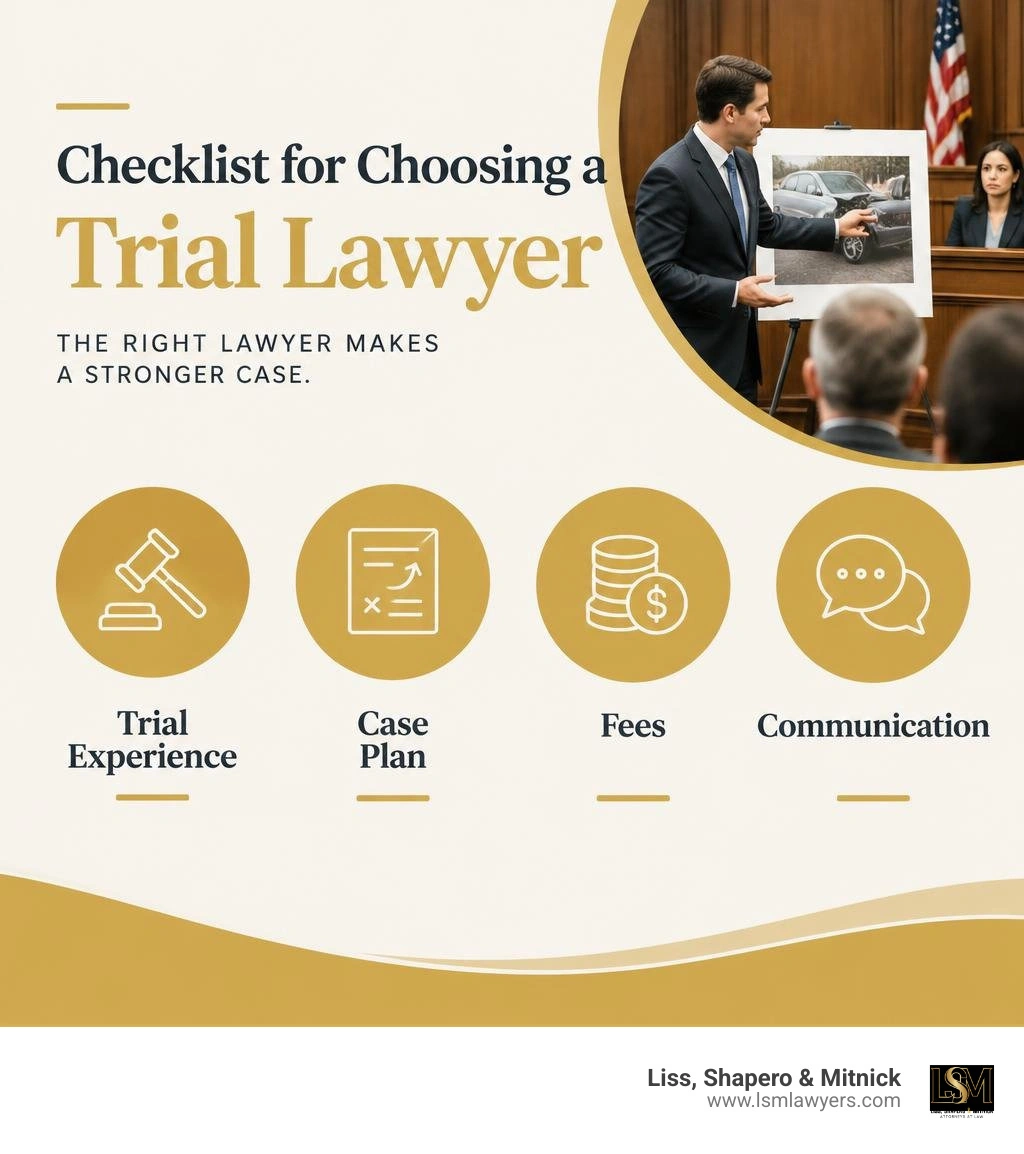
Easy accident trial lawyers word list:
How Accident Trial Lawyers Change the Dynamics of Insurance Negotiations
When insurance adjusters look at an incoming personal injury claim, their primary objective is simple: resolve the liability for as little capital as possible. Insurance carriers are massive corporations driven by risk management formulas and claims-handling software. When an adjuster assigns a settlement reserve to your case, they do not just evaluate medical bills and property damage. They evaluate the attorney sitting across the negotiating table.
If an injured person is represented by an attorney known only for processing desk settlements, the insurer has very little financial motivation to offer top dollar. There is no impending threat of a courtroom verdict. However, when insurance companies recognize that they are dealing with proven accident trial lawyers, the financial equation changes immediately.
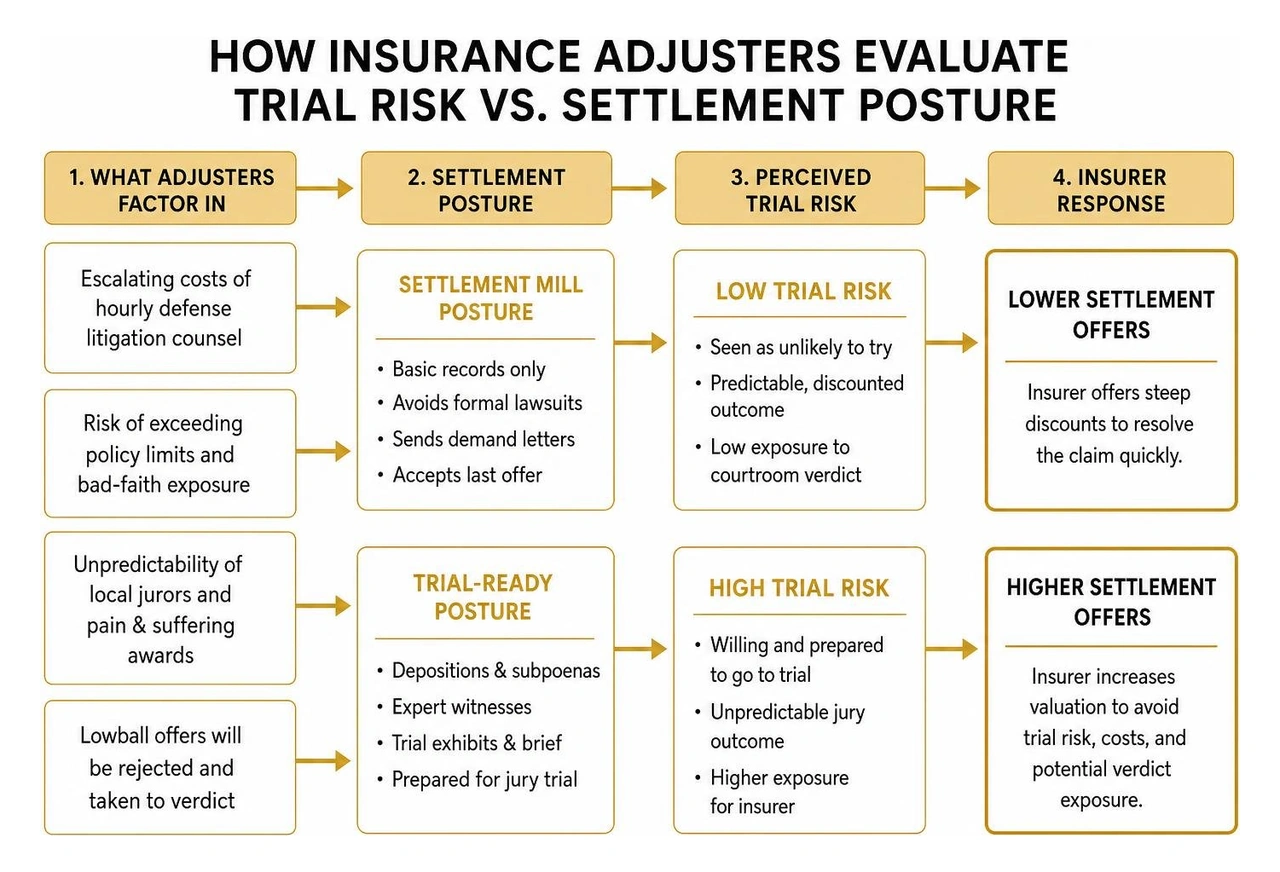
The threat of facing an experienced litigator in front of a jury forces insurance defense adjusters to re-evaluate their potential exposure. Suddenly, the insurance carrier must factor in:
- The escalating costs of paying hourly defense litigation counsel.
- The risk of exceeding policy limits and triggering potential bad-faith exposure.
- The unpredictability of local jurors who may award significant damages for pain and suffering.
- The reality that lowball offers will be rejected outright and taken directly to a courtroom verdict.
Retaining a skilled car accident injury lawyer who builds a comprehensive trial binder from day one creates real negotiation leverage. It transforms a standard administrative claim into a high-risk liability for the insurer.
| Strategic Dimension | High-Volume Settlement Mill | Trial-Ready Litigation Practice |
|---|---|---|
| Primary Objective | Fast turnover and high case volume | Maximum client compensation and full accountability |
| Case Preparation | Gathers basic records; stops at demand letters | Deposes key witnesses, retains experts, prepares exhibits |
| Insurer Perception | Low risk; insurer offers discount settlements | High risk; insurer faces courtroom exposure and trial costs |
| Discovery Strategy | Avoids filing formal lawsuits whenever possible | Uses subpoenas, depositions, and motions to uncover evidence |
| Courtroom Readiness | Refers difficult cases out or accepts last offer | Fully prepared to present the case before a judge and jury |
Trial-Ready Preparation vs. Settlement Mill Tactics
The personal injury legal market includes two fundamentally different operational models: settlement mills and trial-ready litigation firms.
Settlement mills rely on heavy advertising to bring in hundreds of files per month. Because these operations lack the infrastructure and courtroom focus to try every claim, their business model depends on resolving cases rapidly through telephone negotiations and form demand letters. Insurance adjusters know exactly which firms operate this way. If an insurer knows your legal team will never step into a courtroom, their "final offer" will consistently reflect a steep discount.
In contrast, our trial-first philosophy treats every motor vehicle collision, truck crash, and catastrophic injury as if it will be decided by a jury. We take formal witness statements, issue subpoenas for electronic vehicle data, retain medical and economic experts early, and build demonstrative trial exhibits. When the defense sees a fully prepared trial brief instead of a vague settlement brochure, their valuation multipliers adjust upward. Courtroom readiness is the single most effective tool for producing prompt, fair settlements.
Leveraging Insurance Defense Insight Against Corporate Insurers
Understanding the opponent's playbook provides an undeniable tactical edge. Having spent years working in insurance defense before representing injury victims across Metro Detroit and Michigan, our legal team understands how claims departments operate behind closed doors.
Insurers rely on specialized claims software algorithms to determine baseline settlement ranges. These algorithms look for specific documentation: objective medical imaging, consistent treatment records, vocational impairment assessments, and the litigation history of the plaintiff's attorney.
Because we understand the internal benchmarks adjusters must meet to justify higher settlement reserves to their supervisors, we structure our evidence to satisfy those precise criteria. Furthermore, we know how defense counsel advises their corporate clients regarding trial risk. By anticipating defense arguments—such as comparative negligence claims or preexisting condition defenses—we dismantle their strategy before they even have the opportunity to present it in court.
Evaluating Legal Representation: Qualifications and Courtroom Experience
Not all attorneys who advertise personal injury services possess the qualifications necessary to manage complex courtroom litigation. Evaluating an attorney's background, professional recognition, and verifiable litigation history is critical to securing proper representation.

When selecting an experienced Michigan accident lawyer, look closely at peer reviews, professional organization memberships, and past case handling. Recognition among peers—such as listings in Super Lawyers, membership in elite invitation-only trial forums, and active participation in local and national trial lawyer associations—serves as an objective indicator of competence.
Furthermore, real-world courtroom experience cannot be replicated by academic theory. An attorney who has personally conducted voir dire (jury selection), direct and cross-examinations, expert witness challenges, and closing arguments understands how to communicate complex medical evidence to regular citizens serving on a jury.
Key Differences Between Settlement Lawyers and Accident Trial Lawyers
Understanding the fundamental distinctions between desk negotiators and trial litigators helps injury victims make informed choices about their legal representation:
- Deposition Tactics: A desk negotiator conducts standard depositions focusing only on surface facts. A seasoned trial lawyer approaches depositions as cross-examination, pinning defense witnesses and corporate representatives down on specific safety violations to eliminate their defenses before trial.
- Evidentiary Standards: Trial attorneys ensure every piece of medical documentation, accident reconstruction model, and wage record adheres strictly to the rules of evidence, making it fully admissible in court.
- Pretrial Motion Practice: Trial lawyers use targeted motions to compel hidden evidence, strike improper defense arguments, and exclude biased defense medical examiners.
- Client Dignity and Advocacy: Litigators view cases through the lens of human impact, ensuring the jury understands how an injury permanently altered a client's daily life, dignity, and independence.
Trial Advocacy Credentials
Elite accident litigators frequently distinguish themselves through rigorous credentialing and dedicated trial organizations. Groups like the Multi-Million Dollar Advocates Forum and the Million Dollar Advocates Forum represent fewer than 1% of all practicing lawyers in the United States, honoring attorneys who have demonstrated the ability to secure complex, high-value outcomes for their clients.
Similarly, formal certifications in civil trial advocacy demonstrate that a lawyer has undergone rigorous peer review, judicial evaluation, and proven courtroom testing. When insurance companies evaluate their exposure on a catastrophic injury claim, these credentials signal that your legal team possesses the resources and technical skill required to hold corporate wrongdoers fully accountable.
Complex Litigation Strategies in Trucking and Catastrophic Injury Cases
Commercial trucking crashes and catastrophic injury claims involve complex evidentiary rules and corporate defense structures that standard vehicle accident claims rarely encounter. When an 80,000-pound commercial tractor-trailer causes severe harm, the legal battle quickly expands into federal safety violations, corporate safety policies, and multi-layered liability policies.
Navigating Commercial Regulations and Corporate Defenses
Commercial motor carriers operate under strict federal guidelines established by the Federal Motor Carrier Safety Administration (FMCSA). When investigating a catastrophic trucking collision, trial lawyers must immediately intervene to prevent the destruction of vital evidence:
- Electronic Control Module (ECM) Data: Often referred to as the truck's "black box," the ECM records vehicle speed, braking patterns, engine RPM, and throttle positions in the seconds leading up to a crash.
- Hours-of-Service (HOS) Logs: Electronic logging devices (ELDs) track whether the truck driver exceeded legal driving limits, leading to dangerous driver fatigue.
- Fleet Maintenance and Inspection Records: Corporate maintenance files often reveal deferred brake repairs, worn tires, or ignored safety warnings that contributed directly to the crash.
- Hiring and Qualification Files: Freight companies frequently attempt to shield themselves from liability by claiming the driver was an independent contractor. Proper discovery exposes negligent hiring practices, lack of required drug screenings, and inadequate driver training.
Corporate defense teams often dispatch rapid-response investigators to the accident scene within hours of a catastrophic collision. To counter these aggressive defenses, trial lawyers immediately file preservation-of-evidence letters and emergency motions to inspect the vehicle and download crucial telematics data before it is lost or overwritten.
Proving Full Economic and Non-Economic Damages
Catastrophic collisions often result in traumatic brain injuries, spinal cord damage, amputations, or severe polytrauma. Calculating and proving the true cost of these injuries requires comprehensive economic modeling and medical analysis.
Economic damages extend far beyond current medical bills. For long-term care, trial lawyers work alongside certified lifecare planners and vocational specialists to map out:
- Lifetime medical expenses, including surgeries, physical therapy, home modifications, and assistive technology.
- Future lost earning capacity and loss of employment benefits.
- Ongoing attendant care and in-home nursing assistance.
Non-economic damages address the human element of a catastrophic injury: physical pain, mental anguish, loss of companionship, and the loss of the ability to enjoy life's daily moments. In the most tragic situations where negligence results in a loss of life, a dedicated Michigan wrongful death lawyer works to secure accountability for surviving family members, seeking damages for the loss of financial support, guidance, and emotional companionship.
What to Expect When Working With Accident Trial Lawyers
Navigating a formal lawsuit can feel overwhelming when you are already focusing on physical recovery. Knowing what to expect at each stage of the litigation process provides clarity and peace of mind. Working with an experienced personal injury attorney near Berkley MI ensures your legal rights are protected from initial investigation through final resolution.
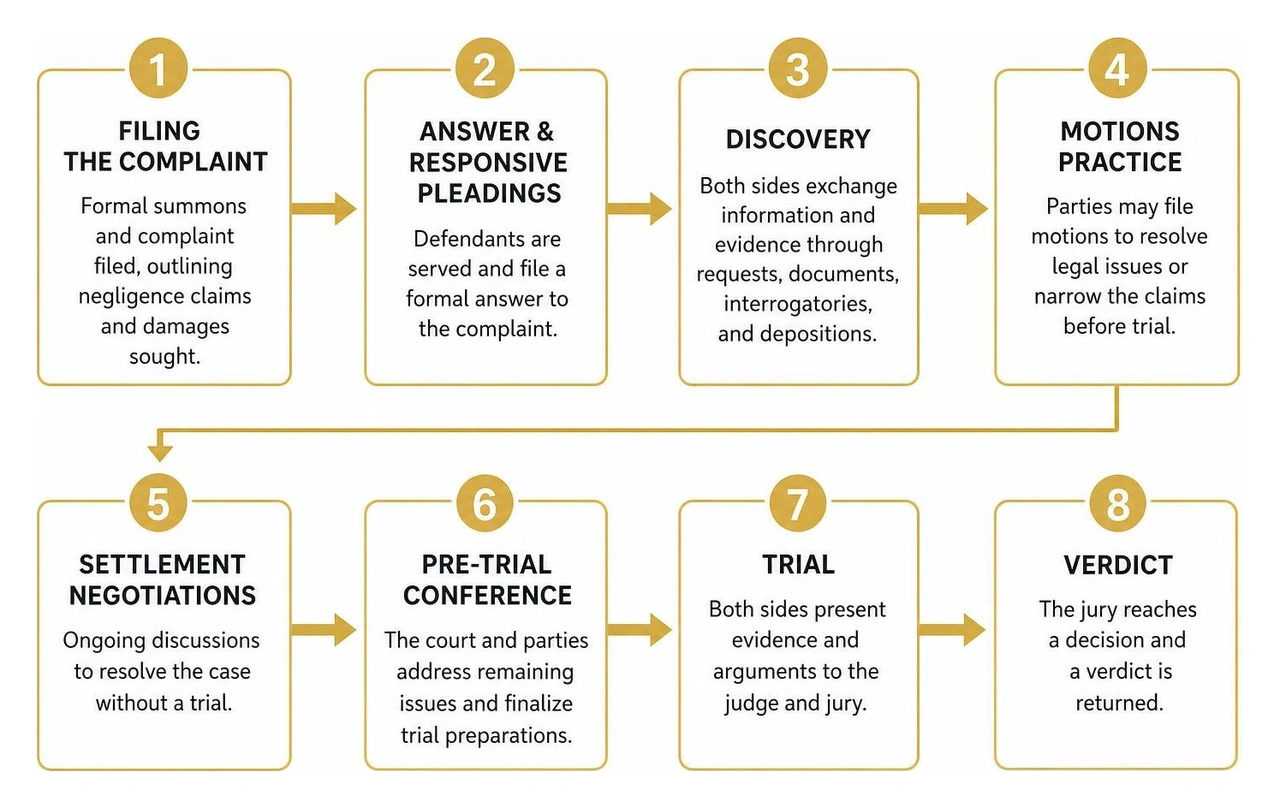
Step-by-Step Litigation Process from Filing to Verdict
The civil litigation timeline moves through several distinct procedural stages:
- Initial Filing and Pleadings: The process begins with filing a formal summons and complaint in the appropriate circuit court, detailing the factual allegations of negligence and the legal grounds for damages. The defendants are served and must file a formal answer.
- Written Discovery: Both parties exchange formal written interrogatories, requests for production of documents, maintenance records, medical charts, and insurance policy details.
- Depositions: Attorneys take sworn, recorded testimony from all parties involved, including the injured victim, eyewitnesses, investigating law enforcement officers, corporate representatives, and medical experts.
- Pretrial Motions and Case Evaluation: The court hears legal motions regarding evidence admissibility. In Michigan, cases typically proceed through mandatory case evaluation or mediation to explore settlement opportunities based on neutral third-party assessments.
- Trial and Jury Verdict: If the defense refuses to offer fair compensation, the case proceeds to trial. The process involves jury selection (voir dire), opening statements, witness examinations, demonstrative evidence presentation, closing arguments, jury deliberation, and the return of a binding verdict.
Contingency Fee Structures and Initial Case Consultations
Most injury victims cannot afford to pay high hourly legal rates out of pocket while facing mounting medical bills and missed paychecks. For this reason, personal injury trial lawyers work on a contingency fee basis.
Under a standard contingency fee agreement, you pay no upfront legal fees. The attorney's fee is calculated as an agreed-upon percentage of the final recovery obtained through settlement or trial verdict. If the attorney does not recover compensation for you, you do not owe attorney fees for their time. Litigation expenses (such as expert witness retainers, court filing costs, and deposition transcripts) are typically advanced by the law firm and reimbursed from the recovery at the conclusion of the case.
To maximize the value of your initial legal consultation, prepare and bring the following essential documentation:
- Official police crash reports and accident exchange slips.
- Photographs or video recordings of the accident scene, vehicle damage, and visible injuries.
- Complete contact information for any eyewitnesses.
- Emergency room discharge summaries, medical records, and physical therapy plans.
- Health insurance cards and auto insurance declaration pages.
- Pay stubs, tax forms, or employer documentation demonstrating lost wages.
- All written or recorded correspondence received from insurance adjusters.
Frequently Asked Questions About Trial Attorneys
What is the advantage of hiring a trial lawyer with specialized credentials?
Hiring a lawyer with recognized trial credentials, peer recognitions, and professional trial memberships provides immediate negotiation leverage. Insurance companies track attorney performance; they know which attorneys routinely take cases to verdict and which settle out of convenience. Specialized trial credentials demonstrate that your legal advocate possesses the verified courtroom skill, technical evidentiary knowledge, and financial resources needed to take complex claims all the way to a jury verdict if an insurer refuses to settle fairly.
How do trial lawyers calculate catastrophic injury and wrongful death damages?
Calculating catastrophic and wrongful death damages requires specialized financial, vocational, and medical projections. Trial lawyers collaborate with lifecare planners, forensic economists, and medical specialists to calculate future inflation-adjusted medical expenses, lifetime lost wages, and home accommodation costs. Non-economic damages—such as physical pain, emotional trauma, and the profound loss of society and companionship—are illustrated through witness testimony, family video documentation, and personal medical narratives to show the true impact on the victim's life.
What percentage do accident lawyers take if a case goes to court?
In personal injury litigation, attorney contingency fees are structured as a percentage of the total recovery. In Michigan, standard personal injury contingency fees are generally set at one-third (33.3%) of the net recovery. When a case proceeds into formal litigation and trial, legal teams must advance substantial costs for expert witness testimony, court reporters, video depositions, and trial exhibits. These litigation costs are tracked transparently and deducted from the gross settlement or verdict according to your written representation agreement.
Conclusion
When you or a loved one suffers a serious injury, the attorney you choose directly impacts how the insurance company treats your claim. Settling for an attorney who avoids the courtroom often results in compromised outcomes and lowball settlements.
At Liss, Shapero & Mitnick, our legal team brings decades of courtroom experience and deep insight gained from former insurance defense work. We know how insurers assess risk, and we use that knowledge to fight for the maximum compensation our clients deserve across Metro Detroit and throughout Michigan. If you need dedicated motor vehicle accident representation, contact our office today to discuss your case and discover the difference a true trial-first approach makes.