.svg)
Why You Need an Auto Accident Cases Lawyer Immediately After a Collision

An auto accident cases lawyer protects your rights after a crash by immediately preserving critical evidence, handling all insurer communications so you do not make damaging recorded statements, and accurately calculating the full value of your past, present, and future damages before any settlement is accepted. This legal protection begins on day one, before adjusters can lock you into a lowball offer or evidence disappears.
Across the nation, motor vehicle collisions happen with alarming frequency. According to data compiled by the National Highway Traffic Safety Administration, over 38,000 fatal crashes occurred on roadways across the country in 2020 alone, and more than 5 million police-reported accidents took place—averaging more than 14,000 collisions every single day. Dangerous driving behaviors cause immense harm: speeding accounts for more than 11,000 deaths each year, while impaired driving accounts for nearly 14,000 annual fatalities, causing over 30% of all fatal crashes.
When a crash happens in Michigan, navigating the immediate aftermath can feel overwhelming. Adjusters move quickly to minimize their exposure, and important physical evidence can vanish within days. Having an experienced auto accident cases lawyer step in right away provides immediate stability and levels the playing field.
Studies demonstrate that victims who retain legal counsel recover an average of 3 to 4 times more financial compensation than those who attempt to negotiate claims on their own.
| Factor | Negotiating Alone | With an Experienced Lawyer |
|---|---|---|
| Evidence Preservation | Often limited to police reports and personal smartphone photos | Thorough forensic collection, subpoenaed surveillance footage, and expert analysis |
| Claim Valuation | Based on current bills, frequently overlooking future care | Comprehensive accounting of past, present, and lifetime economic and non-economic losses |
| Insurance Tactics | Vulnerable to quick, lowball offers and recorded statement traps | Insurers cannot contact you directly; adjuster tactics are quickly neutralized |
| Average Recovery | Baseline offers, often failing to cover ongoing care | Statistically 3–4× higher average financial recovery |
| Litigation Threat | Insurers know unrepresented claimants rarely file lawsuits | Trial-ready posture forces insurers to offer realistic settlement values |
Understanding the Role of an Auto Accident Cases Lawyer
Our primary role extends far beyond merely filling out legal paperwork. When we take on a case, we manage every moving piece so you can dedicate your energy entirely to physical healing:
- Independent Accident Investigation: We secure physical evidence from the collision site, review roadway skid marks, inspect vehicle damage patterns, obtain dashcam or nearby security camera footage, and interview eyewitnesses.
- Accident Reconstruction: In complex collisions, we partner with specialized reconstruction engineers to determine vehicle speeds, braking distances, and exact points of impact.
- Medical Documentation & Future Care Auditing: We work closely with your treating doctors, surgeons, and physical therapists to obtain comprehensive documentation of your diagnostic scans, treatment plans, and long-term care needs.
- Identifying All Insurance Coverage: We audit every policy involved—including your own auto coverage, the at-fault driver's bodily injury coverage, commercial policies, umbrella plans, and underinsured motorist endorsements.
- Crafting Compelling Demand Packages: We compile detailed legal demands that outline the full scope of liability and quantify every dollar of your damages to present a formidable case to the insurance carriers.
Avoiding Costly Mistakes With Insurance Companies
Insurance companies are profit-driven corporations. Their primary objective following a crash is to minimize their financial payout. Even your own insurer uses specialized claim adjusters and automated algorithms designed to limit claim value.
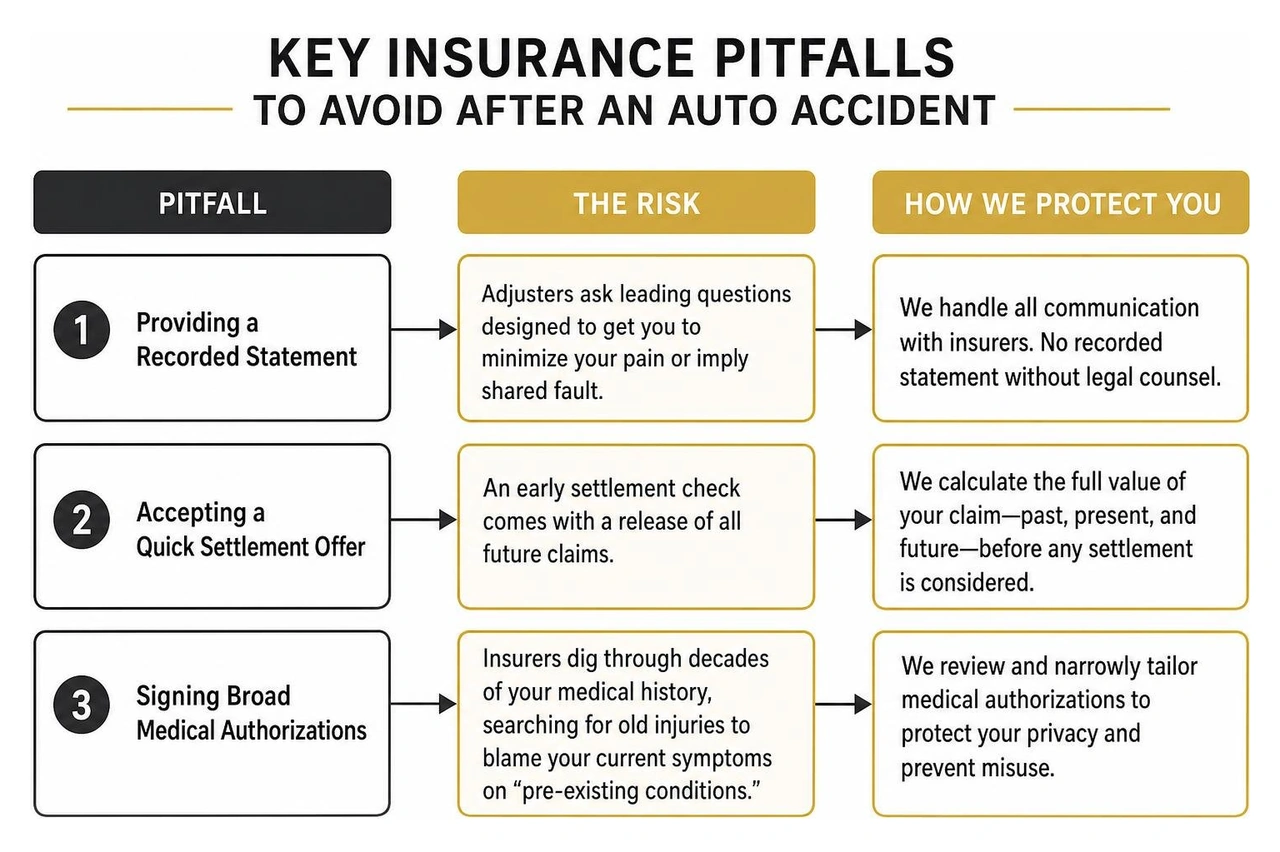
Here are the most critical mistakes you can make after a crash—and how we shield you from them:
- Providing a Recorded Statement: Adjusters often call shortly after the accident when you may still be shaken, medicated, or unaware of the full extent of your injuries. They ask leading questions designed to get you to inadvertently minimize your pain or imply shared fault. You are not required to provide a recorded statement to the other driver's insurer, and you should never do so without legal counsel.
- Accepting a Quick Settlement Offer: An early settlement check comes with a release of all future claims. If your soft-tissue pain turns out to be a herniated disc requiring surgery down the road, you cannot reopen the claim once that release is signed.
- Signing Broad Medical Authorizations: Insurers frequently ask you to sign blanket medical release forms. These allow them to dig through decades of your prior medical history, searching for old injuries to claim your current symptoms are merely "pre-existing conditions."
- Discussing Your Life on Social Media: Even an innocent photo taken at a family dinner can be taken out of context by defense attorneys to argue that you are not truly injured or suffering.
Critical Auto Accident Laws, Fault Rules, and Deadlines
Every state maintains its own framework governing motor vehicle collisions. Understanding the difference between at-fault and no-fault insurance structures, along with the rules of comparative negligence, is vital to protecting your recovery rights.
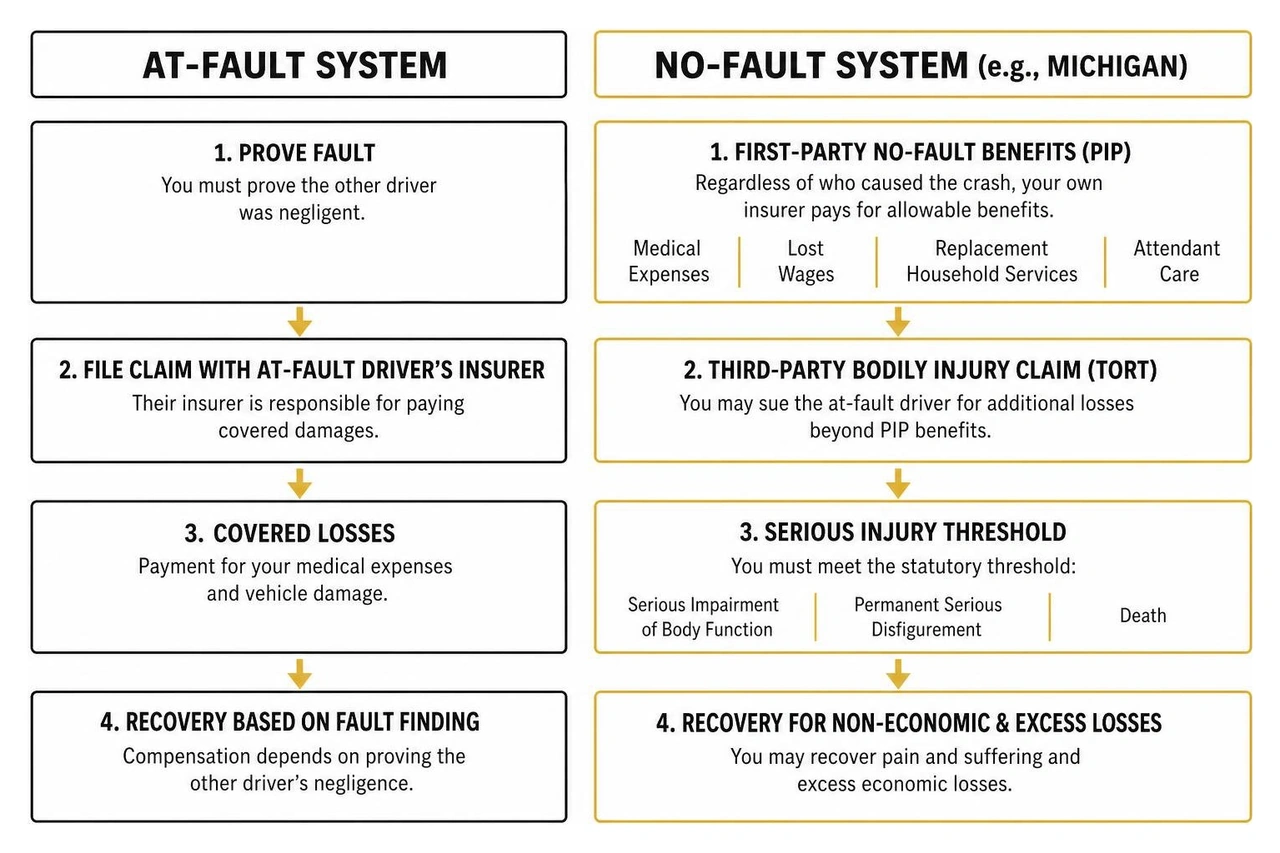
Under pure at-fault systems, you must prove the other driver was negligent before their insurer pays a single dollar for your medical care or vehicle damage.
In no-fault states like Michigan, the framework is different:
- First-Party No-Fault Benefits (Personal Injury Protection - PIP): Regardless of who caused the crash, your own auto insurer pays for your allowable medical expenses, a percentage of lost wages, replacement household services, and attendant care up to your chosen policy limits.
- Third-Party Bodily Injury Claims (Tort Liability): While your PIP covers basic economic support, you retain the legal right to sue the at-fault driver for non-economic damages (pain and suffering) and excess economic losses, provided your injuries satisfy the statutory threshold of serious impairment of body function, permanent serious disfigurement, or death.
How Fault and Comparative Negligence Affect Compensation
When pursuing a third-party claim against the at-fault driver, liability rules determine how much compensation you can collect if responsibility is shared:
- Pure Comparative Negligence: In states using this rule, you can recover damages even if you were 99% at fault, though your financial recovery is reduced by your exact percentage of fault.
- Modified Comparative Negligence: In states like Michigan that apply a modified comparative fault standard (51% bar rule), you can recover damages as long as you are 50% or less at fault. If a jury determines you were 51% or more responsible for the collision, you are completely barred from recovering non-economic damages like pain and suffering. If you are found 20% at fault, your final award is simply reduced by 20%.
Establishing clear liability through police reports, traffic control camera footage, vehicle event data recorders (black boxes), and witness testimony is critical to preventing insurance defense teams from shifting unwarranted blame onto you.
Statutes of Limitations and Filing Deadlines
Missing a legal deadline permanently destroys your ability to collect compensation, no matter how catastrophic your injuries may be:
- First-Party PIP Claims: Under Michigan law, you must provide written notice of injury to your auto insurer and file your first-party PIP claim within one year of the accident date (the "one-year-back rule").
- Third-Party Bodily Injury Lawsuits: For claims against a negligent driver for pain and suffering or excess damages, the statute of limitations is generally three years from the date of the crash.
- Claims Involving Government Entities: If your crash involved a municipal bus, county road commission vehicle, or state agency, significantly shorter notice deadlines apply—sometimes requiring formal notice within 60 to 120 days.
Acting immediately guarantees that evidence is preserved before roadway markings wash away, surveillance tapes are overwritten, or key witnesses relocate.
Types of Damages and How Legal Representation Maximizes Case Value
Securing full, fair compensation requires accurately categorizing and proving every dimension of your loss.

Auto accident damages fall into two main categories:
1. Economic Damages (Tangible Financial Losses)
- Medical Expenses: Emergency room care, surgical procedures, hospital stays, physical therapy, diagnostic imaging (MRIs, CT scans), prescription medications, and medical equipment.
- Future Medical Care: Projected costs for future surgeries, long-term physical therapy, home modifications, and assistive care.
- Lost Income: Wages lost while recovering from injuries.
- Loss of Future Earning Capacity: Compensation for permanent disability that reduces or eliminates your ability to earn a living in your trade or profession.
- Replacement and Attendant Care Services: The cost of hiring help—or compensating family members—for everyday household chores, child care, and personal assistance you can no longer perform.
2. Non-Economic Damages (Intangible Personal Losses)
- Pain and Suffering: The physical pain, discomfort, and physical limitations caused by your injuries.
- Emotional Distress and Mental Anguish: Psychological trauma, post-traumatic stress disorder (PTSD), anxiety, sleep disturbances, and depression stemming from the crash.
- Loss of Enjoyment of Life: Inability to participate in hobbies, recreational pursuits, family activities, and daily pleasures you enjoyed prior to the collision.
- Scarring and Disfigurement: Compensation for permanent scarring, burns, or physical alterations.
- Loss of Consortium: Compensation for the negative impact the injuries have on your relationship with your spouse.
What an Auto Accident Cases Lawyer Evaluates to Calculate Settlement Value
Accurately evaluating a case requires far more than adding up your current hospital bills. We assess:
- Maximum Medical Improvement (MMI): We never settle a case before you reach MMI—the point at which your condition has stabilized and your doctors can clearly forecast your future medical prognosis and limitations.
- Independent Medical Examination (IME) Reports: Insurers frequently hire their own doctors to perform examinations designed to minimize your injuries. We actively counter these biased reports with objective findings from your actual treating specialists.
- Life-Care Plans & Vocational Assessments: For catastrophic injuries, we consult medical economists and vocational experts to build comprehensive life-care plans that project lifetime costs over your expected lifespan.
- Structured Settlements vs. Lump Sums: Depending on your ongoing needs, we help structure financial payouts to provide lifetime financial security and tax advantages.
Uninsured and Underinsured Motorist Coverage Options
When an at-fault driver has no insurance or carries only bare-minimum liability coverage, recovering fair compensation can seem impossible. In these scenarios, we turn to your own policy's Uninsured Motorist (UM) and Underinsured Motorist (UIM) coverage:
- Uninsured Motorist (UM): Protects you if you are hit by a driver with no auto liability insurance or if you are the victim of a hit-and-run collision where the driver cannot be identified.
- Underinsured Motorist (UIM): Steps in when the at-fault driver's bodily injury limits are too low to cover your severe damages. Once their policy is exhausted, your UIM coverage pays the remaining balance up to your policy's limits.
We carefully review all household policies to identify potential coverage and prevent insurers from improperly denying or limiting these essential benefits.
The Auto Accident Claims and Litigation Process: From Investigation to Trial
Understanding the legal roadmap helps reduce stress and lets you know what to expect at every stage of your claim.
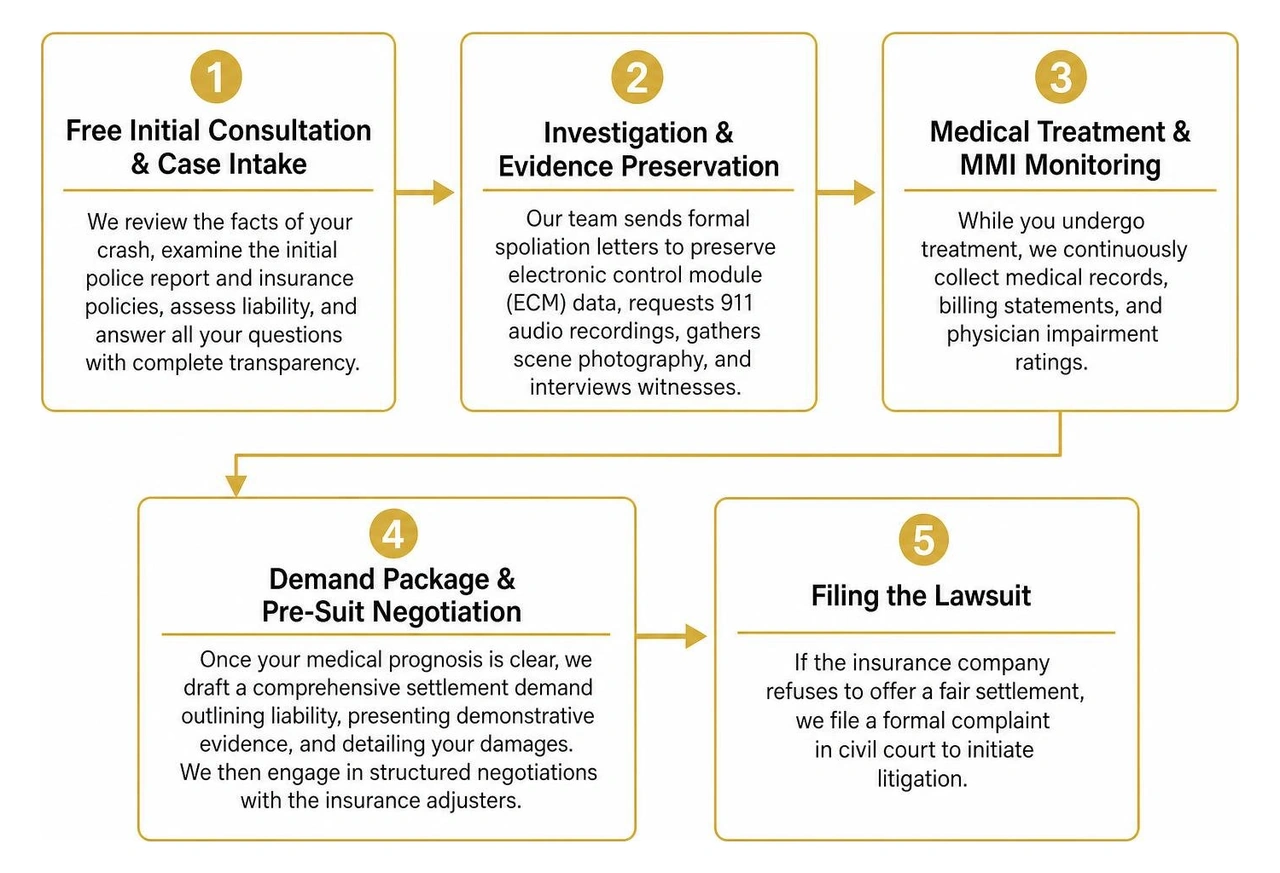
- Free Initial Consultation & Case Intake: We review the facts of your crash, examine the initial police report and insurance policies, assess liability, and answer all your questions with complete transparency.
- Investigation & Evidence Preservation: Our team sends formal spoliation letters to preserve electronic control module (ECM) data, requests 911 audio recordings, gathers scene photography, and interviews witnesses.
- Medical Treatment & MMI Monitoring: While you undergo treatment, we continuously collect medical records, billing statements, and physician impairment ratings.
- Demand Package & Pre-Suit Negotiation: Once your medical prognosis is clear, we draft a comprehensive settlement demand outlining liability, presenting demonstrative evidence, and detailing your damages. We then engage in structured negotiations with the insurance adjusters.
- Filing the Lawsuit: If the insurance company refuses to offer a fair settlement, we file a formal complaint in civil court to initiate litigation.
- Discovery Phase: Both sides exchange formal documents, submit written interrogatories, and conduct depositions of the drivers, eyewitnesses, treating physicians, and expert witnesses.
- Alternative Dispute Resolution (Mediation / Case Evaluation): Many courts require the parties to attempt non-binding case evaluation or private mediation, where a neutral third-party mediator helps facilitate settlement discussions.
- Courtroom Trial: If the defense remains unreasonable, our trial-tested litigators present your case before a judge and jury to seek a full verdict.
Frequently Asked Questions About Auto Accident Cases
How much does it cost to hire an auto accident lawyer?
Hiring an auto accident cases lawyer involves zero upfront or out-of-pocket costs. Personal injury cases operate on a contingency fee agreement. Under this structure, our legal fees are paid as an agreed-upon percentage of the final settlement or jury verdict we recover on your behalf. If we do not win compensation for your case, you owe us nothing in attorney fees. We also advance all litigation expenses—such as filing fees, expert witness costs, and medical record fees—which are reimbursed only upon a successful financial recovery.
How long does it take to settle an auto accident injury claim?
The timeline varies depending on the complexity of the crash, the severity of your injuries, and the insurer's willingness to negotiate in good faith:
- Straightforward Claims with Clear Liability: Cases involving minor injuries and clear fault can sometimes resolve within 4 to 8 months.
- Severe Injuries Requiring Extended Treatment: When injuries require surgeries or long-term rehabilitation, a case generally takes 12 to 18 months, as we must wait until you reach Maximum Medical Improvement (MMI) to properly value your lifetime damages.
- Contested Liability or Litigated Cases: If the insurance company disputes fault or undervalues the claim, formal litigation and trial preparation may take 18 to 24+ months, depending on court trial dockets.
What should I do if the insurer offers a lowball settlement?
Never accept a quick, low settlement offer or sign any release forms without having an attorney review the terms. Lowball offers are an insurance tactic designed to close files cheaply before the true cost of your injuries becomes clear.
When you retain an experienced lawyer, we reject inadequate offers, serve a detailed counter-demand backed by medical and financial evidence, and make it clear that we are fully prepared to take the case to trial. The credible threat of courtroom litigation is the single most effective tool for compelling insurance companies to offer realistic settlement figures.
Conclusion
A serious motor vehicle crash can change your life in a fraction of a second, leaving you to deal with physical pain, missed paychecks, and mounting medical bills while insurance companies focus on minimizing their exposure. You do not have to face this challenge alone.
At Liss, Shapero & Mitnick, our unique advantage lies in our former insurance-defense experience. Having spent years inside the systems and strategies insurance companies use to devalue injury claims, we know exactly how to counter their tactics and build undeniable cases on your behalf. Whether we are resolving complex PIP benefit claims or taking a negligent driver to trial for maximum pain and suffering damages, our team is dedicated to securing the full financial justice you deserve.
If you or a loved one was injured in a collision, explore our dedicated legal representation for motor vehicle accidents and contact us today to schedule your free, confidential case review. We will handle the legal fight so you can focus on healing.