.svg)
Immediate Steps and Critical Evidence Preservation After a Crash

To choose a qualified car accident injury lawyer, look for dedicated trial readiness, direct attorney communication, manageable caseloads, and clear contingency fee agreements rather than settlement mills. Pairing skilled legal representation with rapid evidence preservation gives your injury claim the strongest possible foundation.
Immediately after a collision, scene safety is the absolute first priority. Move vehicles out of active traffic lanes if possible, activate your hazard lights, and ensure everyone involved is safe from incoming traffic.
Once safety is established, contact law enforcement so responding officers can draft an official police report. While waiting for emergency services, focus on gathering factual information without engaging in heated discussions or assigning blame. If you notice signs of insurance disputes after personal injury brewing—such as an uncooperative driver changing their story—stick to documenting the physical scene methodically.
Critical Actions in the First 48 Hours
The first 48 hours serve as the cornerstone for both your medical care and legal protections:
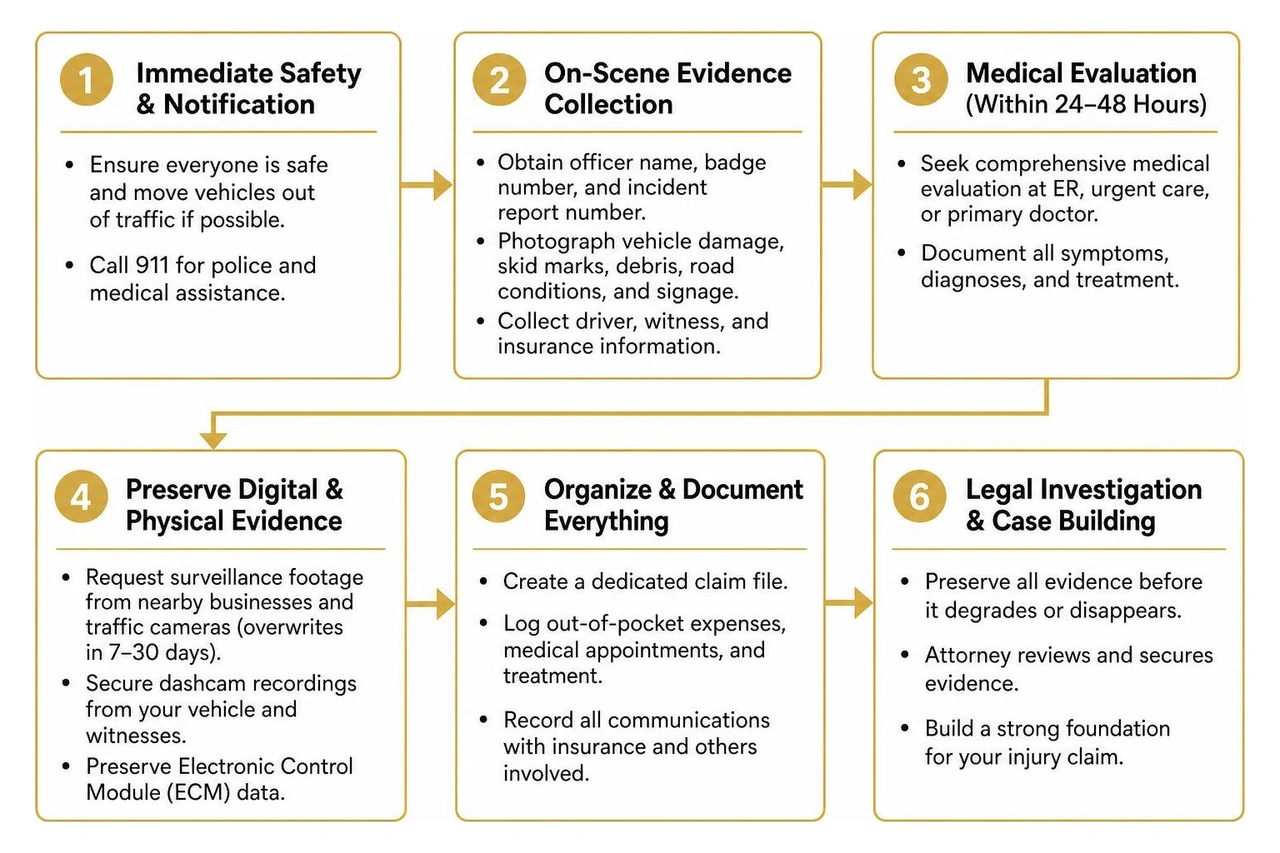
- Dial 911 immediately: Request both police and emergency medical triage at the scene, even if your pain feels minimal.
- Obtain the police report number: Ask the responding officer for their name, badge number, and the incident report identifier.
- Undergo a comprehensive medical evaluation: Seek an evaluation at an emergency room, urgent care, or primary doctor within 24 to 48 hours. Many severe conditions, like concussions and soft tissue damage, manifest delayed symptoms.
- Preserve vehicle positioning and physical damage: Capture wide-angle and close-up photographs of all vehicle damage, skid marks, debris fields, road conditions, and traffic signage.
- Keep a dedicated claim file: Follow a structured post-crash protocol, such as reviewing our first snow first crash your Michigan no-fault checklist, to systematically log your out-of-pocket costs, medical appointments, and interactions with insurance representatives.
Preserving Digital and Physical Evidence Before It Disappears
Physical evidence at a crash scene degrades quickly. Weather washes away skid marks, debris is cleared within hours, and digital systems often overwrite memory on automated loops.
Critical evidentiary items that must be secured promptly include:
- Commercial and traffic surveillance: Nearby businesses and municipal traffic cameras often overwrite security footage within 7 to 30 days.
- Dashcam recordings: Secure flash drives or cloud backups from your vehicle and ask nearby witnesses if their dashboard cameras captured the impact.
- Electronic Control Modules (ECM): As documented by the National Highway Traffic Safety Administration, modern vehicle event data recorders log vital pre-crash telemetry, including speed, braking status, throttle position, and seatbelt usage.
- Spoliation letters: Formal legal notices prevent insurance carriers and adverse parties from destroying or altering vehicle components, cell phone records, and maintenance logs.
- Independent witness testimony: Contact information collected at the scene allows our team to take recorded statements while facts are fresh in witnesses' minds.
How to Choose the Best Car Accident Injury Lawyer vs. a Settlement Mill
Not every law practice approaches auto claims with the same strategy. Some operations run as high-volume "settlement mills"—firms that rely on mass marketing to bring in large numbers of cases, process them through non-lawyer case managers, and settle quickly for whatever the insurance adjuster offers first.
In contrast, dedicated boutique litigation practices maintain focused caseloads, prepare every file as if it will go before a jury, and demand full value for every injury.
| Feature / Metric | High-Volume Settlement Mill | Dedicated Boutique Trial Firm |
|---|---|---|
| Primary Goal | Fast turnover, volume file processing | Maximum financial recovery per client |
| Direct Attorney Access | Rare; communication handled by case managers | Direct access to your dedicated attorney |
| Caseload Per Attorney | Often 150–300+ active files | Carefully limited to allow deep investigation |
| Courtroom Readiness | Rare trial appearances; avoids filing lawsuits | Proven trial readiness and active litigation |
| Insurer Perception | Known for accepting lower, faster settlements | Respected by insurers who know trial is likely |
| Fee Transparency | May bundle unexpected costs or hidden fees | Clear, capped contingency agreements |
Warning Signs of Settlement Mills vs. a Dedicated Car Accident Injury Lawyer
Identifying a settlement mill early can save you months of frustration and prevent substantial financial losses:
- You never speak with an attorney: If your initial consultation and subsequent check-ins are handled exclusively by intake staff or case managers, your file is likely treated as routine paperwork rather than a trial-ready claim.
- Early pressure to accept quick offers: Settlement mills often encourage clients to settle before reaching Maximum Medical Improvement (MMI), leaving ongoing treatment uncovered.
- Lack of trial experience: Review a firm's published case results to see whether they litigate complex disputes or settle everything quietly out of court.
- Generic legal advice: If a firm fails to analyze jurisdiction-specific no-fault benefits, wage loss calculations, or comparative fault risks, they are unlikely to maximize your compensation.
Contingency Fees and the Process for Switching Legal Counsel
Reputable auto accident attorneys work on a contingency fee model, meaning you pay nothing upfront and owe zero legal fees unless financial compensation is successfully recovered. Contingency agreements typically range between 33.3% for pre-litigation claims and up to 40% if formal litigation or trial is required.
If you are dissatisfied with your current legal representation due to poor communication, unreturned calls, or pressure to accept an unfair offer, you have the legal right to change counsel at any time.
The transition process is straightforward:
- Retain your new law firm by signing a standard representation agreement.
- Your new attorney files a formal Substitution of Attorney form with the court and sends notice to the prior firm and insurance carriers.
- Your former lawyer may place an attorney fee lien on the file to recover fees for work already performed, but this is resolved between the lawyers out of the final settlement without increasing your overall legal fee percentage.
Calculating Damages and Negotiating Full Settlement Value
An accurate damage valuation requires accounting for every financial, physical, and psychological consequence of a collision.
Economic vs. Non-Economic Losses
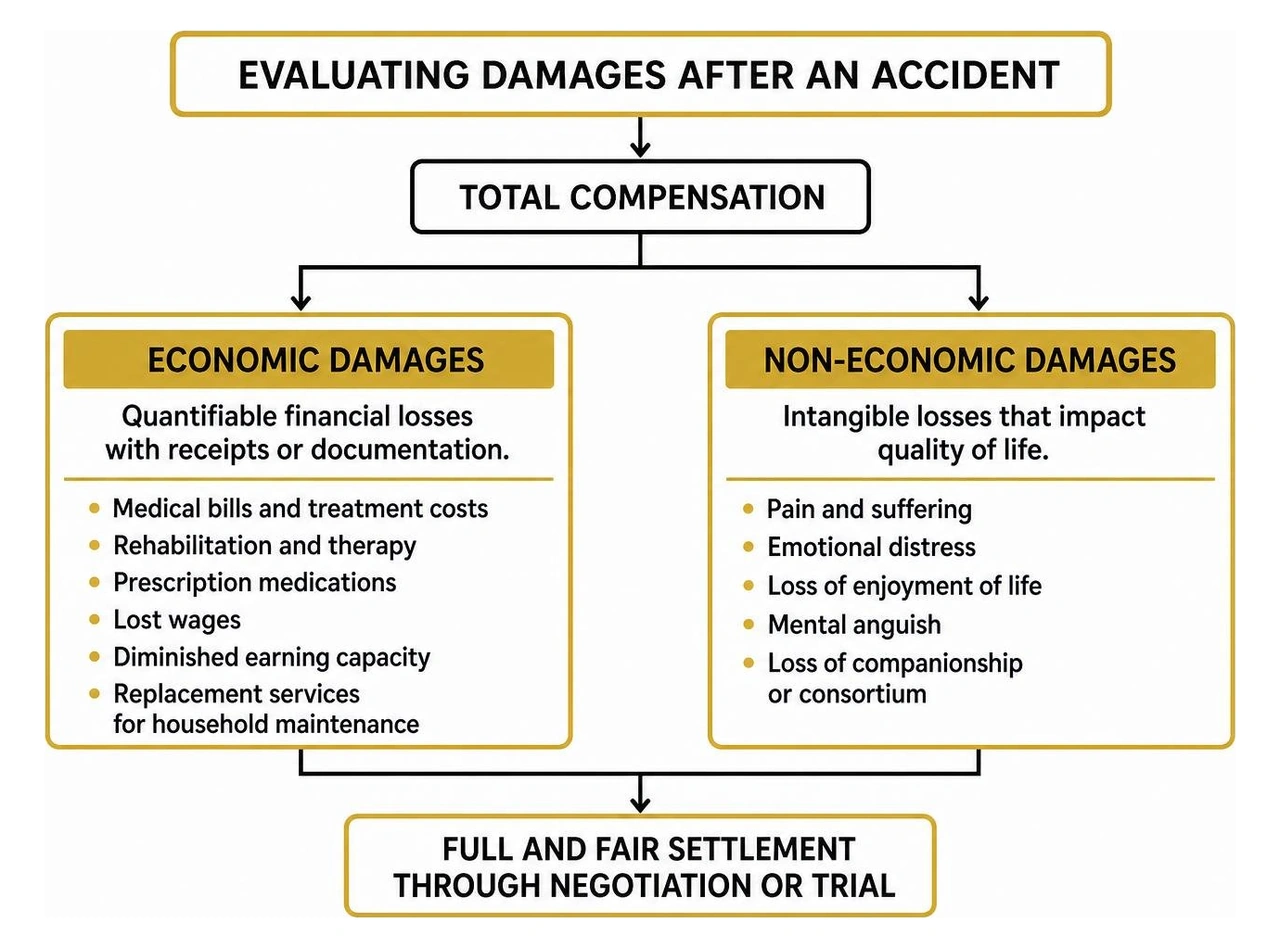
Under the law, compensation falls into two primary categories:
- Economic Damages: Quantifiable, objective financial losses, including past and future hospital bills, rehabilitation therapy costs, prescription medications, lost wages, diminished earning capacity, and replacement services for household maintenance.
- Non-Economic Damages: Subjective, non-monetary losses, including physical pain and suffering, mental anguish, loss of enjoyment of life, physical impairment, and scarring or disfigurement. In the most tragic instances involving fatal collisions, families pursue wrongful death claims to recover burial costs, medical expenses incurred prior to passing, and loss of financial support and companionship.
To ensure all recovery avenues are examined, our team evaluates every facet of a client's personal injury claim against available policy limits.
Why You Should Never Accept the Initial Insurance Settlement Offer
Insurance adjusters work for profit-driven corporations whose primary objective is minimizing payouts. Initial settlement offers sent within days or weeks of a crash are almost always lowball offers designed to close the claim before the full extent of your injuries is known.
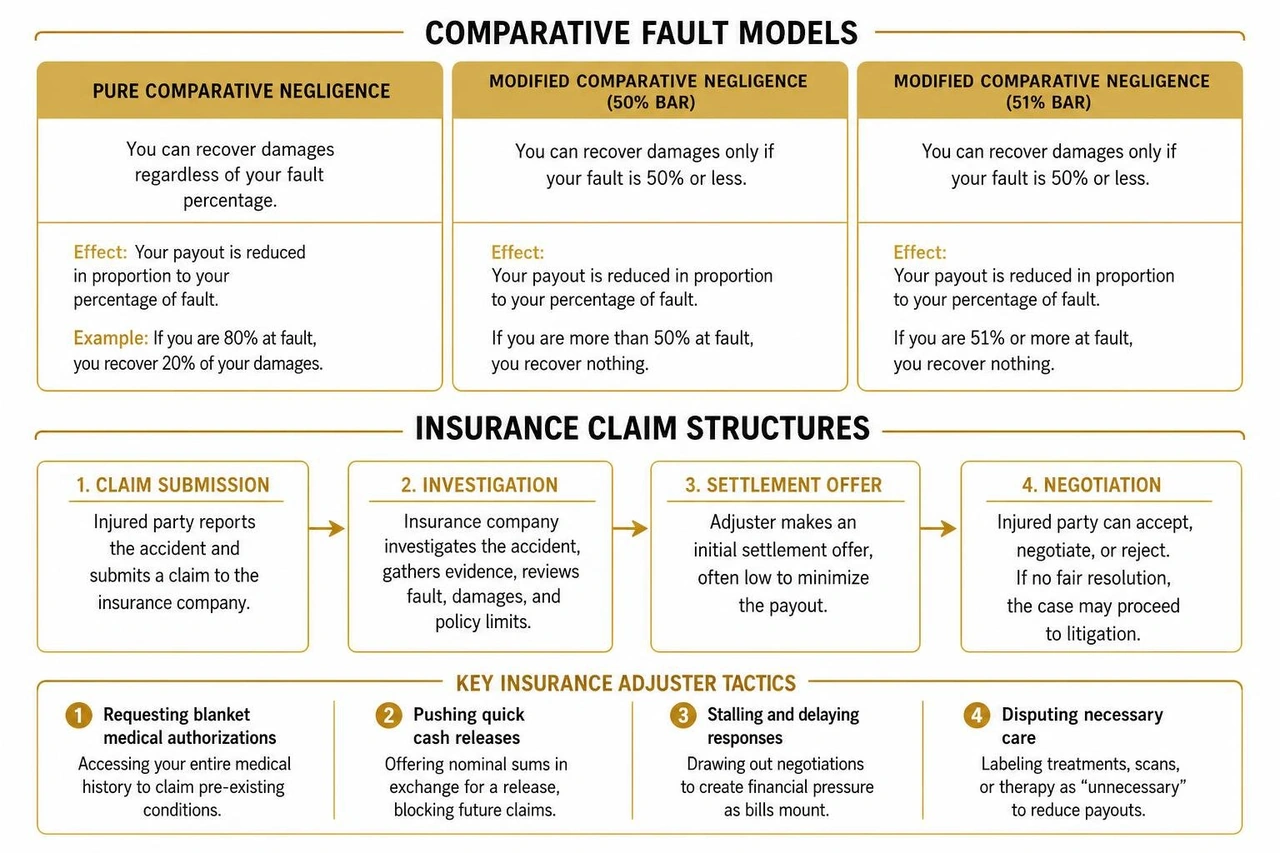
Common adjuster tactics include:
- Requesting blanket medical authorizations: Gaining access to your entire medical history to claim your current symptoms are tied to "pre-existing conditions."
- Pushing quick cash releases: Offering nominal sums in exchange for a signed general release of liability, permanently barring you from seeking future coverage if surgery or therapy becomes necessary.
- Stalling and delaying responses: Drawing out negotiations to create financial pressure as your medical bills mount, making smaller settlement offers look more appealing.
- Disputing necessary care: Using internal medical review software to label treatments, diagnostic scans, or physical therapy as "unnecessary."
Our background in former insurance defense gives us direct insight into these internal carrier tactics, allowing us to build strategic, trial-ready claims that anticipate and counter lowball settlement strategies.
State Legal Frameworks: Fault Rules, Insurance Systems, and Deadlines
Every state maintains its own statutory framework governing auto collision claims, fault allocations, and filing deadlines. Understanding these distinctions is crucial for protecting your rights.
Comparative Negligence and Modified Fault Rules Across Jurisdictions
Legal responsibility in motor vehicle crashes is evaluated under different fault standards across the country:
- Pure Comparative Negligence: An injured party can recover damages regardless of their fault percentage, but their payout is reduced proportionally (e.g., if you are 80% at fault, you recover 20% of your damages).
- Modified Comparative Negligence (50% or 51% Bar Rules): In many jurisdictions, an injured person is barred from recovering any compensation if their share of fault exceeds 50% or 51%. Understanding comparative fault in Michigan is essential, as Michigan applies a modified comparative fault standard in third-party tort claims. Under this system, economic damages are reduced by your percentage of fault, while non-economic damages (pain and suffering) are completely barred if you are found more than 50% at fault.
- Pure Contributory Negligence: In a small minority of states, if an injured party contributes even 1% to the cause of the accident, they are completely barred from recovering compensation.
Navigating Uninsured Motorist and No-Fault Claims with a Car Accident Injury Lawyer
Navigating insurance recovery becomes complex when crashes involve uninsured motorists, underinsured drivers, or hit-and-run incidents.
Under Michigan's auto insurance system, injured motorists turn first to their own policy for mandatory Michigan no-fault insurance benefits. These first-party no-fault claims—also known as Personal Injury Protection (PIP)—cover allowable medical expenses up to your selected policy limit, 85% of lost gross wages for up to three years, and daily replacement services for household tasks, regardless of who caused the collision.
When an at-fault driver has no insurance or flees the scene, Uninsured Motorist (UM) and Underinsured Motorist (UIM) coverages provide an essential safety net for pain and suffering damages that exceed PIP protections. Because UM/UIM claims involve contractual disputes with your own insurer, having a dedicated legal advocate ensures your carrier treats your claim fairly.
Frequently Asked Questions About Auto Accident Claims
How long does a car accident claim typically take to resolve?
A car accident claim can take anywhere from a few months to two years or more to resolve, depending on case complexity. Straightforward claims with clear liability and resolved injuries often settle within 4 to 8 months. Complex claims involving catastrophic injuries, extensive medical treatment, disputed liability, or formal litigation typically take 12 to 24 months.
We ensure clients do not settle their claims until they reach Maximum Medical Improvement, so that future medical costs and long-term disabilities are fully accounted for.
Can I recover damages if I was partially at fault for the crash?
Yes. Under modified comparative fault systems, you can recover damages as long as your fault does not exceed the statutory threshold. In Michigan third-party tort lawsuits, your economic recovery is reduced by your percentage of fault. For non-economic damages (such as pain and suffering), you can recover damages as long as you are 50% or less at fault; if a jury determines you were 51% or more responsible, non-economic damages are barred.
What happens if the at-fault driver has no insurance or flees the scene?
If an at-fault driver is uninsured or leaves the scene of a hit-and-run collision:
- Your first-party PIP benefits continue to cover medical bills, lost wages, and replacement services according to your policy terms.
- You can file an Uninsured Motorist (UM) claim through your own auto insurance policy to recover compensation for non-economic damages, such as pain and suffering.
- Your vehicle's collision coverage pays for vehicle repairs or replacement, subject to your policy deductible.
Conclusion
A serious motor vehicle crash can change your financial, physical, and emotional stability in seconds. Navigating no-fault benefits, proving fault, and dealing with aggressive insurance adjusters requires experienced legal guidance.
At Liss, Shapero & Mitnick, our unique advantage comes from leveraging former insurance-defense experience to stay one step ahead of the tactics insurance companies use to undervalue claims. We treat our clients as individuals, not file numbers, and we prepare every case with the trial readiness required to secure the maximum compensation available.
If you or a family member was injured in a crash, do not face the insurance companies alone. Contact our experienced team handling motor vehicle accidents today to schedule your free consultation.