
Choosing a Car Accident Lawyer in Michigan: Start With Your Claim Options

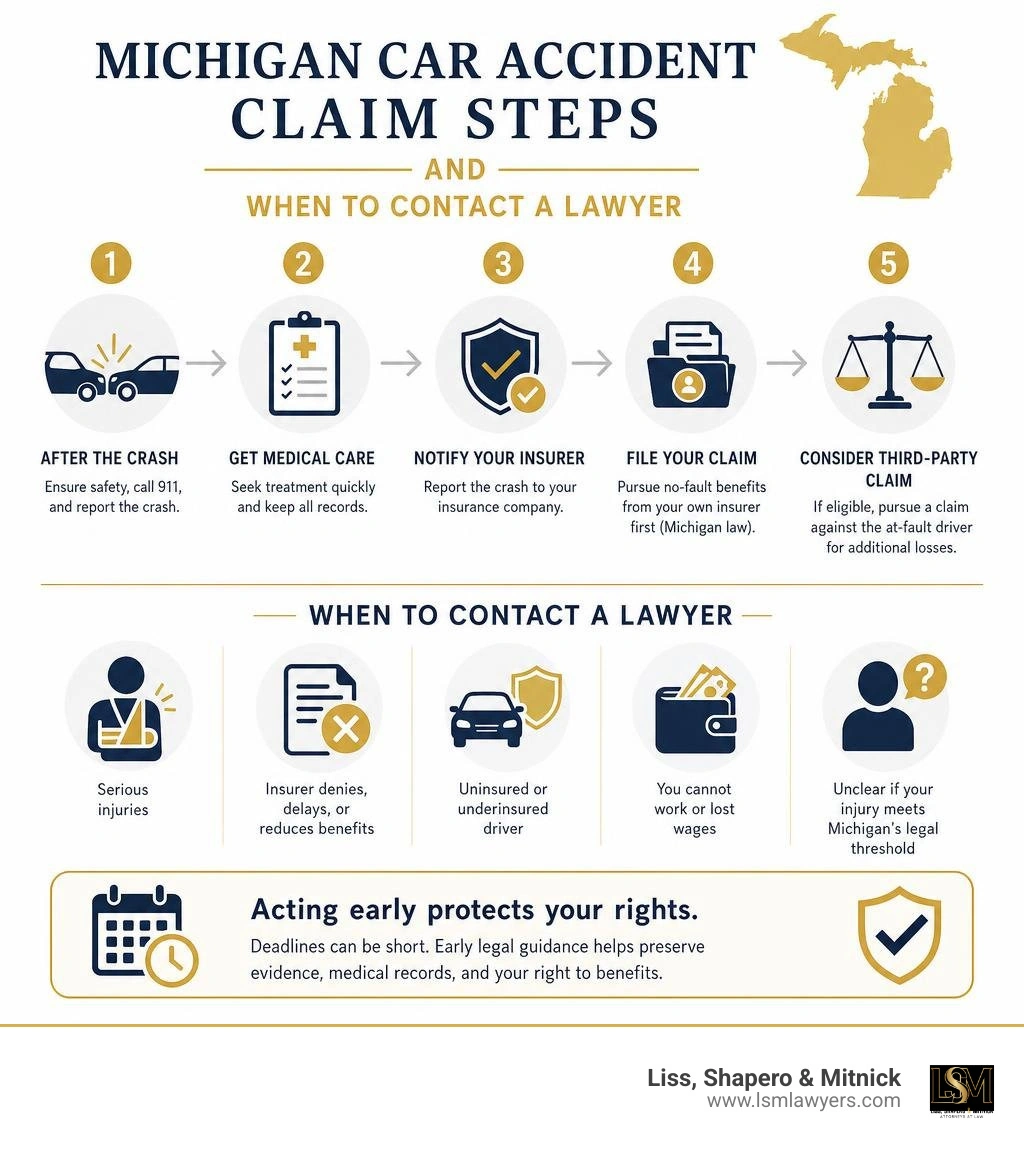
After a Michigan crash, a car accident lawyer in Michigan can help you identify the right insurance claim, protect critical deadlines, and challenge a denial or low settlement offer. This matters because Michigan's no-fault system usually requires you to seek medical and wage-loss benefits from your own insurer first, regardless of who caused the crash.
Consider speaking with a lawyer promptly if your injuries are serious, your insurer disputes benefits, the other driver was uninsured, or you cannot work. A lawyer can also assess whether your injury may meet Michigan's legal threshold for a pain-and-suffering claim against the at-fault driver.
Michigan crashes can create two very different claim paths:
- First-party no-fault claims for eligible medical care, wage loss, and certain replacement services.
- Third-party claims against the at-fault driver when the law allows recovery for pain and suffering and other losses.
Deadlines can be short, and insurance companies may question whether treatment is necessary, whether an injury came from the crash, or whether it seriously limits your normal life. Acting early helps preserve medical records, crash evidence, and your right to benefits.
Introduction
Michigan roads can be unforgiving. In 2021 alone, our state recorded over 300,000 traffic crashes, leaving more than 80,000 people injured. Worse yet, Michigan saw 1,083 traffic fatalities in 2022, with alcohol-impaired driving playing a significant role in many of those tragedies.
When you find yourself dealing with vehicle damage, hospital visits, and missed paychecks, navigating the legal aftermath feels overwhelming. Many people assume insurance adjusters will step in and fairly resolve everything. Unfortunately, auto insurers are businesses focused on their own bottom lines.
Securing fair financial recovery often requires understanding the unique mechanics of our state's legal framework. While approximately 40% of crash victims in Michigan hire an attorney, those who do secure representation typically receive 3.5 times higher settlements than those attempting to negotiate alone. Average settlements for serious injury cases in Michigan often range from $50,000 to well over $500,000 depending on medical costs, permanent impairment, and insurance policy limits.
Whether your collision occurred on the Lodge Freeway in Metro Detroit or during a winter storm elsewhere in the state, understanding your rights from day one makes all the difference.
Understanding Michigan No-Fault Law and Auto Accident Claims

Michigan operates under an intricate auto insurance system that sets it apart from most of the country. Unlike traditional tort states where you immediately sue the driver who hit you for all crash-related losses, Michigan utilizes a mandatory No-Fault framework.
Under this system, every insured driver turns to their own auto insurance provider for primary medical expenses and economic protections, regardless of who caused the wreck. However, recent auto insurance reforms have created tier-based coverage selections, making post-accident claims more complex than ever before.
First-Party PIP Benefits vs. Third-Party Lawsuits
To protect your rights, you must understand the distinction between first-party and third-party claims.

- First-Party Claims (Personal Injury Protection or PIP): Filed directly with your own insurance company (or the insurer of a relative living in your household). These cover essential economic losses, including allowable medical expenses, three years of lost wages up to statutory monthly caps, and household replacement services. Learn more about your basic statutory coverages in our guide to Michigan No-Fault Insurance Benefits.
- Third-Party Lawsuits (Tort Liability Claims): Filed directly against the at-fault driver and their insurance carrier. This claim covers non-economic damages, commonly known as pain and suffering, emotional distress, and excess economic losses not paid by your PIP policy.
How a Car Accident Lawyer in Michigan Proves Serious Impairment
You cannot sue the at-fault driver for pain and suffering simply because they made a mistake. Under Michigan Compiled Laws (MCL 500.3135), an injured victim must cross a legal statutory threshold:
- Death;
- Permanent serious disfigurement; or
- A serious impairment of body function.
To prove a serious impairment in motor vehicle accidents, your legal team must establish three elements:
- An objectively manifested impairment (observable or medically testable, such as via MRI, CT scan, X-ray, or physical examination);
- The impairment affects an important body function; and
- It affects your general ability to lead your normal life (affecting your capacity to work, perform daily chores, or enjoy hobbies).
We gather objective diagnostic testing, detailed treating physician statements, and testimony from family and co-workers to prove exactly how your physical limitations have altered your everyday routine.
Critical Deadlines and the One-Year-Back Rule
Timing is everything in Michigan auto litigation. Missing a statutory deadline can completely forfeit your right to compensation, regardless of the severity of your injuries.
- Initial Written Notice of Injury: You have exactly one year from the date of the crash to provide written notice of injury to your auto insurer.
- Third-Party Lawsuit Statute of Limitations: You generally have three years from the collision date to file a pain and suffering lawsuit against the at-fault party.
- The One-Year-Back Rule: Under MCL 500.3145 set forth in the Michigan Legislature Auto Insurance Statutes, you cannot recover PIP benefits for any medical expenses, wage losses, or attendant care costs incurred more than one year prior to filing a formal lawsuit against the insurer. If your insurer delays or ignores an outstanding bill, you must take legal action before that 365-day clock runs out. Read our breakdown on No-Fault Deadlines Avoiding the One Year Back Trap in PIP Claims to protect your benefits.
Recoverable Damages in Michigan Auto Collision Cases

Understanding what damages you can claim ensures you do not accept an early, inadequate settlement that leaves future medical procedures unpaid.
Economic Losses and PIP Coverage
First-party PIP benefits are designed to keep you financially stable after an unexpected crash. Key recoverable economic losses include:
- Reasonable Medical Expenses: Hospital stays, surgeries, physical therapy, prescription medication, and specialized medical equipment up to your selected policy PIP cap.
- Medical Transportation Mileage: Reimbursement for driving to and from doctor appointments and rehabilitation facilities.
- Attendant Care & Replacement Services: Compensation for in-home nursing or aide care, as well as up to $20 per day for domestic help (cooking, cleaning, yard care). Proper documentation is essential; review our tips on No-Fault PIP Mileage Replacement Services and Attendant Care How to Document It Correctly.
- Work Loss Benefits: Up to 85% of your gross lost wages for up to three years, subject to annual state-adjusted maximum caps.
- Survivor's Loss: In tragic instances involving fatal crashes, surviving dependents can seek economic support and funeral benefits through a wrongful death claim.
Non-Economic Damages and Comparative Fault
When an at-fault driver's negligence inflicts severe harm, non-economic damages compensate you for intangible losses:
- Physical pain and discomfort
- Mental anguish and trauma
- Loss of companionship and enjoyment of life
- Fright, shock, and post-traumatic stress
| Feature | First-Party PIP Benefits | Third-Party Tort Claims |
|---|---|---|
| Who Pays? | Your own auto insurer | The at-fault driver’s insurer |
| Fault Required? | No, paid regardless of fault | Yes, must prove the other driver was negligent |
| Types of Damages | Medical bills, lost wages, replacement care | Pain and suffering, excess wage/medical loss |
| Threshold Needed? | None | Serious impairment of body function / disfigurement |
| Filing Deadline | 1-year notice; 1-year-back limitation | Generally 3 years from accident date |
Michigan applies a modified system of comparative negligence. If you share partial responsibility for the collision, your non-economic financial recovery is reduced by your percentage of fault.
For instance, if a jury awards $200,000 in pain and suffering damages but finds you were 20% at fault for speeding, your payout is reduced to $160,000. Under MCL 600.2959, if you are found to be more than 50% at fault, you are completely barred from recovering any non-economic damages. You can discover more about how fault percentages affect financial outcomes in our guide on Comparative Fault in Michigan How Percentages Really Change Your Recovery.
Additionally, if the at-fault driver carries only state-minimum bodily injury coverage, your own optional coverages become critical. Make sure to check your policy for UM UIM 101 Protecting Yourself When the Other Driver Has Minimum Limits.
When to Hire a Car Accident Lawyer in Michigan
While minor fender-benders involving superficial property damage rarely require formal litigation, hiring a seasoned car accident lawyer is crucial whenever:
- You suffered fractures, head trauma, spinal injuries, or required surgery.
- Your auto insurance adjuster has stopped paying medical bills or wage-loss benefits.
- The insurance company claims your injuries were caused by a "pre-existing condition."
- Liability is contested or multiple vehicles were involved.
- The collision involved commercial trucks, pedestrians, or municipal vehicles.
Key Qualities to Look for in a Car Accident Lawyer in Michigan
Choosing the right legal advocate directly impacts the outcome of your claim. When evaluating attorneys in Metro Detroit and throughout Michigan, look for:
- Insurance-Defense Background: Law firms that possess former insurance-defense experience understand the playbook, formulas, and evaluation software carriers use to deny claims.
- Demonstrated Trial Results: Insurance adjusters know which attorneys settle for pennies on the dollar and which ones take cases to trial. Review an attorney's past Case Results before signing an agreement.
- Contingency Fee Structure: Reputable personal injury lawyers operate on a contingency basis, meaning you pay zero upfront costs and no attorney fees unless we successfully recover money for you.
- Direct Access & Communication: You should work directly with seasoned attorneys who treat you with empathy. Meet Our Team to see how personalized advocacy makes a difference.
Handling Insurance Denials and Lowball Settlement Offers
Insurers frequently try to limit payouts by requiring you to attend an "Independent Medical Examination" (IME). In practice, these exams are conducted by defense-selected doctors whose business models often depend on finding that crash victims are fully healed.
Common tactics adjusters employ include:
- Claiming medical treatment is no longer "medically necessary."
- Disputing in-home family attendant care rates.
- Offering quick, low cash settlements before the true extent of your injuries is known.
When you face these challenges, our article on No-Fault PIP in Real Life The Most Common Denials and How to Fix Them highlights proven steps to push back.
Frequently Asked Questions About Michigan Auto Accident Claims
How long do I have to file a car accident claim in Michigan?
You must submit written notice of your injury to your auto insurer within one year of the crash date to preserve your right to PIP benefits. For third-party pain and suffering lawsuits against an at-fault driver, Michigan’s statute of limitations is generally three years from the collision date.
What is the serious impairment of body function threshold?
It is the statutory legal requirement under MCL 500.3135 that an injured person must satisfy to sue an at-fault driver for non-economic damages (pain and suffering). You must provide objective medical evidence proving an impairment of an important body function that has tangibly affected your ability to lead your normal life.
Can I recover compensation if I was partially at fault for the crash?
Yes, provided you were not more than 50% responsible. Under Michigan's modified comparative fault rules, your pain and suffering compensation will be reduced in proportion to your fault percentage. If you are 51% or more at fault, you cannot collect non-economic damages from the other driver, though you may still receive your first-party PIP benefits.
Conclusion
Car crashes can disrupt your life in seconds, leaving behind mounting medical bills, lost earnings, and immense physical distress. Navigating Michigan's dual-claim insurance system without seasoned legal support often means leaving critical benefits on the table.
At Liss, Shapero & Mitnick, our legal team draws on decades of collective insight—including valuable former insurance-defense experience—to protect injury victims across Berkley, Metro Detroit, and throughout Michigan. We know the tactics adjusters use, and we aggressively pursue the maximum economic and non-economic compensation you deserve.
If you or a loved one has been injured, reach out to our No-Fault Claims team today to schedule a free, confidential consultation and secure the experienced legal representation you need.