.svg)
National Statistics: How Many Pedestrians Are Killed by Cars Each Day?

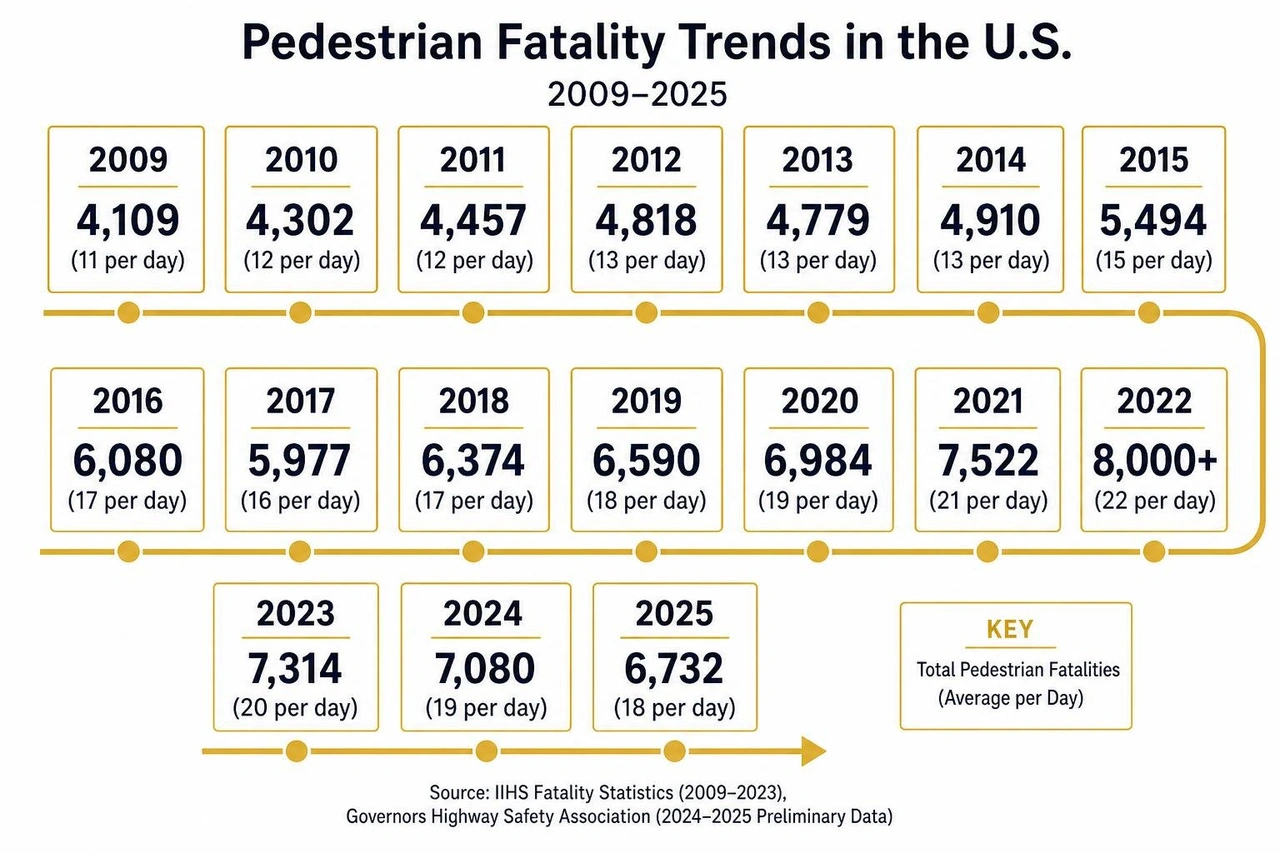
When examining national road safety records, the central question for many safety advocates and families is how many pedestrians are killed by cars each day. Over the past decade, that figure climbed to alarming heights before showing modest, much-needed declines.
In 2022, the United States reached a tragic 40-year peak, with more than 7,500 walkers losing their lives. During that year, someone on foot was killed roughly every 64 minutes, representing an average of nearly 22 deaths every single day. By 2023, the pace slowed slightly to one loss every 72 minutes (about 20 deaths per day, totaling 7,314 fatalities).
Preliminary numbers compiled by the Governors Highway Safety Association preliminary data show that this downward trend continued through 2024 and 2025. In 2024, the nation recorded 7,080 pedestrian fatalities, translating to roughly 19 deaths daily. By 2025, total pedestrian fatalities dropped to 6,732, bringing the daily average down to approximately 18 people.
| Year | Total Annual Pedestrian Fatalities | Approximate Daily Fatalities | Frequency of Fatal Crash |
|---|---|---|---|
| 2022 | 8,000+ (FARS/CDC estimated) | ~22 per day | Every 64 minutes |
| 2023 | 7,314 | ~20 per day | Every 72 minutes |
| 2024 | 7,080 | ~19.4 per day | Every 74 minutes |
| 2025 | 6,732 | ~18.4 per day | Every 78 minutes |
While a drop from 22 to 18 daily deaths represents measurable progress, it still means that over 6,700 individuals per year do not make it home to their loved ones.
Historical Trends and Recent Declines from 2009 to 2025
To understand how our streets became so dangerous, we have to look back at the broader trendline. In 2009, pedestrian fatalities in the United States hit a historic low of 4,109. Over the fifteen years that followed, pedestrian deaths surged by more than 70%, far outstripping the rise in total vehicle occupant deaths.
According to long-term tracking in IIHS pedestrian fatality statistics, pedestrian deaths grew to account for 18% of all motor vehicle crash fatalities, compared to barely 11% in the early 2000s.
The reversal began taking root during the 2024–2025 period. GHSA research revealed an 11% year-over-year decline in the first half of 2025 alone (3,024 fatalities, averaging 16 per day). This pushed the overall pedestrian fatality rate below 2.0 per 100,000 population for the first time since before 2020. Yet, despite three consecutive years of minor reductions, the annual death toll remains roughly 5% higher than 2019 levels and 20% higher than 2016 levels.
Analyzing How Many Pedestrians Are Killed by Cars Each Day Across the Past Decade
A closer look at federal Fatality Analysis Reporting System (FARS) data illustrates how quickly daily averages can accumulate into a nationwide public health crisis.
Between 2014 and 2023, pedestrian injuries also surged, with the CDC recording over 140,000 emergency department visits for non-fatal pedestrian collisions in a single year. On average, an injured walker enters an emergency room every eight minutes.
When daily fatality rates hovered around 20 to 22 people per day between 2021 and 2023, the national economic and societal cost surpassed $90 billion annually. Even at 18 daily fatalities in 2025, the human and financial toll remains staggering.
5 Major Factors Driving Fatal Pedestrian Crashes Daily
Fatal pedestrian collisions rarely happen entirely by chance. Federal crash data reveals clear, recurring patterns in how, where, and why these crashes occur.
Hit-and-run crashes, for instance, have skyrocketed nationwide, accounting for nearly 24% to 25% of all pedestrian fatalities. In approximately 94% of those cases, the driver flees the scene to avoid accountability, delaying critical medical care that could save a victim's life.
Beyond hit-and-runs, five distinct structural and behavioral factors explain why our daily death toll remains high.
1. Vehicle Size and the Proliferation of SUVs and Light Trucks
The types of vehicles Americans drive have changed dramatically over the last two decades. Light trucks—a category that includes SUVs, pickup trucks, and minivans—now account for over 50.4% of all fatal pedestrian collisions where the vehicle type is identified, compared to 40.6% for standard passenger sedans.
The physical design of modern light trucks makes impacts far more lethal:
- Blunt Front Grilles: Traditional sedans typically strike an adult pedestrian in the lower legs, often rolling them onto the hood and absorbing some crash energy. Full-size SUVs and pickups have high, vertical front ends that strike pedestrians directly in the chest, torso, and head.
- Blind Zones: The towering hood height of modern pickups creates massive forward blind spots, making it difficult for drivers to spot people crossing in front of them at low speeds or in crosswalks.
- Force Multipliers: The increased mass of large vehicles requires greater stopping distance and delivers significantly more kinetic energy upon impact.
2. Nighttime Visibility and Lighting Gaps
Darkness is one of the single greatest risk factors for people on foot. Comprehensive federal statistics show that 76.5% of fatal pedestrian crashes occur after dark.
When daylight fades, a driver's reaction window shrinks significantly. In areas with inadequate overhead street lighting, low-beam headlights often fail to illuminate a person walking across the road until the vehicle is too close to stop safely.
These hazards become especially acute during seasonal daylight shifts. For commuters walking to transit stops or families traveling during early mornings, our guide on pedestrian safety during dark commutes breaks down the essential right-of-way rules and visibility tips needed when navigating poorly lit roadways.
3. Roadway Design and Lack of Sidewalk Infrastructure
The environment where a person walks plays a direct role in their safety. More than 62% of pedestrian fatalities occur on roadways where no sidewalk exists. When municipal planners fail to build continuous sidewalks, pedestrians are forced to walk on road shoulders or directly in traffic lanes.
Furthermore, approximately 75% of pedestrian fatalities take place on open roadway sections rather than at established intersections. When marked crosswalks are spaced miles apart, pedestrians have little choice but to cross multi-lane roads mid-block.
Even when walking within designated crossing points, vulnerable road users frequently encounter drivers who fail to yield. In these situations, understanding how insurers handle crosswalk right-of-way disputes is essential for holding negligent motorists accountable.
4. Driver Distraction and Impairment
Driver behavior remains a primary catalyst in daily fatal crashes:
- Distraction: Federal reporting reveals that driver distraction was an identified factor in 21.7% of pedestrian deaths in 2024. In-vehicle touchscreens, smartphones, and navigation devices divert a driver's eyes from the road during critical seconds.
- Alcohol and Drug Impairment: Nearly 46% to 48% of all fatal pedestrian crashes involve alcohol consumption by either the driver or the pedestrian. Drivers with a blood alcohol concentration (BAC) of 0.08 g/dL or higher account for nearly one in five fatal pedestrian collisions. Alarmingly, alcohol impairment among young drivers aged 16 to 24 involved in fatal pedestrian crashes has nearly doubled since 2019.
5. High-Speed Multilane Arterials and Suburban Expansion
Urban and suburban arterial roads designed with speed limits between 35 and 55 mph are among the most lethal corridors in America. Urban environments account for 84% of all pedestrian crashes, driven by dense commercial development along multilane transit roads.
These arterial roadways are built primarily to move large volumes of motor vehicles quickly, often featuring five or more travel lanes and minimal mid-block refuges. When pedestrians attempt to cross wide corridors to access grocery stores, bus stops, or retail plazas, higher vehicle speeds drastically reduce survival odds:
- A pedestrian struck by a vehicle traveling at 20 mph has a 90% chance of survival.
- At 40 mph, the fatality rate jumps above 50%.
- At 50 mph or greater, impact is fatal for the vast majority of pedestrians.
Why Walking in the U.S. Remains Disproportionately Dangerous
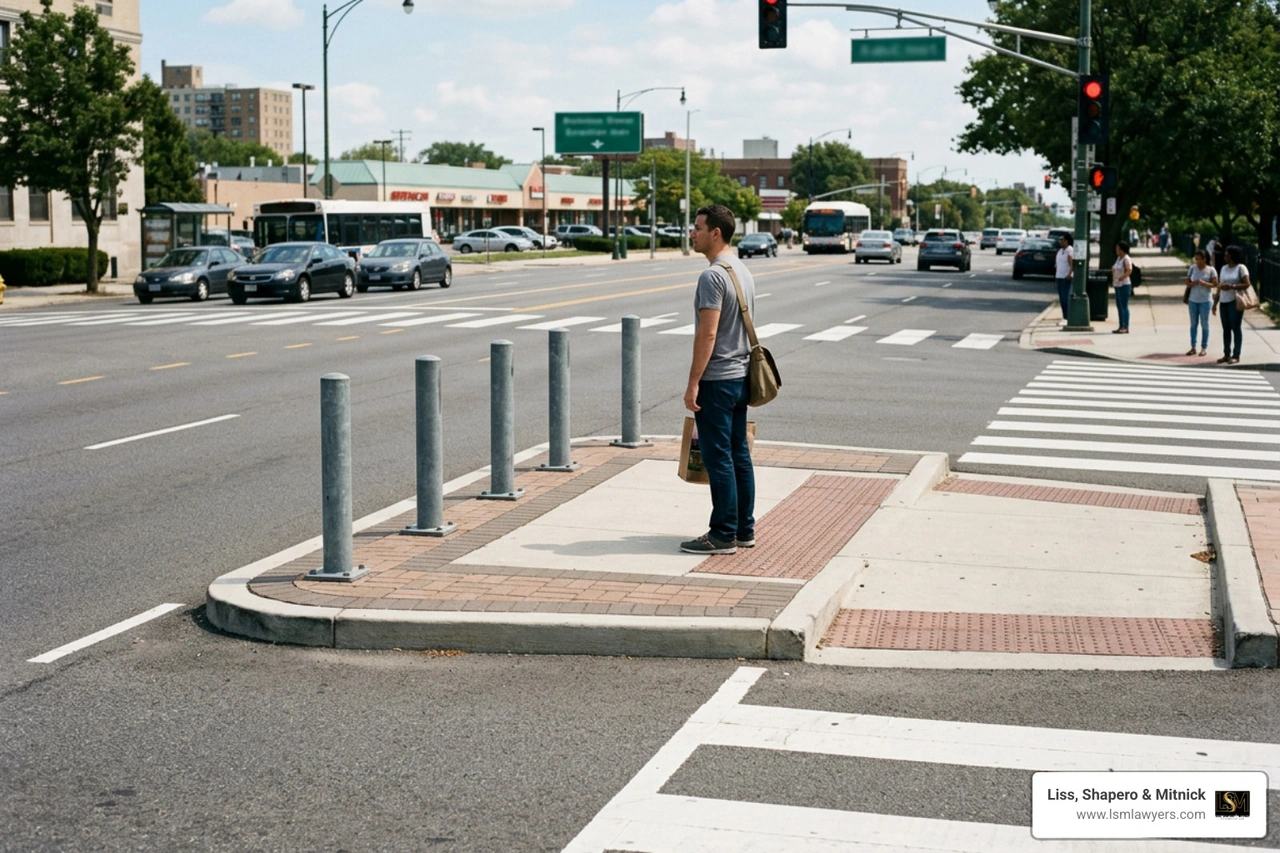
Walking down the street should not be an act of bravery. Yet, as highlighted in a Vox analysis on pedestrian safety disparities, the United States has the tragic distinction of being one of the most dangerous developed nations for pedestrians.
The U.S. pedestrian fatality rate per capita is roughly three times higher than Canada's, four times higher than the United Kingdom's, and more than 13 times higher than Norway's. While European nations have steadily reduced pedestrian fatalities over the last two decades by redesigning urban spaces, American road fatalities climbed.
To bridge this safety gap, transportation engineers and community advocates are promoting the Safe System approach, which assumes human error will occur and designs roads to prevent fatal outcomes:
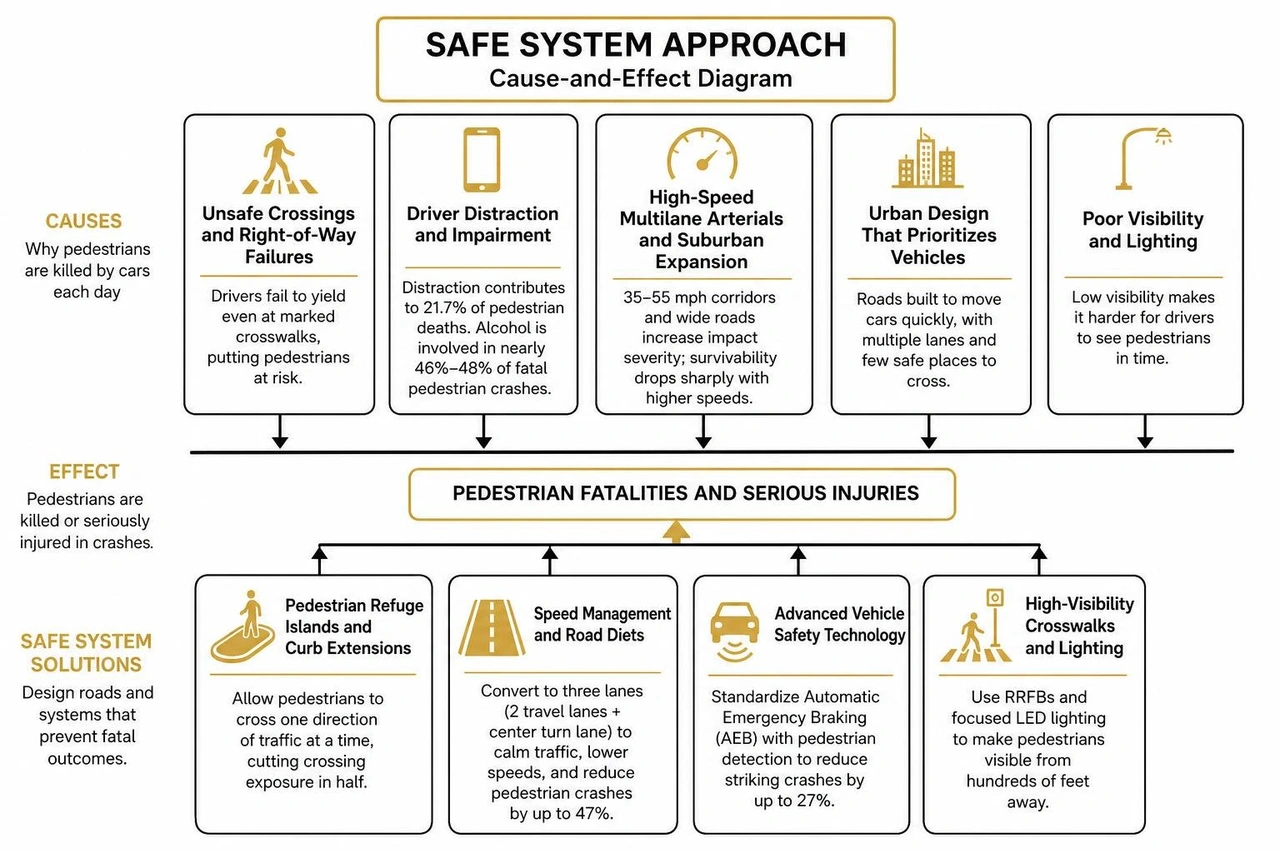
- Pedestrian Refuge Islands and Curb Extensions: Adding raised concrete islands in the middle of wide thoroughfares allows pedestrians to cross one direction of traffic at a time, cutting crossing exposure in half.
- Speed Management and Road Diets: Converting four-lane undivided roads into three lanes (two travel lanes and a center turn lane) naturally calms traffic, lowers speeds, and reduces pedestrian crashes by up to 47%.
- Advanced Vehicle Safety Technology: Standardizing Automatic Emergency Braking (AEB) systems with pedestrian detection can reduce striking crashes by up to 27%.
- Targeted High-Visibility Crosswalks and Lighting: Installing pedestrian-activated rectangular rapid-flashing beacons (RRFBs) and focused overhead LED lighting makes walkers visible to approaching motorists from hundreds of feet away.
Frequently Asked Questions About Pedestrian Fatalities
How Many Pedestrians Are Killed by Cars Each Day in the United States?
In recent years, between 18 and 22 pedestrians have been killed by motor vehicles every single day in the United States. In 2025, preliminary data recorded 6,732 total pedestrian deaths, which averages to roughly 18 people per day. In 2024, the average was roughly 19 people daily (7,080 total).
What Time of Day Are Pedestrians Most at Risk?
Pedestrians face the highest risk during nighttime hours, specifically between 6:00 PM and midnight. Over 76% of all fatal pedestrian crashes take place in dark conditions. Fatality rates also surge on weekend nights (Fridays and Saturdays), when traffic volumes, driver fatigue, and alcohol impairment levels are highest.
What Legal Rights Do Families Have After a Fatal Pedestrian Incident?
When a reckless, distracted, or impaired driver takes someone's life, surviving family members have the legal right to pursue financial accountability. Families can file wrongful death claims against the negligent motorist's auto insurance policy to recover compensation for funeral expenses, medical bills incurred prior to passing, lost future income, and the loss of companionship. In cases involving hit-and-run drivers or uninsured motorists, uninsured motorist (UM) coverage can provide essential relief. Reviewing our guide on Michigan wrongful death legal claims can help clarify the specific legal deadlines and recovery rights available under state law.
Conclusion: Turning Awareness into Action on Roadway Safety
Every daily statistic represents a parent, child, sibling, or friend whose life was cut short on roads that should be safe for everyone. Achieving zero pedestrian fatalities requires a united effort: traffic engineering that protects the vulnerable, vehicle safety standards that account for human impact, and attentive, sober driving by everyone behind the wheel.
When drivers fail to exercise reasonable care and cause catastrophic harm, victims and their families deserve fierce, experienced legal advocacy. At Liss, Shapero & Mitnick, we represent injured pedestrians and grieving families throughout Berkley, Metro Detroit, and across Michigan.
We leverage our deep background in former insurance defense to anticipate insurer tactics, protect your rights, and secure the full compensation you deserve. If you or a loved one has been struck by a motor vehicle, reach out to our team by contacting a Michigan pedestrian accident lawyer for a free, compassionate consultation.