.svg)
When to Contact a Michigan Accident Lawyer After a Crash

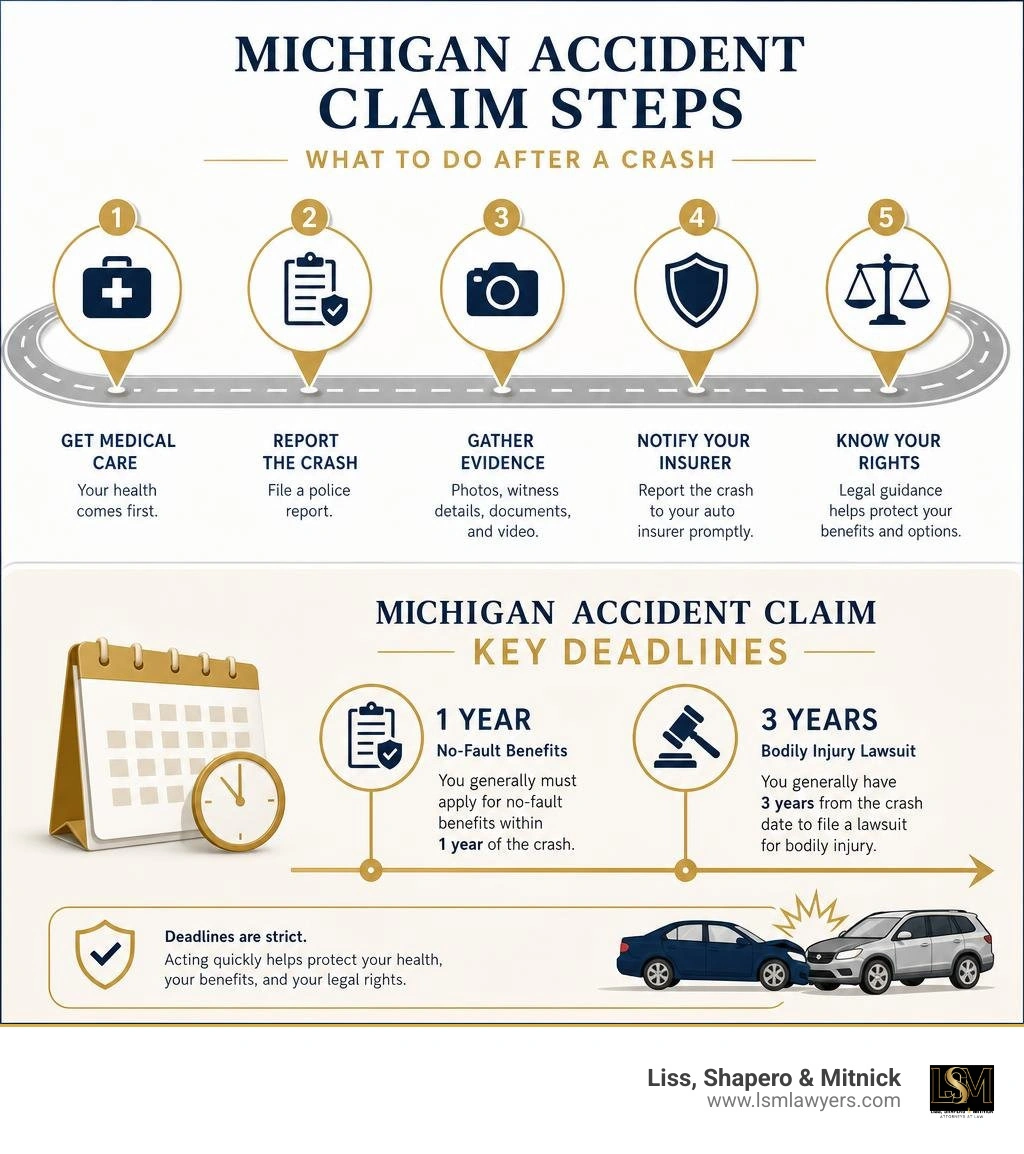
After an accident, get medical care, report the crash, save evidence, and notify the correct insurer quickly. A Michigan accident lawyer can help you protect no-fault benefits, respond to an insurance denial, and determine whether you may also have a claim against the driver or company that caused the crash.
Michigan's no-fault system usually means your own auto insurer pays certain medical and wage-loss benefits, regardless of fault. But deadlines are strict. In many cases, a claim for no-fault benefits must be made within one year, while a lawsuit for bodily injury may have a three-year deadline.
The right legal path depends on the facts. Serious injuries, permanent disfigurement, disputed fault, uninsured drivers, commercial trucks, pedestrians, cyclists, and work-related crashes can all make a claim more complex. Evidence such as the police report, photos, witness details, medical records, and available video can make a major difference.
This guide explains what to do after a Michigan crash, what compensation may be available, and how Liss, Shapero & Mitnick can help you deal with insurers and legal deadlines.
Understanding Michigan No-Fault Auto Insurance Laws
Michigan's auto insurance system is unique and often misunderstood. Unlike pure at-fault states where you immediately turn to the other driver's carrier to pay your emergency room bill, Michigan operates under a comprehensive no-fault model. Under this framework, after a crash on any roadway across Metro Detroit or greater Michigan, you turn primarily to your own auto insurer to cover specific economic losses.
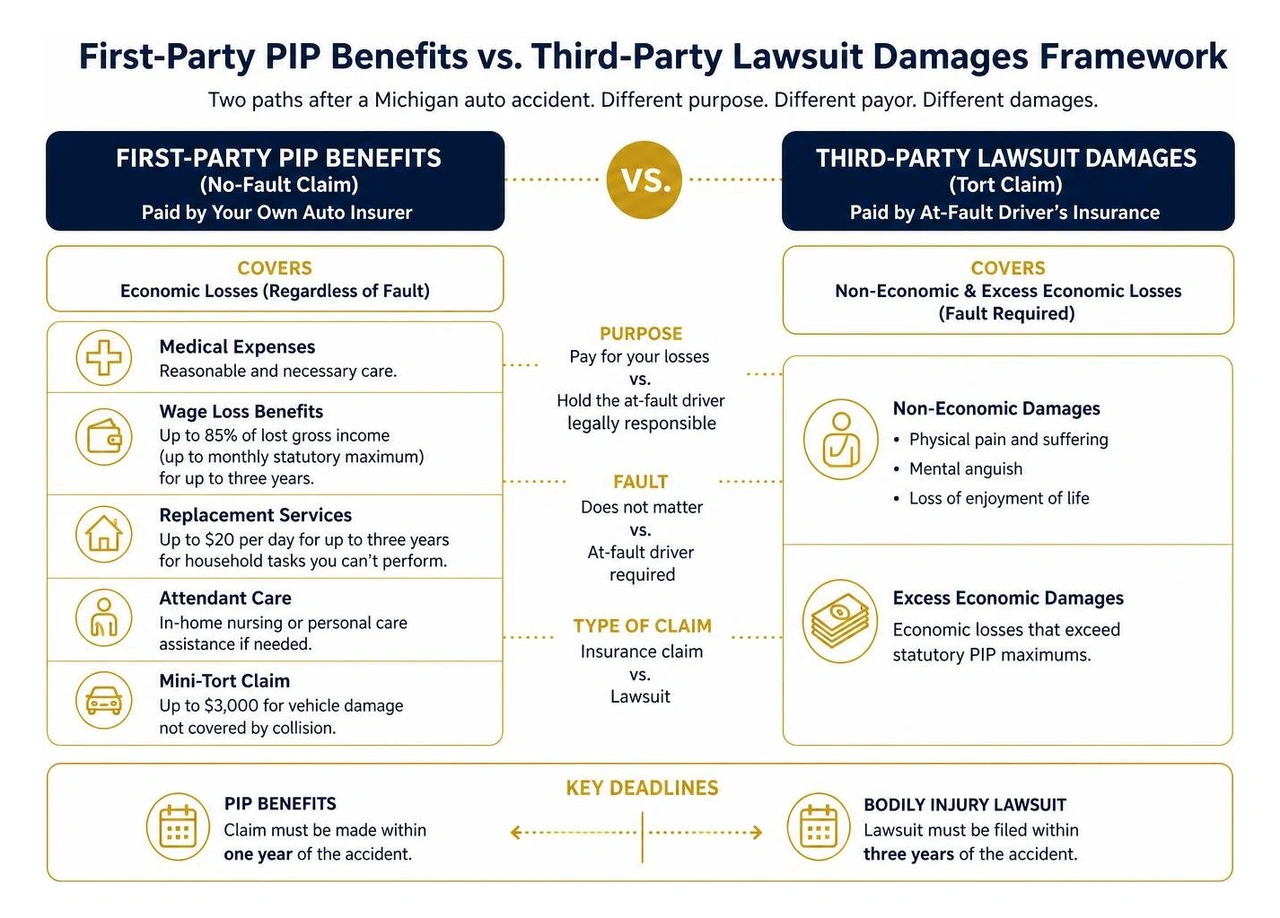
Navigating Michigan No-Fault Insurance Benefits requires understanding the primary components of Personal Injury Protection (PIP):
- PIP Medical Coverage: Covers reasonable and necessary medical care for your entire lifetime if you chose unlimited coverage, or up to the specific statutory cap selected on your policy.
- Wage Loss Benefits: Reimburses up to 85% of your lost gross income (up to a monthly statutory maximum adjusted annually) for up to three years from the date of the accident.
- Replacement Services: Provides up to $20 per day for up to three years to pay for daily household tasks you can no longer perform, such as childcare, cleaning, and yard maintenance.
- Attendant Care: Pays for in-home nursing or personal care assistance if your injuries leave you unable to manage basic daily activities like dressing, bathing, or mobility.
- Mini-Tort Claims: Allows you to recover up to $3,000 from the at-fault driver's insurance carrier to cover vehicle damage that is not covered by your own collision policy.
Recent auto insurance reforms introduced tiered medical benefit levels, making it essential to review your specific policy declarations page to see your current limits.
First-Party PIP Benefits vs. Third-Party Lawsuits
Understanding the difference between first-party and third-party claims is vital to securing your complete financial recovery.
First-party No-Fault Claims are filed directly against your auto insurance provider. These claims strictly cover economic losses, including your hospital bills, rehabilitation, prescriptions, and statutory lost wages. Because fault does not matter, you are entitled to these benefits even if you made a driving error that caused the collision.
In contrast, a third-party claim is a tort liability lawsuit filed against the negligent, at-fault driver who caused the crash. Through a third-party lawsuit, you can recover non-economic damages, such as physical pain and suffering, mental anguish, and loss of enjoyment of life, as well as excess economic damages that exceed statutory PIP maximums.
Threshold Requirements for Pain and Suffering Damages
You cannot sue an at-fault driver for minor aches and bruises under Michigan law. To pursue a third-party Personal Injury lawsuit for non-economic damages, an injured person must meet Michigan's legal injury threshold.
Under MCL 500.3135, you must demonstrate that your injuries resulted in:
- Death: In which case the family may pursue a Wrongful Death action.
- Permanent Serious Disfigurement: Severe scarring, amputations, or visible physical alterations.
- Serious Impairment of Body Function: An objectively manifested impairment of an important body function that affects your general ability to lead your normal life.
Proving a serious impairment requires extensive objective medical evidence—such as MRIs, CT scans, surgical records, and physician-imposed lifestyle restrictions—showing that your post-accident lifestyle has substantially changed compared to your pre-accident routine.
Why You Need an Experienced Michigan Accident Lawyer
Auto insurance adjusters are trained negotiators whose primary job is protecting the insurer's bottom line. At Liss, Shapero & Mitnick, our legal team includes attorneys with past insurance-defense experience. We know the exact strategies insurance companies use to undervalue, delay, and deny legitimate claims.
| Benefit / Claim Feature | First-Party PIP Claim | Third-Party Bodily Injury Lawsuit |
|---|---|---|
| Who Pays? | Your own auto insurance company | At-fault driver's insurance company |
| Fault Required? | No, paid regardless of fault | Yes, must prove defendant was negligent |
| Covered Damages | Medical bills, lost wages (up to 3 years), attendant care, replacement services | Pain and suffering, mental distress, excess economic losses |
| Injury Threshold | Any crash-related medical injury | Serious impairment, disfigurement, or death |
| Filing Deadline | 1 year from crash date (MCL 500.3145) | 3 years from crash date (MCL 600.5805) |
How a Michigan Accident Lawyer Handles Complex Insurance Disputes
When adjusters wrongfully deny benefits or schedule adverse Independent Medical Examinations (IMEs) to cut off treatment, handling Insurance Disputes requires aggressive litigation. We challenge bad-faith tactics, counter biased IME physicians, and demand prompt payment under statutory penalty interest provisions. You can review our past Success Stories to see how our targeted approach consistently delivers results for injured Michiganders.
Proving Fault: How a Michigan Accident Lawyer Gathers Evidence
Even under a no-fault umbrella, proving fault remains critical for third-party settlements and mini-tort recovery. Especially in Distracted Driving Accidents, establishing liability requires immediate evidence preservation, including:
- Subpoenaing cell phone records to prove texting or phone use at the moment of impact.
- Securing dashcam, traffic camera, or nearby commercial security video footage.
- Preserving vehicle Event Data Recorders ("black boxes") that capture vehicle speed and braking data.
- Consulting accident reconstruction specialists to establish lane positions and points of impact.
- Interviewing eyewitnesses and analyzing police crash reports.
Key Differences in Special Accident Claims
Not all roadway collisions are standard two-car crashes. Different legal standards, federal safety rules, and priority statutes apply when handling various types of Motor Vehicle Accidents.
Commercial Truck Accidents vs. Passenger Car Collisions
Crashes involving tractor-trailers and commercial rigs represent a separate legal landscape. Pursuing Truck Accidents involves navigating Federal Motor Carrier Safety Regulations (FMCSR), investigating hours-of-service logbooks, maintenance histories, and cargo-loading protocols.
Because commercial trucks can weigh up to 80,000 pounds, the resulting catastrophic trauma often involves multiple liable parties—including motor carriers, freight brokers, maintenance contractors, and commercial insurance policies with multi-million-dollar limits.
Protecting Pedestrians and Cyclists Under Michigan Law

When motor vehicles strike individuals on foot or on bicycles, the injuries are often devastating. Michigan law provides clear avenues for recovery in a Pedestrian Accident or Motorcycle Bicycle Accident through Michigan's statutory "Order of Priority":
- The pedestrian's or cyclist's own auto policy (or a policy in their household).
- If uninsured, through the Michigan Assigned Claims Plan (MACP), which provides statutory PIP medical coverage up to $250,000.
- A third-party tort claim against the negligent driver who struck them.
Critical Steps and Deadlines After a Crash in Michigan
The hours and days following a crash are critical for both your physical recovery and legal protections. As outlined in our guide on First Snow First Crash Your Michigan No-Fault Checklist, taking decisive, organized steps prevents insurance companies from undermining your claim:
- Seek Immediate Medical Attention: Go to an emergency room or urgent care right away. Gaps in treatment provide insurers an excuse to claim your injuries were pre-existing or unrelated.
- Call the Police: Ensure a formal Michigan Traffic Crash Report (UD-10) is completed by local police, county sheriff, or Michigan State Police.
- Document Everything: Photograph vehicle damages, road conditions, skid marks, visible injuries, and license plates.
- Do Not Give Recorded Statements: Decline to give recorded interviews to the other driver's insurance adjuster before consulting with an attorney.
- Submit Written Notice to Your Insurer: Provide formal written notice of your injury to your auto insurer within one year of the crash date.
Michigan Statute of Limitations for Auto Accident Claims
Missing a legal deadline in Michigan will permanently bar your right to compensation:
- One-Year Notice Rule (First-Party PIP): Under MCL 500.3145, you must submit a formal written application for PIP benefits to the appropriate insurer within one year of the accident date. Individual unpaid medical bills must also be sued upon within one year of the date the expense was incurred (the "one-year-back rule").
- Three-Year Bodily Injury Deadline (Third-Party Tort): Under MCL 600.5805, you have three years from the date of the crash to file a lawsuit against the at-fault driver for pain, suffering, and excess economic damages.
- Government Entity Notice Requirements: If your crash involved a defective roadway or a government-owned vehicle, notice requirements can be as short as 60 to 120 days.
Frequently Asked Questions About Michigan Accident Claims
What is the average settlement for a car accident in Michigan?
While typical minor accident settlements often average around $30,000, case values vary significantly based on injury severity, lifetime wage losses, and available insurance policy limits. Catastrophic injury cases involving spinal trauma, traumatic brain injuries, or permanent disability frequently result in settlements exceeding $1 million.
How long do I have to file a claim after an auto accident in Michigan?
You must file your no-fault application for PIP benefits within one year of the crash. To sue an at-fault driver for pain and suffering, you have three years from the date of the incident.
How much does it cost to hire an accident attorney in Michigan?
At Liss, Shapero & Mitnick, we represent injured clients on a contingency fee basis. You pay no upfront retainers or out-of-pocket legal fees. Our fee is a state-regulated percentage (typically one-third) of the financial recovery we secure on your behalf. If we do not win compensation for you, you owe us no attorney fees.
Conclusion
Navigating Michigan's auto insurance laws requires swift action, detailed evidence, and seasoned legal advocacy. If you or a loved one has suffered an injury on Michigan roadways, do not let insurance carriers dictate what your recovery is worth.
Contact Liss, Shapero & Mitnick today to schedule a free, confidential case consultation and let our experienced team fight for the maximum compensation you deserve.