.svg)
Help After a Michigan Distracted Driving Crash

A Michigan distracted driver accident attorney can help you protect key evidence, deal with insurers, and pursue the benefits or compensation available after a crash. Get medical care first, report the collision, save photos and witness details, and avoid giving a recorded statement to the other driver's insurer before you understand your rights.
Michigan recorded 13,807 distracted-driving crashes in 2022. Those crashes caused 6,129 injuries and 50 deaths. Phone use is only one form of distraction. A driver who is texting, using an app, eating, adjusting a screen, or simply not watching traffic can cause a serious collision in seconds.
Michigan's no-fault system may provide certain personal injury protection benefits regardless of fault. But proving the other driver was distracted can matter greatly when injuries are severe, benefits are denied, or you may have a claim against the at-fault driver. Phone records, police reports, vehicle data, video, and witness statements can all become important quickly.
This guide explains Michigan distracted-driving laws, no-fault benefits, potential damages, evidence, and the deadlines that may affect your case.
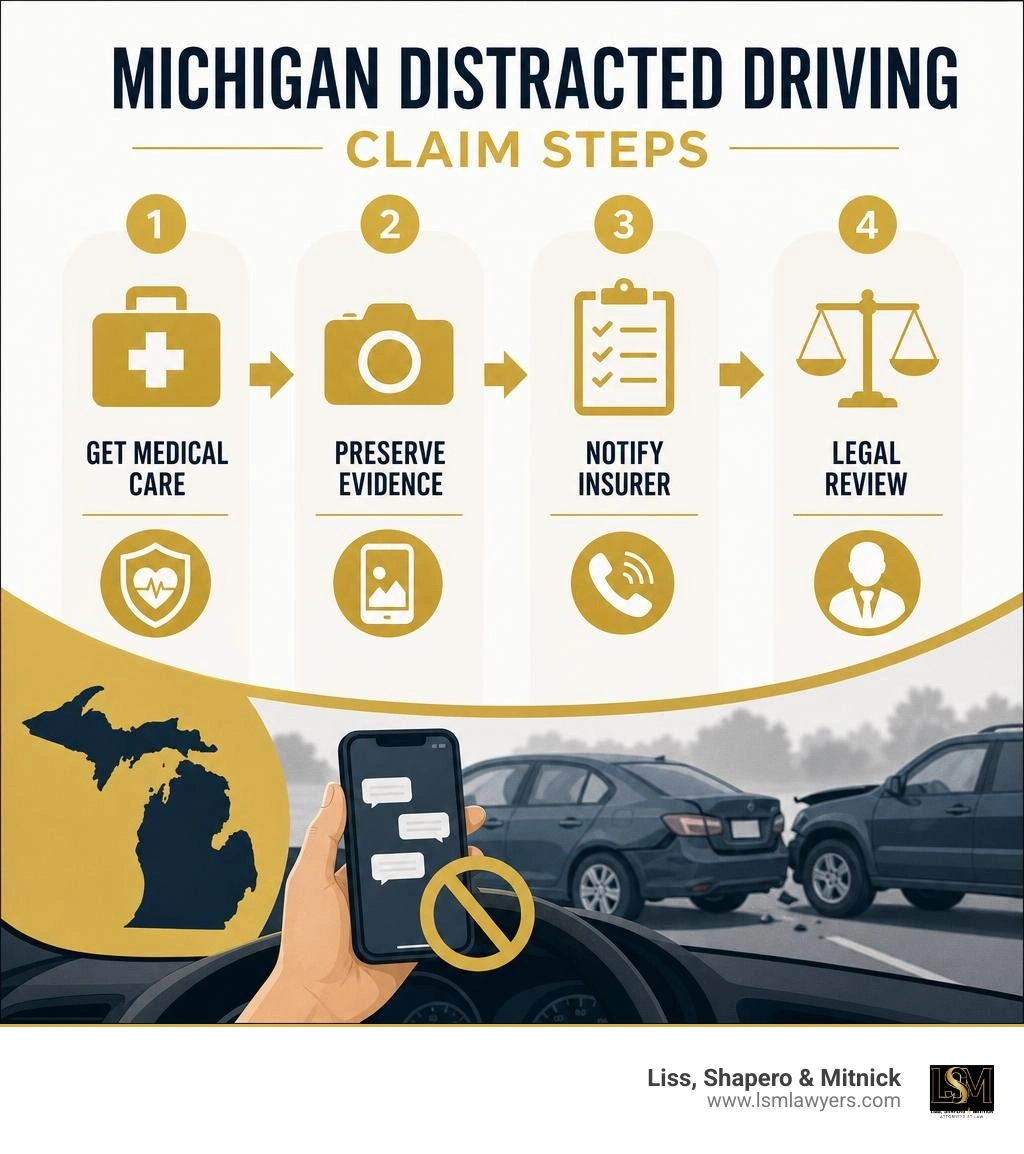
Understanding Distracted Driving Laws and Common Causes in Michigan
Distracted driving remains one of the most preventable hazards on our roadways. According to data from the National Highway Traffic Safety Administration (NHTSA), distraction-related collisions account for nearly 9% of fatal traffic accidents nationwide. Here in Michigan, our roads tell a similar story. While state agencies have ramped up public awareness campaigns and enforcement initiatives, thousands of motorists still take their eyes off the road every single day.

When someone chooses to scroll social media, respond to an email, or fiddle with an infotainment console while cruising down I-696 or Woodward Avenue, they endanger everyone sharing the asphalt. At Liss, Shapero & Mitnick, we see the real human aftermath of distracted driving accidents. Understanding what the law says—and how drivers routinely violate it—is the first step toward holding reckless individuals accountable.
Michigan Hands-Free Laws and Legal Distractions
Under the Michigan Vehicle Code, holding or manually using a mobile electronic device while operating a motor vehicle is strictly prohibited. State statutes make it illegal to:
- Send, read, or type text messages.
- Access, view, or post to social media networks.
- Browse the internet or watch streaming video content.
- Manually dial phone numbers or scroll through contact lists.
- Physically hold a phone during a call while driving.
A first-time violation triggers a civil infraction with a $100 fine, while subsequent offenses carry fines reaching up to $200, along with potential community service hours and points against a driver's license. Commercial vehicle operators and school bus drivers face even stricter penalties and higher fines under federal and state regulations.
While hands-free voice commands and built-in navigation software are generally permitted, using these systems can still divert a motorist's mental focus away from sudden traffic changes. If a driver causes a wreck while manipulating hands-free technology, they can still be held liable for civil negligence.
Common Forms of Distracted Driving Behind Recent Crashes
Safety researchers categorize driving distractions into three distinct buckets:
- Visual Distractions: Taking your eyes off the roadway (e.g., glancing at a smartphone screen, rubbernecking at a roadside billboard, or checking on kids in the backseat).
- Manual Distractions: Removing your hands from the steering wheel (e.g., eating breakfast on the morning commute, reaching for a dropped drink, or adjusting dashboard climate controls).
- Cognitive Distractions: Taking your mind off the task of driving (e.g., daydreaming, intense phone arguments over speakerphone, or mentally rehearsing a work meeting).
Texting while driving is uniquely catastrophic because it demands visual, manual, and cognitive attention simultaneously. Traveling at 55 mph, taking your eyes off the road for five seconds to read a single text is equivalent to driving the entire length of a football field blindfolded.
- Smartphones and Wearables: Reviewing incoming notifications, voice-dictating replies, or checking smartwatches.
- In-Vehicle Infotainment: Scrolling through complex multi-touch menus to find a playlist or radio station.
- Food and Beverages: Juggling hot coffee, dipping sauces, or messy takeout items behind the wheel.
- Personal Grooming: Applying makeup, shaving, or styling hair in the rearview mirror.
- GPS Programming: Typing an address into navigation apps while the vehicle is in motion.
Navigating Michigan No-Fault Insurance and Distracted Driving Claims
Michigan operates under a unique auto insurance framework governed by the Michigan No-Fault Act. Following a collision, injured victims often feel confused about which insurance company pays for their medical bills, who replaces their lost earnings, and when they are allowed to sue the reckless driver directly.
Securing your mandatory Michigan no-fault insurance benefits is a separate legal process from pursuing a lawsuit against the distracted driver. When adjusters delay or deny legitimate claims, resolving insurance disputes after personal injury becomes critical to preventing financial ruin.
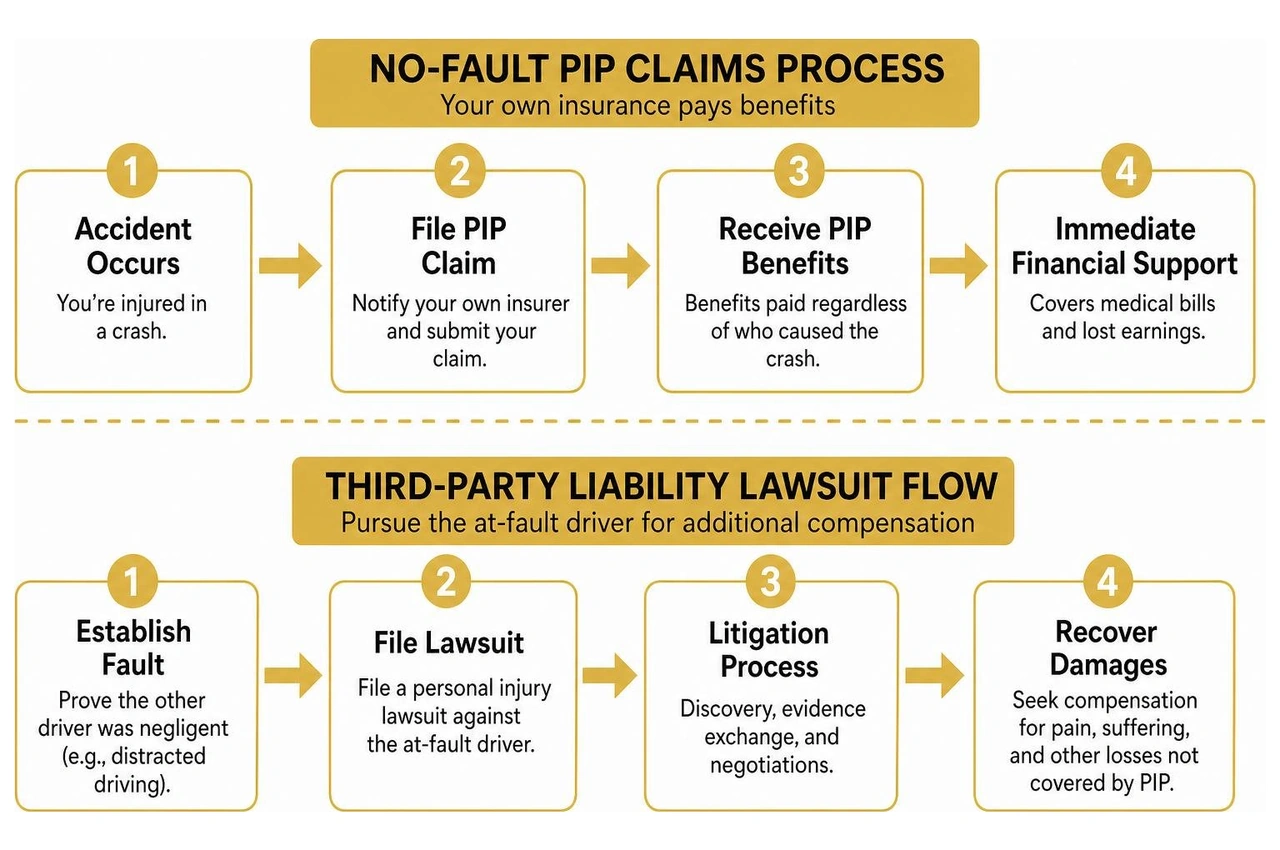
First-Party No-Fault Benefits vs. Third-Party Lawsuits
First-party benefits, commonly called Personal Injury Protection (PIP), are paid by your own auto insurer regardless of who caused the crash. These benefits help keep you financially afloat immediately following an injury.
First-party PIP benefits include:
- Allowable Medical Expenses: Hospital stays, surgeries, physical therapy, prescription medications, and durable medical equipment up to your policy's chosen coverage cap.
- Wage Loss Replacement: Up to 85% of your gross lost wages for up to three years, subject to state statutory maximums.
- Replacement Services: Up to $20 per day to hire assistance for routine household chores you can no longer perform, such as cleaning, snow removal, or cooking.
- Attendant Care: Compensation for nursing services or specialized personal care required due to catastrophic harm.
Unfortunately, insurance carriers frequently issue common PIP claim denials, citing independent medical examination (IME) disputes or alleged paperwork mistakes.
When your injuries are severe, PIP benefits alone are rarely enough. That is where a third-party tort claim against the at-fault, distracted driver comes into play.
| Feature | First-Party PIP Claim (Your Insurer) | Third-Party Tort Lawsuit (At-Fault Driver) |
|---|---|---|
| Fault Requirement | No-fault (payable regardless of blame) | Must prove the other driver was at fault |
| Medical Expenses | Covered up to selected policy limits | Covers excess medical costs beyond policy limits |
| Pain and Suffering | Not available under first-party PIP | Available if injury meets statutory threshold |
| Wage Loss | Up to 85% for 3 years (statutory cap) | Covers excess wage loss and future lost earning capacity |
| Property Damage | Handled via collision coverage | Up to $3,000 via Michigan mini-tort statute |
Recoverable Damages in a Severe Distracted Driving Case
To file a third-party lawsuit against the distracted driver for non-economic damages (pain, suffering, and emotional trauma), Michigan law requires you to meet a specific legal threshold under MCL 500.3135. You must prove that your injuries resulted in:
- Death,
- Permanent serious disfigurement (such as severe facial scarring or lost limbs), or
- Serious impairment of body function.
A serious impairment of body function means an objectively manifested impairment of an important body function that affects your general ability to lead your normal life.
Beyond non-economic pain and suffering, a successful third-party action allows you to recover excess economic damages, including medical expenses that exceed your PIP limit and wage loss continuing beyond the statutory three-year cutoff.
Victims of reckless motorists deserve comprehensive personal injury compensation that reflects every facet of their physical and emotional recovery.
Why You Need a Michigan Distracted Driver Accident Attorney After a Crash
Attempting to handle a distracted driving claim alone puts you at a severe disadvantage against massive insurance defense firms. Adjusters are trained to minimize payouts, dispute medical findings, and shift blame back onto you.

At Liss, Shapero & Mitnick, our legal team brings unique leverage to the table: we utilize former insurance-defense experience to anticipate the tactics insurance adjusters and defense counsel use to avoid paying full value. We know how insurers assess risk, how they build defenses, and how to counter their arguments effectively.
Critical Evidence Needed to Prove Driver Inattention
Drivers rarely admit to police officers that they were texting or checking an email right before rear-ending someone. Proving liability demands swift, methodical evidence collection before vital electronic data disappears.
Key forms of evidence we gather include:
- Cell Phone Carrier Records: Detailed call logs, data transmission spikes, and text message timestamps that coincide precisely with the moment of impact.
- Event Data Recorders (EDRs): Vehicle "black boxes" that capture braking inputs, steering angles, throttle positions, and vehicle speed seconds before a crash.
- UD-10 Traffic Crash Reports: Michigan police collision reports documenting officer observations, witness statements, physical skid marks, and citations issued.
- Surveillance and Dashcam Footage: Video feeds from nearby storefronts, traffic cameras, Michigan Department of Transportation (MDOT) cameras, or passenger vehicle dashcams.
- Eyewitness Testimony: Statements from other drivers who observed the at-fault motorist looking down at their lap or weaving across lane dividers prior to the impact.
When to Contact a Michigan Distracted Driver Accident Attorney
It is best to consult legal counsel immediately following medical stabilization. Reaching out early ensures critical evidence—such as traffic camera recordings that overwrite every 7 to 30 days—is secured via formal legal spoliation letters.
Early representation also protects you from giving recorded statements to third-party insurance adjusters who might twist your words to assert comparative fault, which can reduce your ultimate financial recovery under Michigan's modified comparative negligence standard.
Selecting the Right Legal Representation for Your Case
Your choice of legal representation directly influences the trajectory and ultimate outcome of your injury claim. You want an advocate who understands the local court systems in Berkley, across Metro Detroit, and throughout Michigan, and who is not afraid to take a case to a jury verdict if an insurer refuses a fair settlement.
Qualities to Look for in a Michigan Distracted Driver Accident Attorney
- Proven Courtroom Readiness: Insurance carriers track which attorneys settle quickly for low figures and which ones prepare every file for full trial litigation.
- Direct Defense Insight: Choosing a law firm with former insurance-defense background means your case strategy is built with inside knowledge of how claims departments evaluate files.
- Transparent Fee Structures: Dedicated injury lawyers represent clients on a contingency fee basis, meaning you pay zero upfront costs and no attorney fees unless a recovery is secured.
- Accessible Client Communication: You deserve responsive attorneys who listen to your concerns, answer your calls, and keep you informed at every stage of the legal process.
Michigan Statute of Limitations and Case Deadlines
Missing a statutory deadline will permanently bar your right to recover compensation. Michigan enforces strict time limits depending on the type of claim:
- Third-Party Pain and Suffering Lawsuits: Under MCL 600.5805, you generally have three years from the date of the collision to file a lawsuit against the at-fault driver.
- First-Party PIP Benefit Notice: Under MCL 500.3145, you must provide written notice of your injury claim to your auto insurer within one year of the accident.
- First-Party PIP Lawsuits (The "One-Year-Back" Rule): Lawsuits for unpaid PIP benefits must be filed within one year from the date the specific expense was incurred.
- Government Entity Claims: If a city, county, or state vehicle (such as a road commission truck or municipal bus) was involved, formal notice requirements can be as short as 60 to 120 days.
Frequently Asked Questions About Michigan Distracted Driving Accidents
Can I sue a distracted driver if Michigan is a no-fault state?
Yes. While your own insurer covers initial PIP medical and wage benefits regardless of fault, you can file a third-party lawsuit against the at-fault driver if their negligence caused death, permanent serious disfigurement, or a serious impairment of body function. You can also sue them for economic losses exceeding your PIP coverage limits.
What evidence is most effective in proving the other driver was on their phone?
Subpoenaed cellular data records paired with the vehicle's onboard Event Data Recorder (EDR) information create the strongest evidence. When cellular data activity matches the exact timestamp of zero braking before an impact, it leaves little room for an insurer to deny distracted driving.
How long do I have to take legal action after a distracted driving collision?
You generally have three years from the crash date to file a personal injury lawsuit against the at-fault driver. However, you must notify your own no-fault insurance carrier within one year of the accident to protect your first-party PIP benefits. Contacting an attorney immediately is crucial to avoid missing strict deadlines.
Conclusion
A distracted driving collision can upend your life in a fraction of a second, leaving you facing painful physical recovery, mounting medical debt, and confusing insurance disputes. You do not have to fight insurance companies alone.
At Liss, Shapero & Mitnick, our legal team leverages former insurance-defense experience to maximize compensation for injured victims across Berkley, Metro Detroit, and all of Michigan. We handle the paperwork, untangle no-fault claims, track down digital phone evidence, and hold reckless drivers accountable.
If you or a loved one suffered injuries in a crash, contact us today for a free consultation and get experienced motor vehicle accident representation fighting in your corner.