.svg)
Your Rights Under Michigan Slip and Fall Law

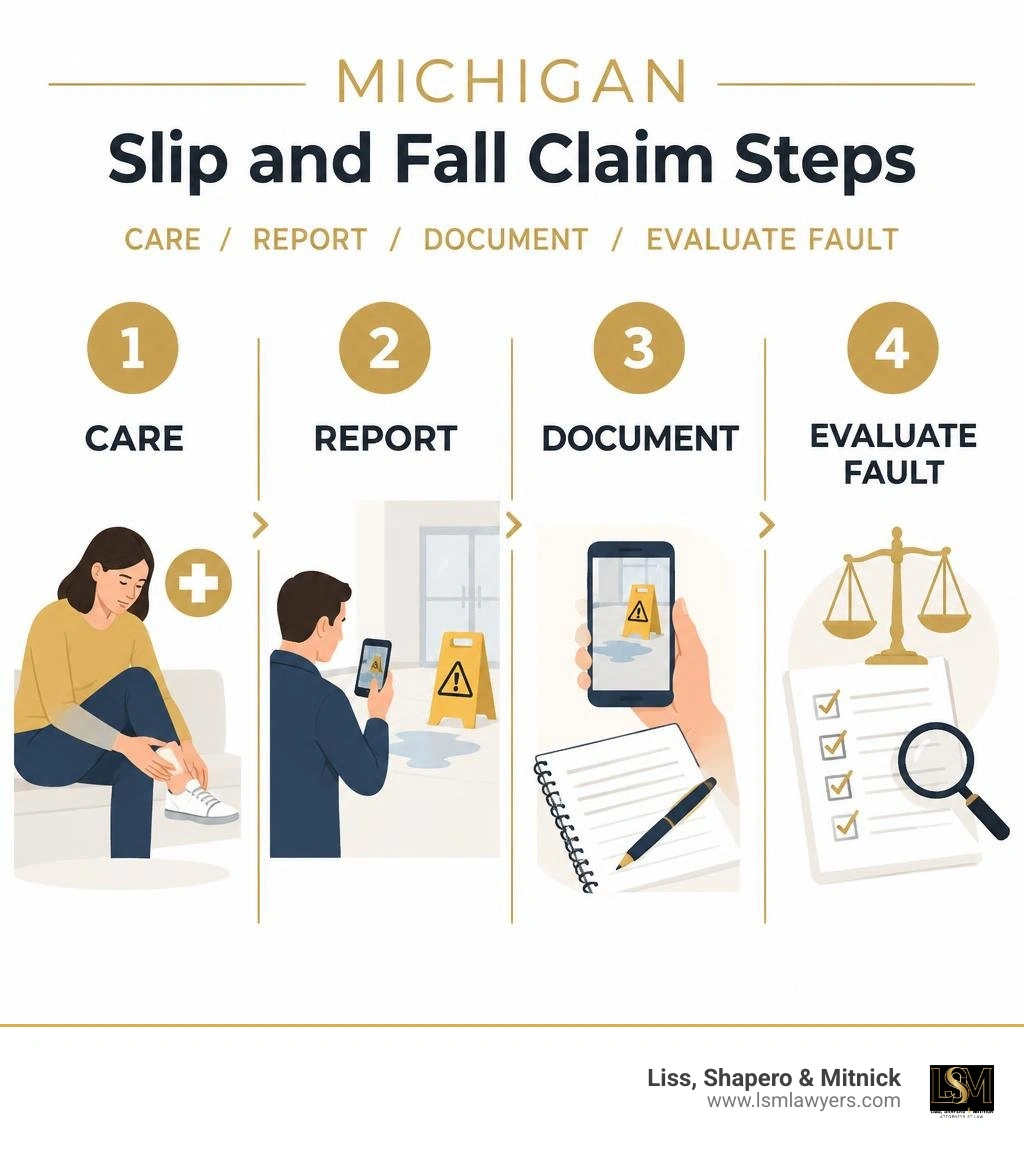
Michigan slip and fall law requires many property owners to use reasonable care to keep their premises safe for visitors. If you are hurt, get medical care, report the fall, photograph the hazard, identify witnesses, and preserve your shoes and clothing. A visible danger can still matter, but it generally goes to your share of fault rather than automatically ending the case.
The Michigan Supreme Court's 2023 decision in Kandil-Elsayed v. F&E Oil, Inc. changed how courts handle the former "open and obvious" defense. Instead of treating an obvious hazard as a complete bar to many claims, courts now focus on whether the owner acted reasonably under the circumstances. Your own actions may reduce damages under comparative fault, but they do not necessarily erase the owner's duty.
This can affect falls in stores, apartment common areas, parking lots, sidewalks, and workplaces. Landlords also have separate repair duties under MCL 554.139, and a lease cannot simply waive legal duties imposed on a landlord.
I am Scott Mitnick, a Michigan civil litigator and partner at Liss, Shapero & Mitnick with more than 20 years of experience handling personal injury, insurance, and premises liability matters. In this guide to Michigan slip and fall law, I explain the rules, evidence, deadlines, and practical issues that can shape a claim.
Quick michigan slip and fall law terms:
How Recent Supreme Court Rulings Reshaped Michigan Slip and Fall Law
For decades, getting hurt on someone else's property in Michigan felt like an uphill battle against a legal brick wall. If a hazard was visible, insurance companies would routinely dismiss claims before they ever saw a courtroom. That dynamic shifted dramatically when the Michigan Supreme Court handed down its landmark ruling in Kandil-Elsayed v. F&E Oil, Inc. (along with its companion case, Pinsky v. Kroger Co. of Michigan).

This pivotal decision overhauled the state's premises liability landscape by restoring the foundational duty of reasonable care owed to invitees. According to the Centers for Disease Control and Prevention (CDC), slip, trip, and fall incidents account for more than 800,000 hospitalizations across the United States every year. Many of these falls result in broken hips, spinal damage, and severe head trauma.
Before the high court intervened, property owners could frequently ignore obvious hazards on their walkways, arguing that the visitor should have simply avoided them. By returning Michigan law to standard negligence principles, the court aligned premises cases with how virtually every other injury claim is handled in Michigan, fundamentally altering settlement projections statewide.
The Shift from Lugo Open and Obvious to Reasonable Care
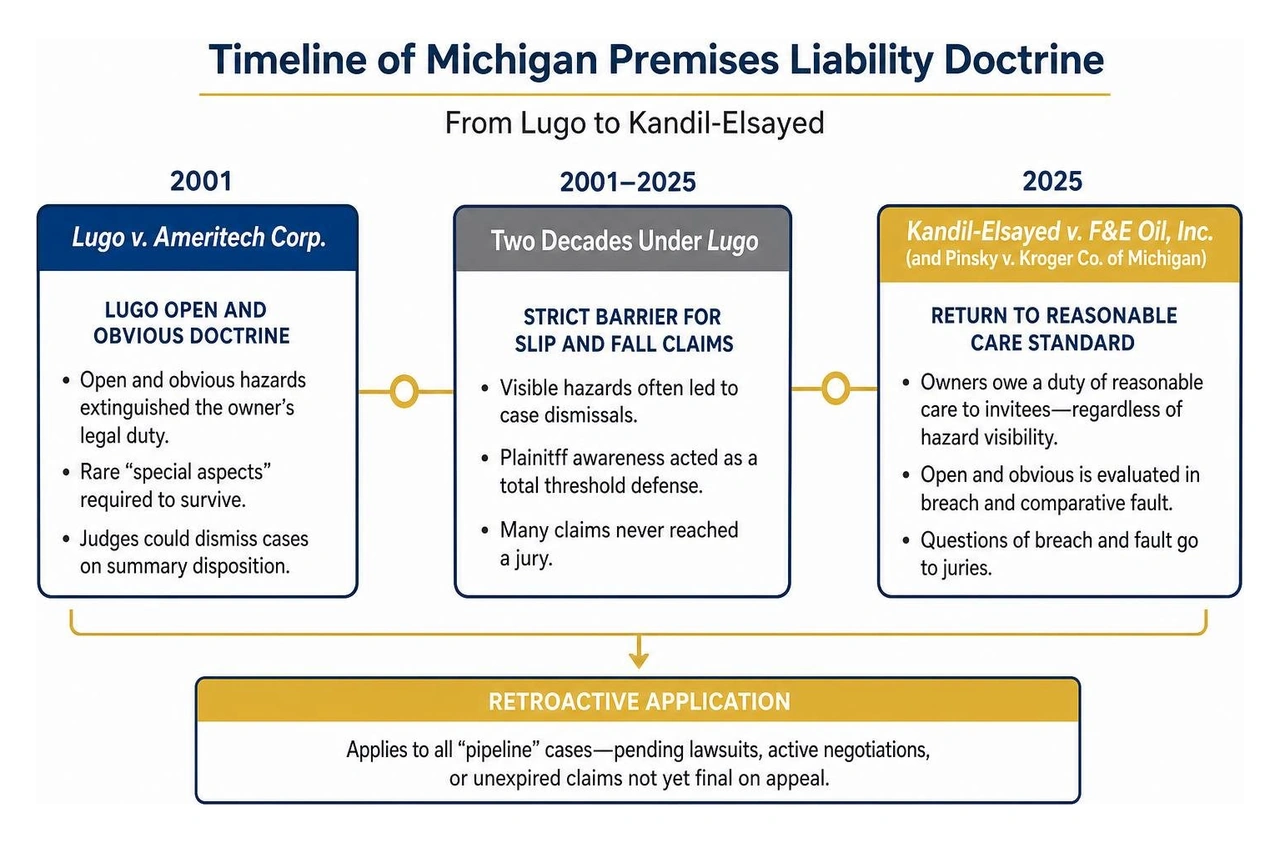
To appreciate why this change matters, it helps to understand the doctrine established over twenty years ago in Lugo v. Ameritech Corp. Under the old Lugo framework, property owners owed no legal duty to protect invitees from dangers deemed "open and obvious." Unless a plaintiff could prove rare "special aspects"—such as a hazard being unavoidable or posing an unreasonably high risk of severe harm—judges were required to dismiss the lawsuit on summary disposition.
Under the restored reasonable-care standard, the open and obvious nature of a condition no longer erases the property owner's legal duty. Instead, it is evaluated as part of whether the owner breached their duty and how fault should be divided between the parties. You can read more about how open and obvious affects a Michigan premises liability claim today.
| Legal Element | Prior Lugo Standard | Current Reasonable Care Standard (Kandil-Elsayed) |
|---|---|---|
| Duty Analysis | Open and obvious hazards extinguished the owner's legal duty entirely. | Owners owe an overarching duty of reasonable care to invitees regardless of hazard visibility. |
| Breach of Duty | Evaluated only if the hazard was hidden or had rare "special aspects." | Juries decide whether the owner acted reasonably to inspect, repair, or warn about the danger. |
| Role of Plaintiff's Awareness | Acted as a total threshold defense, barring claims before trial. | Considered under comparative fault to determine percentages of responsibility. |
| Courtroom Decision Maker | Trial judges regularly dismissed cases via summary disposition. | Questions of breach, reasonableness, and fault apportionment go to juries. |
Retroactive Application in Michigan Slip and Fall Law
A crucial dimension of the Kandil-Elsayed ruling is its retroactive application. The Michigan Supreme Court determined that the new standard applies to all "pipeline" cases—meaning any pending premises liability lawsuit, active negotiation, or unexpired claim that has not yet reached a final judgment on appeal.
For injury victims whose cases were stalled or threatened with dismissal under the old framework, this retroactive reach provides a vital opportunity. Claims previously evaluated as low-value or indefensible because of the Lugo defense can now be actively renegotiated. When managing serious slips, trips, and falls, this shift prevents insurers from securing easy dismissals on pending matters that occurred prior to the ruling.
Calculating Claim Values and Comparative Fault
The procedural shift from judge-decided duty questions to jury-decided comparative fault has fundamentally changed the financial math behind Michigan premises liability claims. Because insurance companies can no longer rely on automatic dismissals, settlement calculations now reflect real trial risk.
- Actuarial modeling projects average Michigan slip and fall settlements to rise from $15,000–$45,000 under the Lugo standard to $30,000–$85,000+ under the reasonable care standard.
- Settlement values are projected to increase by 35% to 55% for claims where the open-and-obvious defense was previously the carrier's primary defense strategy.
- Plaintiff win rates at trial in Michigan slip and fall cases are projected to increase from roughly 38% to between 52% and 60%.
Understanding comparative fault in Michigan is essential when assessing these numbers. Under Michigan's modified comparative negligence framework (MCL 600.2959), an injured person's damages are reduced in proportion to their percentage of fault. If a jury determines that a store was 70% at fault for leaving a slick puddle in an aisle and the customer was 30% at fault for looking at a shelf, the customer recovers 70% of their total assessed damages.
Importantly, if the plaintiff's fault exceeds 50%, they are barred from recovering non-economic damages (such as pain and suffering), though they may still recover their proportionate share of economic losses. This makes knowing your options for recovering compensation when partially at fault critical during pre-trial settlement negotiations.
Duty of Care and Comparative Negligence Standards
Under the modernized standard, property owners cannot escape accountability simply by claiming a hazard was visible. Instead, juries must weigh several practical factors to decide if an owner exercised reasonable care:
- Foreseeability of Harm: Did the property owner anticipate, or should they have anticipated, that visitors might encounter the hazard despite its visibility?
- Efforts to Remediate: Did the business perform routine inspections, apply salt, clean spills promptly, or place clear physical barriers around the dangerous area?
- Visitor Distraction: Was the hazard situated where a reasonable person's attention would naturally be diverted, such as retail merchandise displays or high-traffic transition thresholds?
- Apportionment of Responsibility: If both parties made errors, what precise percentage of liability belongs to the property manager versus the injured visitor?
Because these questions are fundamentally factual, they belong in the hands of a jury rather than being decided prematurely by a judge.
Critical Evidence and Incident Documentation
Winning a premises claim or negotiating a fair settlement requires prompt, detailed evidence gathering. Property owners and their insurers often move quickly to repair hazards or clear surveillance footage once an incident occurs.

Knowing what evidence to preserve after a store fall can make or break your case. Critical evidence includes:
- Time-Stamped Visuals: High-resolution photographs and videos showing the hazard from multiple angles, close-up details, and wider contextual views of lighting and warning signs.
- Internal Business Logs: Floor inspection sheets, janitorial sweep logs, and vendor maintenance records that reveal when the area was last checked.
- Surveillance Footage: Digital video capturing the fall, the creation of the hazard, and any store personnel walking past the condition prior to the incident.
- Formal Legal Preservations: Immediately issuing spoliation letters to ensure the business does not overwrite or destroy digital recordings and inspection records.
- Footwear and Clothing: Preserving the exact shoes worn during the fall in an uncleaned state to counter claims of inadequate footwear.
Commercial Property Owners, Landlords, and Insurance Impacts
The legal overhaul has prompted commercial enterprises and property managers across Metro Detroit and Michigan to rethink their risk strategies. Commercial General Liability (CGL) insurers have projected premium increases of 18% to 30% on Michigan premises policies following the decision.
To manage increased exposure, businesses are updating risk management protocols, increasing documentation requirements, and conducting routine premises safety audits to address common premises liability risks.
Landlord Statutory Duties and Tenant Protections in Michigan Slip and Fall Law
Residential and commercial landlords face clear obligations under Michigan law. Beyond standard common-law negligence principles, landlords owe specific statutory obligations under Michigan Compiled Laws (MCL) Section 554.139.
As detailed in the state bench guide regarding the Liability of Landlord for Injury to Tenant, Invitees of Tenant, or Tenant’s Property, landlords must keep all common areas "fit for the use intended by the parties." Under the Michigan Truth in Renting Act (MCL 554.633), residential lease clauses that attempt to waive these statutory maintenance duties or exculpate landlords from negligence are strictly void and unenforceable.
When ice builds up on apartment steps or shared tenant walkways, navigating sidewalk snow removal liability in Michigan requires examining both these statutory mandates and local municipal codes.
Risk Mitigation and Winter Hazard Management Protocols
Winter in Michigan presents severe hazards, from sudden freezes to hidden melt-and-refreeze cycles. Commercial property managers must take proactive operational steps to protect the public and mitigate legal exposure.
Essential winter safety protocols include:
- Detailed Salt and Plow Logs: Contractors and in-house maintenance crews must log exact application times, salt quantities, chemical agents used, and prevailing weather conditions.
- Targeting High-Risk Transition Zones: Prioritizing exterior curb cuts, entry vestibules, downspout runoff zones, and handicap parking ramps where meltwater frequently refreezes.
- Continuous Monitoring for Black Ice: Establishing dedicated inspection schedules during freezing transitions to mitigate black ice in Michigan parking lots.
- Proper Interior Entry Mats: Installing commercial-grade, moisture-absorbing walk-off mats that extend far enough into entrances to dry pedestrian footwear during heavy precipitation.
Frequently Asked Questions About Michigan Slip and Fall Claims
What should I do immediately after falling on ice or a store hazard?
Seek an immediate medical evaluation to document your physical injuries, even if symptoms seem minor at first. Report the incident directly to the store manager, landlord, or property owner and ensure an official written report is completed—requesting a copy or incident number before leaving.
Take clear photos of the hazard, your footwear, and the surrounding environment, and collect the names and phone numbers of any witnesses. Understanding the necessary actions in the first 24 hours ensures that perishable physical evidence is protected before property conditions change.
How long do I have to file a premises liability lawsuit in Michigan?
Under MCL 600.5805, the general statute of limitations for personal injury and premises liability claims in Michigan is three years from the date the injury occurred.
However, strict exceptions exist. If your fall occurred on government-owned property, a public sidewalk, or within a municipal building, state law imposes stringent formal notice requirements that can be as short as 60 to 120 days. Missing these deadlines can permanently bar your claim. Reviewing standard injury claim filing deadlines with counsel helps keep your case on track.
Does the open and obvious defense still dismiss cases before trial?
No. The Michigan Supreme Court's ruling removed the open and obvious doctrine as an absolute threshold defense evaluated under duty.
While defense counsel can still argue that a hazard was visible, that argument now applies strictly to comparative fault and whether the owner breached their duty—questions that must be decided by a jury rather than through pre-trial dismissal. For more on this distinction, see our analysis on open and obvious defense relevance.
Conclusion
The transformation of premises liability standards has restored accountability to Michigan's legal system, providing injured victims with a fair path toward recovery. If you or a family member was injured on dangerous commercial or residential property, your case must be evaluated under these updated reasonable-care rules rather than outdated defense playbooks.
At Liss, Shapero & Mitnick, our legal team draws upon decades of experience—including valuable former insurance-defense insight—to understand how adjusters evaluate risk and to maximize financial recoveries for our clients. Contact our dedicated Michigan Slip, Trip & Fall Lawyers today to schedule a comprehensive, free consultation and ensure your rights are fully protected.