.svg)
Immediate Post-Accident Protocol and Reporting Requirements

The minutes immediately following a crash are chaotic, but the actions you take at the scene establish the legal foundation for your recovery. Your absolute priority must always be physical safety. If your vehicle is operational and sitting in active traffic lanes, move it to the nearest shoulder or well-lit hazard zone. Turn on your hazard lights, set out emergency flares or triangles if you have them, and check all passengers, other drivers, and pedestrians for injuries. Call 911 immediately to request emergency medical services and dispatch police to the scene.
Once safety is secured, preserving perishable evidence becomes your top objective. Physical evidence disappears quickly: rain washes away fluid trails, traffic erases skid marks, and damaged vehicles are towed away. Use your smartphone to document every angle of the collision:
- Wide-angle shots showing vehicle positions, traffic control devices, street signage, and intersection layouts.
- Close-up photographs of vehicle damage, paint transfers, shattered glass, and deployed airbags.
- Environmental factors such as weather conditions, road hazards, construction zones, or obstructed sightlines.
- The other vehicle’s license plate, VIN, registration card, and insurance certificate.
- Physical injuries suffered by you or your passengers.
When exchanging details with the other driver, collect their full legal name, home address, phone number, driver’s license number, auto insurer, and policy number. If there are independent witnesses, get their contact details right away; their neutral statements often decide disputed liability questions. Speak calmly and politely, but never apologize or say things like "I didn't see you" or "I'm so sorry." In insurance investigations, casual expressions of politeness are routinely misconstrued as admissions of legal fault.
Reporting Deadlines to Law Enforcement and State Agencies
Filing an official police report is vital for your claim. When law enforcement officers investigate an accident scene, they generate a formal collision report that records driver identities, vehicle movements, weather, point of initial impact, and preliminary assessments of traffic code violations.
If officers do not respond to the scene—which can happen during severe weather events or in minor property-damage incidents—you remain legally obligated to report the crash yourself if it meets statutory thresholds. In many jurisdictions, drivers must submit a written collision report within a strict window (often 24 hours to four days) if the incident caused bodily injury, death, or apparent property damage exceeding a specific dollar amount (typically $1,000).
Failing to report an accident can lead to administrative penalties, including driver's license suspension. State administrative departments compile collision data to update driving histories. While an accident entry on a driving record documents the occurrence of the crash, formal fault determinations for financial liability are resolved through the civil claims and legal process.
First-Party vs. Third-Party Insurance Claims
When you seek compensation after a crash, you generally have two main paths for insurance recovery: a first-party claim or a third-party claim.
- First-Party Claims: This is a claim filed directly with your own insurance company under your existing coverage, such as collision, comprehensive, or Personal Injury Protection (PIP). When you use your own collision coverage, your insurer pays for vehicle repairs (or actual cash value) minus your deductible, regardless of who caused the wreck. If another motorist caused the crash, your insurer will typically initiate subrogation against the at-fault driver’s insurer to recover the funds they paid out, including your deductible.
- Third-Party Claims: This is a claim submitted directly against the at-fault driver’s auto insurance liability policy. Because the other driver caused your losses, you demand that their insurer pay for vehicle repairs, diminished value, replacement car seats, rental costs, and medical harm. Under a third-party claim, you do not pay an insurance deductible. However, the other insurer will not pay a dime until they complete an investigation and accept liability.
For medical treatment and wage loss, specialized statutory systems govern the recovery framework. In no-fault states like Michigan, accident victims turn first to their own auto policy for medical and economic recovery regardless of who caused the collision. Navigating these overlapping policies can be complex, and working through No-Fault Claims requires a precise understanding of which insurer stands first in the statutory priority order.
Step-by-Step Guide to Filing a Motor Vehicle Collision Claim for Damages
Initiating a property damage and injury claim requires systematic organization. Insurance companies process thousands of claims daily; claims backed by thorough documentation and clear organization settle far more efficiently than those with incomplete files.
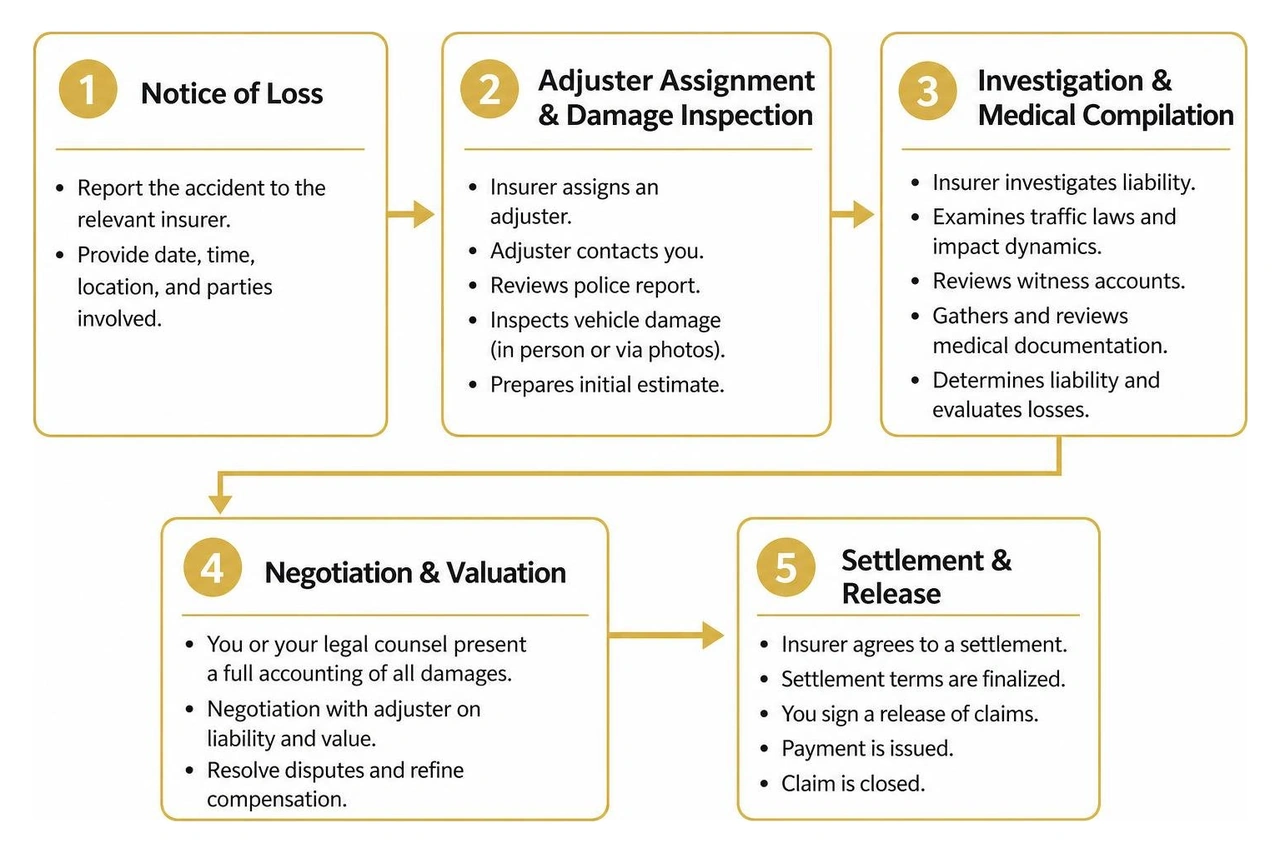
The typical lifecycle of a collision claim proceeds through five distinct stages:
- Notice of Loss: You notify the relevant insurer (your own or the adverse carrier) that an accident occurred, providing the date, time, location, and parties involved.
- Adjuster Assignment & Damage Inspection: The insurer assigns an insurance adjuster who contacts you, reviews the police report, inspects vehicle damage (either in person or via digital repair network photos), and writes an initial estimate.
- Investigation & Medical Compilations: The insurer examines traffic laws, physical impact dynamics, witness accounts, and medical documentation to determine liability and evaluate losses.
- Negotiation & Valuation: You or your legal counsel present a formal accounting of all damages, negotiating against the adjuster's valuation formulas.
- Settlement Release & Disbursement: Once an agreement is reached, you execute a legal release discharging the insurer and at-fault driver from future liability regarding the settled issues in exchange for the agreed compensation.
| Claim Element | First-Party Claim (Your Insurer) | Third-Party Claim (At-Fault Insurer) |
|---|---|---|
| Applicable Coverage | Collision / Comprehensive / PIP | Bodily Injury & Property Damage Liability |
| Deductible Required | Yes (subject to subrogation reimbursement) | No deductible applies to you |
| Speed of Property Payment | Faster (insurer owes contractual duties) | Slower (insurer investigates liability first) |
| Rental Car Coverage | Limited to policy endorsement limits | Owed for reasonable duration of repair/total loss |
| Fault Requirement | Payable regardless of fault | Fault must be proven against insured driver |
Critical Evidence Needed for a Motor Vehicle Collision Claim for Damages
To prove your damages, you must establish two points: legal liability (the other party was at fault) and damages (the exact financial cost of your physical and personal harm).
To build an airtight record, compile a centralized claim file containing:
- Official Documentation: Certified copy of the police collision report, 911 dispatch transcripts, and citations issued to the adverse driver.
- Visual Evidence: Scene photographs, vehicle impact points, dashcam recordings, intersection surveillance, and pictures of visible physical injuries over time.
- Repair Records: Itemized, written repair estimates from licensed collision facilities, parts invoices, and diagnostic scans highlighting hidden frame, suspension, or sensor damage.
- Medical and Financial Records: Emergency department summaries, physician treatment notes, physical therapy logs, prescription receipts, and wage-loss verification forms signed by your employer.
Be aware that insurance adjusters actively monitor public records and online activity to challenge claims. Reviewing key safeguards around Social Media Surveillance can help protect your claim from being compromised by casual posts taken out of context.
How Insurers Investigate Liability and Response Timelines
State insurance regulations require insurance companies to handle claims in good faith and within defined timelines. In most jurisdictions, insurers must provide claim forms and acknowledge receipt of your notice of loss within 15 working days. Furthermore, if a property damage investigation remains unresolved after 30 to 60 days, the insurer is generally required by law to send written delay notices explaining why more time is needed.
During the investigation, an adjuster will scrutinize the collision dynamics, review traffic laws, examine vehicle "black box" event data recorders (EDRs), and often request recorded statements. Be cautious: adjusters are trained negotiators whose goal is to minimize payout exposure. You are under no legal obligation to give a recorded statement to the adverse driver's insurance company without legal representation. When carriers fail to comply with statutory claims handling practices, reviewing the legal mechanics of Insurance Disputes After Personal Injury provides valuable clarity on your rights.
Determining Fault, Liability, and Comparative Negligence
Fault in a motor vehicle accident is governed by the law of negligence. To hold another driver liable, you must show that they owed you a legal duty of reasonable care, breached that duty through an act or omission (such as speeding, running a red light, or texting while driving), and directly caused your injuries and property loss.
However, accidents are rarely simple, and insurance companies often argue that an injured person contributed to the crash. States resolve these shared-liability disputes through legal frameworks known as comparative fault or contributory negligence:
- Modified Comparative Fault (50% or 51% Bar): In modified comparative fault jurisdictions, you can recover damages as long as your share of responsibility does not exceed the statutory threshold (usually 50% or 51%). If you are found 20% at fault for speeding while the other driver is 80% at fault for failing to yield, your total monetary recovery is reduced by 20%. If your fault crosses the threshold, you are completely barred from recovering compensation from the other driver.
- Pure Comparative Fault: Under pure comparative fault, an injured party can recover damages even if they were 90% at fault, though their financial recovery is reduced by their 90% share of liability.
- Pure Contributory Negligence: In a handful of jurisdictions, if you contribute even 1% to the cause of a collision, you cannot recover any compensation from the other party.
Understanding the specific legal framework governing Comparative Fault in Michigan is essential for evaluating how shared responsibility impacts your final compensation.
Minimum Insurance Requirements and Policy Limits
Every state sets mandatory minimum auto liability insurance coverage that motorists must carry to drive legally. A typical statutory liability structure is expressed as three numbers (such as 25/50/20 or 50/100/10):
- Bodily Injury Per Person: The maximum amount the policy will pay for injuries suffered by a single individual in one accident.
- Bodily Injury Per Accident: The total cap the policy will pay for all injured persons combined in a single accident.
- Property Damage Liability: The maximum cap the insurer will pay for all vehicle repairs, structural repairs, and personal property destruction caused by their insured driver.
When a severe crash occurs, minimum property damage limits (often set as low as $10,000 to $25,000) can be quickly exhausted by modern vehicle replacement costs, structural repairs, and medical bills. If your losses exceed the at-fault party's policy maximums, you must turn to optional first-party coverages. Reviewing the essentials of UM UIM 101 shows how underinsured motorist endorsements safeguard your finances when at-fault drivers carry inadequate insurance limits.
Claims Involving Government Entities and Commercial Fleets
When the vehicle that strikes you is owned by a municipal department, state agency, or corporate commercial fleet, the claims process changes significantly.
Claims against public entities—such as city buses, police cruisers, or road maintenance vehicles—face sovereign immunity laws. To pursue a claim, you must comply with strict statutory notice rules. For example, under the Indiana Tort Claims Act, claimants must submit an official NOTICE OF TORT CLAIM FOR PROPERTY DAMAGE AND/OR PERSONAL INJURY within 180 days for local municipalities or 270 days for state entities.
Similarly, municipal entities like New York City require a notarized MOTOR VEHICLE claim form filed within 90 days of the occurrence. Missing these strict statutory deadlines will permanently bar you from financial recovery.
In contrast, commercial fleet collisions involve corporate entities and large liability policies. Crashes involving semi-trucks, delivery vans, and freight haulers require immediate legal investigation to preserve electronic logging devices (ELD), driver qualification files, and telematics data. These collisions involve complex federal and state safety rules, making the approach to Truck Accidents distinct from typical passenger vehicle claims.
Calculating Vehicle Damage, Total Loss, and Repair Entitlements
Resolving the physical damage to your vehicle requires an understanding of appraisal rules, repair standards, and insurance regulations.

When your vehicle is repairable, you are not legally required to submit multiple repair estimates, though insurers frequently ask for two or three. More importantly, you have the absolute legal right to choose your own licensed repair facility. An insurance carrier cannot force you to use one of their "preferred" or direct-repair-program (DRP) body shops. However, if your chosen facility charges hourly labor rates or parts markups that exceed prevailing local market rates, the insurer may refuse to pay the difference, leaving you responsible for the balance unless your attorney successfully negotiates it.
During the repair estimation process, insurers frequently deduct for pre-existing damage, prior unrepaired body dents, or general mechanical wear and tear (known as betterment deductions). Insurers can deduct the full estimated cost to repair older damage, and can apply statutory betterment deductions (often capped up to $500) for components like tires, batteries, or rusted panels that are replaced with brand-new parts.
Actual Cash Value vs. Vehicle Total Loss Retention
When the cost of repairing a damaged vehicle approaches its market worth, the insurance company will declare the vehicle a total loss.
In most jurisdictions, a vehicle is deemed a total loss when repair costs plus projected salvage value exceed a statutory total-loss threshold (commonly 70% to 80% of the vehicle’s value), or when structural unibody damage cannot be safely repaired. In British Columbia, for instance, statutory indemnity limits under Vol. 64, No. 2 – B.C. Reg. 4/2021 limit insurer payouts to the lesser of repair costs or actual cash value (ACV), capped at specific statutory maximums.
Actual Cash Value is defined as the fair market price a willing buyer would pay a willing seller immediately before the collision occurred, taking into account the vehicle's year, make, model, mileage, options, and pre-crash physical condition.
If your car is totaled, can you keep it? In many states, you can elect "owner retention" only if the vehicle meets specific age criteria (for example, vehicles nine years old or older in certain jurisdictions). If permitted, the insurer will deduct the vehicle’s estimated salvage auction value from your final ACV settlement check, and you will receive a branded salvage title that requires rigorous safety re-inspection before the car can be driven on public roads again.
Loss of Use, Rental Reimbursement, and Personal Property Coverage
When your vehicle is damaged by an at-fault driver, you are legally entitled to compensation for "loss of use." Under a third-party claim, the adverse insurer must pay for a comparable temporary rental vehicle for the reasonable time required to complete repairs. If the vehicle is totaled, their rental obligation ends shortly after a reasonable total loss settlement offer is extended (usually within 3 to 7 business days following the offer). If you file under your own insurance policy, rental car coverage applies only if you purchased a specific rental reimbursement endorsement.
Beyond the vehicle itself, collision claims cover personal property damaged inside the vehicle during the crash:
- Child Safety Seats: Car seat manufacturers and traffic safety regulations universally mandate that child safety seats involved in a moderate-to-severe collision must be replaced immediately, regardless of whether damage is visible. Many state insurance laws require insurers to reimburse the full replacement cost of car seats that were occupied or secured in the vehicle during an accident.
- Personal Cargo and Electronics: Laptops, smartphones, eyeglasses, tools, and luggage damaged in the crash are recoverable under the at-fault driver's property damage liability coverage.
- Aftermarket Equipment and Conversions: Custom wheelchair lifts, commercial racks, or specialty van conversions are compensable, provided you provide purchase receipts or documentation showing their value.
Legal Recourse, Small Claims, and Dispute Resolution
When insurance negotiations stall, you need an effective dispute strategy. Adjusters often make low initial offers, hoping claimants will accept quick cash out of financial pressure. Formal demand letters detailing the facts of negligence, citing relevant traffic statutes, itemizing financial losses, and attaching supporting evidence serve as the foundation for serious negotiations.
If injuries are severe or life-altering, the stakes are much higher. Crashes involving vulnerable road users, such as those addressed in a Pedestrian Accident claim, or catastrophic fatal crashes requiring a Wrongful Death action, demand careful litigation planning to secure full compensation.
Overcoming Insurer Delays and Denials in a Motor Vehicle Collision Claim for Damages
When an insurer issues a claim denial, delays decisions unreasonably, or offers a fraction of your real losses, you have several options:
- Request a Written Denial Letter: Demand that the carrier cite the specific policy exclusion or legal basis for the denial.
- Invoke the Appraisal Clause: If you are dealing with your own insurer over vehicle valuation, most standard auto policies contain an appraisal provision. Under this process, you and the insurer each hire an independent appraiser; the two appraisers select a neutral umpire, and an agreement by any two parties sets the binding value.
- Escalate to State Insurance Regulators: Filing a formal complaint with your state's Department of Insurance or Financial Services triggers an administrative inquiry into unfair claims practices.
- Identify Benefit Denials: For medical and wage benefits, understanding the real-world obstacles covered in No-Fault PIP in Real Life can help you quickly correct improper claim denials.
Statutes of Limitations and Small Claims Court Action
Every state limits the time you have to file a lawsuit after an accident. These deadlines, known as statutes of limitations, vary significantly depending on whether your claim is for physical injuries or property destruction:
- Bodily Injury: In many states, personal injury lawsuits must be filed within two to three years of the collision date.
- Property Damage: Property damage claims often carry longer statutes of limitations—frequently three to five years from the date of the incident.
- Minors: If a crash victim is under 18 at the time of the accident, the statutory clock is typically paused (tolled) until their 18th birthday, giving them until age 19 or 20 to file suit.
When a property damage dispute involves a moderate sum and the insurer refuses to pay, small claims court offers an accessible, cost-effective forum. Small claims courts resolve minor disputes quickly without formal, drawn-out litigation procedures.
Monetary limits for small claims vary by state. For example, claimants handling a motor vehicle property dispute can learn How to Sue for Up To $5,000 in Small Claims Court - Motor Vehicle Case under New Jersey's procedural rules. Similarly, international civil court structures provide specialized small-claims paths, such as resolving a Property damage dispute caused by a motor vehicle accident - CAA under simplified minor civil rules for claims up to $12,000.
Frequently Asked Questions about Motor Vehicle Collision Claims
Do I have to pay a deductible if the other driver was clearly at fault?
If you file a third-party claim directly against the at-fault driver's insurance company, you do not pay a deductible. If you choose to file through your own collision coverage to get repairs completed faster, you must pay your policy deductible up front. Your insurance company will then attempt to recover that money from the at-fault driver's carrier through subrogation and refund your deductible once they succeed.
Can an insurer force me to use aftermarket parts for collision repairs?
In most states, insurance adjusters can write repair estimates using non-OEM (Original Equipment Manufacturer) or aftermarket crash parts for cosmetic components, provided those parts meet safety and quality standards. However, you have the right to request OEM parts. If your policy or state law does not mandate OEM parts, you may simply need to pay the difference in price between the aftermarket part and the factory component.
What happens if the at-fault driver has no insurance or insufficient coverage?
If the at-fault driver is uninsured, you can file a claim under your own Uninsured Motorist (UM) coverage for bodily injuries and your collision coverage for vehicle damage. You can also file a direct civil lawsuit against the uninsured driver. In many states, if an uninsured driver fails to pay an administrative claim or court judgment resulting from a crash, the state can suspend their driver's license and vehicle registration until they enter into a court-approved repayment plan.
Conclusion
Successfully handling a claim after a car accident requires swift action, organized documentation, and a clear understanding of your legal rights. Insurance adjusters work to protect their company's bottom line; your focus must be on protecting your health, your property, and your financial recovery.
At Liss, Shapero & Mitnick, our legal team draws on decades of experience—including valuable background in insurance defense—to help accident victims stand up to insurer tactics and recover the full compensation they deserve. If you are struggling with a disputed claim, unfair lowball offers, or severe injuries following a crash, reach out to our team today through our dedicated Motor Vehicle Accidents team for a free, comprehensive consultation.