.svg)
What Nursing Home Wrongful Death Settlements Can Pay

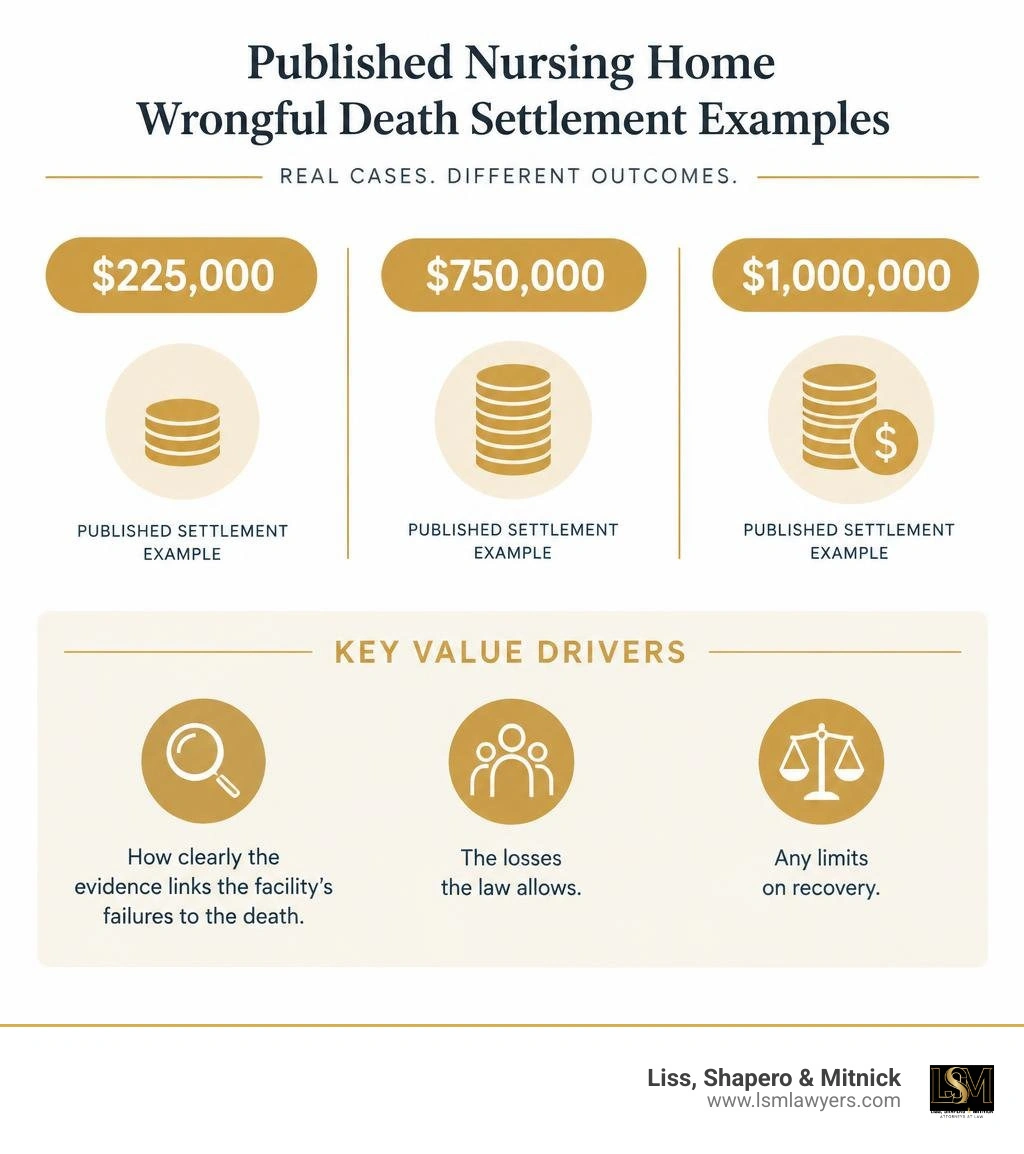
There is no reliable national average for nursing home wrongful death settlements. Published cases show a wide range: one family settled for $225,000, another for $750,000, and a California skilled nursing facility case for $1 million. These are examples, not a promise of what another family will receive. The value depends on how clearly the evidence links the facility's failures to the death, the losses the law allows, and any limits on recovery.
A settlement is also different from a jury verdict. Large verdicts may be reduced by state law or changed on appeal, so they are poor stand-ins for a typical payout.
I'm Scott Mitnick, a partner at Liss, Shapero & Mitnick with more than 20 years of civil litigation experience, including cases involving nursing home harm and wrongful death. I'll explain how to assess nursing home wrongful death settlement amounts and what can raise or limit a family's recovery.
Current Benchmarks for Fatal Nursing Home Neglect Payouts
When evaluating wrongful death claims against long-term care facilities, looking at comparative benchmarks helps provide realistic expectations. Neglect claims differ significantly based on whether the resident survived the injury or passed away due to facility-acquired complications.
| Case Classification | Typical Payout Range | Key Legal & Evidentiary Determinants |
|---|---|---|
| Standard Neglect Claims (Non-Fatal) | $216,428 – $251,296 | Temporary injuries, documented stage 1–2 pressure ulcers, prompt recovery. |
| Moderate Severity / Wrongful Death | $400,000 – $750,000 | Direct causal link to mortality, medication errors, sepsis from ignored wound protocols. |
| Catastrophic / Prolonged Neglect | $1,000,000 – $5,000,000 | Multi-system failure, severe understaffing records, corporate fund siphoning, absence of damage caps. |
| Landmark Jury Verdicts | $3,400,000 – $23,000,000+ | Egregious corporate misconduct, reckless indifference, statutory bill of rights violations. |
Verdicts can often be substantially reduced after trial. For instance, in McCoy v. Avon Place Skilled Nursing & Rehab. Ctr., an initial jury award included $2,300,000 in compensatory damages, $500,000 in punitive damages, and over $1.9 million in prejudgment interest. However, statutory limits on non-economic damages reduced individual survivorship components down to statutory baselines, resulting in a modified total judgment of $3,461,349.73.
Understanding National Averages and Settlement Ranges
Statistical datasets indicate that standard skilled nursing facility neglect claims baseline between $216,428 and $251,296, reflecting an upward trend from historical averages of $245,559. However, when neglect results in a resident's passing, broader datasets report averages climbing toward the $400,000 benchmark.
In severe scenarios where a loved one suffered through prolonged neglect without adequate intervention, settlement values routinely land between $1,000,000 and $5,000,000. These higher-tier payouts occur most frequently in jurisdictions without restrictive non-economic damage caps, particularly when pursuing claims involving systemic nursing home neglect.
Landmark Verdicts vs. Confidential Out-of-Court Settlements
The vast majority of fatal nursing home neglect matters resolve through confidential, out-of-court settlements rather than public jury trials. A confidential settlement allows both parties to avoid the costs and delays of appellate litigation. For example, a 64-year-old resident’s family secured a $750,000 out-of-court settlement after facility staff ignored medical orders for a worsening foot wound, ultimately causing sepsis and fatal complications.
By contrast, when corporate operators refuse to take responsibility during settlement negotiations, trial juries occasionally award record-setting sums. Notable examples include a record $23M Georgia nursing home death verdict involving lethal medication administration errors, as well as an Ohio case resulting in an $11 million compensatory and $1.5 million punitive verdict after an 83-year-old resident suffered a fatal drop. While these massive figures demonstrate jury outrage, out-of-court private mediations remain the primary avenue for families seeking closure without endless court appeals.
Key Factors That Determine Settlement Value

Every wrongful death action is distinct. Settlement negotiations revolve around quantifiable liability, standard-of-care breaches, and the corporate choices that led to the resident's death.

Severity of Harm, Staffing Violations, and Regulatory Citations
The physical trajectory of the resident’s final weeks plays a decisive role in settlement negotiations. Prolonged suffering from advanced stage 4 decubitus ulcers, preventable sepsis, unmanaged bowel impactions, or airway obstructions (such as tracheostomy blockages) establishes significant non-economic harm.
Behind these medical failures, systemic administrative breakdowns are frequently uncovered. Roughly 1 in 10 nursing home residents experience neglect each year, and approximately 64.2% of facility staff admit to witnessing or committing neglectful care. Understaffing is often the driving cause:
- Dangerous Caregiver Ratios: When a facility operates with 1 aide to 25 residents, basic hydration, hygiene, and repositioning schedules fail.
- Ignored Physician Orders: Unchecked wound progression or missed medications demonstrate standard-of-care breaches.
- Regulatory History: Prior citations from state health licensing agencies or the Centers for Medicare & Medicaid Services (CMS) prove the operator had advance notice of systemic safety failures.
- Corporate Siphoning: Evidence showing that an operating management firm transferred millions to related shell entities while skimping on floor staff provides strong support for corporate negligence.
How Statutory Caps Impact Recovery
Settlement negotiations do not happen in a vacuum—they are heavily influenced by state statutory limits. In states with non-economic damage caps, compensation for grief, emotional trauma, and the deceased's pre-death pain can be curtailed by law.
When working with an experienced Michigan wrongful death lawyer, structuring the legal demand is critical. By differentiating between conscious pain and suffering prior to death, direct economic losses, and statutory resident rights violations, legal counsel can maximize the total payout within the governing legal framework.
Wrongful Death Claims vs. Survival Actions: Recoverable Damages
Fatal neglect litigation generally involves two distinct claims: wrongful death actions brought for the surviving family, and survival actions brought on behalf of the deceased resident's estate.
| Category | Wrongful Death Claim | Survival Action (Estate Claim) |
|---|---|---|
| Purpose | Compensates the surviving family members for their personal losses. | Recovers damages the decedent could have claimed had they survived. |
| Key Damages | Loss of society, companionship, protection, and funeral/burial costs. | Conscious physical pain, mental anguish, and pre-death medical bills. |
| Beneficiaries | Surviving spouse, children, parents, or designated next of kin. | The decedent's estate (distributed per will or intestacy laws). |
| Creditor Exposure | Generally shielded from medical and general estate creditors. | Subject to valid creditor claims and healthcare subrogation liens. |
Typical Compensatory and Punitive Damages Recoverable
In fatal care facility claims involving elder disability and negligence, recoverable damages generally include:
- Medical and Palliative Care Costs: All hospitalization, ICU, and emergency intervention expenses resulting directly from the facility's neglect.
- Funeral and Burial Expenses: Direct reimbursement for interring the loved one.
- Loss of Society and Companionship: Compensation awarded to surviving family members for the loss of the relationship, emotional support, and guidance.
- Pre-Death Conscious Pain and Suffering: Compensation for the physical and emotional distress experienced by the resident from the onset of neglect until passing.
- Punitive Damages: Special financial penalties assessed against facility operators whose conduct demonstrated reckless indifference or actual malice.
Dealing with Arbitration Clauses, Insurance Limits, and Liens
Nursing home operators routinely insert mandatory arbitration clauses into initial admission paperwork to prevent families from going before a civil jury. However, these agreements can frequently be challenged if the signer lacked power of attorney, if the clauses violate state public policy, or if the resident was not competent at signing.
Furthermore, final payouts require navigating insurance coverage ceilings and statutory liens:
- Policy Limits: Many facilities carry commercial liability policies ranging from $1,000,000 to $3,000,000 per occurrence.
- Healthcare Liens: Medicare and Medicaid automatically assert statutory subrogation rights to recover medical costs paid for treating the fatal injury.
- Strategic Allocation: Legal counsel can petition the court to allocate settlement proceeds primarily toward wrongful death claims (rather than estate survival claims) to shield funds from creditor collections and optimize the family’s net recovery.
The Settlement Timeline: How Long Cases Take and How to Expedite Them

A contested fatal neglect lawsuit often requires 12 to 30 months from initial filing to resolution. When families ask how long personal injury cases usually take, the timeline is dictated by discovery disputes, depositions of rotating nursing staff, and medical expert schedules.
Cases can be expedited when families secure comprehensive records early and present clear, well-supported demand packages during voluntary mediation, allowing both parties to resolve the matter before trial.
Critical Evidence Required to Maximize Settlement Value
Insurance adjusters evaluate claims based on objective evidence rather than emotional pleas. To build a compelling case, families should gather:
- Complete Electronic Health Records (EHR): Tracking audit trails, physician order timestamps, and nursing shift notes.
- Photographic Progression Logs: When visiting a facility, knowing the importance of documenting bedsores and care errors provides vital visual proof of worsening conditions.
- State Survey Records: Deficiency citations issued against the facility around the time of the incident.
- Staff Rosters and Shift Logs: Verifying whether mandated staff-to-resident ratios were breached during the days the injury occurred.
- Expert Medical Opinions: Board-certified geriatricians and forensic nurses who can establish that the facility's omissions directly caused the fatal decline.
Frequently Asked Questions
What is considered a reasonable settlement amount for a nursing home wrongful death?
A reasonable settlement reflects the clarity of liability, the extent of pre-death pain, available insurance limits, and state statutory caps. While published baselines for neglect hover around $250,000 and wrongful death averages approach $400,000, cases with clear evidence of systemic neglect regularly settle between $750,000 and $1,500,000+. reasonable settlement valuation depends on demonstrating how the facility's direct breaches caused the fatal injury.
Who has legal standing to file a fatal nursing home neglect lawsuit?
Under state law, wrongful death actions must be brought by the court-appointed personal representative (executor) of the deceased resident's estate. The legal action is pursued on behalf of eligible statutory beneficiaries, which typically include the surviving spouse, children, parents, and siblings. Understanding how a wrongful death claim works in Michigan ensures the estate is properly opened and the correct personal representative is designated.
How do healthcare liens affect the net payout received by the family?
Medicare, Medicaid, and private health insurers maintain statutory reimbursement rights against settlement proceeds for medical care they covered relating to the fatal injury. If a resident required $80,000 in emergency hospital care before passing, those programs will place a lien on the recovery. An experienced attorney negotiates these liens downward and structures the settlement allocation to maximize the final compensation distributed to the family.
Conclusion: Securing Justice and Maximum Compensation for Your Loved One
Corporate nursing home chains frequently treat state care regulations as optional operating suggestions, cutting staff to maximize their bottom line. When this neglect leads to the preventable loss of an elderly parent or spouse, pursuing a legal claim holds the facility accountable while securing the financial justice your family deserves.
At Liss, Shapero & Mitnick, our legal team draws on former insurance-defense experience to anticipate the tactics facility defense lawyers use to downplay claims. We know how to uncover hidden staffing shortages, expose fraudulent charting, and negotiate top-tier settlements. If you have questions about wrongful death after a preventable incident in Michigan, contact our team today for a compassionate, no-obligation case evaluation.