.svg)
How to Find the Right Pedestrian Accident Attorneys Near You

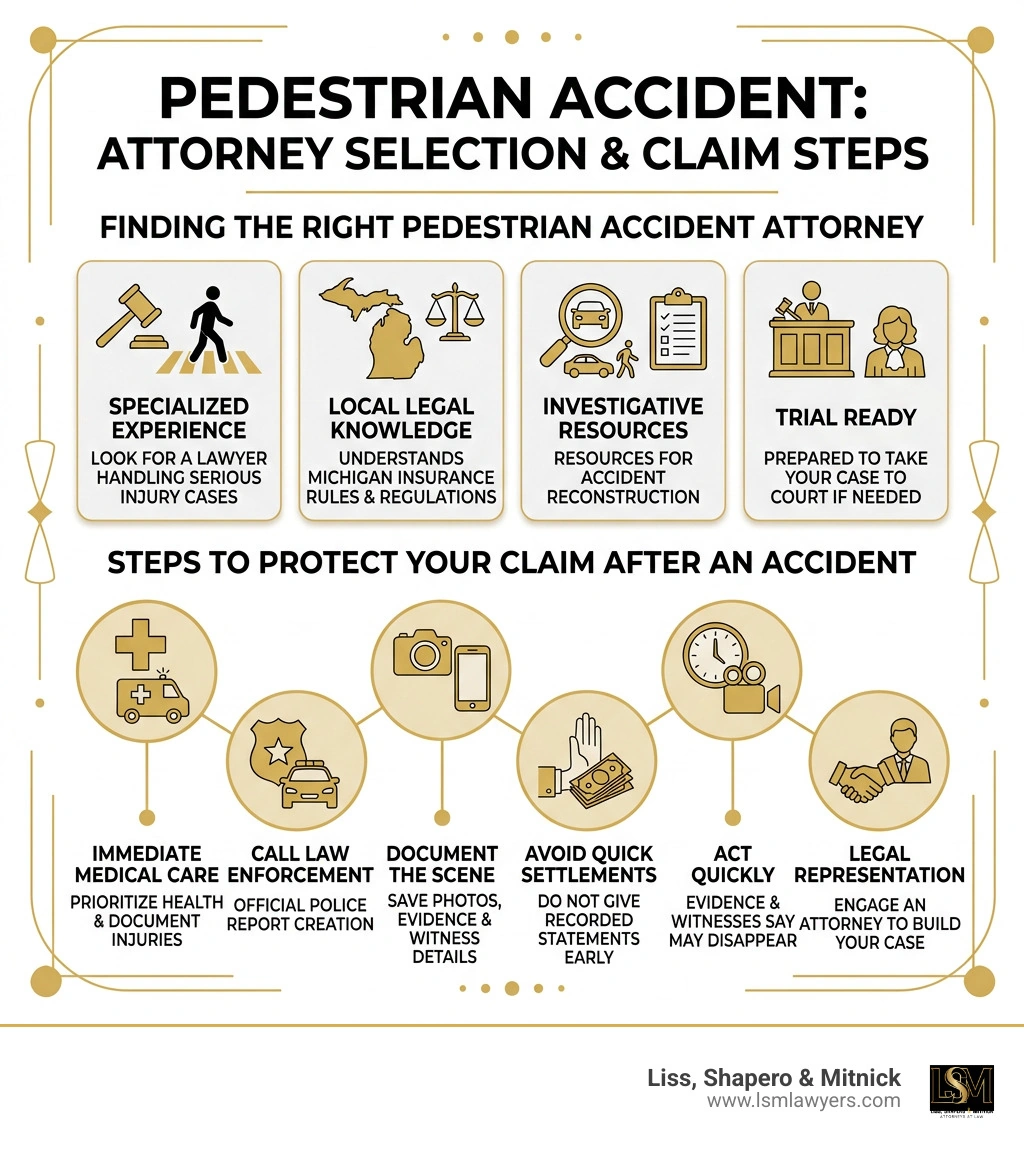
After a pedestrian crash, the right lawyer can help protect evidence, identify every available insurance policy, and push back when an insurer offers less than your claim may be worth. When comparing pedestrian accident attorneys, look for a lawyer who handles serious injury cases, understands Michigan insurance rules, has resources for crash investigations, and is prepared to take a case to court if needed.
Start by seeking medical care, calling police, saving photos and witness details, and avoiding a recorded statement or quick settlement before you know the full extent of your injuries. Fast action matters: video footage can disappear, witnesses can become hard to locate, and legal deadlines may apply.
Pedestrians have little protection in a collision. Injuries may include fractures, brain injuries, spinal trauma, internal injuries, and long-term pain that affects work and daily life. According to research published by the National Highway Traffic Safety Administration, thousands of pedestrians are injured annually across the country. A skilled attorney can investigate whether speeding, distraction, failure to yield, poor roadway design, or another factor caused the crash - even if an insurer claims you were partly at fault.
Critical Steps to Take After a Pedestrian Collision to Protect Your Claim

The moments immediately following a collision can be chaotic, disorienting, and painful. The human body is simply not built to absorb the kinetic energy of a multi-thousand-pound vehicle moving at high speed. Taking the right practical steps right away protects both your physical recovery and your legal rights.
If you are physically able, check yourself for injuries and move to a safe location out of active traffic. Call 911 immediately to dispatch emergency medical responders and law enforcement. A formal police report is a foundational piece of evidence in any personal injury claim, as it records officer observations, driver statements, initial fault determinations, and physical road conditions.
Avoid apologizing or making statements that could be misconstrued as an admission of fault. When interacting with the driver, collect their full name, contact details, driver's license number, license plate number, and auto insurance policy information. Crucially, do not provide a recorded statement to any insurance adjuster—including your own—before speaking with legal counsel. Early statements given under stress or while medicated can be twisted to diminish the financial value of your claim.
Immediate Scene Documentation and Evidence Preservation
Physical evidence begins deteriorating within minutes of a crash. Rain washes away debris, tires erase skid marks, and traffic resumes its regular flow. Using a smartphone to capture thorough photo and video evidence can make or break a liability dispute.
Take wide and close-up photos of the accident scene, vehicle damage, broken glass, skid marks, road conditions, traffic control signals, and sight obstructions. Document the clothes and shoes you were wearing, and preserve them in an unwashed state. If nearby businesses or residential doorbells have security cameras facing the road, note their locations immediately.
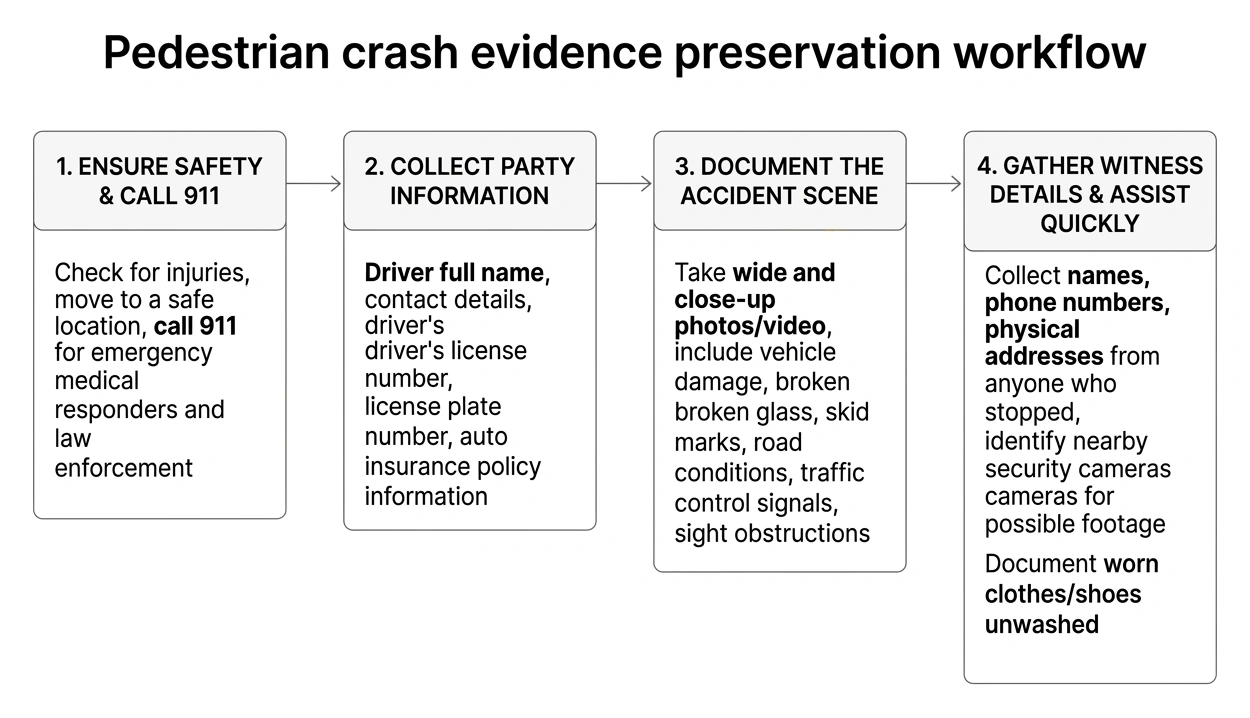
Eyewitness accounts provide vital, unbiased support against aggressive driver defenses. Collect names, phone numbers, and physical addresses from anyone who stopped to assist. In crosswalk or intersection disputes, proving that a motorist neglected basic safety duties is essential. Knowing how to document driver failure to yield empowers your legal team to reconstruct the exact sequence of events that led to the impact.
Managing Medical Care and Ongoing Treatment Records
Prompt medical evaluation is non-negotiable. Many catastrophic pedestrian injuries, such as internal organ hemorrhaging, subtle concussions, and hairline vertebral fractures, mask themselves behind adrenaline surges. Go directly to an emergency room or urgent care facility to receive a comprehensive diagnostic evaluation, including CT scans, MRIs, and X-rays.
Follow every treatment directive provided by your doctors, including attending physical therapy, taking prescribed medications, and consulting with specialists. Gaps in medical treatment give insurance adjusters an excuse to argue that your injuries are exaggerated or unrelated to the collision. Keep an organized folder of diagnostic reports, discharge instructions, medical bills, prescription receipts, and out-of-pocket transportation costs. Maintaining a daily recovery journal detailing your pain levels, sleep disturbances, cognitive difficulties, and missed life activities helps demonstrate the real human cost of the collision.
Why Hiring Experienced Pedestrian Accident Attorneys Makes a Critical Difference

Insurance carriers are profit-driven corporations designed to pay as little as possible on every claim. When unrepresented pedestrians attempt to settle directly with adjusters, they face a severe disadvantage. In fact, industry data shows that individuals who handle insurance claims without legal representation typically walk away with settlements three times smaller than those represented by seasoned litigators.
Experienced pedestrian accident attorneys level the playing field by taking over all communications, preserving vital electronic evidence, and conducting exhaustive asset searches. We understand how insurers attempt to shift blame onto vulnerable pedestrians. Because our firm leverages a unique former insurance-defense background, we know precisely how adjusters evaluate claim files, identify systemic vulnerabilities in their arguments, and anticipate their defense tactics.
How Pedestrian Accident Attorneys Counter Lowball Settlement Offers
Adjusters frequently deploy predatory settlement tactics early in the process. They may offer a quick, nominal payout before the injured pedestrian has even finished diagnostic testing, demanding a signed liability release in exchange. Signing this release permanently extinguishes your right to seek additional funds if your condition worsens or requires surgery down the road.
We counter these maneuvers by establishing accurate claims valuations backed by objective data. We work alongside medical providers, vocational rehabilitation specialists, and forensic economic consultants to calculate the full scope of your damages, including:
- Past, current, and future hospital and surgical bills
- Prescription medications, mobility devices, and home modifications
- Lost wages, missed bonuses, and diminished future earning capacity
- Non-economic damages for physical pain, emotional distress, and loss of life enjoyment
By applying structured financial models and preparing every case with courtroom readiness, we place maximum pressure on insurers to negotiate fairly or risk a public trial.
Evaluating Trial Experience and Resources in Pedestrian Accident Attorneys
Not all law firms are built the same. Some operate as high-volume settlement mills, resolving cases quickly for small sums rather than putting in the work required to maximize value. When interviewing prospective legal representation, prioritize attorneys with a proven courtroom track record, substantial trial experience, and the financial resources necessary to front costly expert fees.
Complex pedestrian claims demand significant financial investment. Investigating an accident scene properly requires retaining certified accident reconstructionists, human factors experts, biomechanical engineers, and medical authorities. Firms that represent clients on a contingency fee basis front all litigation costs, meaning you pay zero upfront fees and owe nothing unless financial recovery is secured. Securing dedicated Wayne County pedestrian representation ensures your legal team has intimate familiarity with local courts, judges, and municipal traffic patterns.
Determining Fault, Comparative Negligence, and Traffic Law Liability
Determining legal responsibility requires demonstrating that the driver breached their fundamental duty of care to operate their vehicle safely. Driver negligence manifests in many ways:
- Distracted Driving: Texting, adjusting navigation devices, or eating behind the wheel.
- Excessive Speed: Driving too fast for weather or road conditions, drastically increasing stopping distances.
- Impaired Operation: Driving under the influence of alcohol, illicit drugs, or prescription medications.
- Failure to Yield: Rolling through stop signs or turning right on red without checking for pedestrians in the crosswalk.
- Reckless Driving: Passing stopped school buses or vehicles that have yielded for crossing pedestrians.
Liability can also extend beyond individual motorists. If an intersection suffers from defective sight lines, missing signage, or broken pedestrian signal heads, government municipalities and contractors responsible for roadway maintenance may share legal liability.
| Legal System | Fault Threshold for Recovery | Impact on Financial Recovery |
|---|---|---|
| Pure Comparative Fault | Plaintiff can recover even at 99% fault | Compensation reduced by exact percentage of plaintiff's fault |
| Modified Comparative Fault (50% Rule) | Plaintiff barred from recovery if 50% or more at fault | Compensation reduced by plaintiff's fault percentage up to 49% |
| Modified Comparative Fault (51% Rule) | Plaintiff barred from recovery if 51% or more at fault | Compensation reduced by plaintiff's fault percentage up to 50% |
Crosswalk Rights, Jaywalking, and Partial Fault Disputes
A widespread myth pushed by insurers is that crossing outside a marked crosswalk automatically forfeits a pedestrian's right to compensation. While pedestrians have a duty to obey traffic signals and exercise reasonable care for their safety, drivers maintain a continuous legal duty to maintain a proper lookout and avoid hitting people on foot.
State traffic regulations give pedestrians clear right-of-way protections within both marked and unmarked crosswalks. Understanding common driver and insurer crosswalk misconceptions is crucial when an adjuster tries to place undue blame on you for a mid-block crossing. Under comparative negligence systems, an injured pedestrian who was crossing outside a painted line can still pursue significant financial recovery if the driver was speeding, distracted, or failed to brake in time.
Hit-and-Run Crashes and High-Risk Traffic Zones
When a negligent driver strikes a pedestrian and flees the scene, the physical and emotional trauma is compounded by uncertainty. In hit-and-run scenarios, legal teams immediately launch private investigations to identify the perpetrator. This process includes canvassing surrounding businesses for surveillance footage, interviewing eyewitnesses, examining vehicle debris left at the impact point, and coordinating with law enforcement.
Pedestrians are especially vulnerable in high-density corridors, unlit suburban roads, and areas near schools. Pursuing justice after school zone collisions requires evaluating specialized traffic safety rules, crossing guard protocols, and commercial vehicle responsibilities. If you were injured in a hit-and-run, retaining an attorney experienced in Oakland County hit-by-car incidents helps you identify every insurance avenue available, even when the fleeing driver is never found.
Maximizing Financial Compensation Across Insurance Coverages and Damages
Securing full compensation requires looking beyond the basic liability insurance policy of the at-fault driver. In catastrophic injury cases, minimal policy limits are quickly exhausted by initial trauma care and emergency surgeries. Maximizing recovery requires identifying every layer of insurance coverage available across all involved parties.
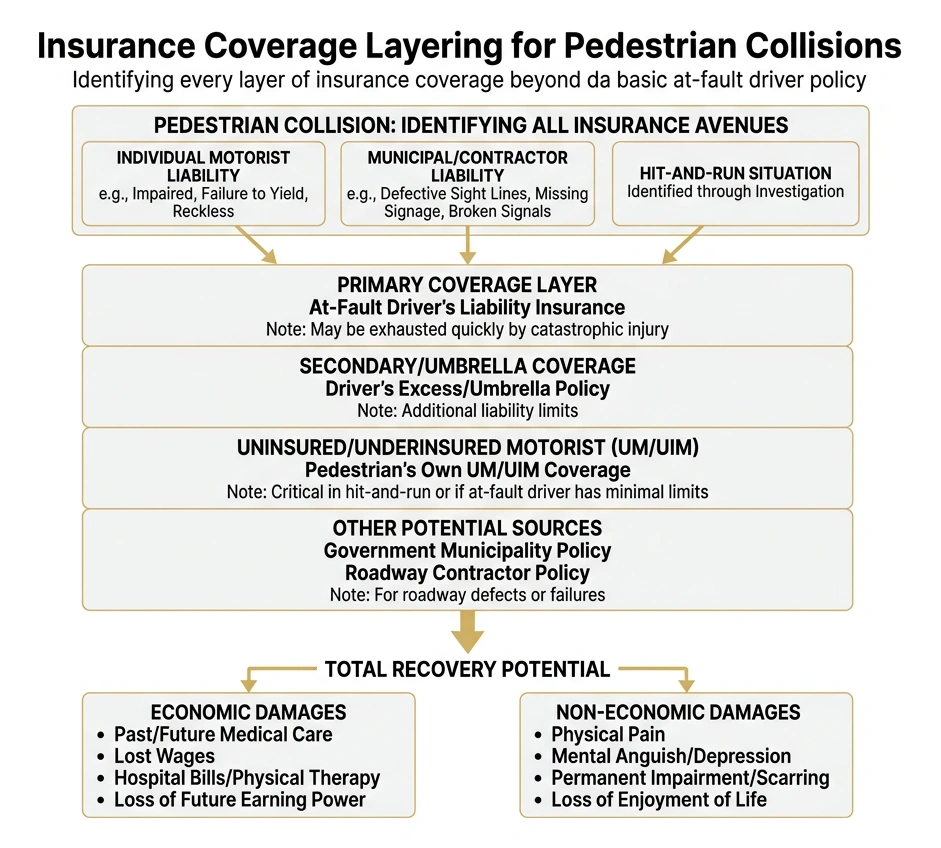
Financial recovery in a pedestrian collision generally falls into two primary categories:
- Economic Damages: Concrete, quantifiable financial losses including past and future medical care, hospital bills, physical therapy, diagnostic testing, lost wages, vocational rehabilitation, loss of future earning power, and specialized in-home nursing support.
- Non-Economic Damages: Subjective, life-altering harms including physical pain, permanent physical impairment, scarring and disfigurement, mental anguish, depression, loss of enjoyment of life, and loss of consortium.
In tragic instances where a collision results in the loss of a loved one, eligible family members may pursue a wrongful death claim to recover funeral expenses, burial costs, lost financial support, and compensation for the loss of companionship.
Navigating Multiple Insurance Policies and UM/UIM Claims
When an at-fault driver carries inadequate insurance—or no insurance at all—your pedestrian accident claim can tap into additional auto insurance policies. Many pedestrians are surprised to learn that their own personal auto insurance policies, or policies held by resident relatives within their household, can provide crucial benefits while they are on foot.
- Personal Injury Protection (PIP) / Med-Pay: Provides direct reimbursement for medical expenses, lost wages, and replacement services regardless of fault.
- Uninsured Motorist (UM) Coverage: Steps in to act as the at-fault driver's insurance policy if you are struck by an uninsured driver or an unidentified hit-and-run motorist.
- Underinsured Motorist (UIM) Coverage: Activates when the at-fault driver's bodily injury liability limits are insufficient to cover the full value of your catastrophic injuries.
Coordinating these overlapping policies requires careful handling to avoid accidental waivers of coverage or disputes over policy priority.
Catastrophic Injury Valuation and Long-Term Rehabilitation
The biomechanics of a vehicle-versus-pedestrian impact often involve a violent two-stage collision: first with the vehicle's bumper, hood, or windshield, and second when the pedestrian strikes the pavement or roadside obstacles. These impacts frequently lead to life-altering trauma:
- Traumatic Brain Injuries (TBI): Ranging from concussive syndromes to severe diffuse axonal injuries that permanently impair cognitive and motor function.
- Spinal Cord Trauma: Leading to partial or complete paraplegia, quadriplegia, chronic neuropathy, and disc herniations requiring surgical fusion.
- Complex Orthopedic Fractures: Including crushed pelvises, femur fractures, and "bumper fractures" to the lower legs requiring open reduction and internal fixation (ORIF).
- Internal Organ Damage: Traumatic ruptures to the spleen, liver, kidneys, and lungs caused by blunt-force impacts.
Managing these complex conditions requires lifetime medical care planning. Securing dedicated advocacy for crosswalk injury claims ensures that long-term care needs, future surgeries, and specialized home modifications are fully calculated. Partnering with a skilled Berkley pedestrian accident advocacy firm guarantees that your legal team has the medical network and trial experience necessary to convey the true severity of your injuries to a jury.
Frequently Asked Questions About Pedestrian Accidents
What should I do if the driver who hit me fled the scene?
If you are the victim of a hit-and-run crash, call 911 immediately and remain at the scene if it is safe to do so. Provide law enforcement with every detail you remember about the vehicle, including its make, model, color, license plate letters or numbers, and the direction it fled. Seek emergency medical attention right away.
Notify your insurance carrier that a hit-and-run collision occurred. Even if the police are unable to locate the fleeing driver, you can still recover compensation for your medical bills, wage loss, and pain and suffering by filing an Uninsured Motorist (UM) claim through your own auto policy or a resident relative's policy. Consult a pedestrian injury attorney promptly so they can subpoena private security camera footage before it is recorded over.
Can I still recover compensation if I was hit while crossing outside a crosswalk?
Yes. Crossing a roadway outside a designated or painted crosswalk does not automatically bar you from recovering compensation. While motorists often claim they had no time to react, all drivers have a continuous legal duty to pay attention to the road ahead, operate at speeds appropriate for the conditions, and avoid collisions with pedestrians.
Under comparative fault principles, your financial recovery is simply reduced by your percentage of fault, provided your fault does not exceed legal limits. For example, if a distracted driver was speeding and struck you while you were crossing mid-block, a jury may find the driver 80% responsible and you 20% responsible, allowing you to recover 80% of your total damages.
How long do I have to file a pedestrian accident lawsuit?
The timeframe within which you must file a lawsuit is governed by the statute of limitations. For standard personal injury claims involving a negligent private driver, state law generally gives you a set number of years from the exact date of the accident to initiate formal legal action. If the collision resulted in a fatality, a wrongful death claim must also be filed within statutory deadlines.
Crucially, much shorter notice requirements apply if the collision involved a government agency, public transit vehicle, municipal work truck, or hazardous road condition. In these public entity claims, you may have only a few months to serve a formal Notice of Claim. Missing these strict deadlines permanently bars you from seeking financial recovery, making it essential to consult a lawyer as soon as possible after a crash.
Conclusion
A pedestrian collision can upend your physical health, your family's financial security, and your overall quality of life in a single instant. You do not have to confront aggressive insurance adjusters, confusing liability laws, and mounting medical debt on your own.
At Liss, Shapero & Mitnick, our unique advantage comes from leveraging former insurance-defense experience to maximize compensation for injured pedestrians across Metro Detroit and throughout Michigan. We know the playbooks insurance carriers use to minimize claims, and we prepare every case from day one with the investigative rigor and trial resources required to secure full justice.
If you or a loved one has been struck by a vehicle, protect your legal rights immediately. Contact our dedicated pedestrian accident legal team today for a free, confidential case evaluation, and let us help you pursue the maximum compensation you deserve.