.svg)
Introduction
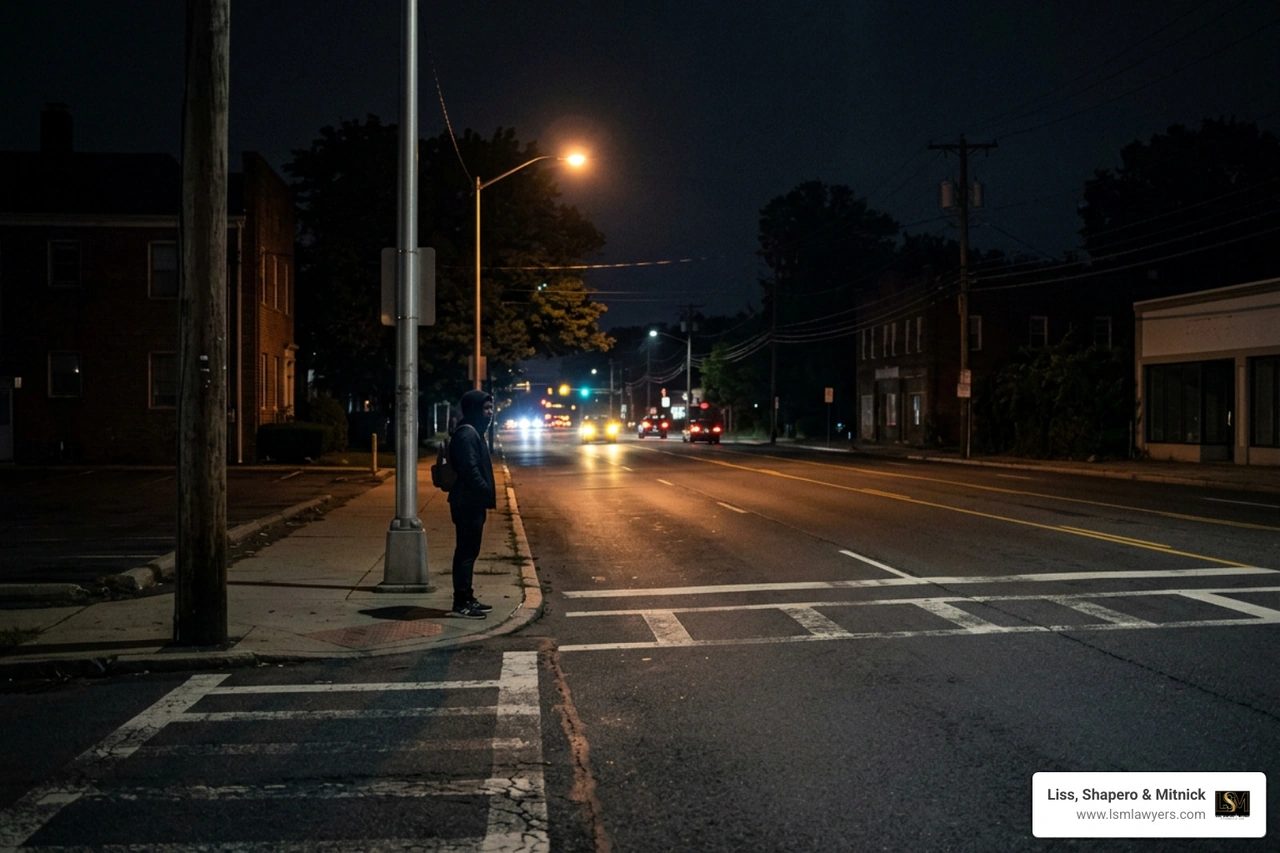
Each year, upwards of 270,000 pedestrians are killed worldwide on public roadways, representing over 20% of all global traffic fatalities. While walking remains the most fundamental, environmentally sustainable, and universal mode of human transportation, stepping onto a roadway exposes individuals to profound physical risk. Every day, thousands of people navigate complex urban corridors, rural thoroughfares, and suburban intersections where motor vehicles travel at lethal velocities. When collisions occur, the immense physical disparity between multi-ton vehicles and unprotected human bodies consistently yields catastrophic trauma.
The epidemiological burden of pedestrian mortality represents an ongoing international public health crisis. While modern automotive engineering has significantly improved occupant safety through side-curtain airbags, crumple zones, and reinforced passenger compartments, vulnerable road users outside the vehicle have not enjoyed equivalent structural safeguards. Understanding the statistical magnitude, geographic distribution, and structural causes of these fatalities is crucial for engineering safer roadways and holding negligent drivers legally accountable.
Global Road Safety: How Many Pedestrians Are Killed Each Year Worldwide?
To comprehensively evaluate international road trauma, researchers must synthesize datasets from diverse public health bodies, law enforcement agencies, and global transport authorities. When examining how many pedestrians are killed each year worldwide, baseline metrics from the World Health Organization (WHO) document that upwards of 270,000 pedestrians lose their lives annually, representing approximately 22% of all fatal road collisions. Extended epidemiological studies, such as the Global Burden of Diseases, Injuries, and Risk Factors Study (Khan et al., 2020), suggest that when accounting for under-reported trauma and broader injury complications, pedestrian mortality figures can reach even higher levels across various reporting frameworks.
Globally, road traffic collisions claim between 1.25 and 1.35 million human lives annually. Understanding these global road injury patterns highlights a stark reality: pedestrian deaths are not random anomalies, but predictable outcomes of systemic urban and vehicular design. While overall mortality rates per 100,000 individuals have exhibited slight per-capita reductions in certain modernized regions, the absolute volume of vulnerable road user casualties remains intolerably high.
| WHO Global Region | Pedestrian Proportion of Total Traffic Deaths (%) | Primary Infrastructure Challenges |
|---|---|---|
| African Region | 38% | Unpaved shoulders, lack of sidewalks, minimal crossing lighting |
| European Region | 21%–26% | High urban pedestrian density, older population vulnerability |
| Region of the Americas | 18%–23% | High vehicle speeds, wide multi-lane arterial roadways |
| Western Pacific Region | 19% | Mixed-use traffic conflicts, rapid motorization rates |
| Eastern Mediterranean Region | 27% | Speed regulation compliance, sparse pedestrian overpasses |
| South-East Asia Region | 12%* | High two-wheeler dominance altering proportional user shares |
*Note: While South-East Asia records a lower percentage proportion of pedestrian deaths relative to its total traffic casualties due to massive motorcycle usage, the absolute number of pedestrian casualties remains severe.
Understanding How Many Pedestrians Are Killed Each Year Worldwide by Region
Disaggregating global pedestrian fatalities reveals profound territorial disparities governed by local economic development, roadway topography, and modal share. The WHO African Region demonstrates the highest proportional toll, where pedestrians account for 38% of all road traffic casualties. In countries such as Liberia, pedestrian fatalities reach an astonishing 66% of total roadway deaths. Similarly, in El Salvador, pedestrian deaths constitute approximately 62% of all traffic fatalities.
Conversely, data aggregated via the UN road traffic database demonstrates that heavily urbanized European nations experience different proportional dynamics. While nations like Iceland record negligible single-digit annual pedestrian losses due to advanced infrastructure and low vehicle exposure, larger nations face ongoing safety challenges. Russia, for instance, historically documented significant annual pedestrian casualties, though structural improvements over the past two decades have steadily reduced these figures.
Developed vs. Developing Nations: Fatality Disparities
The divergence in pedestrian survival between high-income countries (HICs) and low-to-middle-income countries (LMICs) is rooted in socioeconomic infrastructure deficits. Lower-middle-income countries experience disproportionate road traffic mortality despite possessing a fraction of the world’s registered motor vehicles. Rapid motorization in developing economies frequently outpaces the installation of basic physical infrastructure, such as elevated footbridges, dedicated walking paths, and signalized crossings.
In contrast, while developed nations possess greater resources for roadway engineering, their vulnerable road users face distinct hazards. In the United States, pedestrian deaths rose 72% between a low point in 2009 and 2024, reaching 7,080 annual deaths. This surge has been exacerbated by the proliferation of larger consumer vehicles (such as sport utility vehicles and light trucks) and sprawling suburban roadway layouts. Serious motor vehicle accidents involving pedestrians in urban and suburban centers consistently demonstrate that economic development alone does not eliminate risk if roadway geometry prioritizes vehicle throughput over human safety.
Primary Risk Factors and Circumstances Behind Fatal Pedestrian Crashes
Pedestrian collisions rarely stem from a single isolated point of failure. Instead, they represent a convergence of environmental hazards, vehicle performance characteristics, and human behavioral dynamics. According to public health analyses, including published CDC pedestrian safety data, the vast majority of fatal pedestrian strikes occur outside intersections on high-speed urban arterials during hours of darkness.
Impact of Darkness and Urban Roadway Design
Lighting conditions represent one of the single most decisive determinants of pedestrian crash severity. Approximately 73% to 76% of all fatal pedestrian incidents occur during nighttime or low-light conditions (between 6:00 p.m. and 6:00 a.m.). Darkness severely compresses a driver's forward visibility cone and reaction window, particularly on unlit or poorly illuminated corridors where pedestrians cross outside marked crosswalks.
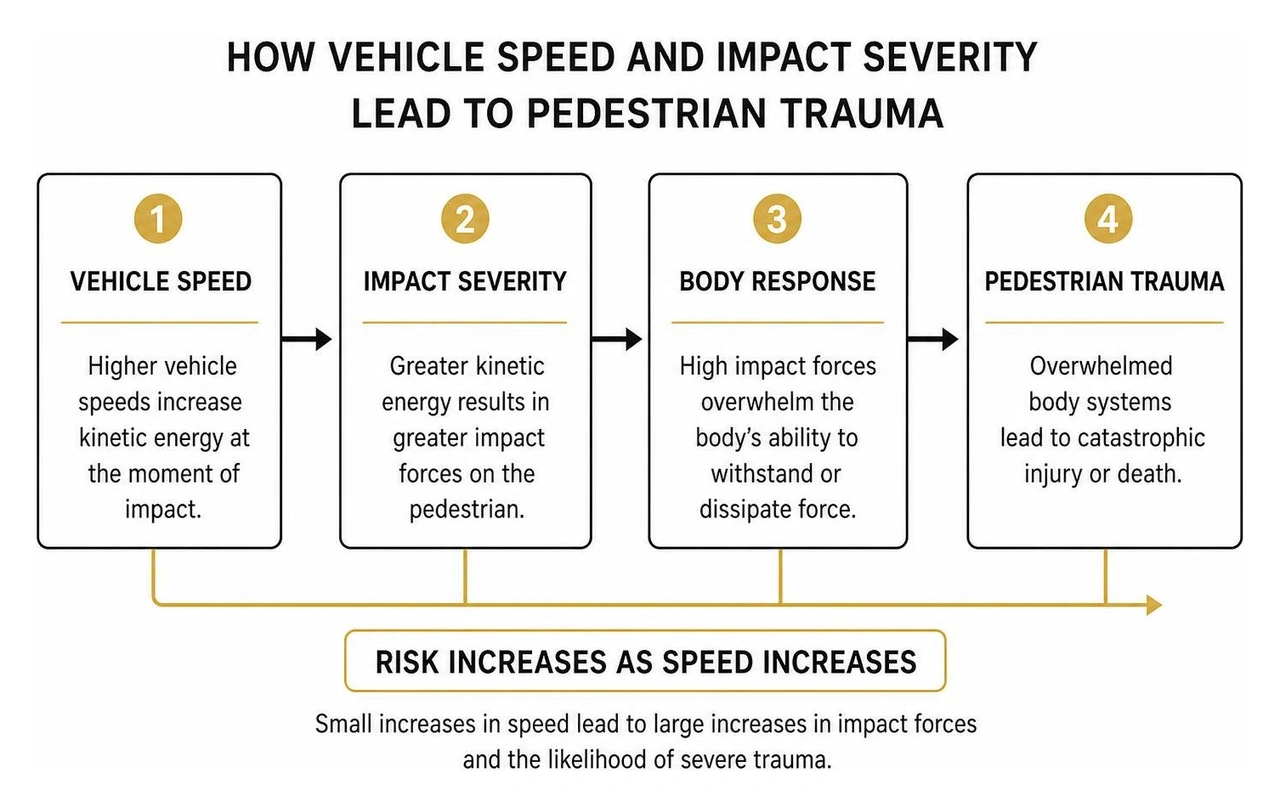
The physical layout of the roadway exacerbates these visibility limitations. Urban arterials designed with five or more lanes and speed limits of 35 to 45 mph represent lethal environments for individuals on foot. When vehicles travel at these speeds, the biological physics of blunt-force impact become overwhelmingly fatal:
- At an impact velocity of 20 mph (32 km/h), a pedestrian has an estimated 90% probability of survival.
- At an impact velocity of 30 mph (48 km/h), the risk of death rises sharply to approximately 40% to 50%.
- At impact velocities exceeding 40 mph (64 km/h), pedestrian mortality exceeds 80%, as the human body absorbs kinetic forces far beyond physiological tolerance thresholds.
Compounding this hazard is the frequency of hit-and-run occurrences. Hit-and-run collisions account for roughly 23% to 25% of all fatal pedestrian crashes, with drivers fleeing the scene under cover of darkness, depriving severely injured victims of immediate, life-saving emergency medical trauma care.
Role of Alcohol Impairment and Driver Distraction
Substance intoxication significantly amplifies fatal crash incidence across all jurisdictions. Alcohol impairment is documented as a contributing factor in roughly 40% of all fatal pedestrian collisions. This risk is bidirectional:
- Driver Impairment: Intoxicated motorists exhibit degraded visual tracking, delayed reaction times, and impaired spatial judgment, rendering them incapable of braking before striking a pedestrian.
- Pedestrian Impairment: Intoxicated pedestrians frequently demonstrate impaired hazard perception, degraded motor coordination, and a propensity to attempt dangerous mid-block crossings against traffic signals.
Simultaneously, cognitive and visual distraction driven by mobile device usage has transformed modern driving and walking behavior. Motorists looking at smartphone screens while operating vehicles at arterial speeds traverse entire football fields completely blind to vulnerable road users crossing their path.
Demographic Vulnerabilities: Gender and Age Disparities
The statistical risk of suffering fatal pedestrian trauma is not distributed uniformly across demographic cohorts. Age, physical resilience, exposure patterns, and behavioral tendencies create stark disparities in casualty tables documented by IIHS pedestrian fatality statistics.
Gender Disproportion: Explaining the Higher Male Fatality Rate
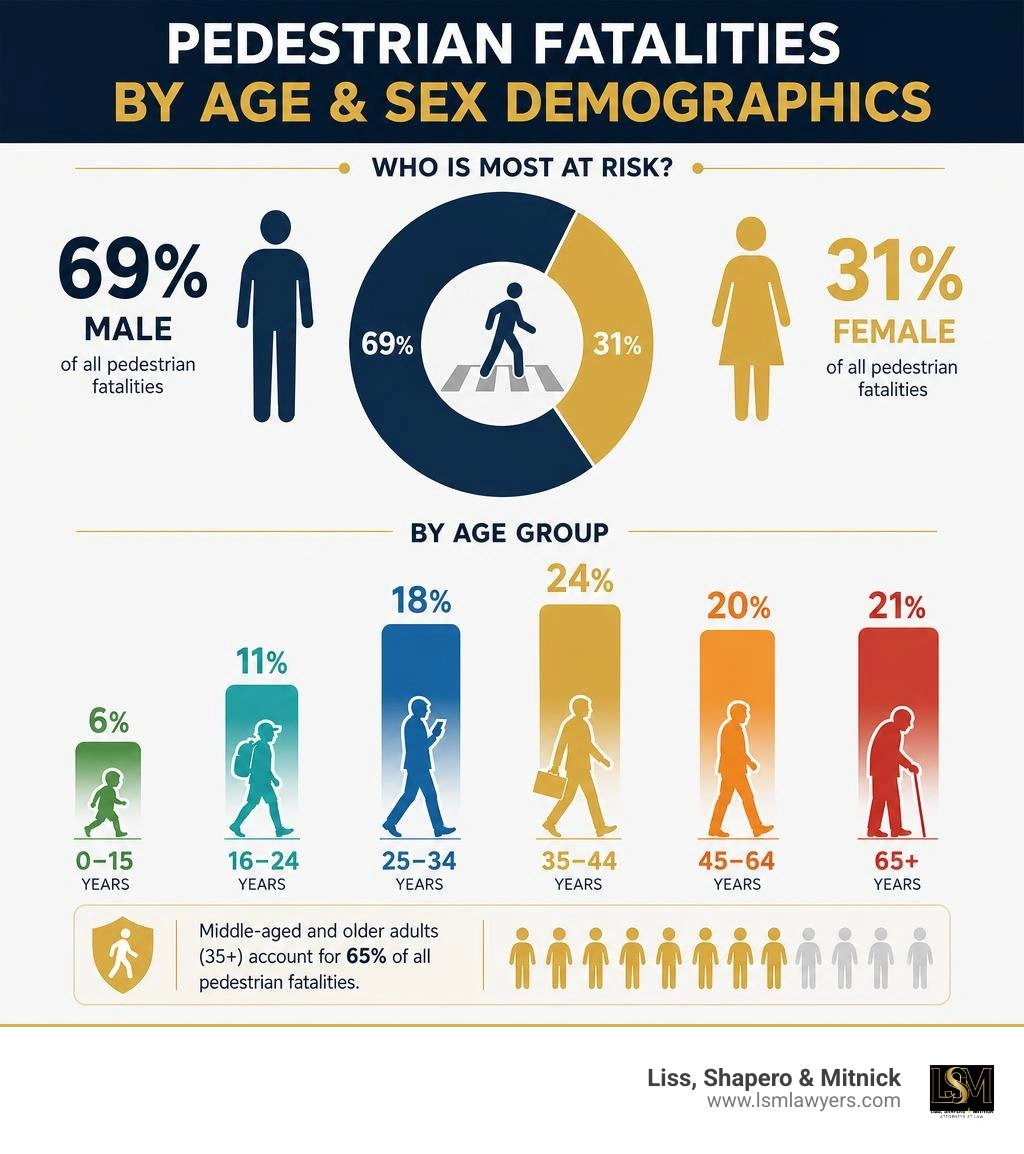
Epidemiological data consistently demonstrates that male pedestrians die at substantially higher rates than females. In the United States and globally, males account for approximately 69% to 70% of all pedestrian fatalities—a proportion that has remained virtually constant for decades.
Decompositional epidemiological research (Zhu et al., 2013) reveals that the male pedestrian death rate per person-year is roughly 2.3 times greater than that of females. Crucially, this disparity is not primarily driven by differences in walking exposure (kilometers traveled on foot, which accounts for only ~1% of the differential). Instead, approximately 79% of the gender gap is attributable to a dramatically higher collision case-fatality rate among males. When struck by motor vehicles, male pedestrians are significantly more likely to sustain fatal injuries due to higher collision speeds, nighttime travel patterns, elevated rates of alcohol consumption, and risk-prone crossing behaviors on higher-speed roadways. In cases where reckless driving terminates a life, surviving families frequently pursue wrongful death claims to obtain civil accountability for their catastrophic losses.
Age-Specific Risks: Older Adults and Young Children
Age represents another decisive vulnerability vector:
- Older Adults (65+ Years): While older adults may account for fewer total walking trips, they represent roughly 18% to 20% of all pedestrian deaths. Diminished visual acuity, slower walking speeds, and reduced physiological resilience mean that blunt trauma which younger individuals might survive often proves lethal to seniors.
- Young Children (Under 15 Years): Children possess developmental limitations in judging vehicle approach speeds and peripheral hazards. While structured school safety initiatives have reduced child pedestrian mortality along commuting paths, children remain uniquely susceptible to low-speed back-over incidents in residential driveways and parking structures where driver sightlines are obstructed by high vehicle front ends.
Proven Infrastructure and Policy Interventions to Protect Pedestrians
Pedestrian deaths are entirely preventable through the rigorous application of the Safe System Approach and Vision Zero principles. International evidence indicates that engineering physical separation between motorized traffic and pedestrians yields immediate, lasting safety dividends, mitigating severe personal injuries across transportation corridors.
Roadway Engineering and Traffic Calming Measures
Comprehensive guidance compiled in NHTSA pedestrian countermeasures highlights specific physical infrastructure upgrades with measurable risk-reduction outcomes:
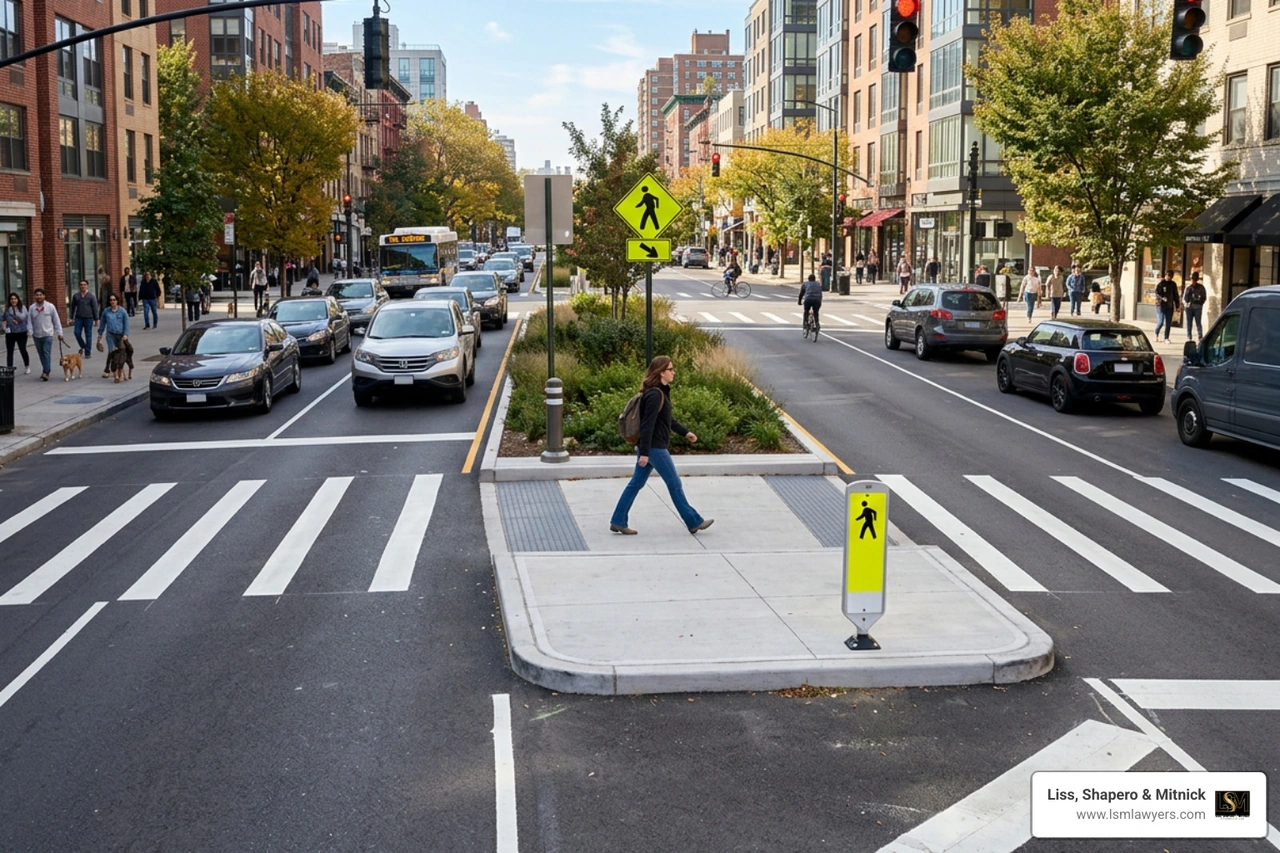
- Pedestrian Refuge Islands: Installing raised physical median islands in the center of wide multi-lane roadways cuts pedestrian crossing crashes by approximately 35% to 40% by allowing pedestrians to navigate one direction of traffic at a time.
- Leading Pedestrian Intervals (LPIs): Reprogramming traffic signals to grant pedestrians a 3-to-7-second advance walk signal before vehicular traffic receives a green light establishes pedestrian primacy in crosswalks and reduces turning-vehicle collisions by up to 44%.
- High-Visibility Crosswalks & HAWK Beacons: Upgraded thermoplastic continental markings combined with High-Intensity Activated CrossWalk (HAWK) beacon signals force driver yielding compliance on multi-lane urban roads.
- Urban Speed Management: Lowering urban statutory speed limits to 30 km/h (20 mph) in high-density pedestrian corridors drastically attenuates crash frequency and ensures that inevitable impacts occur at survivable velocities.
Vehicle Design Standards and Emerging Safety Technology
Automotive safety design must expand beyond occupant preservation to encompass external pedestrian protection. Regulatory bodies in Europe and safety advocacy organizations worldwide have driven key vehicular advancements:
- Pedestrian Automatic Emergency Braking (PAEB): Advanced forward-facing optical cameras and radar arrays that automatically actuate braking systems upon detecting pedestrians have been shown to reduce pedestrian collision rates by roughly 27%.
- Pedestrian-Friendly Front-End Geometry: Redesigning vehicle hoods, cowls, and bumpers with energy-absorbing deformation zones mitigates direct cranial and pelvic trauma during secondary vehicle-to-human impacts.
Frequently Asked Questions About Pedestrian Fatalities
Exactly How Many Pedestrians Are Killed Each Year Worldwide?
Based on official World Health Organization datasets, more than 270,000 pedestrians are killed each year worldwide on public roads. When incorporating broader trauma registries, emergency room mortality figures, and predictive modeling from global public health institutions, comprehensive epidemiological estimates indicate the global toll of fatal pedestrian road traffic injuries ranges between 300,000 and 400,000 individuals annually.
What Percentage of Global Traffic Fatalities Involve Pedestrians?
Pedestrians account for roughly 22% to 25% of all global traffic fatalities. However, this proportion exhibits substantial regional variance, ranging from 12% in South-East Asia (where motorized two-wheelers dominate the mortality share) to 38% across the African continent, and exceeding 60% in specific nations such as Liberia and El Salvador.
Why Have Pedestrian Fatalities Risen in Recent Decades?
In several developed nations—most notably the United States—pedestrian fatalities increased sharply over the last fifteen years due to a combination of factors:
- The rising market share of larger, heavier consumer vehicles (SUVs and trucks) with high, blunt front grilles that strike pedestrians directly in the vital organs rather than the lower extremities.
- Pervasive mobile device distraction among both drivers and pedestrians.
- Inadequate arterial street design that prioritizes rapid motor vehicle throughput over safe mid-block pedestrian crossings.
Conclusion
The reality that over 270,000 pedestrians lose their lives annually on global roadways underscores a profound public safety failure. Pedestrians are not disposable collateral in modern transportation networks; they are vulnerable road users entitled to safe, functional, and forgiving urban infrastructure. Eliminating these preventable tragedies requires an unyielding commitment to proven engineering countermeasures, stringent speed enforcement, enhanced vehicle safety standards, and rigorous legal accountability for reckless drivers.
At Liss, Shapero & Mitnick, we witness the catastrophic physical, emotional, and financial trauma inflicted upon pedestrians and their families by negligent motorists. Our legal team is dedicated to advocating for victims of serious collisions, leveraging our deep understanding of former insurance-defense tactics to secure full, just compensation. If you or a loved one has suffered catastrophic harm in a collision, our dedicated legal team is prepared to protect your rights—explore your options following a serious pedestrian accident to pursue the justice you deserve.
References
Zhu M, Zhao S, Coben JH, Smith GS. "Why more male pedestrians die in vehicle-pedestrian collisions than female pedestrians: a decompositional analysis.." Injury prevention : journal of the International Society for Child and Adolescent Injury Prevention, 2013. PMCID PMC3715558.Moien A. B. Khan, Michal Grivna, Javaid Nauman, Elpidoforos S. Soteriades, Arif Alper Cevik, Muhammad Jawad Hashim, Romona Govender, Salma Rashid Al Azeezi. "Global Incidence and Mortality Patterns and Forecast of Pedestrian Road Traffic Injuries by Socio-Demographic Index Findings from the Global Burden of Diseases, Injuries, and Risk Factors 2017 Study." 2020. DOI 10.20944/preprints202002.0218.v1.