
Michigan Slip and Fall Law: What You Need to Know

In Michigan, a slip and fall claim depends on why you were on the property, whether the owner failed to address a dangerous condition, and whether that failure caused your injury. An obvious hazard, such as visible ice, no longer automatically ends a claim under the Michigan Supreme Court's 2023 ruling. You generally have three years from the injury date to sue, but some claims have shorter notice deadlines. Your share of fault can reduce your compensation.
I'm Anthony Shapero, Managing Partner at Liss, Shapero & Mitnick. I've handled Michigan injury cases from both sides, and my insurance-defense experience helps me explain slip and fall law in Michigan without losing sight of how insurers challenge these claims.
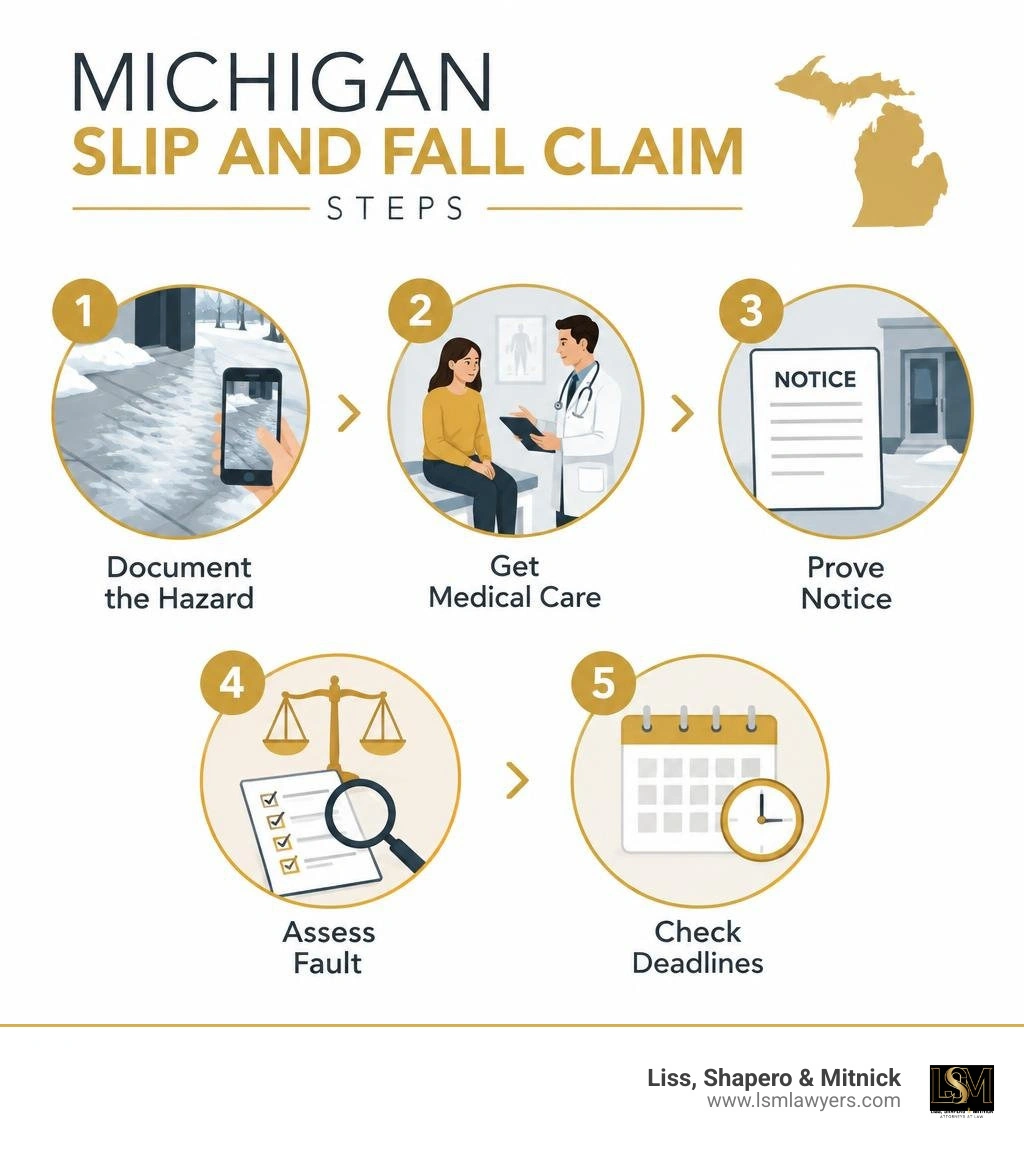
Slip and fall law in michigan terms explained:
How Modern Rulings Reshaped Slip and Fall Law in Michigan

For over twenty years, premises liability in Michigan was stacked heavily in favor of property owners and their insurance carriers. Defense adjusters had a silver bullet: the "open and obvious" doctrine. If an insurer could show that a hazard was visible upon casual inspection, judges were required to dismiss the lawsuit before it ever reached a jury.
That dynamic changed entirely in July 2023. Understanding the legal difference between a property owner's legal duty and whether they committed a breach of that duty is now the cornerstone of any injury claim. Michigan courts align with the Second Restatement of Torts § 343A, shifting how trials and settlements play out across the state. As demonstrated in appellate rulings like COA 364401 KANDICE HOLDER V ANCHOR BAY INVESTMENTS INC Opinion, courts now rigorously analyze whether commercial landlords fulfill their safety obligations rather than throwing out claims at the earliest opportunity.
The Overruling of Lugo: Kandil-Elsayed and Pinsky
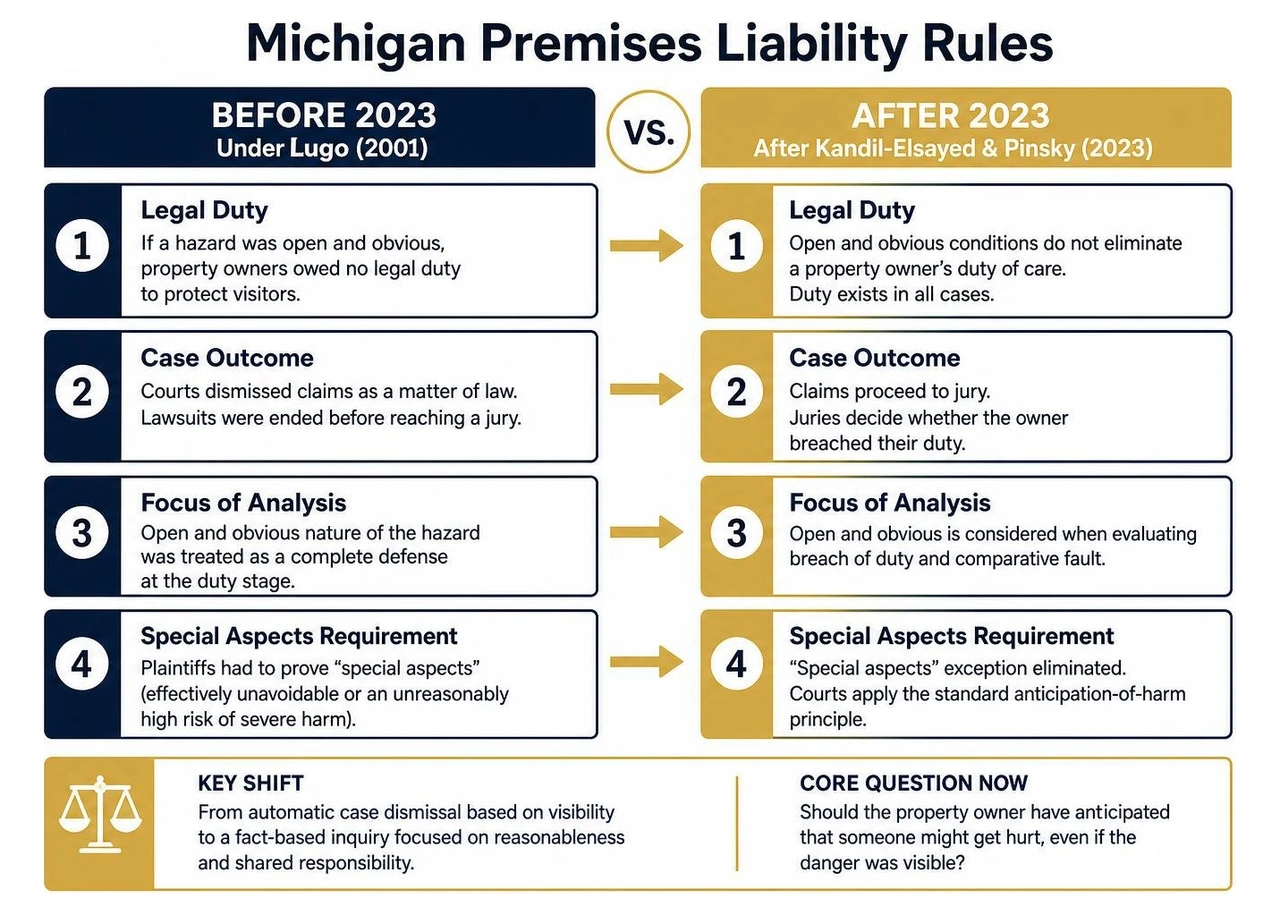
Under the old 2001 precedent established in Lugo v. Ameritech Corp., property owners argued that if a hazard was open and obvious, they owed no legal duty to protect visitors from it. Because establishing a legal duty is a threshold requirement for a judge to decide, insurance defense attorneys filed routine motions for summary disposition, killing thousands of legitimate claims.
In the landmark consolidated ruling Kandil-Elsayed v. F & E Oil, Inc. and Pinsky v. Kroger Co. (512 Mich. 95), the Michigan Supreme Court overruled Lugo. The Court made it clear: the open and obvious nature of a condition does not eliminate a landowner's duty of care.
Instead, open hazards are now evaluated as part of breach of duty and comparative fault. Today, juries decide whether a business failed to act reasonably and whether an injured person shares any responsibility for not avoiding the hazard. To see how these tactical defenses operate today, review our guide on how open and obvious affects modern premises liability claims and whether open and obvious still matters in Michigan fall cases.
Anticipating Harm and the Status of "Special Aspects"
Before the 2023 shift, plaintiffs injured by obvious hazards had to prove rare "special aspects"—such as a hazard being "effectively unavoidable" or posing an "unreasonably high risk of severe harm."
The Supreme Court eliminated this confusing exception. Michigan law now applies the standard anticipation-of-harm principle: Should the property owner have anticipated that someone might get hurt, even if the danger was visible?
Consider a Metro Detroit winter scenario where a store customer encounters black ice conditions in commercial parking lots. Even if the icy patch is visible, a retail business knows shoppers must walk across that lot to enter the building. Because the store should anticipate customers traversing the area, it cannot simply ignore accumulating ice and escape accountability.
Proving Liability: Visitor Classifications and Landowner Notice
Visitor Status Categories Under Slip and Fall Law in Michigan
Even with the elimination of the old Lugo framework, your legal status on the property remains pivotal. Michigan premises liability law divides visitors into three distinct legal classifications:
| Visitor Classification | Definition & Examples | Duty Owed by Property Owner |
|---|---|---|
| Invitee | Enters for a business or commercial purpose (e.g., supermarket shoppers, restaurant diners, gas station patrons). | Highest duty of care: Must inspect premises, repair known hazards, and take reasonable precautions to protect visitors from unreasonable risks. |
| Licensee | Enters with social permission or consent, but not for a commercial transaction (e.g., houseguests, social visitors, unpaid volunteers). | Moderate duty: Must warn the visitor of hidden dangers the owner knows or should know about; no affirmative duty to inspect for unknown defects. |
| Trespasser | Enters property without legal permission, invitation, or consent. | Lowest duty: Must refrain from willful and wanton misconduct; no general duty to inspect or maintain safe premises. |
The distinction between an invitee and a licensee often determines whether a claim survives early defense motions. For example, in COA 364820 LINDA MOLITORIS V SAINT MARY MAGDALEN CATHOLIC CHURCH Opinion, appellate judges analyzed whether an unpaid church volunteer slipping on ice was owed the elevated duty of an invitee or the limited warnings owed to a licensee.
Under the "attractive nuisance" doctrine, child trespassers receive special protection if a landowner maintains artificial, hazardous conditions on the land (like an unfenced swimming pool or open construction pit) that are likely to attract children who cannot appreciate the danger.
Actual vs. Constructive Notice of Dangerous Hazards
To hold a property owner liable for a slip and fall, you must prove they had notice of the hazard. Michigan law recognizes two types of notice:
- Actual Notice: The landowner or their staff directly caused the condition, saw it firsthand, or received complaints before your fall.
- Constructive Notice: The hazard existed for a sufficient length of time that a reasonable business owner, conducting routine inspections, should have discovered and fixed it.
Proving constructive notice requires solid circumstantial evidence. In commercial properties and residential complexes, landlords owe clear statutory duties under MCL 554.139 to keep common areas fit for their intended use. When severe weather hits Southeast Michigan, commercial entities must adhere to strict sidewalk snow and ice removal liabilities to avoid creating hazardous walkways.
Deadlines, Comparative Negligence, and Property Owner Defenses
How Modified Comparative Negligence Affects Slip and Fall Law in Michigan

When an insurance adjuster evaluates your claim, their main objective is to shift blame onto you. Michigan operates under a modified comparative negligence system codified in MCL 600.2959.
Under this statute, your compensation is directly adjusted based on your percentage of fault:
- Economic Damages (Medical Bills, Lost Wages): Reduced proportionally by your percentage of fault. If you suffer $100,000 in medical bills and lost earnings but are found 60% at fault, you can still collect 40% ($40,000).
- Noneconomic Damages (Pain and Suffering): Subject to a strict 51% fault bar. If a jury determines that your share of comparative negligence is 51% or higher, you are completely barred from recovering any compensation for pain, suffering, or emotional distress.
Insurance companies routinely argue that you were texting, wearing inappropriate shoes, or failing to look down. Understanding how partial fault impacts compensation recovery is vital when negotiating with defense adjusters.
The Statute of Limitations and Landowner Defense Tactics
Under MCL 600.5805, the standard three-year statute of limitations for personal injury applies to most slip and fall cases in Michigan. If you fail to file your formal complaint within three years of the incident date, you lose your right to seek financial recovery forever.
However, dangerous exceptions exist where deadlines are drastically shorter:
- Government and Municipal Property: If you fall on a defective public sidewalk maintained by a city, town, or government entity, Michigan's governmental immunity laws require you to serve a formal written notice of injury within 120 days of the incident. Missing this tight deadline usually bars your claim entirely, regardless of how severe your injuries are.
In court, property owners typically file summary disposition motions under MCR 2.116(C)(10), claiming there is no genuine factual dispute regarding their lack of notice or their compliance with reasonable maintenance standards.
Evidence and Damages in Michigan Premises Liability Claims
Economic vs. Noneconomic Damages
A serious slip and fall can cause life-altering orthopedic injuries, spinal damage, and traumatic brain injuries. In Michigan, compensation is split into two categories:
- Economic Damages: Quantifiable out-of-pocket financial losses. These include emergency medical bills, surgery costs, physical therapy, prescription expenses, lost wages from missed work, and diminished future earning capacity.
- Noneconomic Damages: Compensation for intangible human losses, including physical pain and suffering, emotional distress, loss of mobility, scarring, and the loss of enjoyment of daily life activities.
Critical Evidence to Preserve After a Fall
Premises liability claims are won or lost on evidence preserved during the first 48 hours following an incident. If you are hurt on commercial property, act quickly to secure key records:
- Incident Reports: Insist that the store manager or landlord write an official incident report, and request a physical or digital copy before leaving.
- Scene Photography: Take wide and close-up photographs showing the hazard, lighting conditions, weather, lack of warning signs, and footwear worn.
- Video Surveillance: Commercial properties routinely overwrite digital security footage within 7 to 30 days. Securing preservation of store surveillance video and incident logs immediately stops businesses from destroying vital proof.
- Contractor Logs: In winter falls, obtaining commercial snow plow and salt contractor records reveals whether maintenance crews actually salted the property or skipped scheduled sweeps.
- Eyewitness Details: Collect names, phone numbers, and statements from other shoppers or pedestrians who witnessed the fall or observed the dangerous condition beforehand.
- Medical Documentation: Seek immediate care at an emergency room or urgent care facility to document your injuries right away.
Frequently Asked Questions About Michigan Premises Liability
Does a yellow "Caution: Wet Floor" sign eliminate a business owner's liability?
No. While placing a warning sign helps satisfy a business owner's duty to warn, it does not provide an absolute shield against liability. A sign placed in an obscure corner, obscured by merchandise, or set up after liquid has pooled across a major pedestrian walkway can still leave a store liable. Juries must decide whether the warning was adequate and whether the business acted reasonably to clean up the spill within a sensible timeframe.
What is the deadline to file an injury claim against a Michigan municipality?
If you slip on a defective public sidewalk or municipal walkway, you must serve written notice to the responsible governmental agency within 120 days of the occurrence pursuant to MCL 691.1404. This notice must specify the exact location and nature of the defect, the injuries sustained, and known witnesses. Failing to submit this formal notice within 120 days almost always results in a complete dismissal of your claim due to governmental immunity.
When should you hire an attorney for a Michigan slip and fall accident?
You should consult a premises liability lawyer immediately if you sustained significant physical injuries, required surgical intervention, missed time from work, or if the property owner's insurer is disputing liability or blaming you for the fall. An attorney can quickly issue formal spoliation letters to preserve surveillance footage, subpoena snowplow logs, calculate lifetime medical expenses, and counter aggressive comparative fault tactics.
Conclusion: Protecting Your Rights Under Michigan Premises Law
Michigan premises liability has entered a new era. The days when insurance companies could automatically dismiss claims because a hazard was visible are over. However, commercial property owners, landlords, and their insurers still deploy aggressive strategies to blame injured victims and minimize settlement payouts.
At Liss, Shapero & Mitnick, our legal team leverages deep insider knowledge from our former insurance-defense experience to anticipate defense tactics, protect crucial evidence, and maximize compensation for our clients across Berkley, Metro Detroit, and throughout Michigan. If you or a family member suffered injuries due to hazardous property conditions, connect with our skilled Michigan slip, trip, and fall lawyers today for an authoritative case evaluation.
Authored by Anthony Shapero, Managing Partner at Liss, Shapero & Mitnick.