.svg)
Find a Workman's Comp Attorney Near Me Who Can Protect Your Claim

After a work injury, look for a local workers' compensation lawyer who focuses on injured workers, understands Michigan claim rules, and offers a clear plan for reporting the injury, getting medical care, and challenging a denial. Search for a workman's comp attorney near me as soon as your employer or its insurer disputes what happened, delays benefits, questions your treatment, or offers less wage support than you expected.
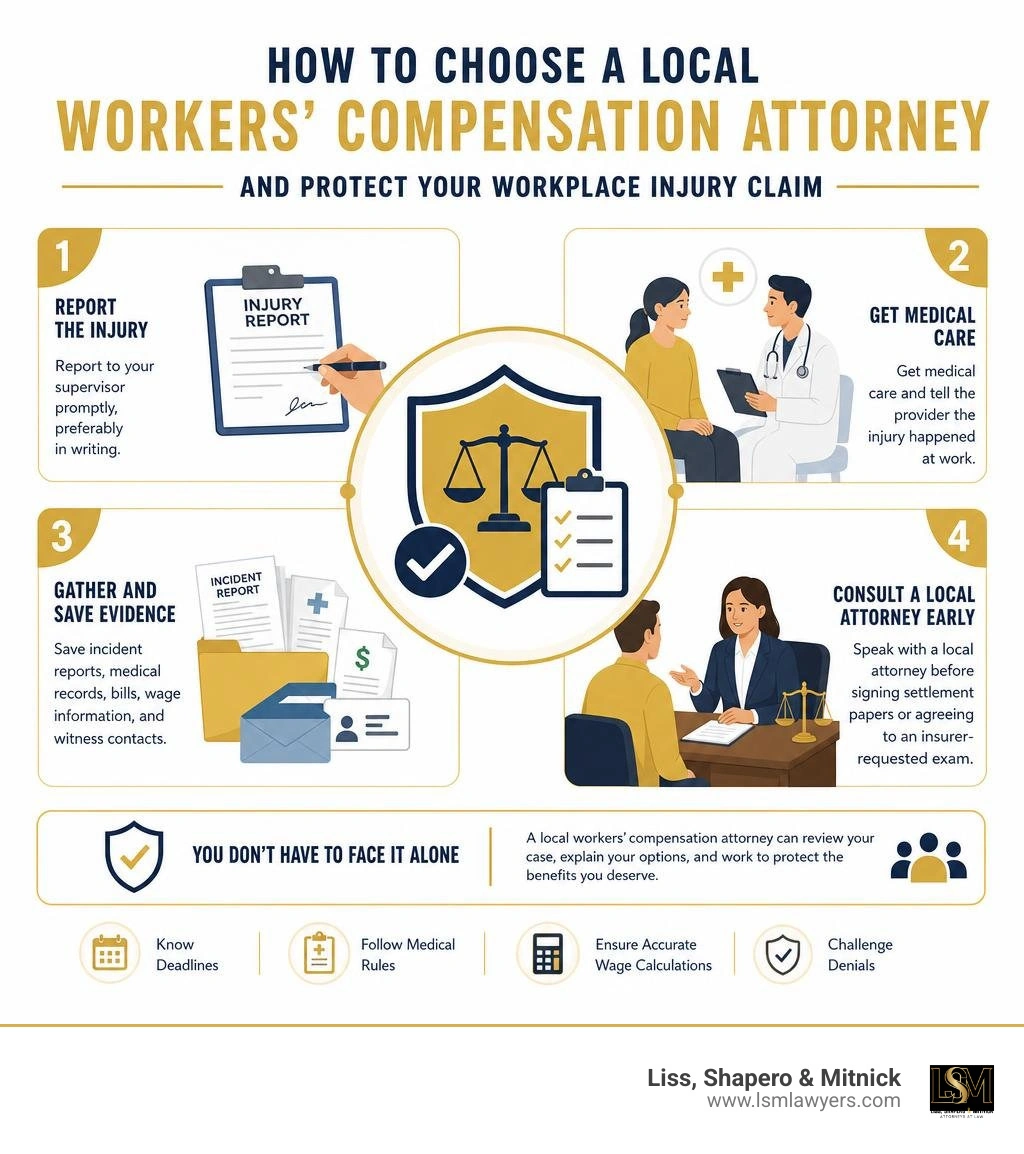
Start with these steps:
- Report the injury to your supervisor promptly, preferably in writing.
- Get medical care and tell the provider the injury happened at work.
- Save the incident report, medical records, bills, wage information, and witness contacts.
- Speak with a local attorney before signing settlement papers or agreeing to an insurer-requested exam.
Workers' compensation is generally a no-fault system, but a claim can still become complicated fast. Deadlines, medical-provider rules, wage calculations, and denied claims can affect the benefits available to you. A nearby lawyer can review the facts, explain your options, and identify whether another party - such as a contractor, property owner, or equipment maker - may also be responsible.
Immediate Steps to Take After a Workplace Injury to Protect Your Claim

When an accident happens on the job, your immediate actions establish the factual and medical foundation for the rest of your claim. Employers and their claims adjusters scrutinize early records looking for any discrepancies to reduce or outright deny payment. Taking deliberate, documented steps from minute one ensures that you do not leave your financial recovery to chance.
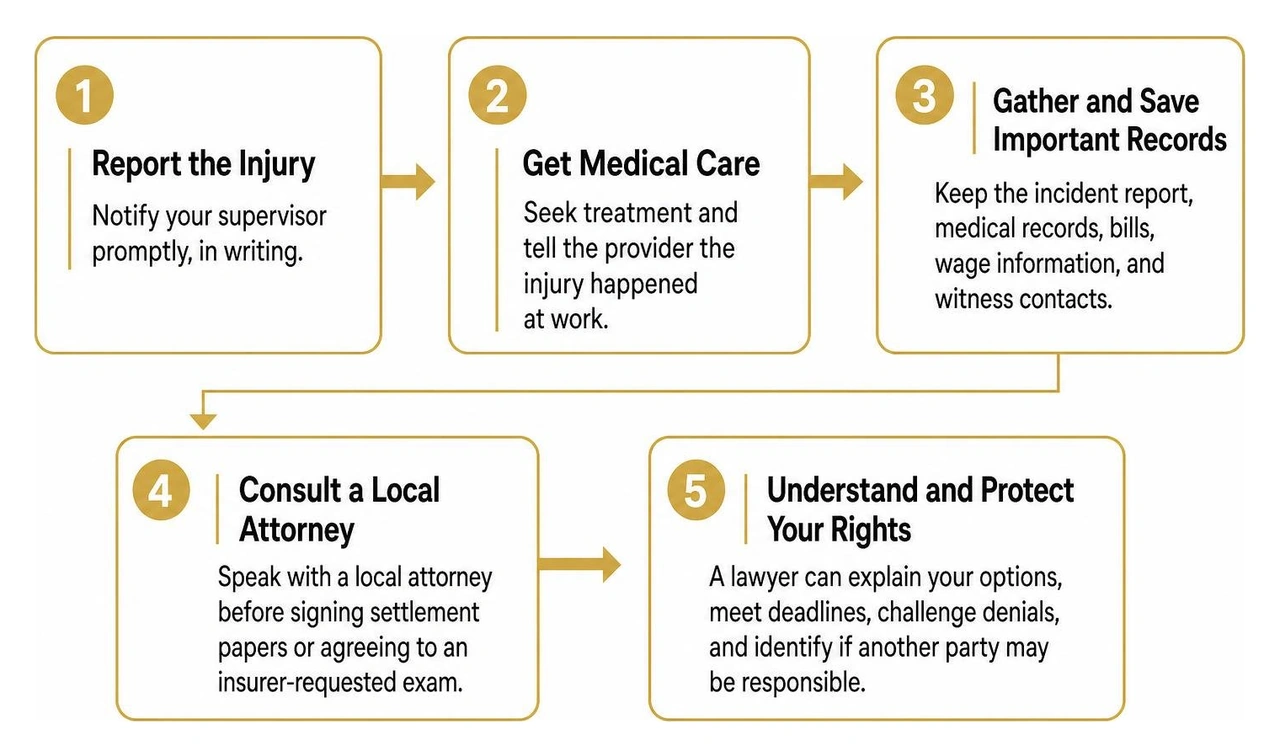
To protect your rights under the law, follow these essential protocols:
- Notify Your Employer Immediately in Writing: Verbally telling a coworker is not enough. Give formal, written notice of your injury to your direct supervisor or HR manager. Clearly state the date, exact time, location, and the specific mechanics of how you were hurt. Keep a time-stamped digital or paper copy for your personal records.
- Seek Immediate Medical Evaluation: Even if you think an injury is minor, get checked out right away. Adrenaline often masks serious soft tissue or head injuries. Explicitly inform the emergency room doctor, urgent care clinician, or occupational physician that your injury happened while performing work duties so it is noted in your official medical intake.
- Obtain the Incident and Injury Report: Request a complete copy of the formal incident report your employer generates. Review it carefully to ensure the details accurately reflect what happened.
- Gather and Preserve Evidence: Take photos and videos of the accident scene, any malfunctioning machinery, unsafe work conditions, and visible bodily injuries. Collect the full names, phone numbers, and statements of any coworkers or third parties who witnessed the event.
- Track Your Financial and Medical Records: Keep an organized folder containing all physician notes, diagnostic imaging reports, out-of-pocket medical bills, prescription receipts, and pre-injury paystubs showing your regular earnings and overtime.
Critical Deadlines and Statute of Limitations by State
Workers' compensation claims are bound by strict statutory timelines. Missing a filing window can permanently destroy your right to recover medical coverage or wage replacement benefits, regardless of how severe your injuries are.
In Michigan, state law requires an employee to give notice of an injury to the employer within 90 days of the injury or within 90 days of when the employee knew or should have known about the work-related condition. Furthermore, the formal claim for compensation must be made within two years of the date of injury. For occupational diseases or repetitive strain injuries, the clock typically begins when the disability manifests and its relationship to the work environment becomes known.
Because navigating overlapping state deadlines and notice rules can be daunting when you are trying to heal, consulting a knowledgeable legal team ensures every statutory requirement is met before time runs out.
When Should You Search for a Workman's Comp Attorney Near Me?
While workers' compensation is designed as a no-fault safety net, insurance companies are for-profit enterprises focused on controlling their bottom line. Insurance carriers often deploy aggressive adjusters to minimize payouts, dispute diagnoses, or allege that your condition is tied to a pre-existing health issue rather than your job duties.
Knowing when to bring in professional representation can prevent an avoidable financial crisis. You should look for local legal counsel if:
- Your employer denies that the injury occurred within the scope of employment.
- The insurance carrier delays processing your weekly wage replacement checks.
- The company attempts to force you back into work duties before your doctor has cleared you.
- Your claim is completely denied through a formal notice of dispute.
- You experience workplace retaliation, such as demotion, harassment, or threats of termination.
Warning Signs You Need a Workman's Comp Attorney Near Me Immediately
Certain red flags indicate an insurance carrier is actively building a case to terminate or curtail your benefits:
- Independent Medical Examination (IME) Requests: If the insurance company schedules you for an evaluation with one of their chosen "independent" examiners, understand that these doctors are hired by the carrier. Their opinions are frequently used to claim that you have reached Maximum Medical Improvement (MMI) or that your injuries are not work-related.
- Incorrect Average Weekly Wage (AWW) Calculations: Insurers frequently miscalculate your pre-injury wage base by omitting regular overtime, shift differentials, bonus pay, or secondary employment, which directly lowers your weekly disability check.
- Aggressive Vocational Rehabilitation Demands: If an insurer sends you to vocational counseling, it may not be to help you; often, they use wage-earning capacity assessments to argue you could work a theoretical job, justifying a reduction in your wage loss benefits.
High-Risk Industries and Third-Party Liability Claims
Certain occupations face heightened daily risks, from operating heavy industrial equipment to working at extreme heights. Workers in construction, manufacturing, transportation, and warehousing experience some of the highest injury rates nationwide.
When a severe accident occurs in these dynamic environments, workers' compensation may not be your only legal remedy. If someone other than your direct employer caused or contributed to your injury, you can pursue a separate personal injury lawsuit. For example, work injuries on new builds third party claims against subcontractors and suppliers allow injured workers to recover compensation for non-economic damages like pain and suffering.
Our firm handles all aspects of work injury construction accidents, helping injured tradespeople hold negligent subcontractors, site owners, and equipment vendors fully accountable.
Types of Workers' Compensation Benefits and Calculating Case Worth
Workers' compensation benefits are structured to address your economic losses following an occupational injury. Understanding these categories helps clarify what you are owed under state law.
| Benefit Type | What It Covers | How It Is Calculated / Paid |
|---|---|---|
| Medical Treatment Benefits | 100% of reasonable and necessary medical care, surgeries, physical therapy, medications, and mileage. | Paid directly by the insurer with zero out-of-pocket copays or deductibles for covered care. |
| Wage Loss / Disability Benefits | Replacement income for employees who cannot work or who earn less due to work restrictions. | Generally 80% of the employee's after-tax Average Weekly Wage (AWW), subject to state maximum caps. |
| Permanent Partial Disability (PPD) | Cash awards for permanent loss of function or specific loss of a body part (e.g., finger, hand, eye). | Set by statutory schedules determining a specific number of weeks of wage-loss compensation. |
| Permanent Total Disability (PTD) | Ongoing income replacement for catastrophic injuries resulting in total, permanent inability to work. | Weekly wage replacement continued long-term, often with cost-of-living adjustments where applicable. |
| Vocational Rehabilitation | Retraining, job placement assistance, and educational support if you cannot return to your prior job. | Paid by the insurer for up to 52 weeks (extendable in specific circumstances). |
Navigating Medical Treatment and Choosing Your Doctor
Medical treatment is the cornerstone of any workers' compensation claim. In Michigan, the employer or their workers' compensation insurance carrier has the legal right to select your treating physician for the first 28 days of treatment.
However, after that initial 28-day period expires, you have the right to change doctors and choose your own treating physician. To do this, you must notify your employer and their insurance carrier in writing, providing the name and address of your new doctor.
Working with an authorized treating physician who understands how to document occupational injuries is vital. Your doctor's clinical findings determine your physical restrictions, whether you have reached Maximum Medical Improvement (MMI), and the impairment rating that supports your long-term benefits.
How Third-Party Claims Increase Total Settlement Value
A major limitation of the workers' compensation system is that it does not compensate you for physical pain, emotional suffering, loss of enjoyment of life, or scarring. This is where third-party liability claims make a profound difference.
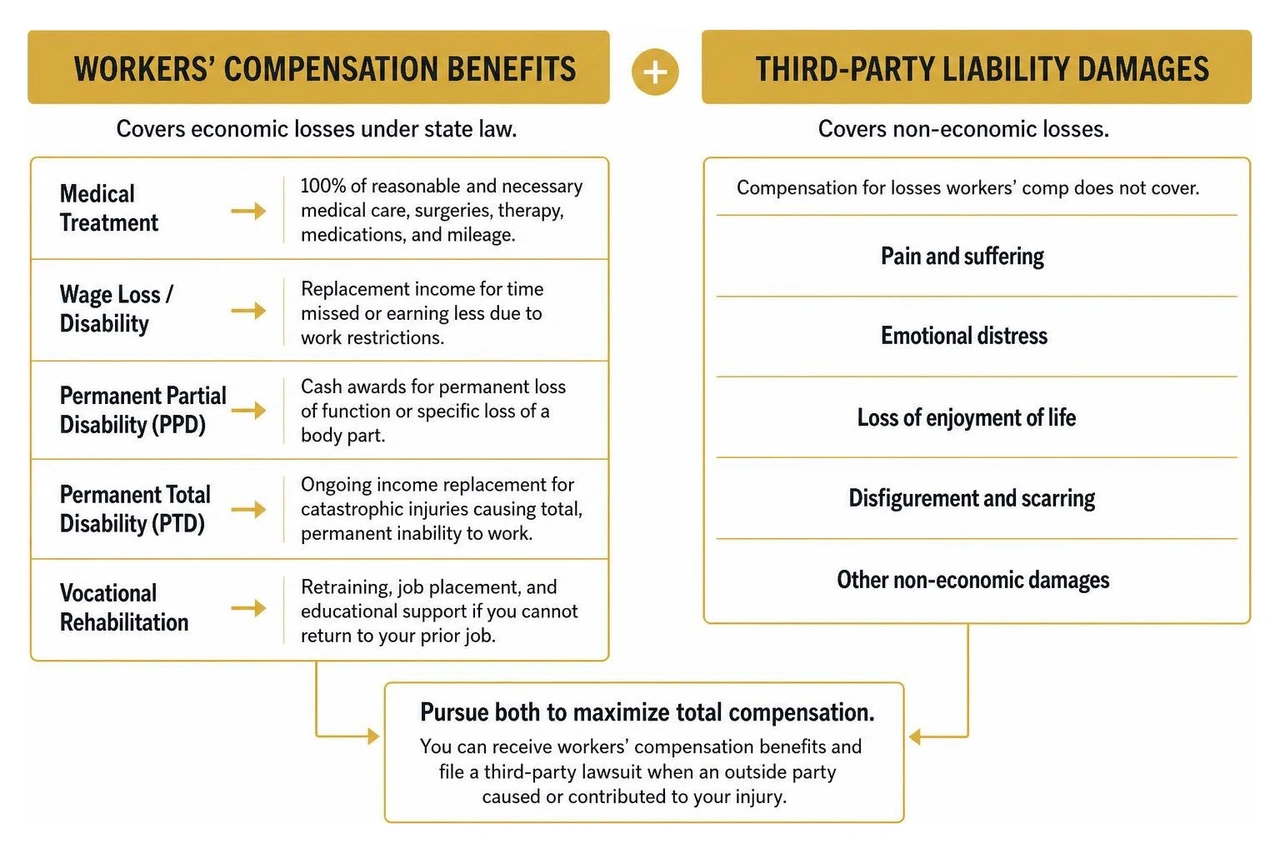
When an outside entity causes your injury, you can file a separate tort lawsuit while simultaneously collecting workers' compensation benefits. Common third-party scenarios include:
- A subcontractor creating an unsafe hazard on a shared commercial job site.
- A negligent property owner failing to maintain safe premises, giving rise to third party work injuries claims against subcontractors property owners.
- An equipment manufacturer supplying a defective industrial tool or safety harness lacking proper safeguards.
- A third-party driver causing a motor vehicle crash while you are running a work errand.
To see the breadth of issues we manage for industrial workers, explore our extensive resources within our category work injury construction accidents hub.
Key Criteria for Choosing the Right Work Injury Lawyer

Not all personal injury attorneys possess the specific focus needed to handle complex workers' compensation litigation and third-party claims. When choosing legal representation, look for these critical qualifications:
- Direct Trial and Courtroom Experience: While many claims resolve through negotiation, insurance carriers know which lawyers settle cheaply and which ones are fully prepared to take a disputed case to an evidentiary hearing or trial.
- Former Insurance-Defense Experience: Lawyers who have previously represented insurance companies understand their evaluation formulas, claims manuals, and litigation defense strategies. We leverage our former insurance-defense experience to anticipate the insurer's next move and maximize total compensation for our clients.
- Deep Knowledge of Local Administrative Rules: Administrative workers' compensation magistrate systems have unique evidentiary requirements, medical deposition procedures, and dispute resolution workflows that differ from general civil litigation.
- Transparent Communication: You deserve direct access to your legal team, clear updates on your case's progression, and honest evaluations regarding settlement offers.
Understanding Contingency Fees: How Much Does a Workman's Comp Attorney Near Me Cost?
Many injured workers hesitate to reach out to an attorney because they fear expensive hourly legal bills. Workers' compensation lawyers operate on a contingency fee basis.
This means:
- You pay zero upfront costs to retain representation.
- The attorney covers all litigation expenses, such as obtaining medical records, hiring vocational experts, and taking doctor depositions.
- The attorney only collects a fee if they successfully secure benefits or negotiate a lump-sum redemption settlement for you.
- Attorney fees in workers' compensation matters are strictly regulated and capped by state administrative rules, ensuring that the vast majority of the recovery remains in your pocket.
Frequently Asked Questions About Workers' Compensation
What happens if my workers' comp claim is denied?
If your claim is denied, the insurance carrier will send a formal Notice of Dispute. This does not mean your case is over. Your attorney will file an administrative Application for Mediation/Hearing before the state workers' compensation agency.
During this dispute resolution process, we conduct depositions of medical experts, assemble employment and wage records, and present your case before a magistrate at an evidentiary hearing to seek full retroactive and ongoing benefits.
Can I be fired for filing a workers' comp claim?
Under state labor laws, it is illegal for an employer to fire, demote, harass, or retaliate against an employee for exercising their statutory right to file a workers' compensation claim.
While Michigan is generally an at-will employment state, workers' compensation retaliation is a clear exception. If you are terminated because of your injury claim, you may have grounds for an additional wrongful termination and retaliation lawsuit against your employer.
How much is my workers' comp case worth?
The total settlement value of a workers' compensation case (often resolved through a lump-sum redemption) depends on several individual factors:
- The projected cost of your future medical care and surgical needs.
- The extent of your wage loss and your pre-injury Average Weekly Wage.
- Your age, education, and likelihood of returning to alternative employment.
- The presence of permanent physical impairment or permanent restrictions.
- The viability of parallel third-party liability claims against outside entities.
Conclusion
A serious workplace accident can disrupt your health, career, and financial security in a single instant. Navigating insurer disputes, medical evaluations, and bureaucratic appeals on your own puts you at a severe disadvantage against seasoned insurance claims teams.
At Liss, Shapero & Mitnick, our legal team combines decades of dedicated advocacy with former insurance-defense experience to aggressively protect the rights of injured workers across Metro Detroit, Berkley, and throughout Michigan. Whether you suffered a catastrophic machine injury on a job site or slipped on an icy commercial walkway, our experienced Michigan slip, trip, and fall lawyers and work injury team are ready to fight for the maximum compensation you deserve.
Contact our office today for a free, no-obligation case evaluation, and let us take the burden of the insurance fight off your shoulders.