.svg)
.avif)



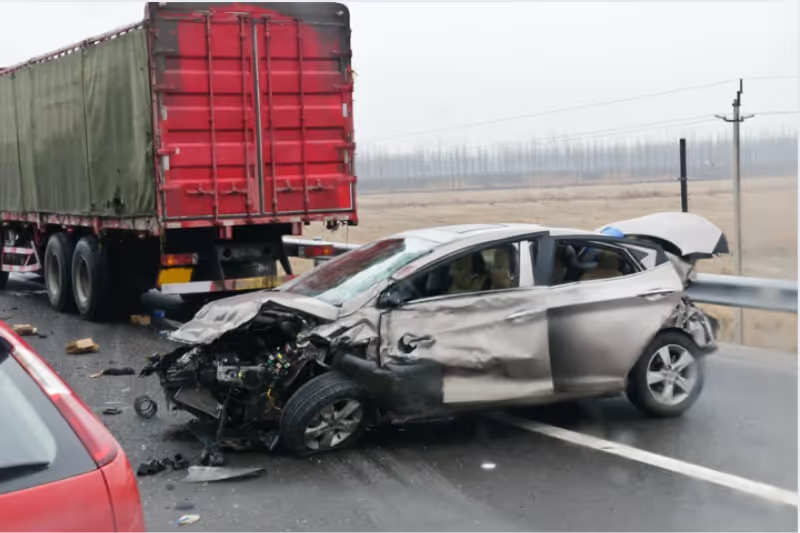
Truck accidents on Michigan roads are often catastrophic. Due to the size and weight of commercial vehicles, even a single collision can result in severe injuries, extensive property damage, and long-term consequences for those involved. Unlike typical car accidents, these crashes frequently involve multiple layers of responsibility, making it far more difficult to determine exactly what happened.
Commercial trucking operations are complex by nature. Drivers, trucking companies, maintenance providers, and equipment manufacturers all play a role in keeping these vehicles safe on the road. With so many moving parts, the risk of failure—whether human or mechanical—is always present. When something goes wrong, identifying the cause requires a detailed examination of evidence that is often highly technical and tightly controlled.
In these cases, evidence is everything. The difference between a strong claim and a disputed one often comes down to what can be proven through data, records, and documentation. However, one of the biggest challenges is that this evidence does not last forever. Key information can be lost, overwritten, or even intentionally destroyed if action is not taken quickly. That is why early investigation and preservation are critical in any truck accident case.
Key Types of Evidence in Truck Crash Cases
Electronic Logging Device (ELD) Data
Electronic Logging Devices, commonly referred to as ELD data, are used to track a truck driver’s hours and activity. These systems are required under federal law and are designed to ensure compliance with hours-of-service regulations.
- What ELD data tracks
ELD systems record driving time, rest periods, engine hours, and vehicle movement. This provides a detailed timeline of a driver’s activity. - Hours-of-service compliance and fatigue analysis
By reviewing ELD data, it is possible to determine whether a driver exceeded legal driving limits or failed to take required breaks—both of which can lead to fatigue-related accidents. - Identifying violations
Patterns such as excessive driving hours or insufficient rest can indicate negligence on the part of the driver or the trucking company.
This data often plays a central role in determining whether driver fatigue contributed to a crash.
ECM Black Box Data
Most commercial trucks are equipped with an Engine Control Module (ECM), often referred to as a “black box.” This system captures critical information about the vehicle’s operation before and during a crash.
- What an ECM black box records
Data may include speed, braking activity, throttle position, engine performance, and sudden changes in motion. - Crash-specific data
The ECM can provide insight into what happened in the seconds leading up to the collision—such as whether the driver attempted to brake or how fast the vehicle was traveling. - Reconstructing the accidentThis information allows experts to analyze the sequence of events and determine how the crash occurred.
Because this data is often overwritten after a certain period, it must be preserved quickly.
Maintenance Records
Maintenance records are a critical component in identifying whether a truck was safe to operate at the time of the crash.
- Inspection history and repair logs
These records show how often the vehicle was inspected and whether known issues were addressed. - Evidence of poor upkeep
Missed inspections, delayed repairs, or repeated mechanical issues can point to negligence. - Ignored safety concerns
If a trucking company failed to address known defects, it may be held accountable for resulting accidents.
In cases involving mechanical failure—such as brake issues or tire problems—maintenance records can be key to proving liability.
Driver and Company Records
Beyond the vehicle itself, the background and practices of the driver and trucking company can provide important context.
- Driver qualification files
These include licensing, certifications, and employment history, helping determine whether the driver was properly qualified. - Training history and safety violationsRecords of prior infractions, lack of training, or disciplinary issues may indicate a pattern of unsafe behavior.
- Prior incidents or patterns of negligence
A history of accidents or regulatory violations can strengthen a claim by showing ongoing safety failures.
These records help paint a broader picture—not just of the crash itself, but of the practices that may have contributed to it.
“Wheel-Off” Accidents and Mechanical Failures
What Is a Wheel-Off Accident?
A wheel-off accident occurs when a wheel separates completely from a commercial truck while it is traveling.
- Definition and impact
This type of failure typically involves the entire wheel assembly detaching from the axle, often at highway speeds. - Why these crashes are so dangerous
A loose wheel can travel unpredictably, striking other vehicles, pedestrians, or roadside structures. At the same time, the truck itself becomes unstable, increasing the likelihood of a secondary collision.
Because of the size and force involved, these accidents frequently result in severe injuries or fatalities.
Causes of Wheel-Off Incidents
Wheel-off accidents are rarely random—they are often the result of preventable errors or neglect.
- Improper installation or torqueing of lug nuts
If lug nuts are not tightened correctly, the wheel can gradually loosen over time until it detaches. - Failure to inspect and maintain wheel assemblies
Routine inspections are essential to identify wear, damage, or loosening components before they become dangerous. - Negligence by maintenance providers or contractors
Third-party mechanics or service providers may be responsible for improper repairs or inadequate maintenance.
These failures often point to breakdowns in safety procedures, whether by the trucking company or an outside contractor.
Evidence Needed to Prove Wheel-Off Liability
Establishing liability in a wheel-off accident requires a detailed investigation and careful preservation of evidence.
- Maintenance and inspection logs
These records can reveal whether proper inspections were conducted and whether any issues were identified or ignored. - Repair history and third-party service records
Documentation of recent work performed on the vehicle can help determine if improper maintenance contributed to the failure. - Physical evidence from the vehicle and scene
The detached wheel, axle components, and surrounding debris can provide critical clues about how and why the failure occurred.
This type of evidence is often highly technical and must be analyzed by experts to fully understand the cause of the accident.
The Role of a Spoliation Letter
What Is a Spoliation Letter?
A spoliation letter is a formal legal notice sent to parties involved in an accident, instructing them to preserve all relevant evidence.
- Purpose of the letter
It puts the recipient on notice that certain records and materials must not be destroyed, altered, or overwritten. - Legal obligation to preserve evidence
Once a party receives a spoliation letter, they are required to take reasonable steps to safeguard the identified evidence.
This letter often serves as the first step in ensuring that critical information remains available for investigation.
Why It Must Be Sent Immediately
Timing is everything when it comes to preserving evidence in a truck accident case.
- Preventing destruction or alteration of dataKey evidence—such as ELD data, ECM black box information, and maintenance records—may be routinely deleted or overwritten if not preserved.
- Securing critical documentation early
Acting quickly helps ensure that logs, inspection reports, and internal communications are retained.
Delays in sending a spoliation letter can result in permanent loss of evidence that may be impossible to recover.
Consequences of Spoliation
When evidence is destroyed or altered after a spoliation letter is issued, there can be serious legal consequences.
- Potential penalties for the responsible partyCourts may impose sanctions or penalties if it is determined that evidence was improperly destroyed.
- Strengthening a claim
In some cases, the loss of evidence can lead to legal presumptions against the party responsible, reinforcing the injured party’s case.
When Evidence Makes the Difference in Truck Crash Cases
Truck accidents are complex, high-stakes cases where the truth is often hidden within layers of technical data and documentation. From ELD data and ECM black box recordings to detailed maintenance logs and evidence of mechanical failure, each piece plays a critical role in uncovering what truly happened. These cases are rarely straightforward, and without the right evidence, it can be difficult to identify who is responsible. In truck accident cases, the difference between a strong claim and a weakened one often comes down to how effectively that evidence is gathered and used.
Speak With a Michigan Truck Accident Lawyer Who Knows What to Look For
If you or a loved one has been injured in a truck accident, you need a legal team that understands how to uncover and protect the evidence that matters most. At Liss, Shapero & Mitnick, you are not just another case—you are treated like family, with a dedicated team working together to build the strongest possible claim on your behalf.
Contact Liss, Shapero & Mitnick today for a free consultation:
Address:
2695 Coolidge Highway
Berkley, MI 48072
Phone: 248-584-1300
Toll Free: 1-855-LISS-LAW (1-855-547-7529)
Fax: 248-584-1323