
What a Detroit Wrongful Death Lawyer Can Do for Your Family

If a loved one died because of someone else's negligence, a Detroit wrongful death lawyer can help your family preserve evidence, identify who may be liable, and pursue compensation. Start by keeping accident reports, medical records, and insurance letters. Ask about filing deadlines early: Michigan often allows three years to bring a claim, but the deadline depends on the facts.
A fatal crash, workplace incident, or nursing home injury can leave a family facing bills and hard decisions while grieving. You do not have to sort out the legal process alone.
I'm Scott Mitnick, a Detroit wrongful death lawyer and partner at Liss, Shapero & Mitnick. I've spent more than 20 years handling civil litigation, including auto and insurance cases, and secured a $3.2 million judgment in a wrongful death case.

Detroit wrongful death lawyer vocab explained:
Understanding Michigan Wrongful Death Law in Wayne County
Navigating Michigan's legal framework during a time of immense grief can feel overwhelming. In Wayne County, wrongful death actions are governed strictly by state statute. Under MCL § 600.2922, a wrongful death occurs whenever the death of a person is caused by a wrongful act, neglect, or fault of another, and the act would have entitled the injured party to maintain an action and recover damages if death had not ensued.
When fatal incidents occur in Detroit, whether on the Lodge Freeway, at a commercial facility, or in a local hospital, the legal claim must proceed through a structured statutory process. Under Michigan Compiled Laws (MCL § 600.5805), the general statute of limitations for filing a wrongful death claim in Detroit is three years from the date of the decedent's death. However, establishing liability and opening the requisite probate estate requires early legal intervention. Understanding how a wrongful death claim works in Michigan helps surviving family members protect their rights from day one.
Who Has Legal Standing to Bring a Claim?
Under Michigan law, individual family members cannot independently file a wrongful death lawsuit on their own behalf. Instead, the action must be brought exclusively by the personal representative of the deceased person’s estate, appointed through the Wayne County Probate Court.
While the personal representative formally files the lawsuit, any financial recovery is intended to benefit specific surviving relatives who suffered losses due to the death. These beneficiaries typically include:
- The surviving spouse and children of the deceased
- Parents and grandparents
- Siblings of the decedent
- Children of the deceased person’s spouse (stepchildren)
- Any individuals who are entitled to inherit under Michigan’s intestate succession laws
Determining who holds the legal authority to file after a fatal crash is one of the initial legal hurdles we address to ensure proper representation and standing.
Survival Actions vs. Wrongful Death Claims
Families often ask whether they are pursuing a survival action or a wrongful death lawsuit. In Michigan, the wrongful death act actually consolidates survival actions and wrongful death actions into a single comprehensive claim brought under MCL § 600.2922.
The key distinction lies in the nature of the damages sought:
- Survival Damages: Compensation for the conscious pain and suffering the decedent experienced between the moment of injury and the time of death, along with any medical expenses incurred during that window.
- Wrongful Death Damages: Losses suffered directly by the surviving beneficiaries as a result of the death, such as loss of financial support, loss of consortium, and funeral expenses.
Understanding the difference between survival actions and wrongful death ensures that all eligible damages are thoroughly documented and pursued.
Common Causes of Preventable Fatalities in Detroit

Wayne County consistently leads Michigan in fatal traffic collisions, with over 180 traffic-related fatalities recorded in a single year. Furthermore, vulnerable road users face severe risks; pedestrian and bicyclist accidents represent nearly 30% of fatal traffic incidents in urban centers like Detroit. Outside of transportation, industrial operations and institutional settings also present significant hazards. According to the U.S. Bureau of Labor Statistics, Michigan recorded 139 fatal occupational injuries in a single year, highlighting common grounds for workplace wrongful death and third-party liability lawsuits.
Reviewing guidance for fatal Metro Detroit crashes provides crucial insight into the common negligence patterns we see across Southeast Michigan.
Severe Traffic and Trucking Collisions
High-speed collisions on major Detroit arteries like I-75, I-94, and Southfield Freeway frequently result in fatal outcomes. Factors such as distracted driving, intoxicated driving, and aggressive lane changes often turn routine commutes into tragedies. Motorcyclists face heightened vulnerability, often requiring specialized representation in fatal motorcycle accident lawsuits.
Commercial trucking accidents present severe complexities. Due to the massive weight disparity between commercial tractor-trailers and passenger vehicles, collisions often involve catastrophic mechanics, such as commercial truck underride crashes, requiring rapid accident reconstruction and federal safety standard compliance checks.
Defective Products and Nursing Home Neglect
Fatalities also arise away from roadways. Defective automotive components, such as catastrophic tread separation leading to tire defect wrongful death claims, require in-depth product liability investigations against manufacturers.
In healthcare and eldercare settings, vulnerable seniors face life-threatening hazards from systemic understaffing, medication errors, and unaddressed falls. Pursuing appropriate nursing home negligence settlements holds facilities accountable for preventable resident deaths.
How a Detroit Wrongful Death Lawyer Proves Liability and Damages
To secure compensation in a Michigan wrongful death lawsuit, the plaintiff’s legal team must establish four core elements of negligence by a preponderance of the evidence:
- Duty of Care: The defendant had a legal obligation to act reasonably (e.g., a driver obeying traffic laws or a physician adhering to medical standards).
- Breach of Duty: The defendant failed to fulfill that legal duty through reckless, negligent, or wrongful conduct.
- Causation: The specific breach directly caused the fatal injuries.
- Damages: The decedent and their surviving beneficiaries suffered measurable economic and noneconomic losses.
Securing full compensation requires proving both economic damages (tangible financial losses) and noneconomic damages (intangible human losses). Experienced Michigan wrongful death legal representation is vital to properly quantifying these impacts.
| Damage Category | Description | Examples Under Michigan Law |
|---|---|---|
| Economic Damages | Verifiable, direct financial losses resulting from the death | Medical bills prior to death, funeral and burial costs, loss of decedent's future wages, loss of employee benefits, loss of household services |
| Noneconomic Damages | Non-financial losses reflecting emotional and personal devastation | Conscious pain and suffering before death, loss of companionship, loss of parental guidance, loss of society and consortium |
Key Qualities to Look for in a Detroit Wrongful Death Lawyer

Choosing the right legal advocate makes a measurable difference in the outcome of your case. Families should look for:
- Trial Readiness and Experience: A firm that prepares every case for the courtroom rather than seeking a quick, low-ball settlement.
- Wayne County Court Familiarity: Deep understanding of the 3rd Judicial Circuit Court procedures, local judges, and Wayne County juries.
- Investigative Resources: Access to premier accident reconstructionists, forensic economists, and medical specialists.
- Compassionate Communication: Direct access to your attorney throughout the litigation process.
How a Detroit Wrongful Death Lawyer Overcomes Insurance Defenses
Insurance companies routinely attempt to limit payouts by asserting Michigan's modified comparative fault rule. Under Michigan law (MCL § 600.2959), if an injured party is found to be partially at fault, their noneconomic damages are reduced by their percentage of fault. Crucially, if the decedent is determined to be more than 50% at fault, the estate is completely barred from recovering noneconomic damages.
Insurance adjusters frequently argue that the decedent was speeding, distracted, or failed to avoid an accident. At Liss, Shapero & Mitnick, our attorneys leverage extensive former insurance-defense experience to anticipate these tactics, dismantle bad-faith arguments, and secure full liability against the at-fault parties.
The Step-by-Step Process and Timeline for Detroit Wrongful Death Claims
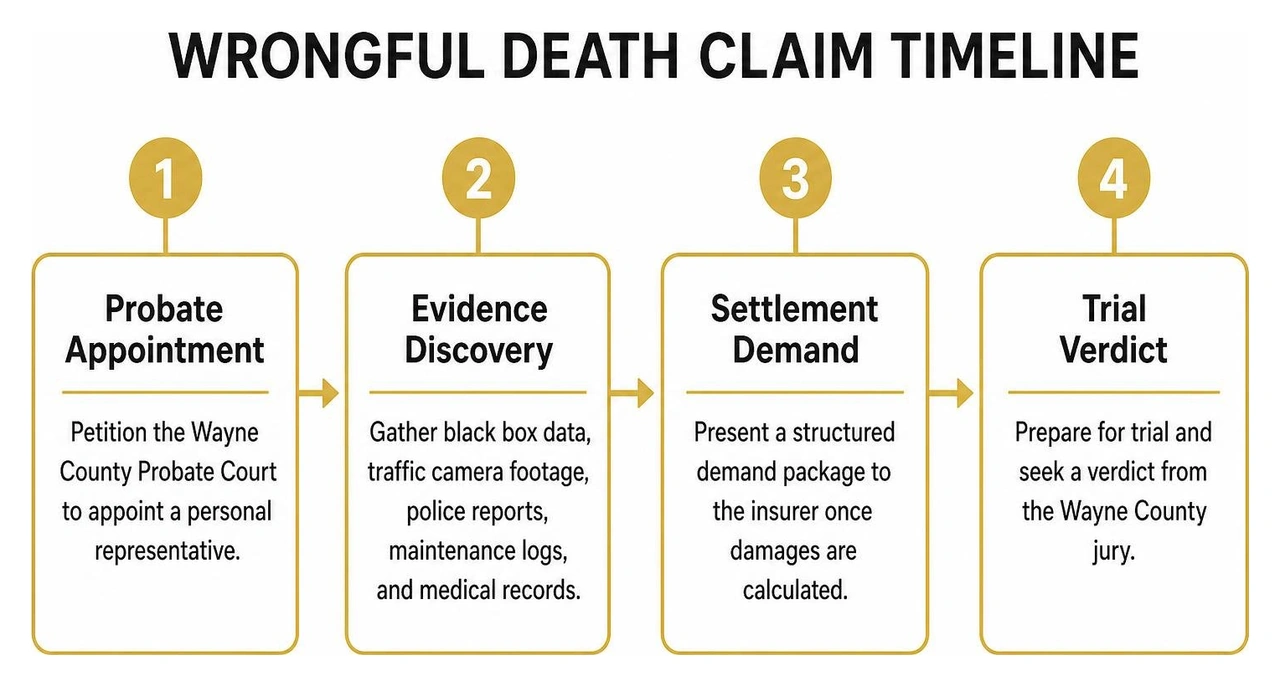
Resolving a wrongful death lawsuit in Wayne County follows a structured legal progression within our comprehensive wrongful death practice area:
- Initial Case Review and Probate Filing: We evaluate the merits of the case and petition the Wayne County Probate Court to appoint a personal representative.
- Investigation and Evidence Preservation: Our team gathers black box data, traffic camera footage, police reports, maintenance logs, and medical records.
- Formal Demand and Negotiations: Once damages are calculated by financial experts, we present a structured demand package to the insurer.
- Filing the Complaint and Discovery: If fair terms are not reached, we file suit in the Wayne County Circuit Court, engaging in formal depositions, interrogatories, and expert witness disclosures.
- Mediation and Trial: We participate in court-ordered facilitation or mediation. If the defense refuses fair compensation, we present the case before a Wayne County jury.
- Probate Court Allocation: Following a settlement or verdict, the proceeds are formally distributed to beneficiaries under probate court oversight.
Frequently Asked Questions About Detroit Wrongful Death Lawsuits
What is the statute of limitations for filing a wrongful death claim in Detroit?
Under MCL § 600.5805, the general statute of limitations is three years from the date of death. If probate letters of authority are issued within that window, Michigan law provides a statutory saving provision (MCL § 600.5852) that may extend the filing window by up to two additional years from the date letters are issued, not to exceed three years past the original three-year deadline. However, waiting risks the loss of critical evidence.
How does Michigan's comparative fault rule impact a wrongful death payout?
Michigan applies a modified comparative fault rule. If the decedent is found partially responsible, economic damages are reduced in proportion to their percentage of fault. If the decedent is found to be 51% or more at fault, the recovery of noneconomic damages (such as pain and suffering and loss of society) is barred entirely.
How are wrongful death settlement proceeds distributed among family members?
Wrongful death proceeds do not automatically follow the terms of a standard will. Instead, under MCL § 600.2922, the personal representative must file a petition with the probate court for approval of the settlement distribution. The court conducts a hearing where eligible beneficiaries can present evidence regarding their individual losses, ensuring a fair and equitable allocation.
Conclusion
Losing a family member due to someone else's reckless actions brings severe emotional and financial upheaval. Securing justice requires holding negligent parties accountable under Michigan law. At Liss, Shapero & Mitnick, our legal team utilizes years of former insurance-defense insight to anticipate insurer strategies and pursue the full compensation your family deserves.
If you have lost a loved one in Detroit, Berkley, or anywhere across Metro Detroit, contact Scott Mitnick today for compassionate, dedicated wrongful death legal support after a preventable incident.