.svg)
Key Factors That Determine Your Dog Bite Claim Value

The total dog bite claim value is determined by totaling tangible economic damages (medical expenses, future reconstructive surgeries, and lost wages) with non-economic damages (pain, emotional trauma, and permanent scarring). Settlements typically range from $1,000 to $15,000 for minor punctures, $50,000 to $250,000 for severe lacerations with nerve damage, and upwards of $1,000,000 for catastrophic or pediatric attacks. Insurance adjusters and attorneys evaluate injury severity, anatomical wound location, statutory liability rules, and policy limits to establish final payouts. Knowing these core factors ensures you do not accept an early settlement that falls short of your long-term needs.
Injury Severity, Location, and Permanent Scarring
The physical nature of a canine attack makes these injuries distinct from typical personal injury cases. Dogs exert immense jaw pressure, causing crush injuries alongside deep punctures, tissue tears, and potential nerve damage.
Key clinical drivers that elevate claim payouts include:
- Laceration Depth and Tissue Loss: Severe bites often tear through epidermis, fat, and muscle tissue, requiring extensive debridement, sutures, or skin grafts.
- Infection Risks: Canine mouths carry dangerous bacteria like Capnocytophaga, Pasteurella, and Staphylococcus. Infections can lead to sepsis, prolonged hospital stays, and costly IV antibiotic treatments.
- Nerve and Structural Damage: Punctures near joints or across the hands and face can sever nerves, resulting in permanent loss of sensation, mobility, or chronic neuropathic pain.
- Cosmetic Disfigurement: Scars on highly visible areas—such as the face, neck, or hands—carry substantially greater non-economic weight than injuries covered by everyday clothing.
Understanding how dog bite scars and medical documentation timelines interact is critical. Scars often take 12 to 18 months to mature before a plastic surgeon can evaluate the feasibility or cost of scar revision surgeries.
Economic Damages vs. Non-Economic Pain and Suffering Multipliers
Valuing a dog bite involves calculating two distinct categories of damages: economic and non-economic.
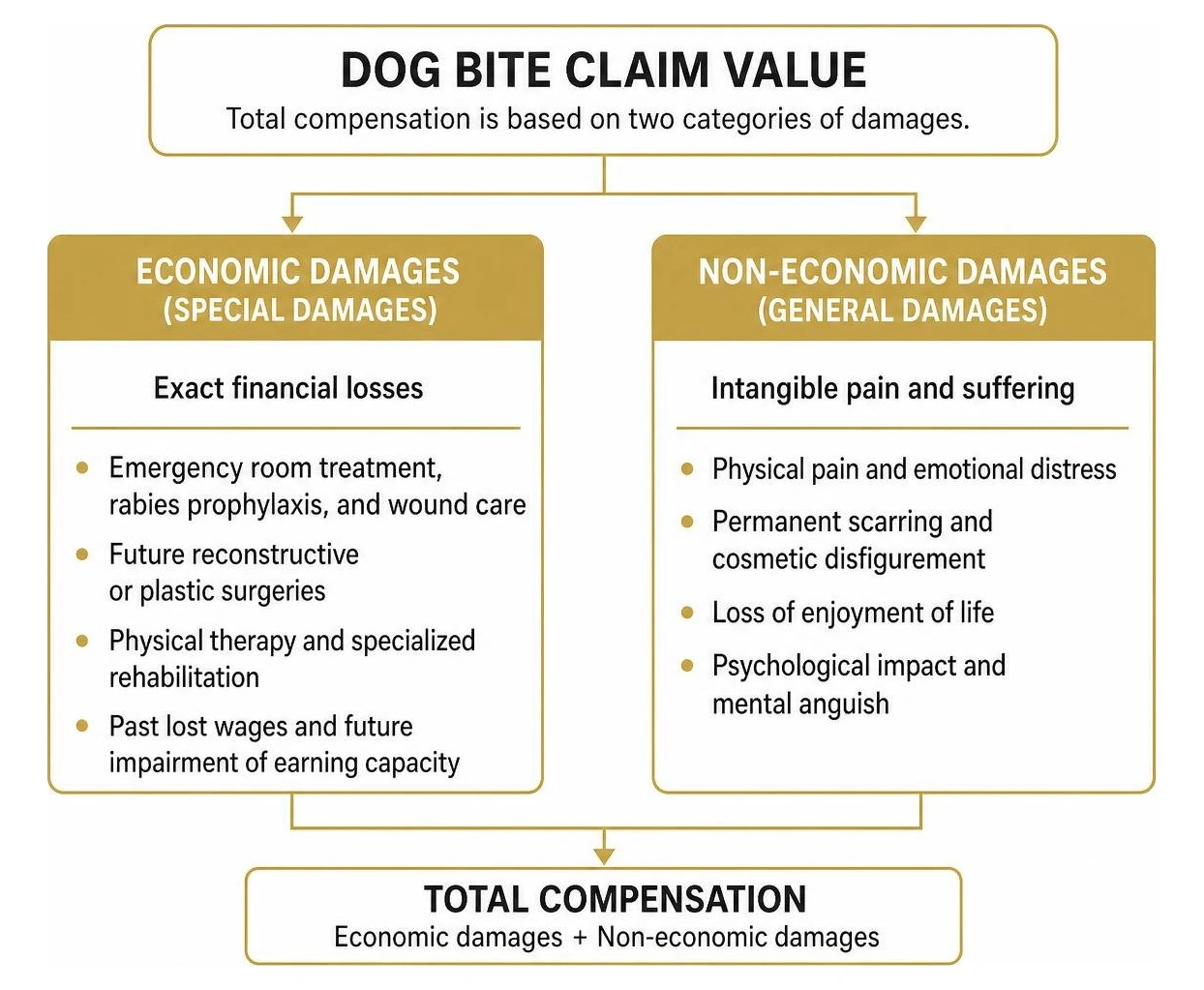
Economic Damages (Special Damages): These represent your exact financial losses, including:
- Emergency room treatment, rabies prophylaxis, and wound care
- Future reconstructive or plastic surgeries
- Physical therapy and specialized rehabilitation
- Past lost wages and future impairment of earning capacity
- Psychological therapy to treat post-traumatic stress or cynophobia (fear of dogs)
Non-Economic Damages (General Damages): This category compensates for physical pain, mental anguish, humiliation from visible disfigurement, and loss of enjoyment of life.
In practice, insurers and attorneys often use a multiplier method—applying a factor between 1.5 and 5 (or higher in catastrophic cases) to total economic damages to estimate general pain and suffering. While using a Dog Bite Settlement Calculator 2026 | Claim Value Estimator can give you an initial baseline estimate, the real multiplier depends heavily on the credibility of your medical narrative and the skill of your legal counsel.
Age of the Victim: Why Pediatric Attacks Recover Higher Payouts
Children represent roughly 50 percent of all dog bite injuries treated in emergency departments nationwide. Due to their height and natural curiosity, young children are disproportionately bitten in the face, neck, and head area.
Pediatric claims consistently resolve for higher amounts than adult cases due to three unique factors:
- Growth-Related Scarring: As a child grows, scar tissue does not expand at the same rate as healthy skin. This often causes contractures and distorting tissue tension that require staged revision surgeries through adolescence.
- Severe Psychological Trauma: Animal attacks frequently cause severe PTSD, nightmares, regressive behaviors, and debilitating fear of domestic pets, necessitating years of specialized pediatric counseling.
- Jury Sympathy and Court Oversight: Juries naturally respond strongly to injured children. Additionally, settlements involving minors require probate or circuit court approval to establish structured settlements or protected accounts, ensuring insurance companies cannot shortchange the child.
Average Dog Bite Settlements: Insurance Data vs. True Case Worth
Headlines often report national insurance payouts, but these numbers require proper context. The Insurance Information Institute reported that dog bite and related injury claims cost homeowners insurers $1.86 billion across 28,450 claims in 2025. While the statistical average cost per claim sat at $65,450, that figure blends low-level nip claims with catastrophic, multimillion-dollar maulings.
National Benchmarks and Dog Bite Claim Value by State
Settlement numbers vary widely depending on injury severity tiers and geographic jurisdictions:
| Injury Severity Tier | Typical Injury Characteristics | Representative Settlement Range |
|---|---|---|
| Minor Injury | Superficial puncture wounds, basic stitches, no nerve damage or lasting scars | $1,000 – $15,000 |
| Moderate Injury | Deep lacerations, localized infection, minor visible scarring, brief missed work | $15,000 – $50,000 |
| Serious / Severe | Muscle tears, facial lacerations, surgical repair, permanent scarring, psychological trauma | $50,000 – $250,000 |
| Catastrophic | Extensive reconstructive surgeries, permanent disability, severe pediatric disfigurement | $250,000 – $1,000,000+ |
Consulting resources like the Dog Bite Settlement Amounts by State (2026): How Much Your Claim Is Worth - Real Cost Report illustrates how geographic and state-specific legal frameworks influence settlement values across the country.
Strict Liability vs. One-Bite Rule Jurisdictions
How the law handles liability is the single biggest legal factor affecting case value. States generally fall into two categories:
- Strict Liability Jurisdictions: Under strict statutory rules (such as Michigan's dog bite statute, MCL 287.351), the owner is held legally liable for damages if the victim was bitten lawfully in a public place or lawfully on private property, without needing to prove the dog had any prior history of aggression.
- One-Bite Rule Jurisdictions: In common-law negligence states, a victim must prove the owner knew or reasonably should have known that the dog had vicious tendencies (the traditional "one free bite" rule), creating a higher burden of proof before securing compensation.
Clear liability shifts immense leverage to the victim during negotiations. Understanding the core components of establishing liability after an animal attack helps prevent insurers from deflecting responsibility.
Insurance Coverage and Policy Limits in Animal Attack Cases
Even a multimillion-dollar injury case can run into practical recovery limits if there is insufficient insurance coverage or assets available to pay the claim.
Homeowners Liability, Medical Payments, and Umbrella Policies
The vast majority of dog bite settlements are paid through personal insurance policies:
- Coverage E (Personal Liability): Standard homeowners and renters policies typically provide liability limits ranging from $100,000 to $300,000. This covers legal defense, bodily injury, and pain and suffering.
- Coverage F (Medical Payments to Others): A "no-fault" micro-coverage usually providing $1,000 to $5,000 for immediate out-of-pocket medical expenses, regardless of who was at fault.
- Personal Umbrella Policies: High-net-worth property owners often carry excess liability umbrella policies providing $1 million to $5 million in additional coverage.
Navigating homeowners insurance dog bite claims requires finding every applicable policy, especially when injuries occurring during social gatherings involve friends, relatives, or neighbors where direct conflict can feel uncomfortable.
Breed Exclusions and Multi-Defendant Property Liability
Insurance carriers increasingly place canine liability exclusions or breed restrictions in their policies, excluding breeds like Pit Bulls, Rottweilers, German Shepherds, or Dobermans.
When a direct policy excludes coverage or policy limits fall short of catastrophic damages, experienced lawyers investigate multi-defendant avenues:
- Landlord Liability: Landlords who know a tenant harbors a dangerous animal with known vicious propensities on their leased property may share liability.
- Commercial Property Owners: Businesses that allow dogs on the premises or fail to maintain safe enclosures can face commercial premises liability claims.
How to Protect and Maximize Your Settlement
Insurance adjusters are trained to minimize payouts by finding inconsistencies in your story, downplaying long-term scarring, or pressuring you into signing a quick release before the full medical prognosis is known.
Essential Documentation to Prove Dog Bite Claim Value
Maximizing recovery requires building an airtight evidentiary file from day one:
- Visual Evidence: Take clear, high-resolution photographs of wounds before treatment, immediately following sutures, during the healing stages, and after scar maturation.
- Official Reports: File an immediate report with local animal control and police agencies to document the incident and quarantine the animal.
- Medical Specialization: Secure documentation not just from emergency rooms, but from board-certified plastic surgeons and dermatologists outlining future surgical needs.
- Financial Proof: Maintain comprehensive records of medical bills, prescription receipts, therapy costs, and pay stubs verifying lost income.
Reviewing the practical steps to take immediately after an attack ensures crucial evidence is not lost in the days following the injury.
Overcoming Common Insurance Defenses and Comparative Negligence
Insurance defense teams frequently deploy three primary defenses to avoid paying full value:
- Provocation: The insurer will claim the victim provoked the dog by petting, startling, stepping on, or teasing it. Under strict statutory frameworks, unintentional contact is rarely legally sufficient provocation, but insurers will try to argue otherwise.
- Trespassing: If the bite occurred on private property, the insurer may argue you were not lawfully present. Showing express or implied permission (such as visiting as a social guest, delivery driver, or postal carrier) defeats this defense.
- Comparative Negligence: Insurers try to assign a percentage of fault to the victim to reduce their payout proportionally.
Our background on the insurance defense side gives us insight into how adjusters evaluate these files, allowing us to proactively dismantle these defenses before they derail a claim.
Frequently Asked Questions About Dog Bite Settlement Value
What is the true average settlement for a serious dog bite?
While broad insurance averages sit around $65,450, serious dog bites involving deep muscle lacerations, permanent facial scarring, or nerve damage routinely settle between $100,000 and $300,000. Catastrophic pediatric attacks requiring multiple reconstructive surgeries regularly exceed $500,000 to $1,000,000+, depending on available insurance limits.
Can I still recover damages if the dog never bit anyone before?
Yes. In strict liability states like Michigan, an owner is held responsible from the very first bite as long as the victim was lawfully on the property and did not provoke the animal. Prior aggressive behavior is not required to establish liability.
How does hiring an attorney impact final settlement compensation?
Studies and industry data show that represented injury victims recover substantially more—often 3 to 4 times higher net compensation—than those who attempt to negotiate directly with insurance carriers. An attorney uncovers hidden umbrella policies, calculates future cosmetic procedures, counters lowball offers, and negotiates health insurance liens to put the maximum recovery into your pocket.
Conclusion
Understanding the true value of an animal attack claim requires looking beyond national averages and examining medical realities, long-term scarring, and insurance coverage. At Liss, Shapero & Mitnick, our legal team uses former insurance-defense experience to anticipate insurer tactics, protect your rights, and pursue maximum compensation.
If you or your child suffered an animal attack, explore our dedicated services through our Liss, Shapero & Mitnick dog bite injury lawyers to receive a thorough, no-obligation evaluation of your case.