.svg)
What Is HCTC Qualified Health Insurance and How Did It Work?

The Health Coverage Tax Credit was created under the Trade Act of 2002 to provide financial relief to displaced workers who lost their jobs due to foreign competition, as well as retirees whose private pensions were taken over by the Pension Benefit Guaranty Corporation (PBGC). According to the Congressional Research Service report, The Health Coverage Tax Credit (HCTC): In Brief | Congress.gov | Library of Congress, the HCTC subsidized 72.5% of qualified health insurance premiums for eligible individuals and their qualifying family members.
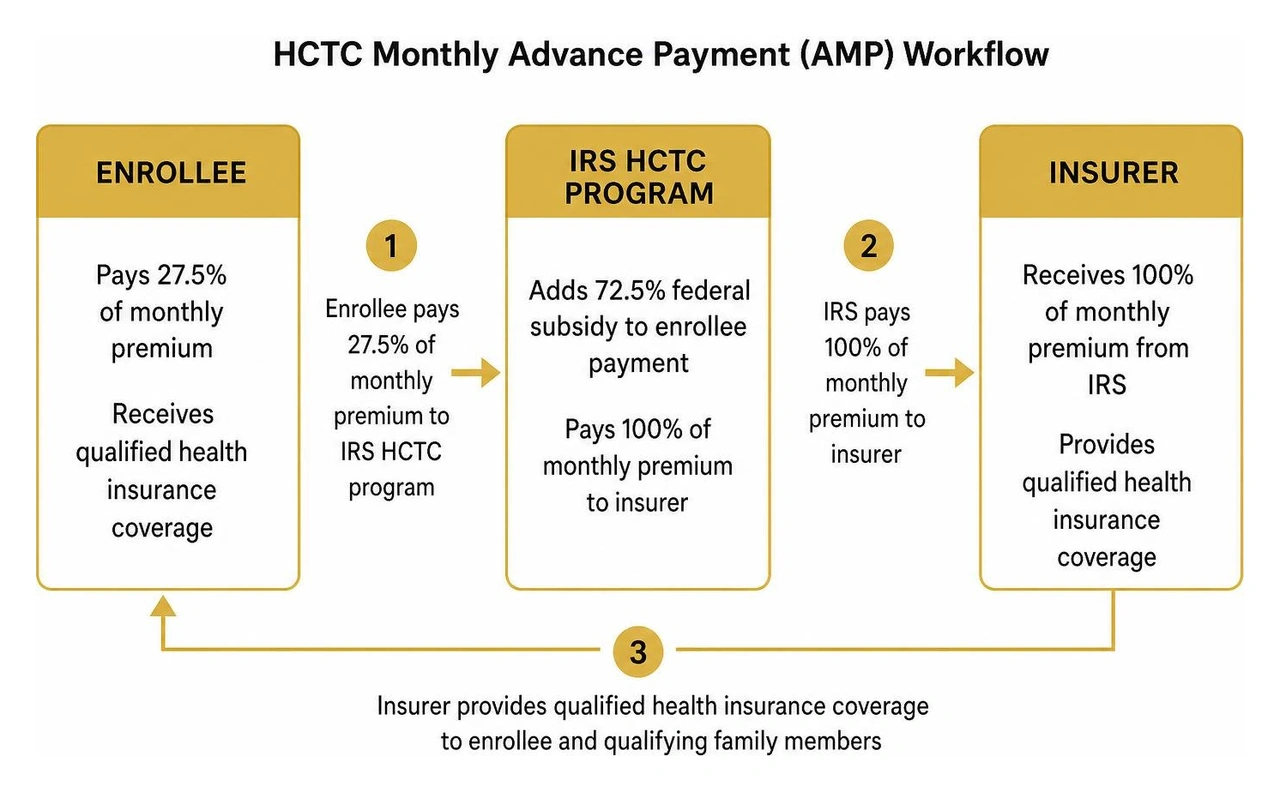
Eligible policyholders paid the remaining 27.5% out of pocket. Beneficiaries had two distinct methods to claim this benefit:
- Advance Monthly Payments (AMP): Participants sent their 27.5% share directly to the IRS HCTC program. The program then added the 72.5% federal subsidy and paid the full monthly premium directly to the health insurance administrator.
- Yearly Tax Filing: Policyholders paid 100% of their premiums throughout the year and claimed the 72.5% refundable credit when filing their annual tax returns. Because the credit was fully refundable, taxpayers received the full monetary balance even if they had zero total income tax liability.
The program provided substantial support during trade-related dislocations. For tax year 2018 alone, 18,970 tax returns claimed the HCTC, totaling approximately $16.4 million in benefits. Despite its utility, Congress did not reauthorize the program, and it officially expired on January 1, 2022. It cannot be claimed for subsequent coverage periods, including tax year 2026.
Eligible Plan Categories and Statutory Requirements
To claim the subsidy, coverage had to fit into one of eleven statutory categories outlined in the IRS Health Coverage Tax Credit Program Kit. These categories were divided into two main classifications: automatically qualified plans and state-qualified health plans.
| Plan Classification | Plan Category Examples | Core Statutory Requirements |
|---|---|---|
| Automatically Qualified Plans | COBRA, qualifying spousal employer plans, individual non-group policies (in place prior to job loss), VEBA trust arrangements | Employer contribution must be under 50%; policy must be active and compliant with federal guidelines. |
| State-Qualified Plans | State continuation coverage, high-risk pools, state employee health pools, local purchasing alliances | Must meet 4 consumer protections: guaranteed issue, no pre-existing condition limits, premium parity, and benefit equivalence. |
Regardless of the plan type, a core requirement was that the employer could not pay 50% or more of the overall premium cost. If an employer contributed half or more, the plan immediately lost its status as qualified coverage. Furthermore, enrollees transitioning into state-qualified plans were required to maintain at least three months of continuous creditable coverage prior to enrollment.
Automatically Qualified vs. State-Approved HCTC Qualified Health Insurance
The division between automatic and state-approved plans determined the administrative hurdles an enrollee had to clear. Automatically qualified plans met statutory standards under federal law without requiring individual state certification.
In contrast, state-qualified plans required the state insurance commissioner or relevant state agency to formally certify that the health insurance option met four mandatory consumer protections:
- Guaranteed Issue: The insurer had to accept any qualifying applicant regardless of medical history.
- No Pre-existing Condition Exclusions: The plan could not exclude or limit coverage for pre-existing medical conditions.
- Premium Parity: Premiums for qualifying individuals could not be higher than the standard rates charged to similarly situated individuals who were not receiving the credit.
- Benefit Equivalence: Benefits offered had to be substantially identical to standard health coverage options.
Rules for COBRA, Spousal Coverage, and VEBA Arrangements
Specific guidelines applied to the most common automatically qualified plans:
- COBRA Continuation Coverage: Qualified beneficiaries needed a valid COBRA election letter. As noted by the Health Coverage Tax Credit (HCTC) resources from the PBGC, COBRA was only eligible if the former employer paid less than 50% of the premium cost.
- Spousal Group Coverage: If a displaced worker obtained coverage through a spouse's employer-sponsored policy, it qualified only if the employer contributed less than 50% of the total premium. The employee-paid portion (the remaining 50%+) had to be paid with post-tax dollars, as pre-tax payroll deductions could not be subsidized by federal tax credits.
- Voluntary Employees' Beneficiary Associations (VEBA): Coverage established under a VEBA trust created through a Chapter 11 bankruptcy settlement was automatically qualified, provided it met IRS structural criteria.
Excluded Coverage, Separate Benefits, and ACA Marketplaces
The statutory framework explicitly excluded several common forms of healthcare coverage. Individuals enrolled in public healthcare programs or receiving alternate government health subsidies could not participate in the HCTC program.
Non-Qualifying Plans and HCTC Qualified Health Insurance Exclusions
According to IRS guidance in General Information, the following coverage types were strictly non-qualifying:
- ACA Marketplace Policies: Health insurance purchased through the Health Insurance Marketplace (Healthcare.gov or state exchanges) was disqualified to prevent dual-subsidization under Section 36B Premium Tax Credits.
- Medicare: Individuals enrolled in Medicare Part A, Part B, or Medicare Advantage were ineligible.
- Medicaid and CHIP: Government-subsidized healthcare coverage through Medicaid or the Children's Health Insurance Program was excluded.
- Military and Federal Plans: TRICARE, the Civilian Health and Medical Program of the Department of Veterans Affairs (CHAMPVA), and the Federal Employees Health Benefits Program (FEHBP) disqualified enrollees.
- Dependent Filers: Any individual claimed as a dependent on another taxpayer's federal income tax return could not claim the credit.
Handling Standalone Vision, Dental, and Non-Qualified Benefits
The credit applied exclusively to medical coverage. If a health policy bundled non-qualified benefits—such as standalone dental, vision, life insurance riders, or disability income features—those premium amounts had to be unbundled.
Health plan administrators were required to provide an itemized billing statement that separated the qualified comprehensive medical portion from the ancillary riders. Only the medical portion was eligible for the 72.5% subsidy rate; the policyholder was responsible for 100% of the non-qualifying add-on premiums.
Claiming the Credit: IRS Form 8885 and Documentation

Claiming the credit retroactively on an annual tax return required completing IRS Form 8885 (Health Coverage Tax Credit) and attaching it to Form 1040. As highlighted in the state guide LEO - Fact Sheet 108 Health Coverage Tax Credit, strict substantiation rules applied.
Taxpayers had to compile:
- Proof of Eligibility: Letters from the Department of Labor confirming Trade Adjustment Assistance (TAA/TRA/ATAA/RTAA) certification or benefit statements from the PBGC.
- Invoices and Billing Records: Premium invoices matching each month of claimed coverage.
- Proof of Payment: Bank statements, canceled checks, or electronic transfer receipts proving the taxpayer actually paid the premiums out of pocket.
- Form 1099-H Reconciliation: For advance payment recipients, the IRS issued Form 1099-H (Health Coverage Tax Credit Advance Payments), documenting all federal payments disbursed directly to the insurer per the Health Plan Administrator Operations Guide.
Navigating Healthcare Transitions and Michigan Insurance Rights
Understanding the classification of your health insurance matters beyond federal tax credits. In Michigan, the structure of your private health insurance plan directly impacts your rights when navigating medical billing disputes, disability benefits, and motor vehicle accident claims.
Under Michigan law, healthcare policies interact directly with auto coverage through Michigan No-Fault Insurance Benefits. When purchasing auto insurance, Michigan drivers often choose between "coordinated" and "uncoordinated" Personal Injury Protection (PIP) medical coverage.
A coordinated policy requires your private health insurance to act as the primary payer for accident injuries, while auto PIP covers out-of-pocket balances like deductibles and copays. If your health insurance policy excludes auto accident injuries or contains restrictive coordination clauses, significant payment delays can occur.
At Liss, Shapero & Mitnick, our legal team leverages former insurance-defense experience to advocate for injured individuals facing complex insurance disputes after personal injury. When injuries occur, managing overlapping coverage requires clear strategies for coordinating medical bills with pending health insurance liens. Evaluating these terms during year-end insurance policy reviews ensures your family avoids coverage gaps across private health and auto policies.
Frequently Asked Questions About HCTC Qualified Health Insurance
Can I claim the HCTC for health insurance purchased through the ACA Health Insurance Marketplace?
No. Health insurance plans purchased through the ACA Health Insurance Marketplace were excluded from the HCTC. Federal law prohibited individuals from claiming both the Section 35 HCTC and the Section 36B Premium Tax Credit for the same coverage period.
Does COBRA coverage automatically qualify for the HCTC subsidy?
COBRA continuation coverage qualified as an automatically approved plan category, but only if the former employer paid less than 50% of the total premium cost. The beneficiary also had to maintain an official COBRA election notice and prove that the remaining premium was paid out of pocket.
Can the HCTC be claimed for current tax years like 2026?
No. The statutory authorization for the Health Coverage Tax Credit expired on January 1, 2022. It cannot be claimed for coverage months in tax year 2026 or any other tax period after 2021.
Conclusion
The Health Coverage Tax Credit provided a critical 72.5% subsidy for displaced workers and pension recipients navigating employment transitions. While the program sunset on January 1, 2022, understanding how health plan structures and federal regulations operate is essential when reviewing past coverage, resolving legacy tax filings, or coordinating benefits.
Today, managing private healthcare changes requires a clear view of how your medical policy interacts with state protections, particularly when coordinating health insurance with Michigan no-fault coverage. If you or a loved one are facing complex coverage denials, unpaid medical liens, or personal injury claims in Metro Detroit or across Michigan, contact Liss, Shapero & Mitnick to ensure your legal rights and benefits remain fully protected.