.svg)
Download the Official Michigan Motor Vehicle Code PDF First

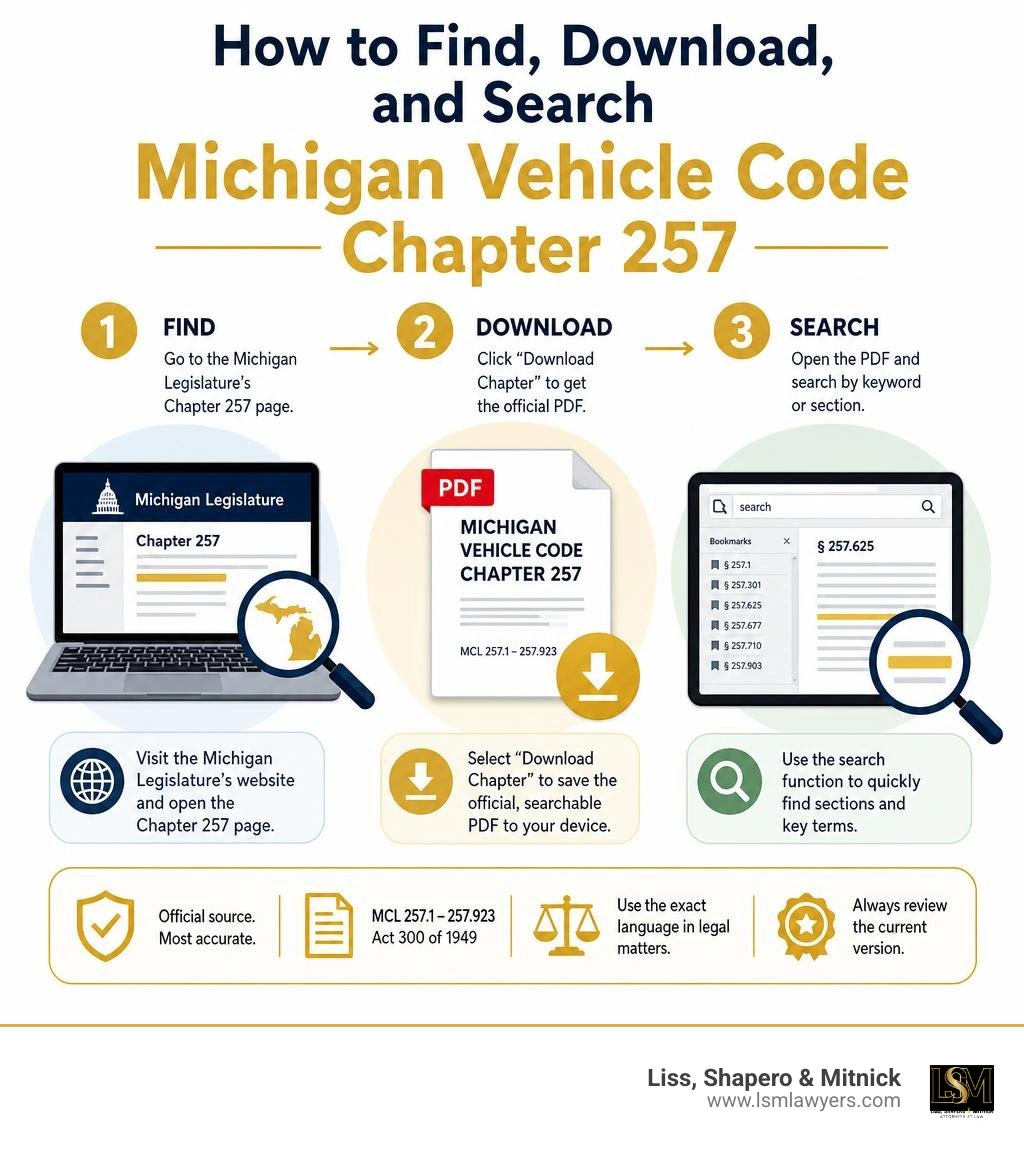
To get the current Michigan Motor Vehicle Code PDF, visit the Michigan Legislature's Chapter 257 page and select Download Chapter. The official file is free, searchable, and is the safest version to use when you need the actual legal text.
Chapter 257, also called the Michigan Vehicle Code, is Act 300 of 1949. It runs from MCL 257.1 through 257.923 and covers the rules that affect everyday drivers: licensing, registration, road rules, OWI, vehicle equipment, parking, towing, and more.
If a crash, ticket, impound, or insurance dispute is involved, do not rely only on a summary online. Find the exact section, check its amendment history, and read the current language. Small details - including notice deadlines and legal definitions - can matter.
This guide shows you how to download and search the PDF without having to read hundreds of pages from start to finish.
How to Legally Access and Download the Official Michigan Motor Vehicle Code PDF
When legal questions come up after a ticket, an impoundment, or a collision, looking at secondary summaries can sometimes lead to confusion. Obtaining the official text directly from the State of Michigan gives you the exact statutory language applied in local district courts across Berkley, Metro Detroit, and the entire state.
The primary home for state legislation is the Michigan Legislature's digital repository. To download the complete statute directly:
- Navigate to the official state portal hosting MCL - Chapter 257 - Michigan Legislature.
- Look for the "Download Chapter" button located near the top of the chapter index.
- Save the resulting PDF file to your local drive for offline searching.
Always make sure you are accessing an authentic .mi.gov domain. Third-party repositories often host outdated versions that miss critical legislative changes enacted in recent years.
Navigating the Michigan Motor Vehicle Code PDF Structure and Chapters
Opening the full Chapter 257 document can feel overwhelming. Spanning hundreds of pages, the compiled statutes for Act 300 of 1949 run from Section 257.1 through Section 257.923.
The document is organized into distinct statutory chapters and subject areas:
- MCL 257.1 to 257.82: Words and Phrases Defined (the statutory dictionary for vehicles, roads, and operators).
- MCL 257.201 to 257.259: Administration, Registration, Titling, and Anti-Theft Measures.
- MCL 257.301 to 257.329: Operator and Chauffeur License Issuance, Cancellation, Suspension, and Revocation.
- MCL 257.601 to 257.750: Rules of the Road, Accidents, Traffic Control, and Equipment Mandates.
- MCL 257.901 to 257.923: Penalties, Civil Infractions, and Miscellaneous Administrative Provisions.
Using your PDF reader's built-in search tool (Ctrl + F or Cmd + F) allows you to quickly locate specific numeric references or keywords rather than scrolling page by page.
Key Updates and Recent Legislation in the Michigan Motor Vehicle Code PDF
The Vehicle Code is not static; the Michigan Legislature regularly amends Chapter 257 to reflect evolving technology and transportation models. Over twenty separate statutory acts now integrate into or alongside this framework.
A major addition includes the Peer-to-Peer Car Sharing Program Act (Act 223 of 2024), which created standardized regulatory requirements, insurance frameworks, and consumer safety rules for modern peer-to-peer vehicle sharing platforms.
Additionally, the code features extensive legal definitions and framework rules for autonomous technology, such as:
- Automated Driving Systems (MCL 257.2b): Hardware and software capable of performing the complete dynamic driving task without human oversight.
- Automated Vehicle Roadways: Designated highway segments engineered and authorized for automated fleets.
- Liability and Insurance Mandates: Requiring up to $10,000,000 in insurance bonds for manufacturers testing automated vehicles on Michigan roadways.
Statutory Definitions: Classifying Vehicle Types Under Chapter 257
In any legal matter involving traffic enforcement or roadway collisions, statutory definitions dictate which rules apply. Under the primary definitions in 257.1 Michigan vehicle code; words and phrases defined, how a machine is built and powered determines licensing prerequisites, helmet requirements, and standard equipment rules.
Mopeds, Autocycles, and School Bus Classifications
The code breaks smaller, specialized, and public transit vehicles into exact classifications:
- Mopeds (MCL 257.32b): Defined as a 2- or 3-wheeled vehicle equipped with an engine not exceeding 50 cubic centimeters piston displacement, producing no more than 2 brake horsepower, and unable to exceed 30 mph on level ground.
- Autocycles (MCL 257.25a): An autocycle features three wheels in contact with the ground, a steering wheel, safety belts, a roll bar or cage, and seating that does not require the driver to straddle it. Because of these safety features, riders are treated differently than traditional motorcyclists regarding helmet requirements.
- School Buses (MCL 257.57): Defined specifically as a commercial motor vehicle with a manufacturer's rated seating capacity of 17 or more passengers (including the driver), dedicated to transporting children to and from school or related educational activities.
Exclusions from the Definition of a Motor Vehicle
Under MCL 257.33, the state broadly defines a "motor vehicle" as any vehicle that is self-propelled. However, legislative amendments have carved out key statutory exclusions. Devices that are not motor vehicles under this section include:
- Electric personal assistive mobility devices.
- Power-driven mobility devices designed for individuals with mobility disabilities.
- Electric bicycles (Class 1, 2, and 3).
- Electric skateboards and low-speed scooters.
- Commercial quadricycles (such as pedal-powered multi-passenger pub crawlers).
- Industrial machinery, including front-end loaders, backhoes, and forklifts operating within work areas.
Because these devices fall outside the standard motor vehicle definition, their users are governed by separate regulatory chapters and distinct insurance liability structures.
Critical Rules of the Road: OWI Thresholds, Implied Consent, and Commercial Driver Sanctions
Operating While Intoxicated (OWI) remains one of the most strictly enforced sections of the Michigan Vehicle Code. Understanding statutory limits and chemical test requirements is crucial, especially when evaluating motor vehicle accident liability and applying comparative fault rules in crash claims.
Bodily Alcohol Content Limits and Zero Tolerance
Michigan law defines alcohol limits across several categories based on age and vehicle type:
| Driver Category | Statutory Bodily Alcohol Content (BAC) Limit | Primary Legal Statute |
|---|---|---|
| Standard Adult Driver | 0.08 grams per 100 ml blood (0.10 statutory presumption) | MCL 257.625(1) |
| High BAC ("Super Drunk") | 0.17 grams per 100 ml blood or higher | MCL 257.625(1)(c) |
| Minor (Under 21 Years Old) | 0.02 grams per 100 ml blood (Zero Tolerance) | MCL 257.625(6) |
| Commercial Motor Vehicle | 0.04 grams per 100 ml blood | MCL 257.625m |
Under Michigan's "Zero Tolerance" law for drivers under 21, having a BAC of 0.02 to 0.07 results in civil penalties, up to 360 hours of community service, and fines up to $500, alongside license sanctions.
Refusing a Chemical Test and CDL Penalties
By driving on a Michigan roadway, state law presumes you have given consent to chemical testing (breath, blood, or urine) if an officer has reasonable cause to believe you were driving while impaired.
Under the Offense Index Code and MCL 257.625d:
- Standard First Refusal: An automatic 6-month driver's license suspension and 6 points added to your master driving record.
- Standard Second Refusal (within 7 years): A 1-year driver's license suspension.
For Commercial Driver License (CDL) holders, the stakes are even higher. A first refusal to submit to a chemical test triggers a mandatory 1-year suspension of commercial vehicle group designations. A second refusal within a 10-year period results in a minimum 10-year revocation of the commercial endorsement, effectively ending a commercial driving career.
Stopping, Parking, and Abandoned Vehicle Procedures in Michigan
Parking violations and vehicle removals represent common interactions with Chapter 257. When crashes or property damage occur in connection with stationary vehicles, the statutory framework coordinates directly with Michigan no-fault insurance benefits and the fundamental differences between first-party benefits and tort claims.
Civil Infractions for Stopping, Standing, and Parking
Under the MICHIGAN VEHICLE CODE (EXCERPT) Act 300 of 1949 STOPPING, STANDING AND PARKING rules in MCL 257.674, parking infractions are treated as civil infractions rather than criminal charges.
Standard statutory parking rules include:
- Parallel Parking Alignment: Vehicles stopped on a two-way roadway must be parked with right-hand wheels parallel to and within 12 inches of the curb.
- Fire Hydrant Buffer: Parking within 15 feet of an active fire hydrant is strictly prohibited.
- Crosswalks & Sidewalks: Vehicles may not stop, stand, or park across a designated crosswalk, sidewalk, or within 20 feet of a marked crosswalk at an intersection.
- Disabled Parking Spaces: Parking in spaces reserved for persons with disabilities without displaying a valid state-issued disability placard or registration plate carries mandatory civil fines and towing costs.
Abandoned Vehicles and Private Property Impoundment Rules
The Michigan Vehicle Code establishes a precise, step-by-step process for declaring, tagging, and towing abandoned vehicles under MCL 257.252a.
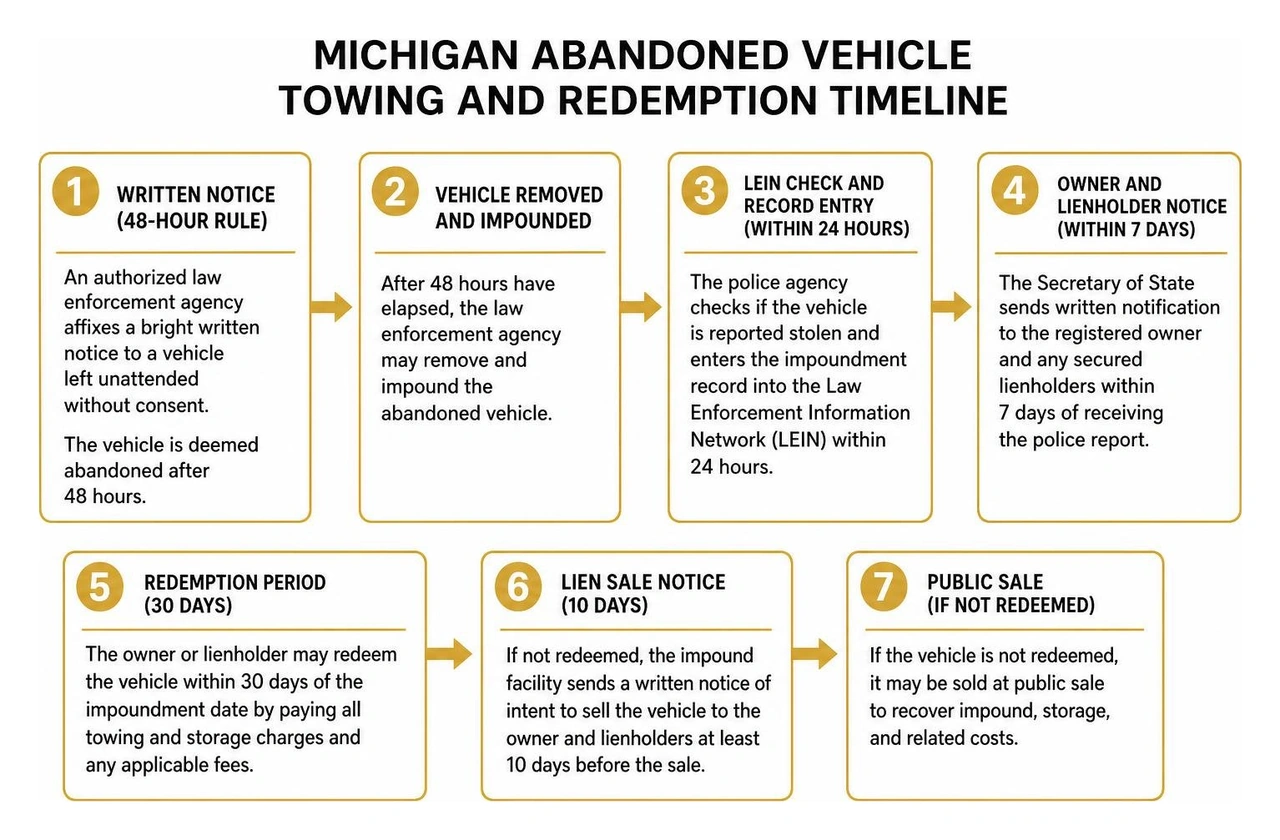
Under the statutory framework:
- 48-Hour Notice Standard: A vehicle left unattended on public or private property without consent is not immediately abandoned. An authorized law enforcement agency must first affix a bright written notice. The vehicle is officially deemed abandoned only after 48 hours have elapsed following that written notice.
- Law Enforcement Information Network (LEIN): Once removed, the police agency must check if the vehicle is reported stolen and enter the impoundment record into the LEIN system within 24 hours.
- Owner Notice: The Secretary of State sends written notification to the registered owner and secured lienholders within 7 days of receiving the police report.
- Scrap Vehicles & Hearings: For registered abandoned scrap vehicles, the owner has a 20-day window from the notice date to redeem the vehicle or file a petition in the local district court to challenge whether the vehicle was properly deemed abandoned or contest the towing and storage fees.
Private property owners seeking to remove unauthorized vehicles must work alongside registered towing agencies and local law enforcement to satisfy these strict statutory notice timelines before a vehicle can be legally scrapped or sold at public auction.
Frequently Asked Questions About the Michigan Vehicle Code
Where can I download the official Michigan Motor Vehicle Code PDF?
The complete and authenticated PDF can be downloaded directly from the Michigan Legislature portal by selecting the "Download Chapter" link. This document contains the entire statutory text from MCL 257.1 to 257.923.
What is the legal threshold for an OWI in Michigan?
Under MCL 257.625, an adult driver is legally intoxicated with a Bodily Alcohol Content (BAC) of 0.08 grams or higher per 100 milliliters of blood, with an evidentiary presumption of impairment at 0.10 grams. Drivers under 21 are subject to zero-tolerance rules starting at 0.02 grams, and commercial drivers face restrictions starting at 0.04 grams.
How long can a vehicle sit before being deemed abandoned under MCL 257.252a?
A vehicle is classified as abandoned under MCL 257.252a after it remains unattended on public or private property for 48 hours after a police agency affixes a formal written notice tag.
Conclusion
The Michigan Vehicle Code provides the foundation for road safety, licensing compliance, and liability across our state. When complex statutory violations result in collisions, injuries, or insurance denials, our team at Liss, Shapero & Mitnick applies our background in insurance defense strategies to help protect our clients' rights and secure fair compensation.
If you or a loved one has questions regarding crash liability, statutory violations, or insurance recovery, reach out to our experienced Michigan personal injury and premises liability attorneys today for a free legal consultation.