
Finding a Michigan Slip and Fall Attorney After an Injury

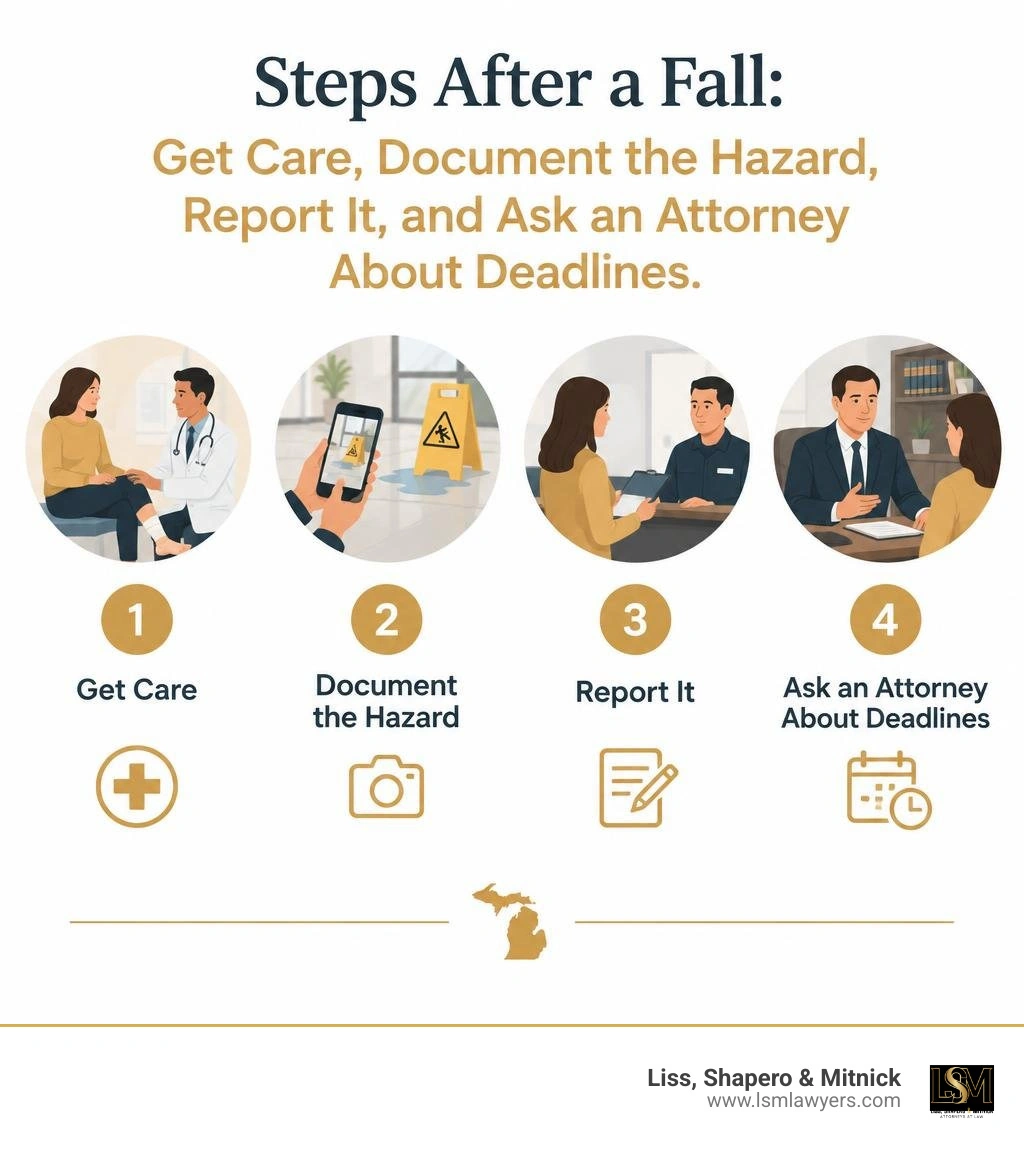
If you were hurt in a fall on someone else’s property, look for a Michigan slip and fall attorney who handles premises liability claims, investigates what the property owner knew about the hazard, and explains fees before you sign. Get medical care, photograph the scene, report the fall, and save witness information. Michigan generally gives you three years to file a personal injury lawsuit, but some claims have shorter notice deadlines.
I’m Anthony Shapero, managing partner at Liss, Shapero & Mitnick and a Michigan slip and fall attorney with experience litigating premises liability cases. I once represented insurers; now I use that insight to build strong cases for injured people and challenge defenses that could limit their recovery.
Michigan slip and fall attorney vocab explained:
Understanding Premises Liability and Fall Claims in Michigan

When you step onto commercial or residential property in Michigan, you have a reasonable expectation that the property owner has maintained a safe environment. When property owners cut corners, neglect dangerous walkway defects, or ignore hazardous winter conditions, devastating injuries can happen in an instant. Nationwide, slip and fall accidents remain the leading cause of emergency room visits, accounting for over one million hospital admissions every single year.
Under slip and fall law in Michigan, legal responsibility is rooted in the concept of premises liability. This legal framework dictates that a property possessor—whether a landlord, retailer, homeowner, or commercial enterprise—owes a legal duty of care to visitors entering the land. However, the precise standard of care owed depends directly on your legal classification at the time of your injury:
- Invitees: These are individuals who enter a property for commercial or business purposes, such as retail store customers, grocery shoppers, or dining patrons. Property owners owe invitees the highest duty of care under Michigan law, requiring them to actively inspect the premises, repair known dangers, and warn visitors of hidden hazards.
- Licensees: These are social guests or visitors who enter the property with the express or implied permission of the owner for non-commercial purposes. Property owners must warn licensees about hidden, dangerous conditions they know exist.
- Trespassers: Individuals who enter a property without permission or legal right generally receive minimal legal protections. Property owners owe trespassers only a duty to refrain from willful and wanton misconduct.
Navigating these distinct legal tiers requires a strategic approach. When insurance adjusters evaluate your claim, their primary goal is often to minimize your visitor status or claim that the owner owed no duty to protect you from the specific danger present.
Key Elements Required to Prove Property Owner Negligence
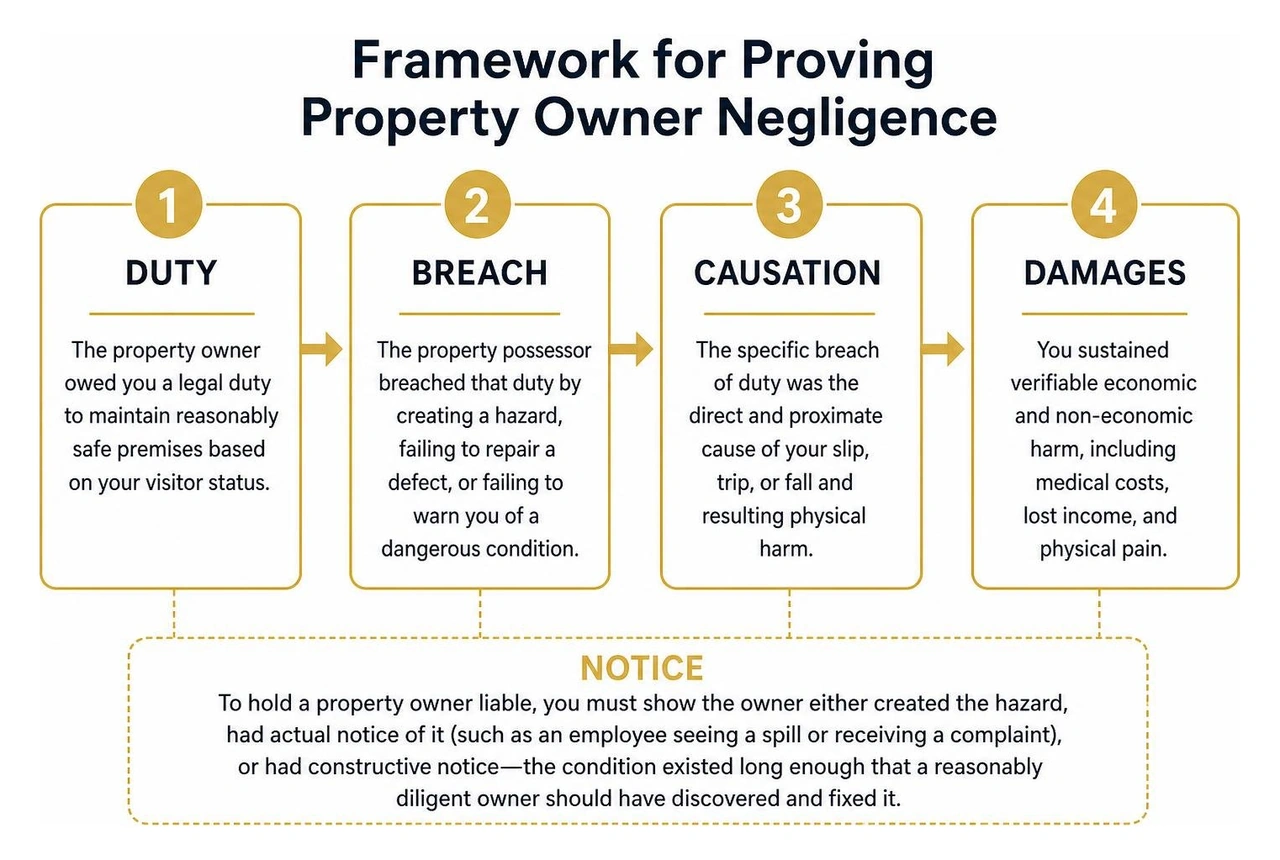
Securing compensation in a premises liability lawsuit is rarely as simple as proving that you fell and were injured. As outlined in our comprehensive Michigan slip and fall guide, your legal team must establish four core legal elements of negligence:
- Duty: The property owner owed you a legal duty to maintain reasonably safe premises based on your visitor status.
- Breach: The property possessor breached that duty by creating a hazard, failing to repair a defect, or failing to warn you of a dangerous condition.
- Causation: The specific breach of duty was the direct and proximate cause of your slip, trip, or fall and resulting physical harm.
- Damages: You sustained verifiable economic and non-economic harm, including medical costs, lost income, and physical pain.
A major battleground in these cases involves proving "notice." To hold a property owner liable, Michigan law requires evidence showing the owner either created the dangerous hazard, had actual notice of it (such as an employee seeing a spill or receiving an explicit customer complaint), or had constructive notice. Constructive notice means the dangerous condition existed for a sufficient length of time that a reasonably diligent property possessor exercising ordinary care should have discovered and resolved it before your fall occurred.
Common Hazards: Winter Conditions and Store Defects
Premises liability incidents stem from a wide variety of structural defects and environmental hazards across Metro Detroit and Michigan. In commercial stores, dangerous conditions often develop rapidly during peak operational hours. Common indoor hazards include:
- Wet tile flooring caused by indoor plumbing leaks, ceiling drips, or mopping without adequate warning cones.
- Missing or saturated entryway mats that fail to absorb winter slush and rain dragged in by foot traffic.
- Sudden, unmarked changes in floor elevation, torn carpets, or loose transition strips.
- Obstructed aisles, misplaced inventory, and poorly illuminated stairwells or corridors.
Outdoor hazards are particularly dangerous throughout Michigan's harsh winters. Commercial parking lots and municipal sidewalks frequently turn into sheets of ice due to poor drainage design, defective downspouts, and negligent maintenance. Our team regularly assists clients dealing with severe injuries after encountering black ice in Michigan parking lots. When business owners fail to monitor freezing temperatures or delay salt applications, unsuspecting patrons face high risks of broken bones, spinal damage, and severe traumatic brain injuries. If you slipped on untreated ice outside a business or apartment complex, consulting an experienced icy sidewalk fall lawyer in Oakland County is essential to protecting your legal rights before critical evidence disappears.
How Michigan Law Impacts Your Slip and Fall Case
Successfully managing a slip and fall lawsuit requires an up-to-date understanding of Michigan's evolving premises liability jurisprudence. Insurance defense attorneys frequently rely on procedural defenses to shield property owners from financial accountability. Having handled premises liability practice from both sides of the courtroom, our firm anticipates these defensive strategies and constructs strong arguments grounded in the latest Michigan Supreme Court rulings, such as the landmark decision in Kandil-Elsayed v. F&E Oil, Inc. (MSC Docket No. 162907).
The Modern Open and Obvious Doctrine in Michigan
For over two decades, Michigan injury victims faced an uphill battle due to the traditional "open and obvious doctrine." Historically, if a defense attorney could argue that an average person of ordinary intelligence would have noticed the hazard upon casual inspection, judges routinely dismissed the entire lawsuit at the summary disposition stage, ruling that the property owner owed no legal duty whatsoever.
Fortunately, Michigan premises liability law underwent a major shift. The Michigan Supreme Court clarified how open and obvious applies in modern injury litigation. Today, the open and obvious nature of a condition is no longer an automatic bar to an owner's initial duty of care. Instead, whether a hazard was visible and apparent is evaluated as part of comparative fault and whether the property owner breached their standard of care.
Under this modern framework, even if an icy walkway or broken step appeared noticeable, a commercial landlord or business owner may still be held legally liable if they failed to take reasonable precautions to protect visitors from foreseeable danger.
Comparative Fault and the Statute of Limitations
Michigan follows a system of modified comparative fault (often referred to as the 51% rule). Under MCL 600.2959, an injured person's financial compensation is reduced in direct proportion to their percentage of responsibility for the incident. If a jury determines you bear some fault for your fall—such as looking down at your phone while walking—your final damage award will be adjusted accordingly.
Crucially, if your assigned fault is determined to be 51% or greater, Michigan law completely bars you from recovering non-economic damages, such as compensation for pain, suffering, and loss of enjoyment of life.
| Assigned Fault Percentage | Jury Verdict Award | Adjusted Recovery for Victim | Legal Outcome |
|---|---|---|---|
| 0% Plaintiff Fault | $200,000 | $200,000 | Full financial compensation |
| 20% Plaintiff Fault | $200,000 | $160,000 | Recovery reduced by 20% |
| 45% Plaintiff Fault | $200,000 | $110,000 | Recovery reduced by 45% |
| 51% or Greater Fault | $200,000 | $0 Non-Economic | Non-economic damages barred entirely |
In addition to comparative fault rules, you must comply with strict filing deadlines. Under Michigan's general statute of limitations (MCL 600.5805), you have three years from the exact date of your injury to file a personal injury lawsuit against a private property owner. If you miss this three-year window, the court will permanently dismiss your case.
Furthermore, if your fall occurred on public property maintained by a municipal, county, or state government agency, you may be subject to strict statutory notice requirements—sometimes requiring formal written notice of the hazard and your injuries within just 120 days.
Critical Steps and Evidence to Preserve After an Injury

The actions you take immediately following a slip and fall accident directly impact the viability and strength of your subsequent legal claim. Because physical hazards such as liquid spills, ice accumulations, and temporary construction defects are quickly cleaned or altered by property owners, gathering immediate evidence is crucial.
If you are physically able to do so safely, take the following steps:
- Obtain Immediate Medical Attention: Never refuse an emergency medical evaluation. Many serious fall injuries, including concussions, internal bleeding, and micro-fractures, do not present immediate symptoms due to adrenaline. Complete medical records provide objective proof of causation.
- Report the Incident Immediately: Notify the store manager, landlord, or security team. Insist that an official written incident report is filed and request a physical or digital copy for your records before leaving.
- Photograph the Scene and Hazard: Use your smartphone to capture high-resolution photos and videos of the hazard from multiple angles. Capture wide shots showing the absence of warning signs and close-ups showing ice texture, water depth, or walkway damage.
- Preserve Your Footwear and Clothing: Secure the exact shoes and clothing you were wearing during the fall inside an unwashed bag. Defense insurers frequently attempt to blame slips on worn footwear treads.
- Collect Witness Contact Information: Gather names, phone numbers, and addresses of any eyewitnesses who observed your fall, noticed the hazard earlier, or heard store employees discuss the condition.
- Seek Guidance on Evidence Preservation: A seasoned attorney can immediately issue formal spoliation letters. You can learn more about preserving evidence after a store slip and fall to ensure security camera footage is not overwritten.
Investigating Maintenance and Snow Removal Liability
Determining every liable party in a commercial fall requires thorough investigation. Commercial real estate properties often utilize third-party facility managers, snowplow vendors, and janitorial services. Reviewing sidewalk snow removal liability rules helps identify whether liability rests with the property owner, a commercial tenant, or an independent contractor.
Securing commercial maintenance records is essential. During formal discovery, our legal team analyzes plow and salt maintenance logs alongside historical weather records to determine whether snow removal contractors met contractual clearing schedules and applied appropriate de-icing treatments.
Why Hiring a Michigan Slip and Fall Attorney Maximizes Your Recovery
Attempting to negotiate a slip and fall claim directly with a commercial liability insurer often leaves injured victims at a serious disadvantage. Insurance adjusters are trained negotiators whose performance is measured by how little money their company pays out on claims. They routinely utilize recorded statements, complex medical record authorizations, and aggressive comparative fault allegations to undervalue or outright deny legitimate claims.
Retaining an experienced premises liability lawyer in Berkley levels the playing field. At Liss, Shapero & Mitnick, our attorneys leverage their deep background in insurance defense strategies to anticipate the insurer's playbook. We build robust evidence files that demonstrate clear liability and calculate the true lifetime financial impact of your physical injuries, protecting you from premature, lowball settlement offers.
Over 20% of slip and fall accidents result in lost work time, with the average cost per workers' compensation claim for a fall exceeding $40,000 in Michigan. When injuries require extensive orthopedic surgery, physical rehabilitation, or cause long-term disability, settlement values reflect that severity:
- Economic Damages: Past and future medical bills, physical therapy costs, out-of-pocket medical supplies, prescription medications, lost wages, and loss of future earning capacity.
- Non-Economic Damages: Physical pain, mental anguish, physical impairment, permanent scarring or disfigurement, and loss of the ability to enjoy everyday family activities.
What to Expect When You Retain a Michigan Slip and Fall Attorney
When you partner with a dedicated slip and fall attorney in Berkley, Michigan, our firm handles every aspect of your legal case so you can concentrate entirely on your physical rehabilitation:
- Comprehensive Case Investigation: We obtain surveillance videos, interview eyewitnesses, inspect the accident scene, and analyze municipal code compliance.
- Expert Witness Retention: When necessary, we collaborate with biomechanical engineers, human factors specialists, floor safety testers, and medical experts to demonstrate how the property hazard caused your injury.
- Insurance Defense Countermeasures: We manage all correspondence with insurance carriers, insulating you from manipulative questioning while countering comparative fault arguments.
- Trial-Ready Litigation: If the insurance company refuses to offer a full and fair settlement that covers your losses, we file a formal complaint in circuit court and present your case before a Michigan jury.
Key Questions to Ask a Prospective Michigan Slip and Fall Attorney
Before selecting legal counsel for your premises liability case, schedule a consultation and ask these critical questions:
- Do you specialize in personal injury and premises liability litigation? Premises liability law contains nuanced evidentiary burdens distinct from standard negligence claims.
- What is your experience with insurance defense tactics? Attorneys who understand how defense adjusters and insurance defense firms evaluate risk can better position your case for maximum recovery.
- Do you take cases to trial if insurers refuse fair settlements? Insurance companies know which lawyers settle cheaply and which firms are prepared to go to verdict.
- How does your contingency fee agreement work? You should always receive clear, written terms explaining how legal fees and case expenses are handled upon successful recovery.
Frequently Asked Questions About Michigan Slip and Fall Claims
What is the average settlement for a slip and fall in Michigan?
Settlement amounts for Michigan slip and fall claims vary based on liability clarity, available insurance policy limits, and the severity of your injuries. Settlements for moderate soft-tissue injuries or short-term sprains typically range from $15,000 to $50,000.
However, cases involving catastrophic injuries—such as fractured hips, torn ligaments requiring reconstructive surgery, herniated discs, or traumatic brain injuries—routinely settle or result in verdicts exceeding $500,000 to account for long-term medical care and substantial lost wages.
How long do I have to file a slip and fall lawsuit in Michigan?
Under Michigan Compiled Laws § 600.5805, the general statute of limitations for filing a personal injury slip and fall lawsuit is three years from the exact date of your accident.
However, if your injury occurred on government-owned property (such as a defective public sidewalk maintained by a city), strict municipal notice provisions may require a formal statutory notice letter to be filed within 120 days of the incident. Failing to meet these statutory deadlines will permanently eliminate your right to pursue legal compensation.
What does it cost to hire an attorney for a slip and fall case?
At Liss, Shapero & Mitnick, our slip and fall attorneys operate entirely on a contingency fee basis. This means:
- You pay zero upfront retainers or out-of-pocket legal fees.
- Our firm advances all litigation expenses, including filing fees, expert witness costs, and medical record retrieval.
- We only receive payment if we successfully recover compensation on your behalf through an out-of-court settlement or a court verdict. If we do not win your case, you owe us nothing in attorney fees.
Conclusion
A serious slip and fall accident can derail your life in seconds, leading to mounting medical bills, lost wages, and chronic physical pain. You do not have to confront corporate property owners and aggressive insurance adjusters alone.
At Liss, Shapero & Mitnick, we utilize our foundational knowledge of insurance defense tactics to protect your rights, defeat comparative fault allegations, and fight for every dollar you deserve. Contact us today to schedule a personal injury consultation and discuss your case directly with our legal team.
— Anthony Shapero, Managing Partner at Liss, Shapero & Mitnick