.svg)
What Counts as Qualified Health Coverage in Michigan?

For Michigan auto insurance, qualified health coverage generally means a health plan that covers injuries from car accidents and has a deductible within the state's current limit. Medicare Parts A and B together can also qualify. An Affordable Care Act qualified health plan is not automatically qualified health coverage under Michigan's no-fault rules.
Before changing your personal injury protection (PIP) coverage, ask your health insurer for a letter confirming whether your plan qualifies. Check the letter for every person on your auto policy whose coverage matters to your PIP choice. A coverage mistake can leave you facing medical bills after a crash.
I'm Scott Mitnick, a partner at Liss, Shapero & Mitnick. For more than 20 years, I've handled Michigan auto negligence and insurance cases, including disputes where qualified health coverage affects who pays for care.
Understanding Qualified Health Coverage and Legal Standards
Navigating healthcare terminology can sometimes feel like trying to assemble complex furniture without the manual. At its core, federal law creates specific baselines for what makes an insurance policy comprehensive, safe, and certified.
Under federal guidelines, qualified plans must satisfy strict statutory benchmarks rather than just catchy marketing slogans. Specifically, the 42 U.S. Code § 18021 definitions outline that a qualified health plan must obtain formal certification through an established Health Benefit Exchange, provide a standardized package of essential benefits, and be underwritten by a licensed carrier that maintains good regulatory standing.
Furthermore, federal statutes separate broad, comprehensive health plans from limited, standalone products. Under the federal statutory definitions under 26 USC 9832, non-excepted benefits represent full-scale medical care, distinguishing true major medical coverage from narrow policies like accident-only or travel insurance.
Mandatory Criteria for Qualified Health Coverage Plans
To earn and keep official certification, plans must adhere to clear financial frameworks, predictable rating areas, and strict limits on out-of-pocket spending. Carriers cannot arbitrarily alter pricing from one consumer to another; uniform premium rules require issuers to charge identical rates for the same plan whether a consumer purchases it through an Exchange, directly from the insurer, or via an independent agent.
Plans are categorized into actuarial tiers—often referred to as metal levels—which define the percentage of total covered healthcare expenses the insurer pays versus what you contribute out-of-pocket:
| Metal Tier | Actuarial Value (Plan Pays) | Typical Consumer Cost-Sharing | Primary Target Audience |
|---|---|---|---|
| Bronze | ~60% | Highest deductibles & copays; lowest monthly premiums | Individuals seeking catastrophe protection |
| Silver | ~70% | Moderate deductibles; eligible for cost-sharing reductions | Balance of monthly premium and routine care costs |
| Gold | ~80% | Lower deductibles & copays; higher monthly premiums | Individuals anticipating regular treatments |
| Platinum | ~90% | Lowest out-of-pocket costs at point of service; highest premiums | High-utilization healthcare needs |
Under statutory rules, certified insurers operating on an Exchange must offer at least one silver-level and one gold-level option to guarantee meaningful consumer choice across standardized pricing structures.
Essential Health Benefits Covered by Qualified Health Coverage
Federal law mandates that certified comprehensive coverage cannot pick and choose which bodily systems to protect. Plans must include ten foundational benefit categories:
- Ambulatory Patient Services: Outpatient care received without being admitted to a hospital.
- Emergency Services: Immediate stabilization and critical care without prior authorization penalties.
- Hospitalization: Inpatient stays, surgeries, and acute recovery room care.
- Maternity and Newborn Care: Comprehensive pre- and post-natal support.
- Mental Health and Substance Use Disorder Services: Behavioral health treatments, counseling, and inpatient recovery.
- Prescription Drugs: Formularies spanning essential medications across generic and brand categories.
- Rehabilitative and Habilitative Services and Devices: Physical therapy, occupational therapy, and adaptive equipment.
- Laboratory Services: Diagnostic testing, imaging, and routine screening evaluations.
- Preventive and Wellness Services: Chronic disease management, vaccines, and annual checkups.
- Pediatric Services: Routine healthcare for children, explicitly including pediatric oral and vision care.
Checklist for Evaluating Qualified Health Coverage Options

Whether you are selecting a plan during an annual workplace window or shopping on the open market, evaluating coverage requires a careful look beyond monthly premium figures. In Michigan, understanding how your policy operates is also crucial when coordinating health insurance with Michigan no-fault auto protections.
Use this actionable checklist when comparing options:
- Deductible Benchmarks: Check whether individual and family deductibles align with state thresholds and personal emergency savings.
- Auto-Accident Exclusions: Read the fine print to confirm whether the plan restricts, limits, or excludes coverage for injuries arising from motor vehicle crashes.
- Network Adequacy: Ensure your preferred regional hospitals, specialists, trauma centers, and primary physicians participate in the plan's network.
- Out-of-Pocket Maximums: Verify the absolute financial ceiling you would have to pay in a single policy year during a major medical event.
- Prescription Formularies: Check whether your ongoing daily maintenance medications or specialized therapies are placed on affordable coverage tiers.
- Formal Documentation: Obtain written verification from the insurer detailing plan certification status.
Employer-Sponsored Group Plans vs. Individual Exchange Options
Large group health plans provided by private employers often deliver broad provider networks and shared premium contributions. However, many self-funded employer plans fall under federal ERISA regulations, meaning they can legally write exclusions for motor vehicle collision treatments or assert aggressive subrogation liens against legal settlements.
Individual Exchange plans, by contrast, offer standard consumer safeguards, structured metal tiers, and potential federal premium tax credits. While individual marketplace plans guarantee essential health benefits, their provider networks are often narrower (such as regional HMOs). Reviewing the plan's underlying network structure prevents unpleasant surprises when seeking specialized treatments.
Identifying Excepted Benefits and Excluded Policies
Not every policy that pays a medical bill is a true health insurance plan. Federal statutes classify several common insurance products as "excepted benefits," which means they do not have to provide essential health benefits or adhere to ACA cost-sharing rules:
- Accident-Only Policies: Plans that provide fixed, limited payouts solely for specified physical accidents.
- Hospital Indemnity & Disease-Specific Plans: Policies that pay a flat cash stipend per day of hospital confinement (e.g., $100/day) or for specific diagnoses like cancer.
- Standalone Dental and Vision: Narrow policies limited to routine cleanings, basic fillings, or corrective lenses.
- Disability Income Insurance: Wage replacement policies that provide income support while you are unable to work, without covering underlying medical bills.
Relying on excepted benefit policies to handle significant trauma care leaves massive coverage gaps that can disrupt your financial security.
Impact of Qualified Health Coverage on Injury Claims and Auto Insurance

In Michigan, your health insurance coverage directly connects with your auto policy. Following the reform of Michigan’s auto insurance laws, drivers can select different levels of personal injury protection (PIP) medical coverage on their auto policies—ranging from unlimited lifetime medical to capped tiers ($250,000 or $500,000), or even complete opt-outs in specific situations.
Understanding Michigan no-fault benefits after an accident is critical before making any election. If you select an auto PIP medical opt-out or cap under the assumption that your private health insurance will cover crash injuries, an overlooked auto exclusion in your health plan can leave you personally responsible for substantial hospital, surgical, and rehabilitation invoices.
When insurance disputes arise after a collision, determining who pays medical bills while a case is pending requires untangling competing insurance priority rules, contractual coordination clauses, and statutory health liens.
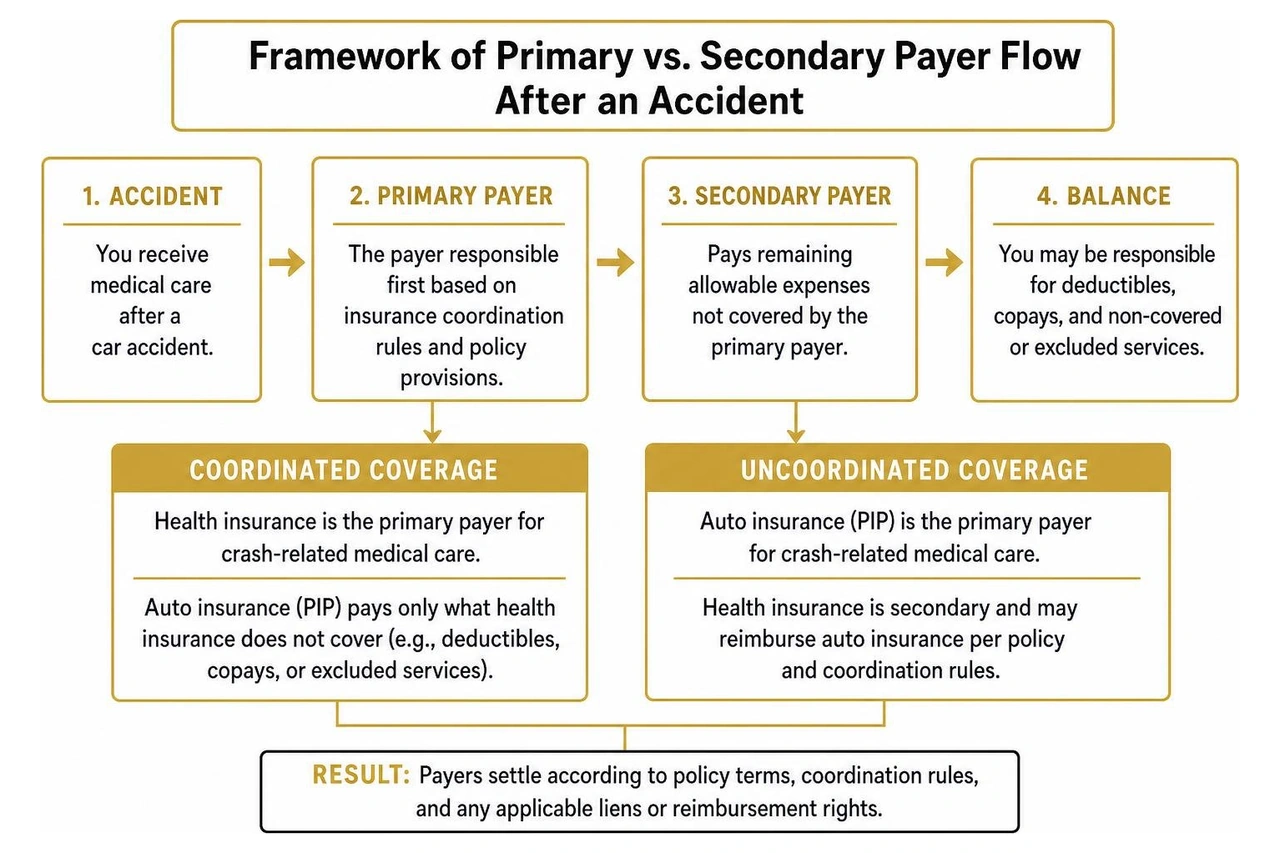
Coordinated vs. Uncoordinated Medical Coverage in Michigan
When purchasing auto insurance, Michigan drivers choose between coordinated and uncoordinated PIP medical benefits:
- Coordinated Coverage: Your private health insurance acts as the primary payer for crash-related medical care. Your auto insurer only pays allowable expenses not covered by your health plan (such as deductibles, copays, or specialized treatments excluded by your health insurer). Coordinated policies offer lower auto insurance premiums, but they require that your health insurance actually covers car accidents without restrictive caps.
- Uncoordinated Coverage: Your auto PIP insurer acts as the primary payer for all accident-related medical expenses from dollar one, regardless of what health insurance you carry. While auto premiums are slightly higher, uncoordinated coverage provides direct access to comprehensive no-fault protections and eliminates disputes between your auto and health carriers over who pays first.
Carefully evaluate how choosing coordinated vs uncoordinated health insurance affects no-fault protections before renewing your policies.
Open Enrollment Verification and Policy Adjustments
Your health coverage and auto insurance should never be treated as separate, disconnected matters. When your employer alters benefit plans during fall open enrollment, or when you switch individual marketplace policies, your auto insurance status must be reviewed simultaneously.
Conducting year-end insurance tune-ups and health plan changes ensures that any change in your deductible, health carrier, or plan exclusions does not inadvertently invalidate your auto insurance PIP selection.
Frequently Asked Questions About Qualified Health Coverage
How do I verify if my health plan meets qualified health coverage standards?
Do not rely on verbal statements from a human resources representative or insurance sales agent. Request a formal, written Qualified Health Coverage (QHC) confirmation letter directly from your health insurer's underwriting department. This document must state:
- The names of all covered family members.
- Whether the policy excludes or limits motor vehicle injury care.
- Whether individual deductibles comply with state-mandated caps.
What is the difference between qualified health coverage and excepted benefits?
Qualified health plans represent comprehensive major medical insurance meeting statutory requirements, including essential health benefits and capped out-of-pocket maximums. Excepted benefits (such as hospital indemnity plans, critical illness riders, and accident-only coverage) offer limited, supplemental financial payouts for specific events and do not cover broad hospital, trauma, or ongoing rehabilitative care.
Can I opt out of auto PIP medical coverage if I have qualified health coverage?
Under Michigan law, you may only opt out of auto PIP medical coverage if the named insured has Medicare (Parts A and B), and any spouse or resident relative on the policy has their own qualified health coverage or another auto policy with PIP medical benefits. Alternatively, individuals enrolled in Medicaid may select a $50,000 PIP option if qualifying household criteria are met. Opting out without verified, compliant health coverage exposes you and your family to severe financial liability if a crash occurs.
Conclusion
Making informed decisions about your health and auto insurance protections requires clear documentation, careful policy reading, and regular updates. Relying on assumptions about what an insurance card covers can lead to unexpected out-of-pocket expenses following an accident.
As former insurance defense attorneys, our team at Liss, Shapero & Mitnick understands the tactics insurance carriers use to deny, delay, and coordinate away their payment obligations. We put that insider knowledge to work for injured individuals across Berkley, Metro Detroit, and all of Michigan, helping ensure accident victims receive the medical care and financial compensation they deserve.
Take the time to review your health and auto policies together. For further insight on safeguarding your rights, read our guide on navigating open enrollment and coordinating health insurance with Michigan no-fault or reach out to our team for a free consultation regarding your coverage questions.