
How to Get Ready for an Accident Attorney Consultation

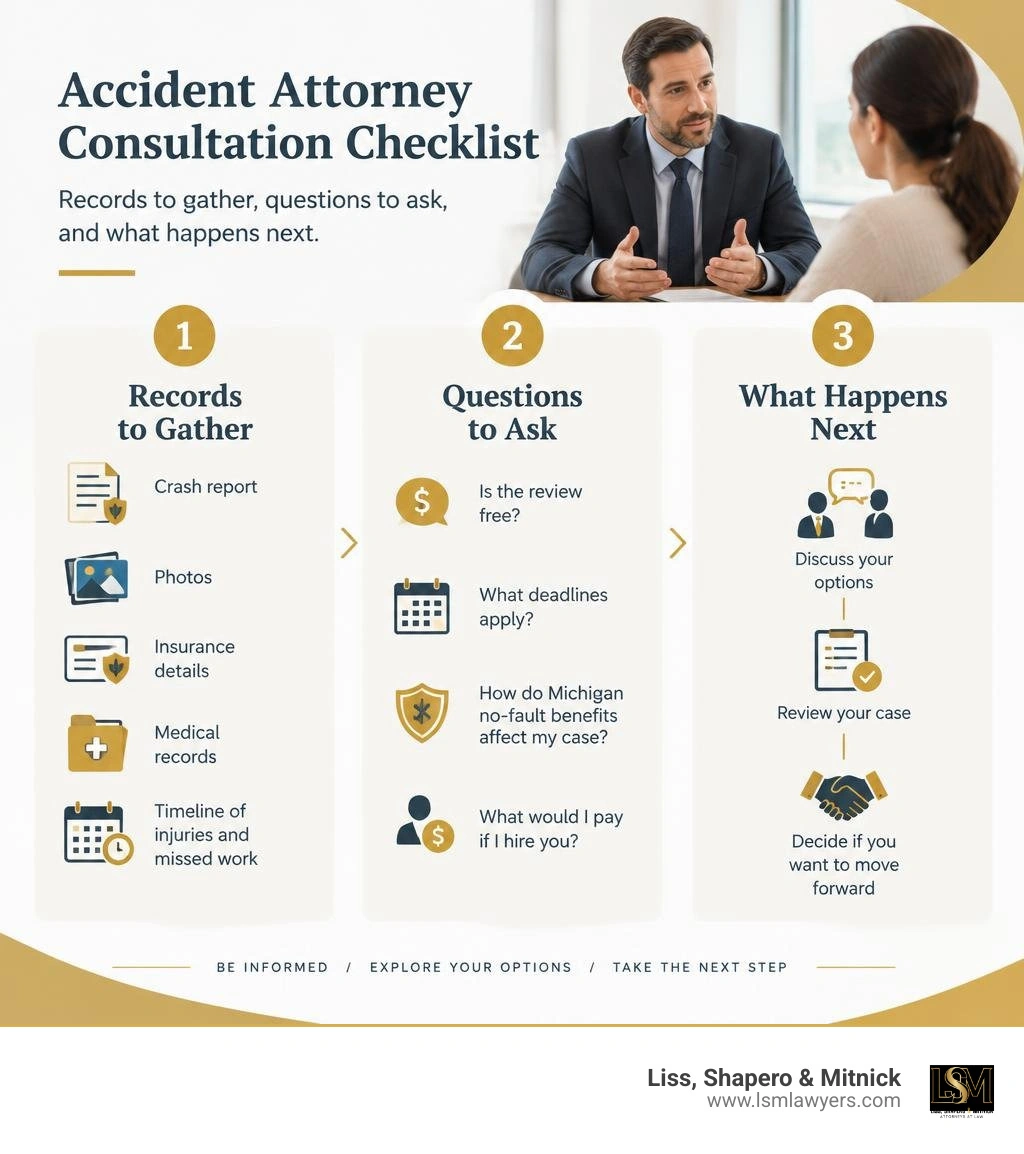
To prepare for an accident attorney consultation, gather what you have: the crash report, photos, insurance details, medical records, and a short timeline of your injuries and missed work. You do not need a complete file to make the call. Ask whether the review is free, what deadlines apply, how Michigan no-fault benefits affect your case, and what you would pay if you hire the attorney. A consultation lets you discuss your options; it does not commit you to hiring anyone.
I’m Anthony Shapero, managing partner at Liss, Shapero & Mitnick. I began my career defending insurers, and I use that experience in every accident attorney consultation to help injured Michiganders spot claim risks and understand their next steps.
Quick accident attorney consultation definitions:
What an accident attorney consultation covers
Think of the first meeting as a map-reading session. We look at what happened, who may be responsible, what insurance is in play, which deadlines apply, and what compensation may be possible. You leave knowing where you stand, and you owe nothing for the conversation.
What is a car accident claim, and how is negligence proven?
A car accident claim is a personal injury claim. You are saying another party's carelessness caused your harm. To prove negligence, we show four things:
- The other driver owed you a duty of care, meaning a duty to drive safely.
- They breached that duty, for example by texting, speeding, or running a light.
- The breach caused the crash and your injuries.
- You suffered real damages, such as medical bills or lost income.
The police report and witness accounts often carry a lot of weight on these points, so tell us who saw what.
How to prepare for an accident attorney consultation
You do not need a perfect folder. Bring what you can:
- Accident details: date, place, weather, and what you remember
- An injury timeline: symptoms, treatment, and missed work
- Insurance information: your policy and any letters from adjusters
- Medical records and bills
- Photos of the scene, vehicles, and injuries
- A list of questions for the attorney
Our guide on records to bring to a first meeting goes through the full list. Missing something? Say so. We can request it.
What happens during an accident attorney consultation?
Expect a conversation, not an interrogation. We review your account, explain how Michigan law applies, and describe our experience with similar cases. Because I spent years on the insurance side, I can tell you how an adjuster is likely to view your file. If we both think we are a fit, we explain the fee agreement in writing and outline next steps. If you want to think it over or get a second opinion, that is fine.

What to do after a crash to protect your claim

What you do in the first hours shapes your claim for months. In short:
- Get medical care and call emergency services if anyone is hurt. Some injuries, such as whiplash, concussions, and internal injuries, show up days later, so get checked even if you feel okay.
- Exchange names, license numbers, plate numbers, and insurance details with the other driver.
- Photograph the vehicles, debris, road, and your injuries.
- Collect witness names and phone numbers.
- Keep damaged items and every message about the crash.
We lay out a first 24 hours after an accident in Michigan checklist you can follow. The state's insurance regulator also publishes How to be "Claim Smart", a helpful consumer guide.
What evidence can help prove fault and damages?
Strong claims are built on documents. Useful evidence includes:
- Police and accident reports
- Dashcam and surveillance video, which can be overwritten quickly
- Vehicle event data recorder information
- Phone records, if distraction is suspected
- Medical records tying injuries to the crash
- Repair estimates
- Expert testimony, such as accident reconstruction
The sooner we ask for video and data, the better the odds it still exists.
What should you avoid saying or doing after an accident?
Avoid these common missteps:
- Admitting fault, even with a casual "sorry"
- Giving a recorded statement before you understand your rights
- Signing broad medical releases that open your whole health history
- Accepting an early settlement before you know the full extent of your injuries
- Skipping treatment or appointments, which insurers read as proof you were not hurt
- Posting about the crash online
Adjusters ask friendly questions for a reason. See what to avoid saying to an insurance adjuster and why posting about an accident on social media can hurt you. Insurers have been known to hire investigators to compare your daily activities with your injury claim. Assume anything public will be seen.
How fault, insurance, and damages affect a car accident claim
Michigan is a no-fault state. Your own insurer pays personal injury protection (PIP) benefits for medical care and certain other losses regardless of who caused the crash. A separate liability claim against the at-fault driver can cover more, including pain and suffering, when injuries meet the legal threshold. Our explainer on Michigan no-fault benefits versus a personal injury lawsuit breaks this down.
Fault still matters. Under comparative negligence, your share of blame can reduce what you recover. Insurers know this, so they often try to push blame your way. If the other driver is uninsured, your own uninsured motorist coverage may help, and we review your policy to find every source of recovery.
Rules differ widely by state, as this comparison shows. Only Michigan's rules apply to your case if you were hurt here.
| State | Shared fault rule |
|---|---|
| Michigan | Comparative negligence; your recovery is reduced by your share of fault, and a driver more than 50 percent at fault faces limits on certain damages |
| California | Pure comparative fault; partial blame does not bar recovery |
| Georgia | Modified comparative fault; recovery is barred at 50 percent or more |
| North Carolina | Contributory negligence; even slight fault can bar recovery |
Insurers value claims by looking at injury severity, treatment records, lost income, evidence, and how fault is divided. Our job is to make sure that math is done honestly.
How do common crash causes affect liability?
The cause of a crash points to who may be responsible:
- Distracted driving, such as texting or reaching for objects
- Impairment from alcohol or drugs
- Speeding and aggressive driving
- Fatigue
- Road hazards, which may involve a government entity
- Vehicle defects, which may involve a manufacturer
- Rear-end and intersection crashes, where fault often turns on signals and following distance
- Hit-and-run crashes, where uninsured motorist coverage may step in
Liability can reach beyond the driver to employers, vehicle owners, repair shops, and manufacturers. Looking at the whole picture keeps us from leaving money on the table.
What compensation may be available?
Damages fall into two groups:
- Economic: medical expenses, future care, lost wages, reduced earning capacity, and property damage
- Non-economic: pain and suffering, emotional distress, and loss of enjoyment of life
Punitive damages are rare and reserved for conduct that is especially reckless or malicious. Your claim's value depends on the severity of your injuries and how they change your life.
What injuries and wrongful-death losses may be part of a claim?
Common crash injuries include traumatic brain injuries, spinal cord injuries, whiplash, fractures, internal injuries, burns, and PTSD. Some do not show up right away, which is one more reason to see a doctor early.
When a crash is fatal, eligible family members may bring a wrongful death claim through the estate. It can cover funeral and burial costs, lost financial support, and the loss of companionship. Talk to us promptly, because strict deadlines apply.
How are civil claims different from criminal cases?
They are separate tracks. Criminal cases are brought by the government to punish conduct such as drunk driving, and they require proof beyond a reasonable doubt. A civil claim is yours, seeks money for your losses, and uses a lower standard of proof. A criminal charge can be dropped or end in an acquittal while your civil claim still moves forward.
What a consultation costs and what happens after it
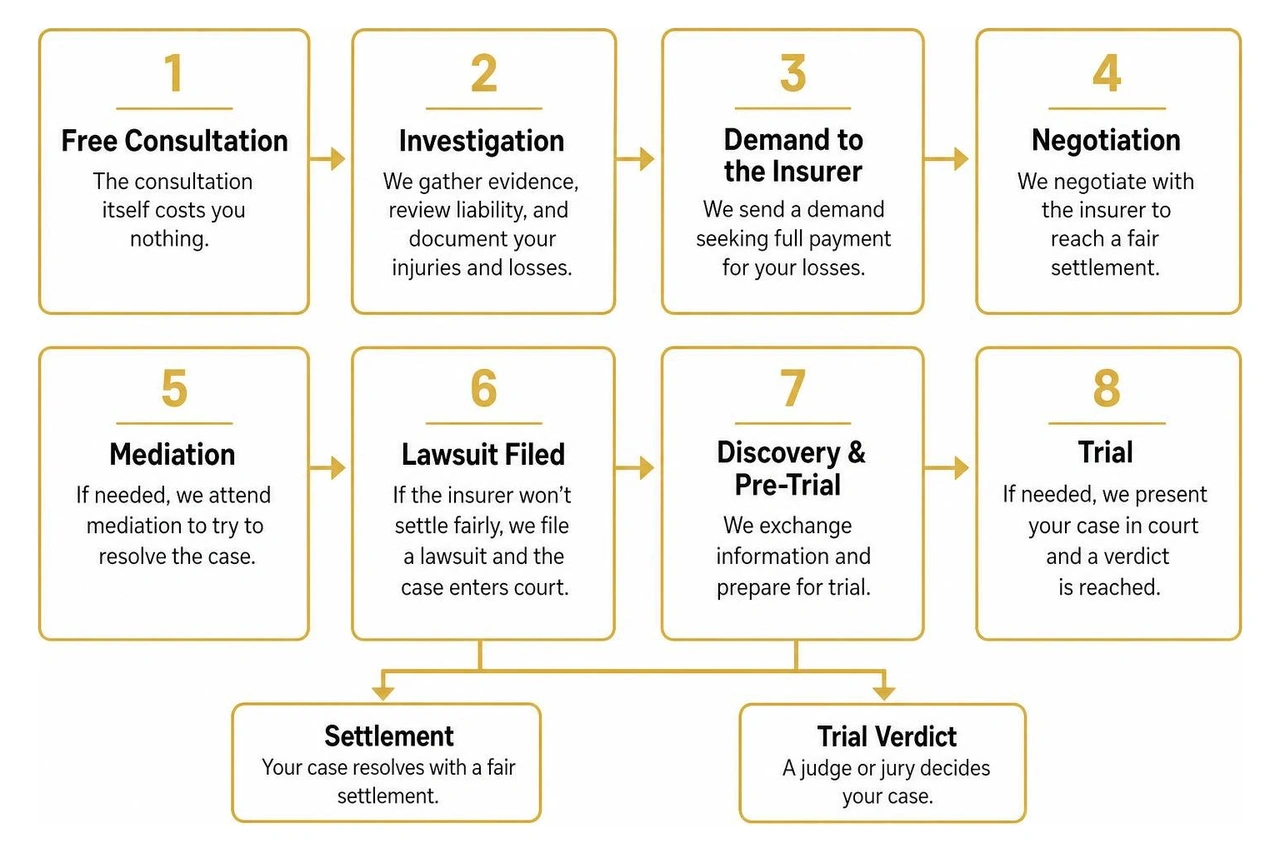
The consultation itself costs you nothing. If you hire us, most injury cases run on a contingency fee, meaning we are paid only if we recover money for you. Read how attorney fees and case costs are handled for details. After hiring, the usual path is investigation, a demand to the insurer, negotiation, possibly mediation, and, if needed, a lawsuit and trial. Timelines vary, and how long personal injury cases usually take depends on injury severity, treatment length, and how stubborn the insurer is.
How much does it cost to hire a car accident lawyer?
Many injury lawyers charge no upfront fee and take a percentage of the recovery. Percentages vary by firm and case stage, and in many places they commonly fall between 33 and 40 percent. Ask these questions before signing:
- What percentage applies, and does it change if the case goes to trial?
- Who advances case expenses, such as records and experts?
- Are expenses taken before or after the fee?
- What do I owe if there is no recovery?
Get the answers in a written fee agreement.
How long do you have to file a lawsuit?
Deadlines vary by state, and missing one can end your claim. Michigan sets time limits for injury lawsuits and no-fault benefits, and claims involving a government entity can carry much shorter notice requirements. Details are in our guide to Michigan injury-claim deadlines. The safest move is to ask at your consultation rather than guess.
Will the case settle or go to trial?
Most claims settle. The process usually starts with a demand, moves into negotiation, and may include mediation, where a neutral person helps both sides find middle ground. Some settlements, such as those involving minors, need court approval. If the insurer will not be fair, we file suit. I always prepare as if trial is coming, because insurers tend to offer more when they know we are ready.
Frequently asked questions about accident attorney consultations
Should I consult an attorney if I may share fault or the other driver is uninsured?
Yes. Shared fault does not automatically end a claim in Michigan, though it can reduce it. We review the evidence so blame is assigned fairly. If the other driver has no insurance, we examine your own policy for uninsured motorist coverage and other sources of recovery.
Can a family member speak for someone who is hospitalized?
Yes, a relative can make the first call and share basic facts, and we can gather records once the injured person gives permission. Deadlines keep running during a hospital stay, so an early call helps. We can often arrange to meet by phone or video.
Can I change attorneys if I already hired one?
Generally, yes. Review your representation agreement for fee and expense terms, since a prior attorney may have a claim for work done. Your file can be transferred. Read more about switching lawyers before deciding.
Conclusion
Call early, protect your evidence, and understand fees and deadlines before you commit to anything. Insurers have teams working for them from day one, and you deserve the same. If you were hurt on Michigan roads, we are ready to help you schedule a consultation about a motor vehicle accident. I'm Anthony Shapero, and I'd be glad to help you take that first step.