
How Is Fault Decided in a Michigan Bike Crash?
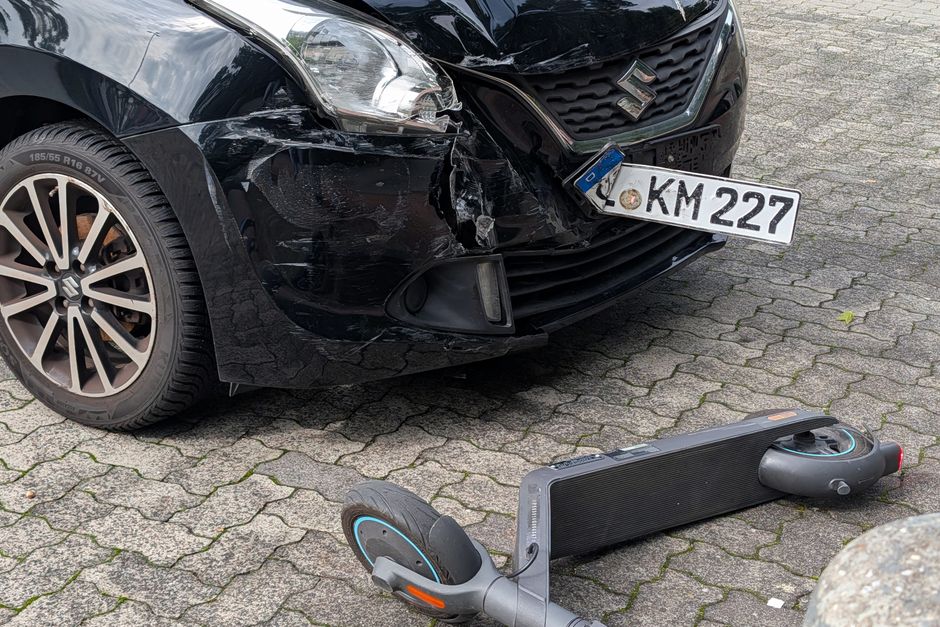
Fault in a Michigan bike crash depends on what each person did, whether they broke a traffic rule, and whether that conduct caused the collision. A driver may be at fault for failing to yield or watch for a cyclist. A cyclist may share fault for turning without warning or riding without required lights at night. Photos, witness accounts, and the police report can help show what happened, so preserve them as soon as you can.
Fault also affects a claim for damages, but it does not necessarily decide who pays medical bills first. If a car was involved, Michigan’s no-fault rules may provide benefits while the fault dispute continues.
I’m Anthony Shapero, managing partner at Liss, Shapero & Mitnick. My years defending insurers and representing injured people shape how I investigate Bike crash fault Michigan claims and push back when an insurer places unfair blame on a cyclist.
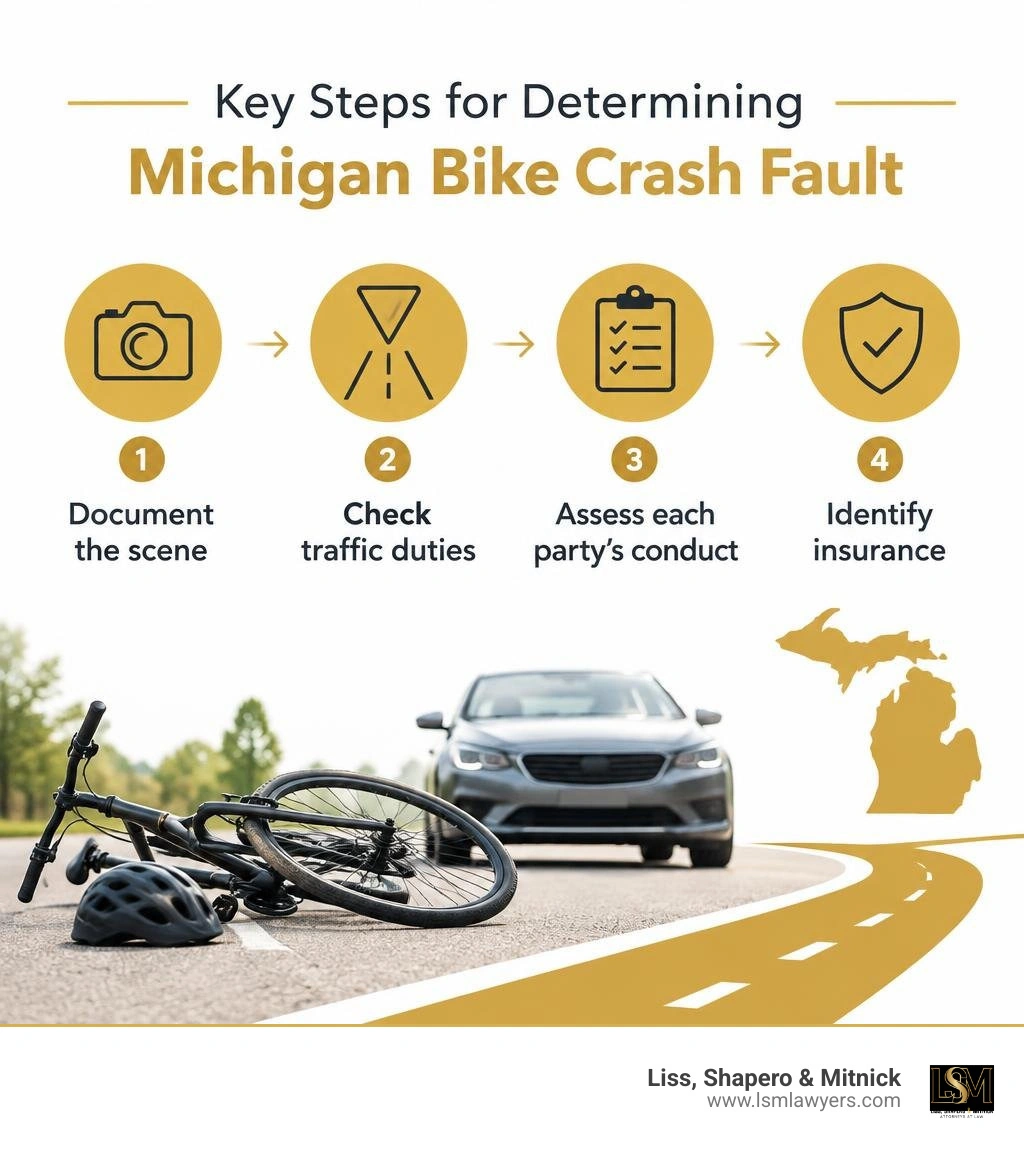
Bike crash fault Michigan word roundup:
Establishing Bike Crash Fault Michigan: Legal Duties and Comparative Negligence

When evaluating any bicycle-motor vehicle collision across Metro Detroit or anywhere in Michigan, the legal inquiry begins with the duties imposed on road users. Under Michigan Compiled Laws (MCL) § 257.657, a person riding a bicycle upon a roadway is granted all the rights and is subject to all the duties applicable to the driver of a motor vehicle, except for special regulations or provisions that by their nature cannot apply.
Cyclists are legal road users with a right to occupy the travel lane under appropriate conditions. Conversely, motorists owe a baseline duty of reasonable care to everyone sharing the roadway. Drivers must maintain an assured clear distance ahead, operate at a prudent speed, maintain vigilance, and yield the right-of-way when required.
In practice, many collisions occur because a motorist overlooks a rider. When pursuing a third-party claim against an inattentive driver, understanding how to prove a driver failed to yield to a cyclist is critical to establishing liability. Another widespread hazard in dense urban areas like Detroit and Berkley is a "doored" cyclist, where an occupant opens a vehicle door directly into an oncoming rider's path. Working with an attorney experienced in motorist dooring collisions helps establish that the motorist violated basic roadway safety duties.
How Modified Comparative Fault Affects Bike Crash Fault Michigan Claims
Michigan handles shared negligence under a modified comparative fault framework codified at MCL 600.2959. Under this statute, if an injured party is partially at fault for causing their injuries, their financial recovery is adjusted based on their percentage of responsibility:
- Economic Damages: Economic losses (such as medical expenses not covered by PIP or excess wage losses) are reduced by the injured party's percentage of fault, regardless of whether that fault is 10% or 80%.
- Non-Economic Damages: Non-economic damages (pain, suffering, mental anguish, and loss of enjoyment of life) are subject to a strict 51% bar. If a jury finds a cyclist 51% or more at fault, the cyclist is completely barred from recovering any non-economic damages from the at-fault driver.
Insurance defense adjusters frequently exploit this 51% threshold by attempting to shift the majority of blame onto the cyclist. They might argue that a rider failed to keep a proper lookout or was riding slightly outside a designated zone.
The crucial role of comparative fault fact-finding was demonstrated in the Michigan Court of Appeals decision COA 328587 Estate of Aaron Reid v Thomas Walker. In that case, a cyclist was struck from behind on a dark road. The trial court initially granted summary disposition for the defense, focusing on allegations that the cyclist was unlit and intoxicated. The appellate court reversed, holding that a jury must weigh the conflicting evidence—including driver speed, sightlines, and accident reconstruction testimony—to apportion comparative fault rather than having a judge dismiss the case prematurely.
Cyclist Duties Under the Michigan Vehicle Code and Impact on Fault
Because cyclists hold the same general duties as drivers, violations of the Michigan Vehicle Code can impact how liability is apportioned:
- Turning and Signaling (MCL 257.648): Cyclists must signal their intention to turn by using standard hand and arm signals continuously during the last 100 feet traveled before turning, unless both hands are needed to control the bicycle.
- Nighttime Lighting and Reflectors (MCL 257.662): When riding between one-half hour after sunset and one-half hour before sunrise, a bicycle must be equipped with a front lamp emitting a white light visible from at least 500 feet, and a rear red reflector or lamp visible from 100 to 600 feet.
- Sobriety and Control (MCL 257.625a): Operating a bicycle while visibly impaired or intoxicated introduces severe comparative fault arguments and may create a rebuttable presumption of negligence if an ordinance or statutory duty is violated.
A statutory violation creates a rebuttable presumption of ordinary negligence in a civil action. However, it does not automatically eliminate a driver’s liability, particularly if the motorist was speeding, distracted by a phone, or failing to keep a proper lookout.
Standard of Care: Motorist Collisions vs. Recreational Co-Cyclist Crashes
When a motor vehicle hits a cyclist, courts apply the classic ordinary negligence standard. A motorist must exercise the degree of care that a reasonably prudent driver would use under similar circumstances. For example, when a driver turns across a cycling lane in Metro Detroit without checking their blind spot, our Oakland County bike lane crash lawyer team evaluates the driver's breach of ordinary care under standard traffic rules.
The Reckless Misconduct Standard for Co-Participants in Recreational Cycling
When two bicyclists crash into one another while riding together, the legal standard shifts. Michigan courts do not apply ordinary negligence to co-participants in recreational sports and activities. Instead, they apply the reckless misconduct standard established by the Michigan Supreme Court in Ritchie-Gamester v. City of Berkley.
Under this rule, individuals participating in recreational activities owe a duty only to refrain from reckless misconduct. Reckless misconduct requires behavior that demonstrates a conscious or willful disregard for an unreasonable risk of harm, well beyond mere carelessness, poor judgment, or failing to signal.
The Michigan Court of Appeals applied this doctrine directly to road cycling in COA 360082 Drema Kalajian v Michael Panoff. In Kalajian, two friends were cycling on a paved public road. The lead cyclist suddenly executed an abrupt left turn without signaling or checking behind, causing the following cyclist to collide with him and suffer serious injuries.
The injured rider sued, alleging statutory violations of MCL 257.648 for failing to signal. The Court of Appeals affirmed the dismissal of the claim, ruling that:
- Riding bicycles together on a roadway is a recreational activity under Michigan law.
- Sudden turns, unexpected maneuvers, and collisions are inherent, foreseeable risks of group recreational cycling.
- Violations of the Vehicle Code do not convert ordinary carelessness into reckless misconduct.
| Comparison Factor | Motorist vs. Cyclist Crash | Co-Cyclist Recreational Crash |
|---|---|---|
| Applicable Standard | Ordinary Negligence | Reckless Misconduct (Ritchie-Gamester) |
| Duty Owed | Duty of reasonable, prudent care | Duty to refrain from willful or reckless disregard for safety |
| Impact of Statutory Violations | Rebuttable presumption of negligence | Insufficient on its own to prove reckless misconduct |
| Inherent Risk Defense | Inapplicable to driver negligence | Protects co-participants from everyday riding errors |
Michigan No-Fault Insurance, PIP Priority, and Third-Party Lawsuits
Michigan’s No-Fault auto insurance system provides critical medical and financial protections for bicyclists struck by motor vehicles. If a bicycle crash involves a motor vehicle (car, truck, SUV, van), the cyclist is eligible for Personal Injury Protection (PIP) benefits under the Michigan No-Fault Act (MCL 500.3101 et seq.), regardless of who was at fault for causing the crash.
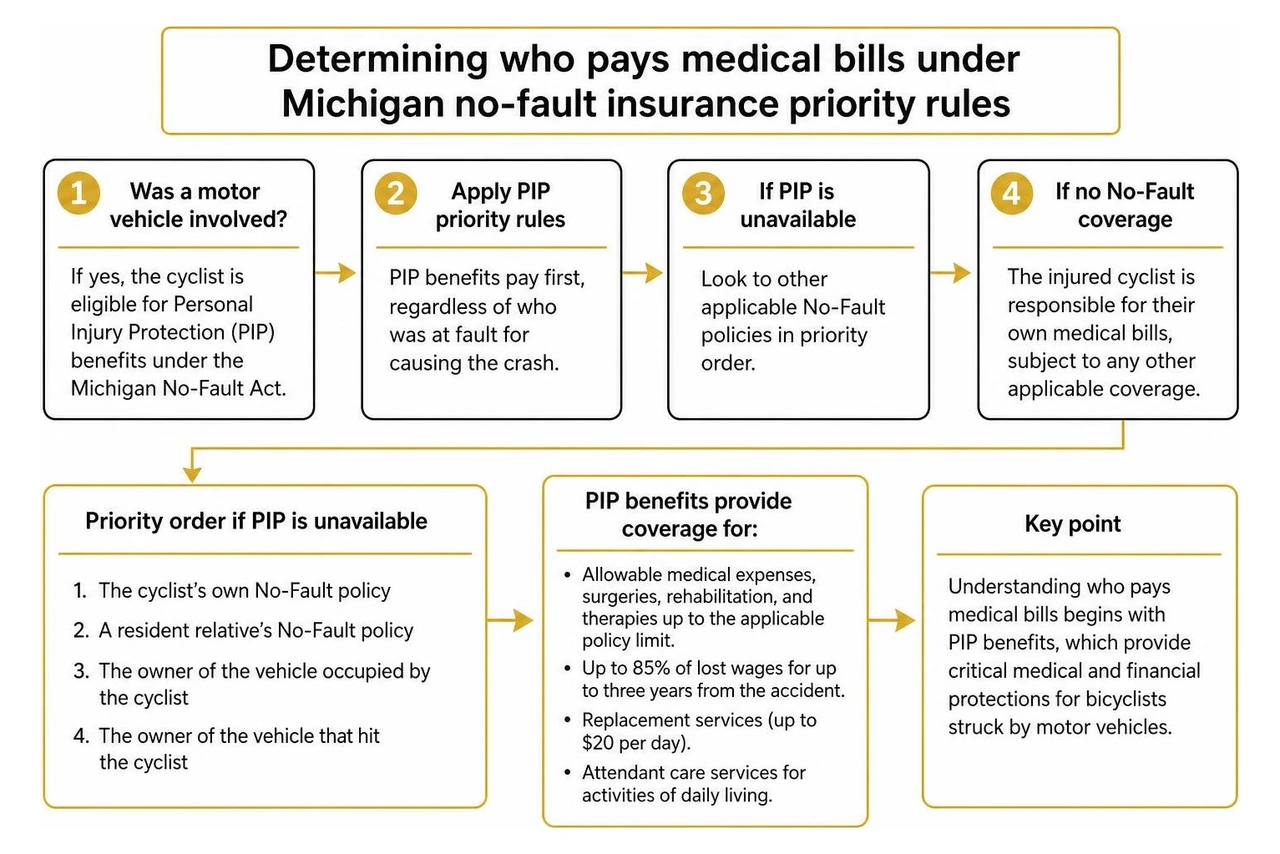
Understanding who pays medical bills after a bicycle or e-bike crash begins with recognizing that PIP benefits provide coverage for:
- Allowable medical expenses, surgeries, rehabilitation, and therapies up to the applicable policy limit.
- Up to 85% of lost wages for up to three years from the accident date.
- Replacement services (up to $20 per day) for domestic tasks the injured rider cannot perform.
- Attendant care services for assistance with activities of daily living.
Understanding PIP Order of Priority and the Assigned Claims Plan
Cyclists do not purchase standalone "bicycle auto insurance." Therefore, Michigan law establishes a specific "order of priority" under MCL 500.3115 to determine which insurance company must pay PIP benefits:
- The Cyclist’s Own Auto Policy: If the injured cyclist owns a registered motor vehicle covered by a Michigan auto policy, their own insurer pays PIP benefits.
- Spouse’s Auto Policy: If the cyclist does not have their own auto policy, they claim benefits under a policy issued to their spouse residing in the same household.
- Resident Relative's Auto Policy: If neither of the above applies, the cyclist is covered under an auto policy belonging to any relative domiciled in the same household.
- The Michigan Assigned Claims Plan (MACP): If an injured cyclist has no auto insurance in their household, they claim PIP benefits through the MACP (administered by the Michigan Automobile Insurance Placement Facility). Under current statutory caps, MACP coverage provides up to $250,000 in PIP medical coverage.
For a comprehensive explanation of how these tiers operate, see our guide on who pays medical bills when hit while riding a bike or review our detailed article on handling medical expenses after being hit while cycling in Michigan.
Meeting the Serious Impairment Threshold for Pain and Suffering Damages
While PIP benefits cover medical bills and wage losses, they do not compensate an injured cyclist for pain, suffering, emotional trauma, or loss of life enjoyment. To obtain these non-economic damages from the at-fault driver, an injured cyclist must meet the "tort threshold" under MCL 500.3135.
To succeed in a third-party liability lawsuit against the negligent motorist, the cyclist must prove that their injuries resulted in:
- Death,
- Permanent serious disfigurement, or
- Serious impairment of body function.
Under the landmark standard in McCormick v. Carrier, establishing a serious impairment of body function requires showing:
- An objectively manifested impairment (medically observable symptoms or findings),
- An impairment of an important body function, and
- That the impairment affects the injured person's general ability to lead their normal life.
Because building a strong third-party lawsuit requires clear documentation from the earliest stages of recovery, knowing what evidence to save after a bicycle crash in Berkley or Metro Detroit helps ensure that medical records, diagnostic scans, damaged equipment, and witness observations are properly preserved.
Special Liability Situations: E-Bikes, Road Defects, and Bystander Emotional Distress
Not every bicycle crash is a simple two-party daylight collision on a clear road. Complex dynamics involve electric assist systems, municipal roadway decay, and severe emotional trauma suffered by family witnesses. First responders across Michigan have documented a noticeable rise in mobility collisions as alternate transit methods grow, as highlighted by local reporting on rising electric mobility injuries.
Determining Fault in a Michigan Bike Crash Involving E-Bikes and E-Scooters
Under Michigan law (MCL 257.13e), electric bicycles are classified into three distinct categories:
- Class 1: Motor provides assistance only when pedaling, stopping assistance at 20 mph.
- Class 2: Motor can propel the bicycle exclusively via throttle, stopping assistance at 20 mph.
- Class 3: Motor provides assistance only when pedaling, stopping assistance at 28 mph (equipped with a speedometer).
Standard e-bikes fitting these classifications are explicitly excluded from the definition of "motor vehicle." As a result, when an e-bike collides with a traditional automobile, the rider is treated as a vulnerable non-motorist entitled to PIP benefits under the standard order of priority.
However, non-compliant e-bikes (modified motors exceeding speed and wattage limits) risk being categorized as mopeds or motorcycles under insurance rules, which can alter coverage. Reviewing our analysis on what insurance applies after an e-bike or scooter crash or checking our FAQs on insurance applicability for e-bikes and scooters provides essential clarity on these coverage considerations.
Municipal Liability for Potholes and Road Defects Under MCL 691.1402
Potholes, crumbling shoulders, missing sewer grates, and defective road transitions present severe hazards for cyclists. However, bringing a legal claim against a city, county road commission, or state agency faces the defense of governmental immunity.
To successfully recover damages from a government entity, an injured cyclist must bring their claim under the strict "highway exception" codified at MCL 691.1402. The agency's legal duty is limited to maintaining the improved portion of the highway designed for vehicular travel in reasonable repair so that it is reasonably safe and convenient for public travel.
Under MCL 691.1403, a plaintiff must prove that the agency knew, or in the exercise of reasonable diligence should have known, of the defect and had a reasonable time to repair it before the crash occurred. Knowledge is conclusively presumed when the defect existed in a readily apparent condition for 30 days or more before the injury.
The legal requirements for road defect cases were addressed in Wilson v. Alpena County Road Commission. In Wilson, a cyclist was injured after striking a severe road depression. The Michigan Court of Appeals clarified that plaintiffs are not required to eliminate every other conceivable cause of a crash to establish proximate causation, provided they present sufficient evidence showing the road defect was a direct, substantial cause of the collision.
Bystander Emotional Distress Claims for Family Members
When a bicycle accident results in catastrophic harm or death, close family members who witness the collision or arrive shortly after may suffer severe psychological trauma. In Michigan, bystander recovery for negligent infliction of emotional distress is governed by the principles analyzed in Gustafson v. Faris.
To maintain a valid bystander claim under Michigan law:
- The emotional injury must be serious and accompanied by definite physical symptoms.
- The plaintiff must be an immediate family member (parent, child, spouse, or sibling).
- The shock must be experienced fairly contemporaneously with the accident itself.
Under the Gustafson ruling, family members who do not see the crash or arrive on the scene immediately afterward—such as parents who learn of the accident hours later at a hospital—do not meet the contemporaneous perception requirement necessary to sustain an independent bystander claim.
Frequently Asked Questions About Bike Crash Fault in Michigan
What happens if a cyclist is hit by an uninsured or hit-and-run driver in Michigan?
If you are struck by a hit-and-run or uninsured driver, you remain entitled to Michigan No-Fault PIP medical benefits through your own household auto policy or the Michigan Assigned Claims Plan (MACP). To pursue compensation for pain and suffering (third-party damages), you must file a claim under the Uninsured Motorist (UM) coverage of your own household auto policy.
In hit-and-run situations, policies require immediate police reporting (often within 24 hours) and evidence of physical contact with the unidentified vehicle.
Can an injured cyclist sue for pain and suffering if they were partially at fault?
Yes, provided the cyclist's share of fault is 50% or less. Under Michigan’s modified comparative fault law (MCL 600.2959), an injured cyclist can recover pain and suffering damages from the at-fault driver, but the financial recovery will be reduced by their percentage of fault. If a jury finds the cyclist 51% or more at fault, all non-economic damages are barred.
Does wearing a helmet affect fault determination in a Michigan bicycle crash?
Michigan law does not require adult bicyclists to wear helmets. Therefore, failing to wear a helmet is not a traffic violation and cannot be used to establish fault for causing the crash itself.
While insurance defense attorneys sometimes attempt to introduce non-use of a helmet to argue comparative negligence for head injuries, courts examine whether the omission constitutes unreasonable conduct. In contrast, unhelmeted motorcycle riders face distinct statutory standards under Michigan's amended helmet legislation.
Conclusion
Determining fault after a bicycle collision requires a thorough evaluation of traffic statutes, accident reconstruction principles, and Michigan's No-Fault insurance rules. Insurance companies frequently attempt to place unfair blame on cyclists to protect their bottom line.
At Liss, Shapero & Mitnick, we draw on our former insurance-defense experience to anticipate insurer strategies, protect injured cyclists, and pursue the full compensation our clients deserve across Berkley, Metro Detroit, and throughout Michigan.
If you or a loved one has been injured on the road, our biker hit by car attorney team is ready to evaluate your claim and help you navigate the recovery process. Reach out to Anthony Shapero and the team at Liss, Shapero & Mitnick through our advocacy for injured Michigan cyclists practice to discuss your legal options.