
When Can You Bring an Insurance Bad Faith Lawsuit?

A bad-faith insurance lawsuit arises when an insurer handles a claim unreasonably, such as denying benefits without a fair investigation or refusing a reasonable settlement. A denied claim alone is not proof of bad faith. The insurer’s duty, what it knew, and the harm its conduct caused all matter. In Michigan, your legal options also depend on the type of claim and the law that applies.
I’m Anthony Shapero, managing partner at Liss, Shapero & Mitnick. I defended insurers before representing injured people, and I use that experience to examine the policy, the claim record, and the available remedies in each bad-faith insurance lawsuit.
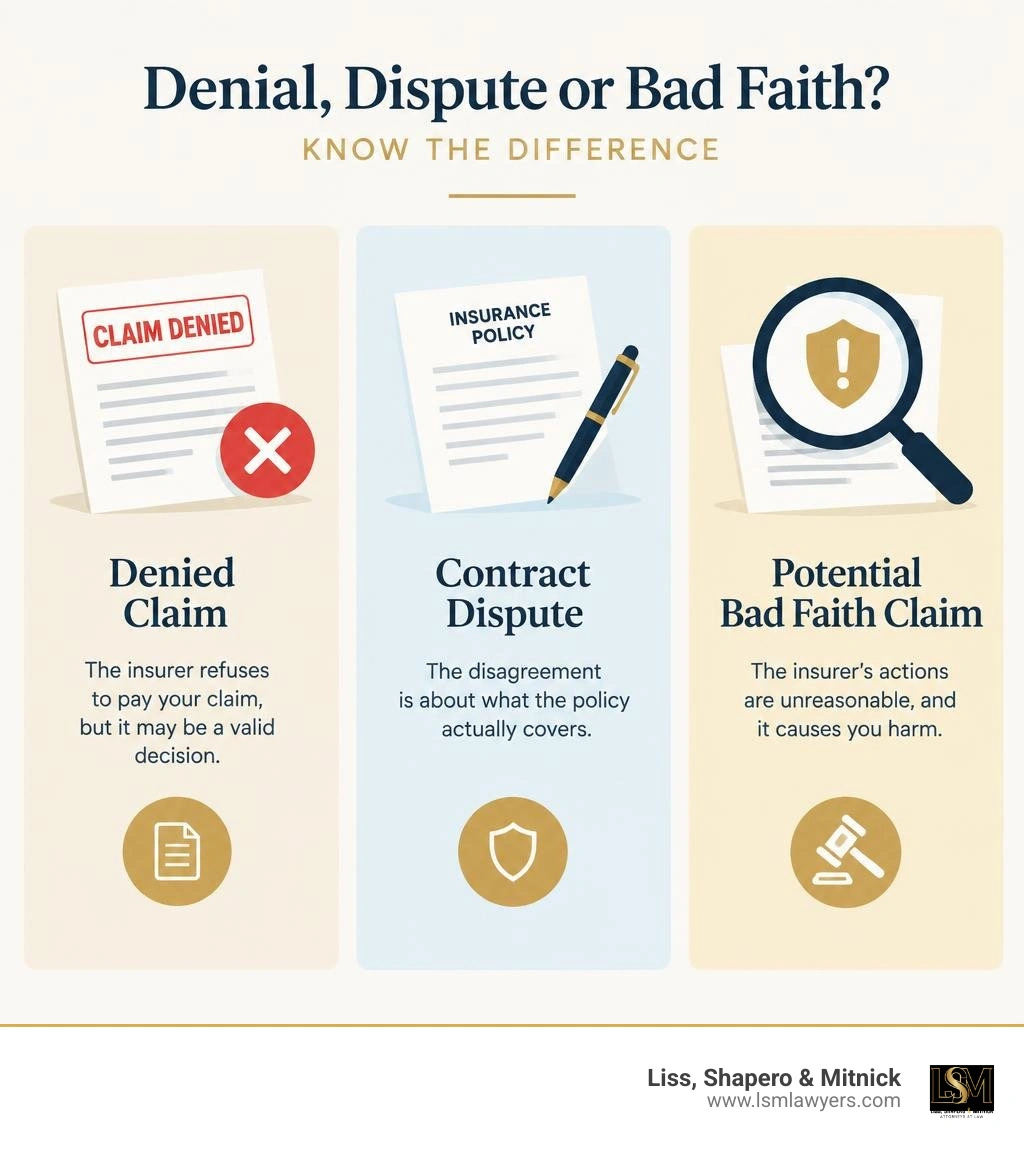
Quick look at bad-faith insurance lawsuit:
What Constitutes an Insurance Bad Faith Lawsuit?
When you purchase an insurance policy, you enter into a binding legal contract. In exchange for your regular premium payments, the insurer promises to provide financial protection when covered losses occur. Every insurance contract contains an underlying legal principle known as the implied covenant of good faith and fair dealing. This legal duty requires the insurance company to treat its policyholders honestly, investigate claims thoroughly, and never place its own financial interests above the legitimate rights of the insured.
When an insurer violates this duty through dishonest, dilatory, or objectively unreasonable claims handling, it commits what the law defines as bad faith. While a standard breach of contract occurs whenever an insurer fails to pay benefits owed under the terms of a policy, bad faith elevates the dispute to actionable tortious misconduct or triggers specific statutory remedies.
A traditional breach of contract lawsuit typically limits recovery to the unpaid policy benefits plus basic interest. An action for bad faith allows injured claimants to hold carriers accountable for the full scope of harm caused by their misconduct, including consequential economic losses, emotional distress, and, in egregious circumstances, punitive damages.
Understanding how to navigate insurance disputes after personal injury requires distinguishing between the two primary categories of bad faith actions: first-party claims and third-party claims.
| Feature | First-Party Bad Faith Claims | Third-Party Bad Faith Claims |
|---|---|---|
| Parties Involved | Policyholder vs. Their Own Insurance Carrier | Injured Third Party vs. At-Fault Party's Insurer (or Insured suing over failure to defend/settle) |
| Core Dispute | Unreasonable denial, delay, or underpayment of direct benefits | Refusal to settle within policy limits or failure to provide a legal defense |
| Primary Risk | Financial hardship and unpaid medical/property losses for the insured | Excess personal judgment and financial exposure for the insured defendant |
| Typical Claims | No-Fault PIP, Collision, Homeowners, Health, Disability, UM/UIM | Commercial Liability, Auto Bodily Injury Liability |
| Available Damages | Contract benefits, consequential damages, statutory penalty interest | Full value of excess verdicts, emotional distress, punitive damages |
First-Party vs. Third-Party Bad Faith Claims
A first-party claim occurs directly between you and your own insurance company. Examples include filing a claim under your own auto insurance policy for Personal Injury Protection (PIP), comprehensive damage, or Uninsured/Underinsured Motorist (UM/UIM) coverage. In first-party contexts, the insurer owes you a direct obligation to promptly investigate, fairly evaluate, and pay legitimate claims.
In jurisdictions recognizing first-party torts, policyholders can pursue substantial extra-contractual damages when an insurer arbitrarily refuses payment. In federal and state courts, key precedents such as Singer v. State Farm Mut. Auto. Ins. Co. have established that an insurer’s duty of good faith applies directly to first-party claims like uninsured motorist coverage, regardless of underlying third-party litigation dynamics.
A third-party claim arises when someone files a liability claim or lawsuit against a policyholder. Here, the insurer has two primary contractual responsibilities:
- The Duty to Defend: The insurer must hire competent legal counsel to protect the insured policyholder against covered allegations.
- The Duty to Indemnify and Settle: The carrier must pay settlements or judgments up to the policy limit and make reasonable efforts to settle the claim within those limits to shield its insured from personal financial ruin.
When an insurer refuses a policy-limit settlement demand despite clear liability and catastrophic injuries, it gambles with the policyholder’s financial life. If the injured victim wins a jury verdict that exceeds the policy limits, the insurer's failure to settle constitutes third-party bad faith, exposing the carrier to liability for the entire excess judgment.
The Implied Covenant of Good Faith and Fair Dealing
The implied covenant of good faith and fair dealing is a non-waivable duty inherent in all insurance agreements across the United States. Because insurance companies hold disproportionate bargaining power and control the claims evaluation process, courts treat them as quasi-fiduciary entities.
This covenant requires that insurers:
- Give equal consideration to the insured’s financial interests as they give to their own profit margins.
- Refrain from misrepresenting policy exclusions or distorting medical facts.
- Conduct a timely, objective, and unbiased investigation before making a denial decision.
- Offer fair, realistic settlement figures when liability and damages become clear.
When carriers treat claims handling as an adversarial cost-cutting exercise rather than a good-faith evaluation, they breach this covenant.
Common Insurer Tactics That Trigger Bad Faith Claims

Insurance adjusters are trained to minimize claim payouts to preserve company reserves. While verifying coverage and preventing fraud are legitimate business practices, adjusters cross the line into bad faith when they employ deceptive, dilatory, or baseless strategies to avoid paying valid claims.

Unreasonable Denials and Independent Medical Exam Abuses
One of the most persistent bad-faith practices in personal injury and auto litigation involves the misuse of "Independent" Medical Examinations (IMEs). Insurers frequently hire paper-review physicians or specialized examination vendors who derive significant portions of their income by authoring boilerplate reports that declare injured policyholders fully recovered or claim their conditions are degenerative.
In Michigan auto injury practice, identifying common no-fault PIP denials and solutions is critical for recovering withheld medical payments, wage loss, and attendant care. Claimants who find their benefits cut off after an IME are often victims of biased medical assessments engineered to construct a pretext for claim termination. When an insurer terminates necessary medical care based on an examination that lasted mere minutes—while disregarding years of consistent findings from treating neurosurgeons and orthopedic specialists—it creates strong evidence of bad faith.
Misrepresentation, Delay Tactics, and Adjuster Conduct
Insurers also engage in bad-faith tactics designed to wear down policyholders financially so they accept lowball settlements:
- Unreasonable Delays: Stalling claims by constantly switching assigned adjusters, failing to return phone calls, or ignoring formal demand letters.
- Excessive and Repetitive Documentation Requests: Demanding irrelevant personal records, ancient tax filings, or duplicate medical files to restart statutory review clocks.
- Lowball Settlement Offers: Offering pennies on the dollar for catastrophic, well-documented injuries where policy limits are clearly warranted.
- Misrepresenting Policy Terms: Falsely telling unrepresented claimants that certain damages, such as replacement services or specific wage loss tiers, are excluded under the policy.
- Abusing Recorded Statements: Pressuring vulnerable, unrepresented victims into recorded interviews while on medication, hoping they make imprecise statements about fault or symptoms. Knowing what to avoid saying to an insurance adjuster is vital to preventing adjusters from twisting innocent remarks into grounds for denial.
- Misusing Suit-Limitation Clauses: Stalling a claim until contractual or statutory limitation periods draw near, then abruptly denying coverage to block litigation.
Proving Liability in an Insurance Bad Faith Lawsuit
Prevailing in an insurance bad faith lawsuit requires clearing a higher evidentiary bar than winning a basic contract claim. You cannot simply show that the insurance company made a mistake or reached a debatable legal conclusion. You must prove that the insurer acted with objective unreasonableness and knew—or recklessly disregarded—the fact that its denial or delay lacked a reasonable basis.
Navigating these challenges requires a dedicated strategy for handling complex insurance disputes that systematically exposes the insurer's bad-faith conduct.
Proving Breach of Duty in an Insurance Bad Faith Lawsuit
To establish liability, a plaintiff must prove the core elements of the tort or statutory violation:
- Duty: The insurer owed a clear contractual and common-law or statutory duty of good faith to the insured.
- Breach: The insurer breached that duty by refusing to investigate, unreasonably delaying payment, misrepresenting facts, or failing to settle within limits.
- Causation: The insurer's bad-faith actions directly caused tangible harm beyond the original loss (such as home foreclosure, destroyed credit, or an excess personal verdict).
- Damages: The policyholder suffered quantifiable financial losses, mental distress, or legal liability.
In landmark complaints such as Keith Sidlo v. Mercury Insurance, plaintiffs demonstrate how systematic patterns of premature claim closures, refusal to inspect structural losses, and bad-faith reliance on ambiguous policy exclusions establish an actionable breach of the implied covenant.
Essential Evidence: Communications, Logs, and Claim Files
Insurance bad faith lawsuits are won and lost through documentary evidence. Because insurance companies document their actions internally, obtaining the complete, unredacted claim file during litigation discovery is essential.
Key pieces of evidence include:
- Internal Adjuster Activity Logs: Time-stamped notes showing what the adjuster knew, when they knew it, and whether internal reserves were set higher than their external settlement offers.
- Underwriting Files and Policy Endorsements: Documentation demonstrating that the policyholder was properly covered at the time of loss.
- Correspondence and Written Notices: Every email, formal demand letter, and written rejection exchanged between the parties.
- Vendor and IME Referral Records: Invoicing records revealing financial relationships between the insurer and its preferred "independent" medical examiners.
- Claims Handling Manuals and Guidelines: Internal corporate performance metrics that incentivize adjusters to lower average claims payouts.
- Expert Witness Testimony: Specialized testimony from former claims managers and insurance industry standards experts detailing how the carrier deviated from accepted claims practices.
Damages and Legal Remedies Available to Policyholders

When an insurer loses a bad faith lawsuit, the available legal remedies often far exceed the dollar limits printed on the policy declaration page. Holding an insurance company liable for bad faith exposes it to multiple tiers of damages designed to restore the victim's financial standing and penalize wrongful corporate conduct.
Compensatory, Consequential, and Punitive Damages
Policyholders pursuing bad-faith litigation can recover three main types of financial relief:
- Contractual and Compensatory Damages: The underlying benefits originally owed under the policy, such as medical expense reimbursements, property repair costs, and wage replacement.
- Consequential Economic Damages: Additional financial losses directly triggered by the insurer’s nonpayment. This includes lost business income, interest on personal loans taken out to cover living expenses, repossessed property, damaged credit scores, and compensation for severe mental anguish and emotional distress.
- Punitive (Exemplary) Damages: Extra damages assessed to punish intentional, malicious, fraudulent, or oppressive misconduct.
In bad-faith trials, punitive damages can be substantial. In Dziadek v. Charter Oak Fire Insurance Co., a federal jury awarded $2.75 million in punitive damages alongside $250,000 in out-of-pocket expenses and $500,000 for emotional distress after the carrier concealed a $900,000 underinsured motorist policy endorsement from an injured claimant. While high punitive verdicts are frequently scrutinized on appeal under constitutional due process standards—as seen in the U.S. Supreme Court's ruling in State Farm v. Campbell, which reduced a $145 million verdict to $9 million—punitive awards remain a powerful deterrent against bad-faith practices.
Excess Judgments and Statutory Bad Faith Penalties
In third-party bad faith claims, the most significant risk for an insurer is liability for an excess judgment.
Consider an example: an at-fault driver carries a $100,000 bodily injury liability policy. The injured plaintiff suffers catastrophic spinal cord injuries with $500,000 in medical bills and offers to settle for the $100,000 policy limit. If the insurer unreasonably rejects the demand and takes the case to trial, a jury may return a $2,000,000 verdict.
Because the insurer exposed its policyholder to a $1,900,000 personal judgment by rejecting a reasonable settlement, the insurer can be sued for third-party bad faith and forced to pay the entire $1.9 million excess verdict out of its own corporate assets.
In first-party claims, state statutory frameworks provide direct financial penalties:
- Statutory Interest: Under Michigan’s No-Fault Insurance Act (MCL 500.3142), overdue PIP benefits incur a mandatory 12% annual penalty interest rate assessed against the insurer from the date payment became overdue.
- Attorney Fee Shifting: Insurers that unreasonably refuse or delay payment of valid first-party claims can be ordered to pay the policyholder’s reasonable attorney fees (e.g., under MCL 500.3148).
- Statutory Multipliers: Certain states provide statutory treble (triple) damages for willful violations of consumer protection or insurance trade practices acts.
Litigation Timeline, Procedural Rules, and State Variations
Pursuing a bad-faith claim requires navigating formal procedural prerequisites, strict statutory notice periods, and complex discovery schedules.
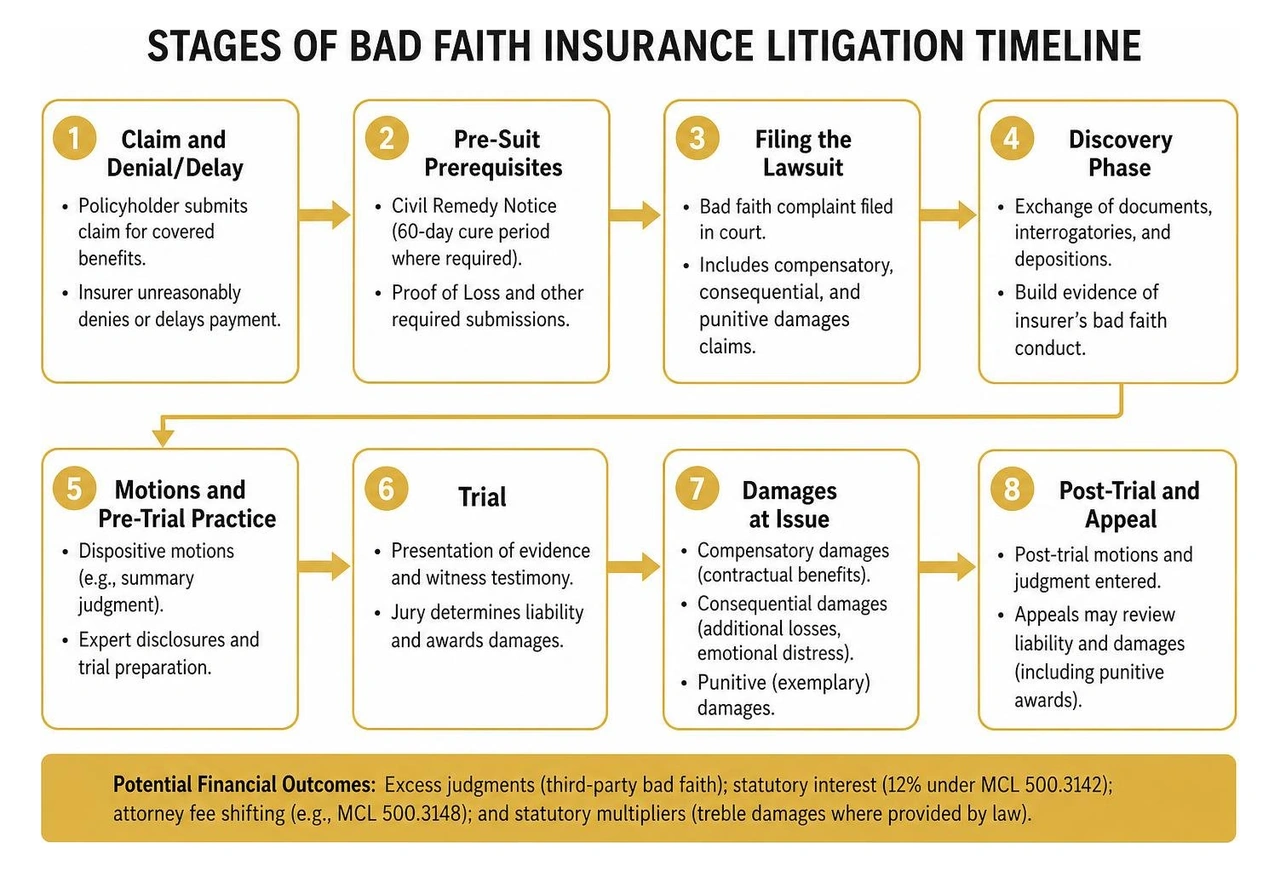
Initiating an Insurance Bad Faith Lawsuit: Notice Requirements and Discovery
Before filing a bad faith complaint in court, claimants must often satisfy specific procedural conditions precedent:
- Civil Remedy Notices: Certain statutory jurisdictions (such as Florida under Fla. Stat. § 624.155) mandate that a plaintiff serve a formal 60-day written notice detailing the statutory violations, providing the insurer a safe-harbor window to cure the breach by tendering payment.
- Tolling Agreements and Proof of Loss: Ensuring formal, verified proofs of loss are submitted to start or toll statutory limitations periods.
- Exhaustion of Internal Appeals: For private group health coverage governed by ERISA, claimants must exhaust administrative appeals before filing suit in federal court. If you are struggling with medical insurance denials, seeking dedicated health insurance denial help ensures all administrative deadlines are preserved.
Once filed, bad-faith litigation centers heavily on the discovery phase. Plaintiffs subpoena corporate claim manuals, depose adjusters and claims supervisors, and compel the production of unredacted claim files. When discovery reveals institutional bad faith, most cases proceed to formal mediation or court-supervised settlement conferences before trial.
State Law Frameworks: Common Law Torts vs. Statutory Remedies
The legal landscape of bad faith litigation varies significantly across state borders:
- Widespread Tort Recognition: By 2012, at least 46 states recognized third-party bad faith as an independent common-law tort, and at least 31 states recognized first-party bad faith as an independent tort.
- Economic Impact on Settlements: Academic and industry data indicates that jurisdictions recognizing tort liability for first-party bad faith experience 10% to 11% higher Uninsured Motorist (UM) settlements, as carriers are strongly disincentivized from making lowball offers.
- Michigan's Legal Framework: In Michigan, common-law first-party tort actions for bad faith are generally limited by contract-remedy precedents (Kewin v. Massachusetts Mutual Life Ins. Co.). However, Michigan law provides policyholders with robust statutory remedies, including the Michigan Uniform Trade Practices Act (UTPA) penalty interest provisions (MCL 500.2006) and the Michigan No-Fault Act’s mandatory 12% penalty interest and attorney-fee shifting mechanisms (MCL 500.3142 / MCL 500.3148), which create powerful financial leverage against recalcitrant insurers.
Frequently Asked Questions About Bad Faith Insurance Claims
How long does a bad faith insurance lawsuit typically take?
Most bad faith insurance lawsuits resolve between one and three years from the initial court filing. The overall timeline depends on the complexity of the underlying claims, the volume of internal electronic discovery, the scope of motion practice regarding privilege logs, and whether the case resolves through alternative dispute resolution (mediation) or proceeds through a full jury trial and subsequent appeals.
What is the primary difference between a breach of contract and an insurance bad faith claim?
A breach of contract claim focuses strictly on the policy language and seeks to recover the exact benefits owed under the agreement. A bad faith claim evaluates the insurer's claims-handling conduct, motives, and objective reasonableness. Unlike basic contract actions, bad faith claims allow recovery for consequential financial harm, emotional distress, attorney fees, statutory penalty interest, and punitive damages.
Can an insurer be sued for bad faith if they eventually pay the claim?
Yes. An insurer cannot escape bad faith liability simply by issuing payment on the eve of trial or months after a legitimate claim was due. If the carrier engaged in unreasonable delays, failed to conduct a timely investigation, or forced the policyholder to incur significant financial hardship, ruined credit, or legal expenses before finally tendering benefits, you can still pursue a claim for the consequential damages and statutory interest caused by the delay.
Conclusion
Insurance companies possess immense financial resources and sophisticated legal teams trained to minimize liabilities. When an insurer refuses to honor its contractual commitments or treats an injured claimant with bad faith, policyholders have clear legal rights to hold them accountable.
At Liss, Shapero & Mitnick, we level the playing field for injury victims and policyholders throughout Berkley, Metro Detroit, and across Michigan. Having spent years on the insurance-defense side of the table before dedicating our practice to injured individuals, we understand how adjusters evaluate risk, conceal coverage, and attempt to lower payouts. We use that insider perspective to fight for every dollar of compensation, penalty interest, and consequential damages you are owed under the law.
If your claim has been wrongfully denied, delayed, or undervalued, or if you have questions regarding coordinating health insurance with Michigan auto no-fault coverage, contact Anthony Shapero and the team at Liss, Shapero & Mitnick today for a comprehensive case evaluation.