.svg)
Michigan Auto Laws: The Insurance Coverage You Must Carry

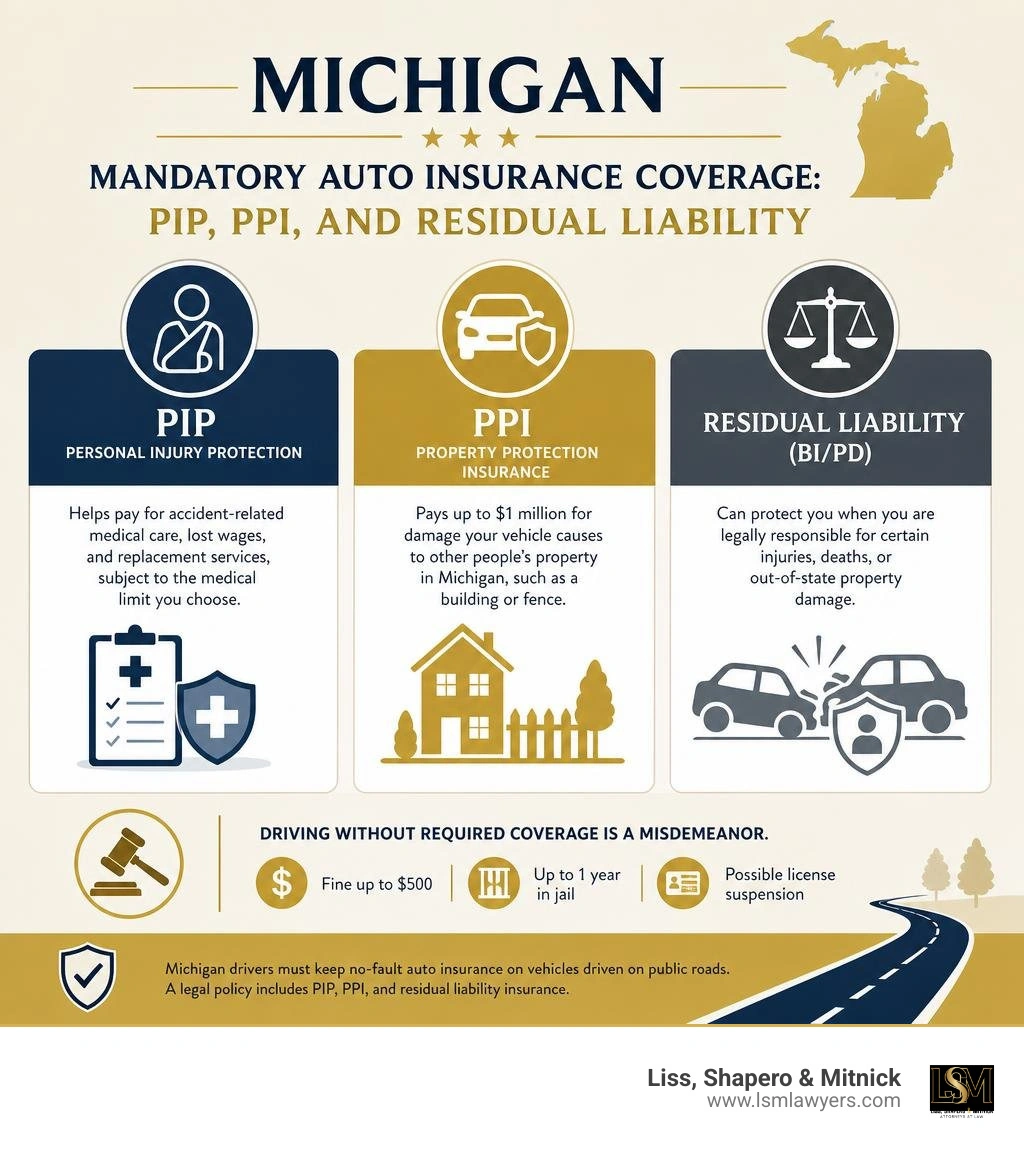
Michigan drivers must keep no-fault auto insurance on vehicles driven on public roads. A legal policy includes Personal Injury Protection (PIP), Property Protection Insurance (PPI), and residual liability insurance for injuries and property damage you cause to others.
At a glance:
- PIP helps pay accident-related medical care, lost wages, and replacement services, subject to the medical limit selected.
- PPI pays up to $1 million for damage your vehicle causes to other people's property in Michigan, such as a building or fence.
- Residual liability (BI/PD) can protect you when you are legally responsible for certain injuries, deaths, or out-of-state property damage.
Driving without required coverage is a misdemeanor. It can bring a fine of up to $500, up to one year in jail, and possible license suspension until you show proof of insurance.
Michigan auto laws changed substantially on July 1, 2020. Drivers can now choose among several PIP medical limits, but lower limits may leave major gaps after a serious crash. That choice can also affect motorcyclists, pedestrians, bicyclists, and families seeking no-fault benefits.
This guide explains what coverage Michigan requires, what the options mean, and where to turn if an insurer delays, denies, or underpays a claim.
Key Michigan Auto Laws Governing Mandatory Vehicle Insurance

Operating a vehicle in Michigan requires strict compliance with state financial responsibility mandates. Under MCL - Section 500.3101 - Michigan Legislature, the owner or registrant of a motor vehicle required to be registered in the state must maintain continuous security for the payment of statutory benefits. This coverage must remain active whenever the vehicle is driven or moved upon a public highway.
Whether you drive daily on I-696 in Metro Detroit or keep a car registered in Berkley, maintaining compliant coverage is non-negotiable. At Liss, Shapero & Mitnick, our experience handling complex Motor Vehicle Accidents Practice Area cases has shown us that misunderstanding these statutory obligations is one of the most common ways motorists inadvertently jeopardize their financial security before an accident even occurs.
The Three Mandatory Coverages: PIP, PPI, and Residual Liability
To legally register and operate a passenger vehicle in Michigan, your auto policy must contain three distinct foundational pillars:
- Personal Protection Insurance (PIP): Under traditional no-fault rules, PIP pays for all reasonable and necessary medical care for your lifetime up to your chosen policy limit. In addition to medical bills, statutory Michigan No-Fault Insurance Benefits include wage loss compensation and replacement services (help with daily household chores) for up to three years following the date of the collision.
- Property Protection Insurance (PPI): PPI provides up to $1 million in coverage for physical damage your vehicle accidentally inflicts on fixed, non-vehicular property within the state of Michigan. This includes structures such as utility poles, storefronts, traffic barriers, guardrails, and parked cars that were properly stationary at the time of the collision.
- Residual Bodily Injury and Property Damage Liability (BI/PD): Because Michigan is a no-fault state, tort lawsuits are limited, but they are not eliminated. Residual liability steps in if you are sued for causing another person's serious bodily injury, permanent disfigurement, or death, or if you cause property damage outside the state of Michigan.
Penalties for Driving Without Insurance in Michigan
Failing to maintain continuous no-fault coverage carries severe criminal, civil, and financial consequences under state law:
- Criminal Penalties: Driving an uninsured motor vehicle is a misdemeanor offense. A conviction can result in a fine ranging between $200 and $500, up to one year in jail, or both.
- License Suspensions: The court or the Secretary of State may suspend your driver’s license for 30 days, or indefinitely until you present verifiable proof of valid insurance and pay statutory reinstatement fees.
- The Absolute Tort Bar: Under Michigan no-fault law, if you are injured while driving your own uninsured vehicle, you are entirely disqualified from receiving PIP benefits (medical coverage, wage loss, replacement services). Furthermore, you are legally barred from suing an at-fault driver for your pain and suffering, even if the other driver was 100% responsible for the collision.
Choosing Your PIP Medical Coverage Tiers and Premium Reductions
The 2020 auto insurance reforms ended Michigan’s decades-old mandate requiring all motorists to purchase unlimited lifetime medical benefits. Drivers can now tailor their PIP medical coverage to match their budget and existing healthcare arrangements. However, these options require careful consideration regarding financial risk exposure.
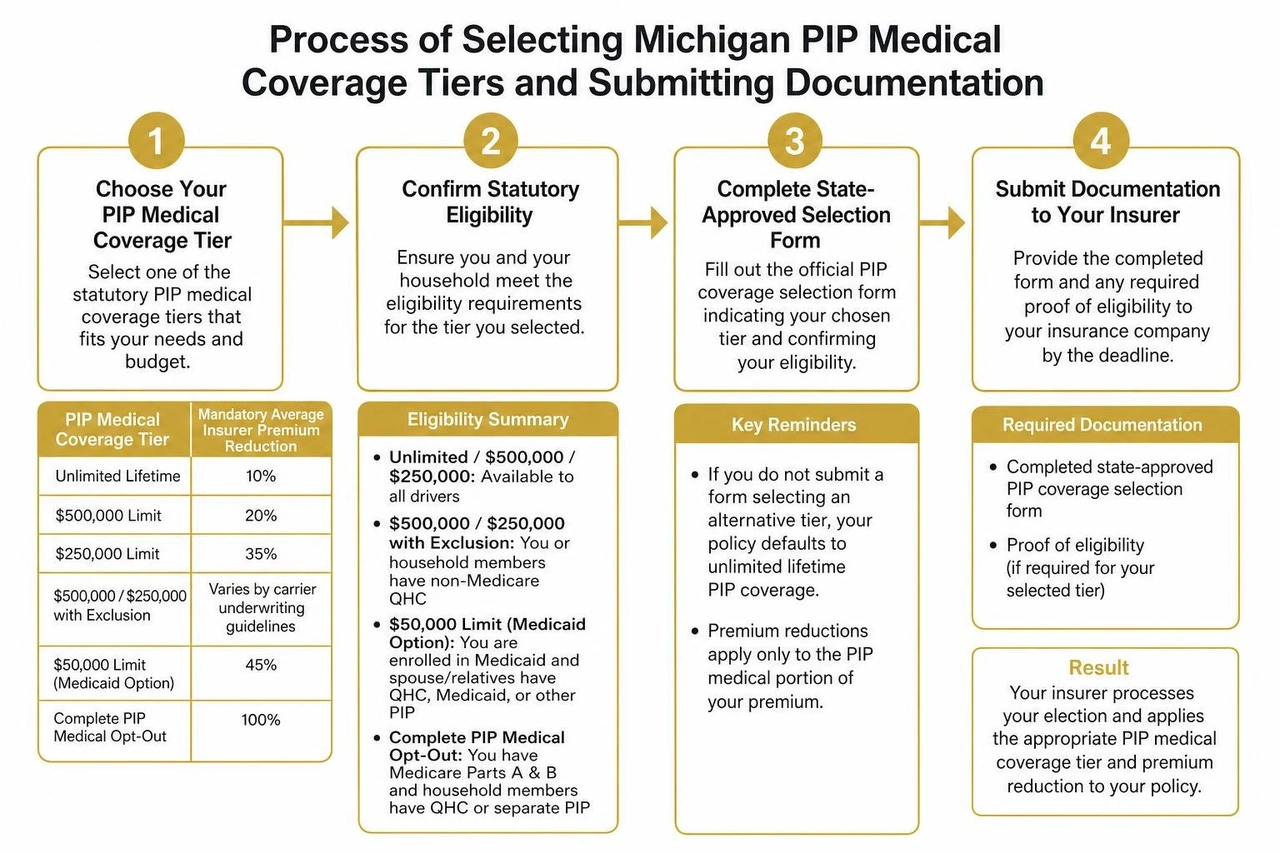
| PIP Medical Coverage Tier | Statutory Eligibility Requirements | Mandatory Average Insurer Premium Reduction |
|---|---|---|
| Unlimited Lifetime Coverage | Available to all drivers without restriction. | 10% average reduction on PIP portion |
| $500,000 Limit | Available to all drivers without restriction. | 20% average reduction on PIP portion |
| $250,000 Limit | Available to all drivers without restriction. | 35% average reduction on PIP portion |
| $500,000 / $250,000 with Exclusion | Driver or household members have non-Medicare Qualified Health Coverage (QHC). | Varies by carrier underwriting guidelines |
| $50,000 Limit (Medicaid Option) | Named insured is enrolled in Medicaid and spouse/relatives have QHC, Medicaid, or other PIP. | 45% average reduction on PIP portion |
| Complete PIP Medical Opt-Out | Named insured has Medicare Parts A & B and household members have QHC or separate PIP. | 100% reduction on PIP medical portion |
Choosing the right tier determines how Michigan No-Fault Benefits After an Accident: Medical Bills, Mileage, Lost Wages, and Attendant Care are administered when catastrophic trauma occurs.
Default PIP Limits and Statutory Premium Reductions
If an applicant or renewing policyholder does not formally submit a state-approved selection form choosing an alternative tier, the law dictates that the policy defaults to unlimited lifetime PIP coverage.
The statutory premium reductions mandated by the reform apply exclusively to the PIP medical portion of your insurance premium—not to your comprehensive, collision, or liability rates. The law requires insurance companies to meet these reduction targets across their overall book of business on average. Because these percentages reflect an industry-wide average rather than a policy-by-policy guarantee, your personal bill may show differing changes depending on vehicle type, location, and driving history.
Regardless of your chosen medical tier, you must remain vigilant about administrative filing timelines. Under statutory rules, failure to submit timely documentation can trigger strict claim defenses; understanding No-Fault Deadlines: Avoiding the One-Year Back Trap in PIP Claims is vital to preventing unexpected claim dismissals.
Residual Bodily Injury Liability and Mini-Tort Limits
With capped PIP medical tiers now in place, injured victims whose medical bills exceed their selected PIP limits can sue the at-fault driver for excess medical expenses. Consequently, bodily injury liability insurance is more important than ever.
The default statutory bodily injury limits in Michigan are:
- $250,000 for injury or death to one person in an accident.
- $500,000 for injury or death to two or more people in an accident.
- $10,000 for property damage in another state.
A motorist may choose to purchase reduced liability coverage down to $50,000 per person and $100,000 per accident, but the law requires them to sign a specific Department of Insurance and Financial Services (DIFS) disclosure form acknowledging the extreme personal asset exposure this choice creates.
Additionally, Michigan's "Mini-Tort" law allows drivers to recover out-of-pocket, uncompensated vehicle repair costs from the at-fault motorist up to a statutory cap of $3,000. Because recovery under mini-tort claims depends on proving the other driver was primarily responsible, reviewing how Comparative Fault in Michigan: How Percentages Really Change Your Recovery applies is essential. For seasonal driving challenges, our breakdown of Holiday Travel, Black Ice, Mini Tort: What Michigan Drivers Need to Know in December offers clear guidance on managing these claims.
Essential Optional Coverages and Roadway Protections
While the state mandates PIP, PPI, and residual liability, several optional endorsements protect drivers from substantial out-of-pocket losses following a wreck:
- Collision Coverage: Pays for physical damage to your own vehicle resulting from a crash. It is available in three forms: Broad Form (deductible waived if you are less than 50% at fault), Basic/Standard Form (deductible applies regardless of fault), and Limited Form (damages covered only if you are less than 50% at fault, with no coverage if you are primarily at fault).
- Comprehensive Coverage: Pays for vehicle repairs caused by non-collision events, including animal strikes (such as hitting a deer), theft, vandalism, falling tree limbs, hail, or windshield damage.
- Towing and Rental Reimbursement: Offsets the daily costs of obtaining a rental vehicle while your car is being repaired and covers towing fees from an accident scene.
- Uninsured and Underinsured Motorist Coverage (UM/UIM): Although not mandated by Michigan law, UM/UIM is essential protection. If you are hit by a hit-and-run driver, an uninsured driver, or a driver carrying only minimum bodily injury limits that do not cover your injuries, your own UM/UIM policy pays the remaining balance of your pain, suffering, and excess economic damages. Reviewing our resource on UM/UIM 101: Protecting Yourself When the Other Driver Has Minimum Limits explains how this coverage acts as your personal financial safety net.
Understanding Michigan Auto Laws on Vehicle Definitions and Exclusions
Michigan statutes draw clear boundaries between different classes of transportation, outlined in the Michigan Vehicle Code. These definitions govern insurance obligations:
- Motor Vehicle: A vehicle driven or drawn by mechanical power and manufactured primarily for use on public streets, roads, and highways, having more than two wheels.
- Motorcycle: A motor vehicle that has a saddle or seat for the use of the rider, is designed to travel on not more than three wheels in contact with the ground, and is equipped with a motor exceeding 50 cubic centimeters.
- Statutory Exclusions: Under no-fault laws, farm tractors, off-road vehicles (ORVs), golf carts, power-driven mobility devices, electric bicycles, and commercial quadricycles are not classified as standard motor vehicles for mandatory PIP purchase requirements.
How Michigan Auto Laws Protect Vulnerable Road Users
The 2020 reforms altered the priority rules and medical coverage limits for non-occupants injured in motor vehicle collisions:
- Motorcyclists: Under Michigan law, when a motorcyclist is injured in a crash involving a motor vehicle, they claim PIP benefits not from their own motorcycle insurance policy, but from the insurer of the owner, registrant, or operator of the motor vehicle involved. Consequently, an injured motorcyclist’s medical benefits are limited by the PIP tier selected on the driver's policy ($50,000, $250,000, $500,000, or unlimited).
- Pedestrians and Bicyclists: When hit by a motor vehicle, pedestrians and cyclists first claim PIP benefits through their own auto policy, or a policy held by a spouse or resident relative. Their medical benefits are governed by whatever PIP limit was selected on that household policy.
- The Assigned Claims Plan (MACP): If an injured pedestrian or bicyclist has no auto insurance in their household and the striking vehicle is uninsured, they must apply for benefits through the Michigan Assigned Claims Plan, which caps PIP medical coverage at $250,000.
Navigating these priority disputes requires dedicated guidance from our No-Fault Claims Practice Area team.
Resolving Insurance Disputes and Regulatory Enforcement in Michigan
Insurance companies often deny valid claims, miscalculate average wage replacement benefits, or delay medical provider reimbursements following a collision. If you face bad-faith claim handling, you have specific legal and administrative remedies.
You can file an administrative complaint with the Michigan Department of Insurance and Financial Services (DIFS) by visiting the official state portal at Auto Insurance - State of Michigan or calling 877-999-6442. DIFS investigates regulatory violations, reviews market conduct, and enforces compliance with Michigan insurance statutes.
However, state regulators cannot award pain and suffering compensation, nor can they force an insurer to settle contested factual issues regarding medical necessity. When an insurer wrongfully denies your benefits, legal representation is critical. Our Insurance Disputes Sub-Practice Area attorneys utilize former insurance-defense experience to counter the strategies claims adjusters use to reduce payouts. For practical insights on addressing claim denials, read our guide on No-Fault PIP in Real Life: The Most Common Denials and How to Fix Them.
Frequently Asked Questions About Michigan Auto Laws and Insurance
What happens if I cause an accident while carrying minimum liability coverage?
If you purchase minimum bodily injury limits ($50,000 per person / $100,000 per accident) and cause a crash that results in severe or permanent injuries, the injured parties can sue you for their medical expenses exceeding their PIP caps and for pain and suffering. If the court enters a judgment exceeding your $50,000 policy limit, your personal assets—including bank accounts, investments, real estate equity, and future wages—can be seized or garnished to satisfy the judgment.
Can a non-resident drive in Michigan without Michigan no-fault insurance?
Non-residents may operate an out-of-state vehicle in Michigan for up to 30 days in a calendar year without purchasing a Michigan no-fault policy, provided their out-of-state insurer has filed a certificate of compliance with DIFS. However, if an out-of-state vehicle is present in Michigan for more than 30 aggregate days during a calendar year, the owner must purchase a compliant Michigan no-fault policy. Failure to do so exposes the owner to misdemeanor penalties and strips them of no-fault protections if a collision occurs.
How does health insurance coordination work with Michigan PIP medical coverage?
A coordinated PIP policy names your private health insurer as the primary payer for accident-related medical care, with your auto PIP acting as secondary coverage to pay copays, deductibles, and non-covered services. An uncoordinated policy makes your auto insurer primary from day one.
Before selecting a coordinated policy to reduce premiums, verify that your health plan qualifies as Qualified Health Coverage (QHC) and does not contain an auto-accident exclusion or an ERISA self-funded exclusion. For a step-by-step review, consult our resource on Open Enrollment Starts: Coordinating Health Insurance with Michigan No-Fault.
Conclusion
Navigating Michigan auto laws requires balancing statutory insurance requirements against personal financial protection. Choosing lower PIP medical tiers or selecting minimum bodily injury limits might lower your monthly premium, but it can leave you and your family exposed to substantial financial risk if an unexpected collision occurs on Michigan roadways.
If you or a loved one has been injured in a collision, do not navigate complex claim filings, priority disputes, or insurer denials alone. At Liss, Shapero & Mitnick, our dedicated Michigan personal injury attorneys leverage years of defense-side insight to protect your rights, demand full statutory benefits, and maximize your recovery under Michigan law. Contact us today for a free consultation.