
Send a Spoliation Letter Before Crash Evidence Disappears

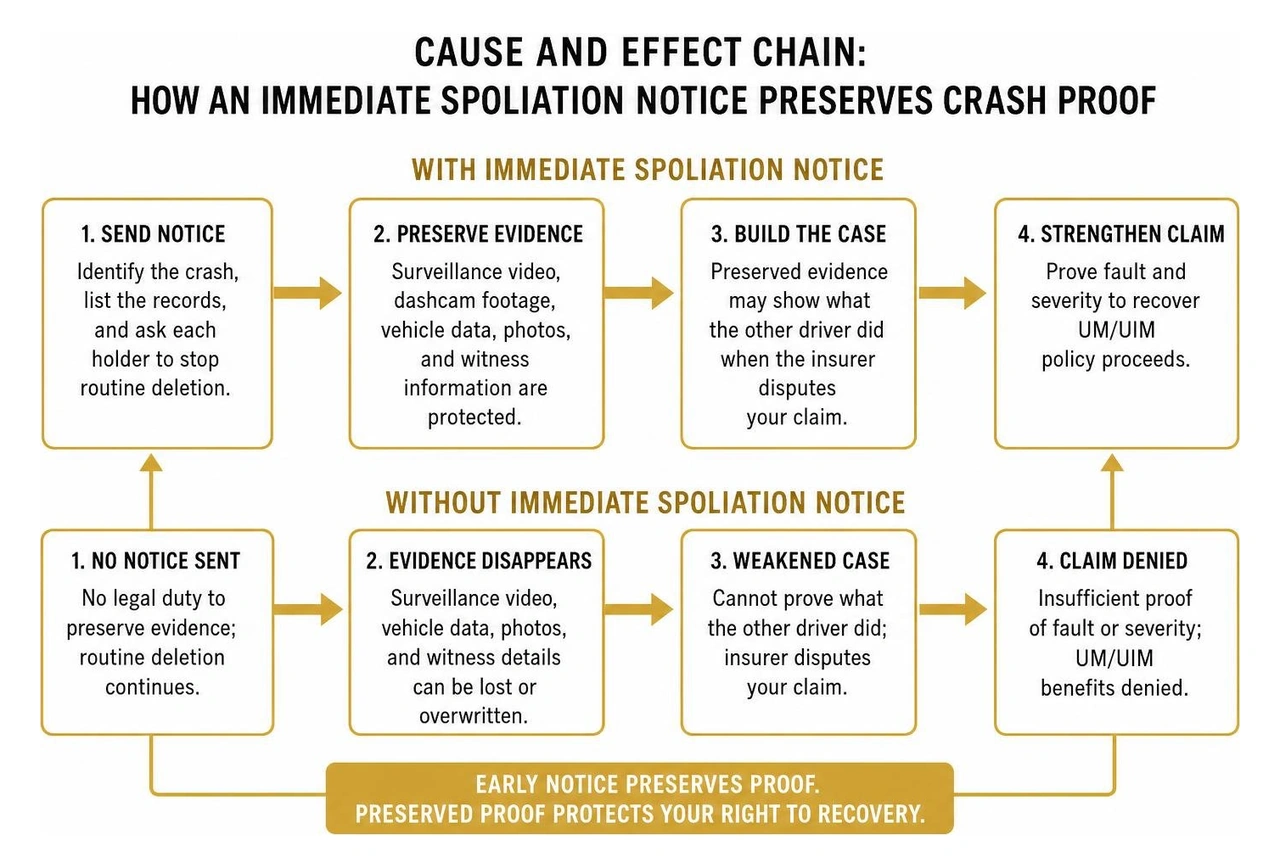
Send a spoliation letter in an uninsured motorist case as soon as you know evidence may be lost. Identify the crash, list the records you need, and ask each person or organization holding them to stop routine deletion. Start with nearby surveillance video, dashcam footage, vehicle data, photos, and witness information. Send a separate notice to your insurer for evidence it controls, and keep proof that each notice was delivered.
That early step can matter just as much in an underinsured motorist case. A letter cannot prove fault on its own, but preserved evidence may show what the other driver did when the insurer disputes your claim.
I’m Anthony Shapero, managing partner at Liss, Shapero & Mitnick, and I once defended insurance companies before I began representing injured people. I bring that experience to every spoliation letter uninsured motorist dispute: protect the evidence first, then use it to build the case.
Why a Spoliation Letter in an Uninsured Motorist Case Is Essential for Recovery

When you purchase uninsured motorist (UM) or underinsured motorist (UIM) coverage, you expect your auto insurer to step in when a reckless driver either lacks coverage or flees the scene. Having spent years on the defense side representing insurance carriers, I know that these claims quickly turn adversarial. When handling uninsured and underinsured motorist claims, your own insurance carrier assumes the role of the at-fault driver's defense team.
To collect policy proceeds, you bear the strict burden of proof to show that you are "legally entitled to recover" damages from the uninsured driver. That means proving both that the other driver caused the crash and that your injuries are severe enough to warrant payment. If you cannot establish the other driver's identity or actions, the carrier will deny your claim.
A formal spoliation letter changes the dynamic entirely. It puts insurance carriers, commercial entities, and third parties on notice that litigation is anticipated, triggering a legal duty to safeguard critical evidence rather than allowing routine document-destruction policies to run.
Understanding the Spoliation Doctrine and Legal Preservation Duties
Spoliation refers to the destruction, significant alteration, or failure to preserve property or data for another's use as evidence in pending or reasonably foreseeable litigation. Under established common law rules across state and federal courts, the duty to preserve evidence arises when a party knows—or reasonably should know—that evidence in its possession is relevant to future litigation.
A well-crafted spoliation letter formally establishes this knowledge. Once served, the recipient cannot claim the destruction occurred through "routine document retention practices" or accidental loss. For instance, in insurance disputes such as Roberson v. Leone, courts have closely examined policy histories, renewal documents, and the preservation of underwriting files to resolve coverage ambiguities and determine the precise limits owed to injured policyholders. By placing a target on notice immediately, you protect your legal standing and eliminate standard excuses for missing records.
Proving Fault When the At-Fault Driver Is Unidentified or Lacks Coverage
In hit-and-run collisions or "phantom vehicle" crashes where an unknown driver runs you off the road without leaving contact details, the evidentiary challenge is steep. Insurers routinely deny these claims by asserting that no other vehicle was involved or alleging that you were solely at fault.
Navigating the process when the at-fault driver is uninsured or flees requires immediate, aggressive evidence preservation. If the driver is unknown, you must often file a claim against "John Doe." To succeed, you must gather physical debris, video evidence, and corroborating witness statements before the trail goes cold.
Critical Evidence to Target Before It Disappears

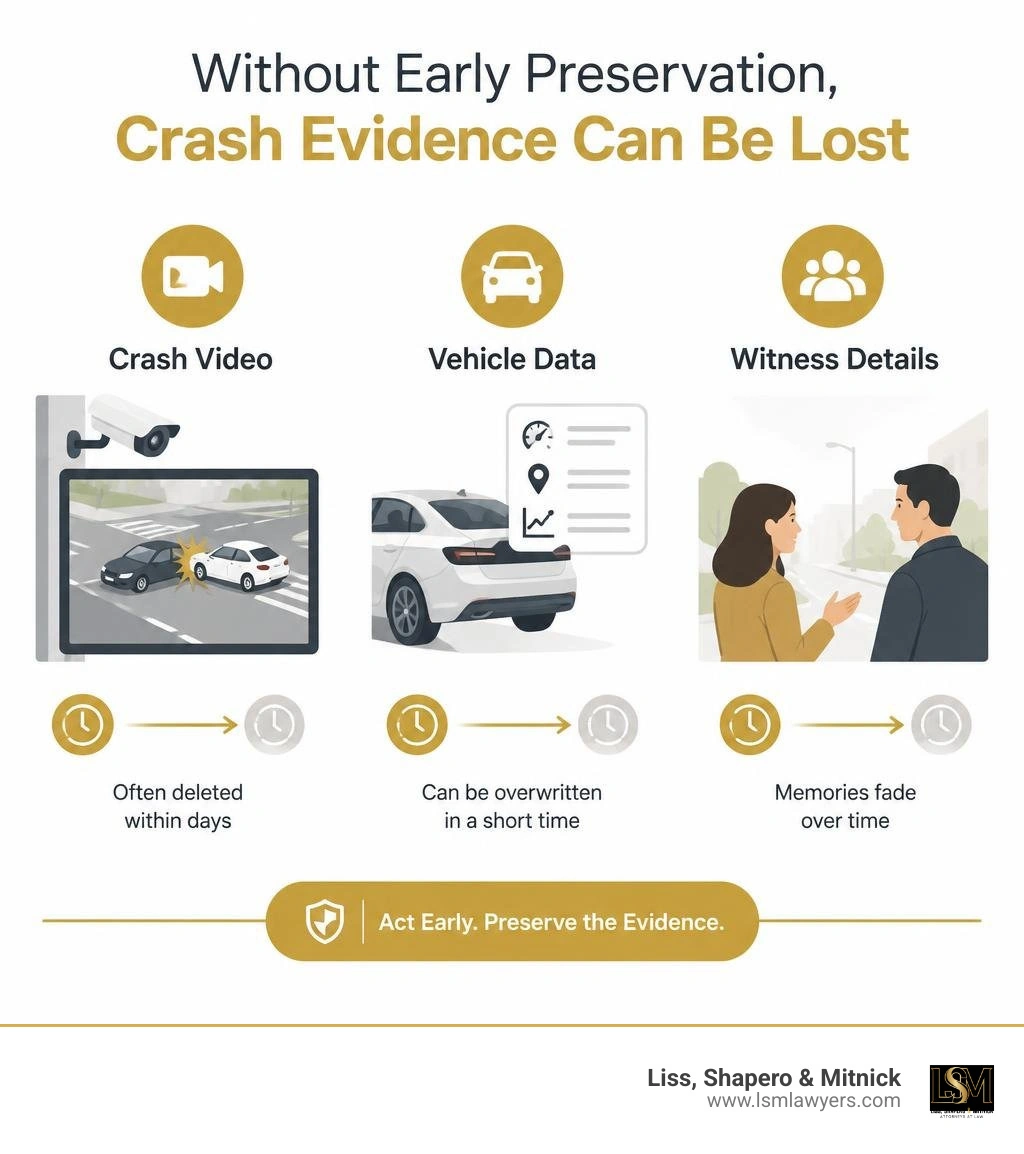
Crucial crash data exists on a ticking clock. Understanding evidence that can disappear quickly after a crash allows you to direct your spoliation notices to the right custodians within hours or days of an incident.
Electronic Data, Telematics, and Black Box Records
Modern passenger cars and commercial vehicles contain Event Data Recorders (EDRs) and Engine Control Modules (ECMs). These systems log vital objective metrics right before, during, and after an impact:
- Vehicle speed and throttle position
- Brake application and antilock braking system (ABS) activation
- Steering input and yaw rate
- Seatbelt status and airbag deployment timing
When a crash involves a delivery van, freight hauler, or fleet vehicle, commercial vehicle black box data can prove vehicle speed, following distance, and hours-of-service compliance. If the vehicle is repaired, put back in service, or sold at salvage auction, this electronic data can be overwritten or permanently lost.
Video Footage, 911 Audio, and Third-Party Records
Digital surveillance systems are routinely programmed to overwrite recordings on rolling 7-day, 14-day, or 30-day loops. Your spoliation letter should target:
- Nearby Commercial CCTV: Gas stations, convenience stores, banks, and retail storefronts along the path of travel.
- Municipal and Traffic Cameras: Department of Transportation cameras, toll-booth sensors, and municipal traffic monitoring feeds.
- Emergency Communications: 911 audio recordings, dispatch logs, Computer-Aided Dispatch (CAD) reports, and emergency medical service (EMS) run sheets.
- Third-Party Telematics & Cell Records: GPS tracking, fleet dispatch records, and mobile device logs of identified commercial or rideshare drivers.
Meeting State Evidentiary Burdens in Hit-and-Run and Unknown Driver Claims
Insurance contracts and state statutes impose strict prerequisites before paying out uninsured motorist benefits for unknown or hit-and-run drivers. Understanding these statutory thresholds illustrates why preserving objective evidence is critical:
| Jurisdiction / Claim Requirement | Physical Contact Required? | Corroborating Evidence / Eyewitness Rule | Key Statutory Citation / Policy Impact |
|---|---|---|---|
| Strict Physical Contact States | Yes (Traditionally required) | Circumstantial or physical debris showing paint transfer or vehicle contact | Standard policy terms require tangible physical impact to prevent fraud. |
| Corroborating Witness States (e.g., South Carolina, Arizona) | No (If independent witness exists) | Requires signed witness affidavit or independent corroboration confirming an unknown vehicle caused the incident | S.C. Code Ann. § 38-77-170; independent witness cannot be the owner/operator. |
| John Doe Procedure States (e.g., Virginia) | No | Strict reporting timelines and formal service on the UM insurer as a nominal defendant | Va. Code § 38.2-2206; rebuttable presumption of uninsured status. |
| Contract-Based Endorsement Claims | Governed by policy language | Objective evidence (video, black box, telematics) confirming phantom vehicle actions | Clear policy terms dictate whether missed contact bars recovery. |
How a Spoliation Letter Uninsured Motorist Strategy Overcomes Insurer Defenses
When carriers attempt to deny claims citing a lack of physical contact or insufficient proof, preserved physical and digital evidence becomes your primary counterweight.
In Hawkins v. Secura Insurance, the court analyzed how physical testimony and debris—specifically an open cattle truck door scattering hay—provided the necessary corroborating evidence to establish an unidentified driver's negligence, ultimately upholding a multimillion-dollar verdict.
Furthermore, state insurance departments regularly crack down on carriers attempting to circumvent coverage with improper restrictions. Regulatory actions, such as the South Dakota Insurance Bulletin on prohibited UM clauses, highlight that insurers cannot enforce unreasonable policy provisions that deprive policyholders of lawful uninsured motorist protections.
Statutory Immunity and Policy Definition Discrepancies
Evidence preservation is equally important when the at-fault motorist is an immune government employee or municipal operator. In such instances, carriers often argue that because the tortfeasor enjoys governmental immunity, the claimant is not "legally entitled to recover" damages, and therefore UM benefits do not apply.
However, judicial precedent demonstrates that specific policy language and timely preserved evidence can overcome these defenses. In the Ohio Supreme Court brief in Marusa v. Erie, the dispute centered on whether policy definitions of an "uninsured motor vehicle" extended to immune government operators. When policy terms conflict with statutory immunities, maintaining a complete record of underwriting files, claim communications, and scene evidence ensures insurers are held to their contractual obligations.
How to Draft and Serve a Legally Effective Preservation Notice
A vague or generic request asking someone to "save everything" often fails to withstand legal scrutiny. If you are exploring your options if the driver fled the scene, your spoliation demand must be precise, authoritative, and direct.
Essential Elements of a Spoliation Letter in an Uninsured Motorist Claim
To ensure your preservation letter creates an enforceable legal duty, include these five core elements:
- Definitive Party and Incident Identification: State the full names of the parties involved, policy and claim numbers, the exact date, time, and geographic coordinates or street intersection of the crash.
- Explicit Litigation Notice: Clearly state that civil litigation and first-party insurance claims are actively anticipated regarding the specified incident.
- Itemized Evidence Inventory: Do not use generic demands. Provide an itemized list of specific materials to retain, including EDR data, video feeds (specifying exact camera angles and time windows), 911 dispatch tapes, mobile phone records, and vehicle physical parts.
- Suspension of Auto-Delete Protocols: Expressly instruct the recipient to halt routine destruction, auto-delete loops, vehicle scrapping, or data overwrites.
- Notice of Sanctions and Legal Consequences: Cite applicable preservation rules and notify the recipient that destruction of the listed items will result in motions for adverse inferences, discovery sanctions, and potential bad-faith claims.
Timing and Service Best Practices to Prevent Loss
Serve the notice immediately using trackable delivery methods. Follow these operational guidelines:
- Certified Mail with Return Receipt Requested: Provides an indisputable, timestamped paper trail confirming receipt by claims managers or registered agents.
- Electronic Service (Direct Email & Facsimile): Send immediate electronic copies to the claims adjuster and third-party risk managers to provide instantaneous actual notice while the physical certified letter is in transit.
- Immediate Commercial Outreach: For gas stations, banks, and businesses near the crash scene, hand-deliver a formal notice within 24 to 72 hours, securing a signed acknowledgment of receipt from store management.
Legal Consequences When Insurers or Third Parties Ignore a Spoliation Demand
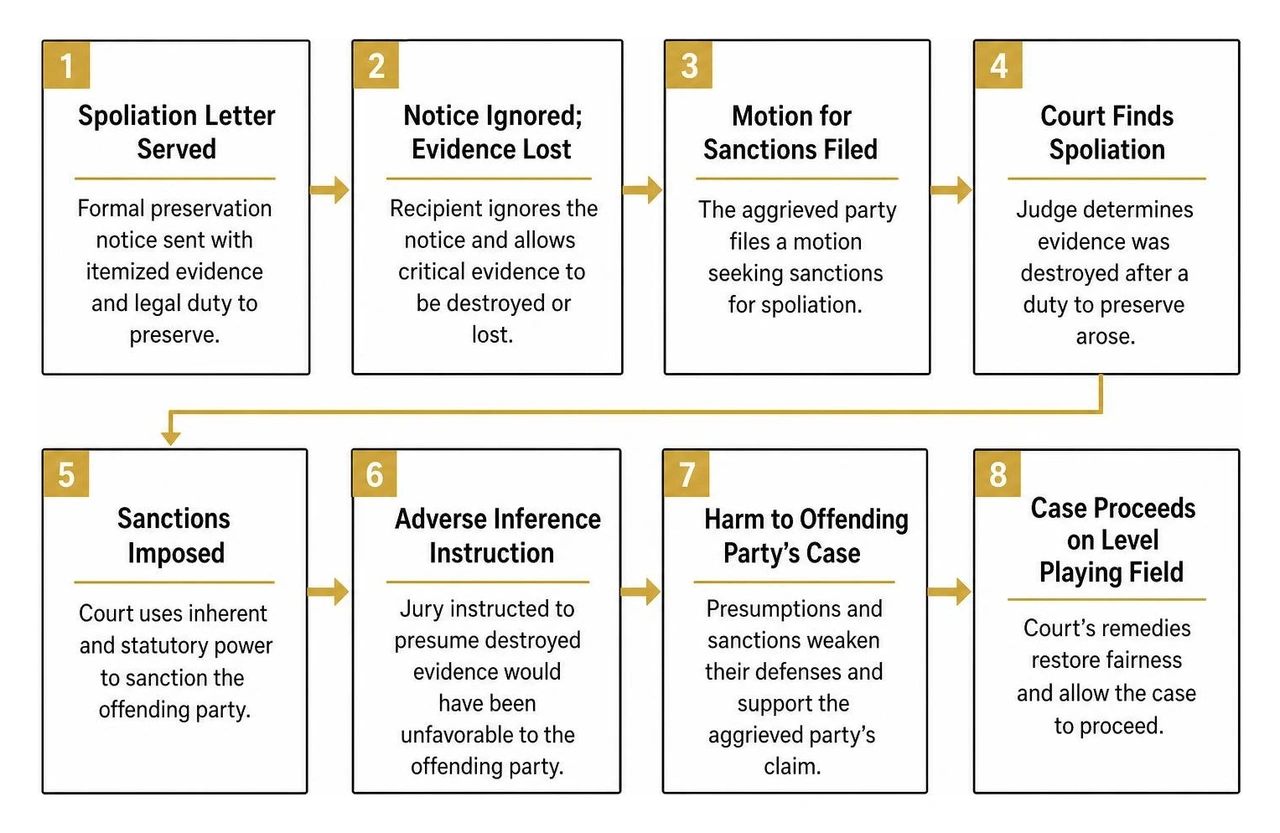
When an insurer or third party receives a formal preservation notice and subsequently allows critical evidence to be destroyed, the legal system provides specific remedies to level the playing field.
Judicial Sanctions and Mandatory Negative Inferences
When spoliation occurs, trial judges possess broad inherent authority and statutory power to sanction the offending party:
- Adverse Inference Instructions: Under statutory provisions and procedural rules (such as principles reflected in O.C.G.A. § 24-14-22 and related state doctrines), the court can instruct the jury to presume that the destroyed evidence would have been unfavorable to the party that destroyed it.
- Striking Defenses or Pleadings: In cases of willful destruction or bad faith, courts can strike the insurer's liability defenses or grant a default judgment on fault.
- Evidentiary Preclusion: The court may bar the defense from introducing alternative theories or expert testimony concerning matters that the destroyed evidence would have addressed.
Bad Faith Exposure for First-Party Insurers
First-party auto insurers owe their insureds a duty of good faith and fair dealing. An insurer that ignores its own policyholder's spoliation demand, fails to investigate an uninsured motorist claim, or destroys internal claim files and investigative data faces substantial financial exposure beyond standard policy limits.
Documenting intentional delays or willful evidence destruction lays the groundwork for extra-contractual bad-faith claims, holding carriers accountable when they put their financial bottom line ahead of their contractual obligations.
Frequently Asked Questions About Spoliation in Uninsured Motorist Claims
How quickly must a spoliation letter be sent after an uninsured motorist accident?
Send a spoliation letter within 24 to 72 hours following an accident. Many commercial security cameras and dashcam systems overwrite footage on a 7-day to 14-day loop, and commercial vehicle black boxes can lose crash data once the vehicle is put back into operational service or repaired.
Can a spoliation letter help if there was no physical contact in a hit-and-run?
Yes. In "phantom vehicle" or non-contact crashes, insurers often claim the driver lost control independently. An early spoliation letter sent to local businesses, the Department of Transportation, or nearby traffic camera operators can secure video footage proving that an unknown vehicle cut you off or created an unavoidable hazard.
What happens if an insurance company destroys evidence after receiving a preservation letter?
If an insurer destroys or discards evidence after receiving a spoliation letter, your attorney can file a motion for sanctions. The court may issue an adverse inference instruction—telling the jury to presume the destroyed evidence proved the insurer was liable—or even strike the insurer's coverage defenses entirely.
Conclusion: Protect Your Claim with Timely Evidence Preservation
Uninsured and underinsured motorist claims are won and lost on the quality of objective evidence. When dealing with hit-and-run drivers, disputed coverage limits, or stubborn insurance adjusters, allowing key video, electronic data, or witness records to disappear can permanently derail your recovery.
At Liss, Shapero & Mitnick, we leverage our inside understanding of insurance defense tactics to protect accident victims across Metro Detroit and throughout Michigan. To understand how we handle these critical early steps, learn more about what a spoliation letter is and when counsel sends one. If you were injured by an uninsured or hit-and-run driver, contact us right away so we can act immediately to preserve the evidence you need to win.