
What Families Should Know After a Fatal Aviation Crash

A wrongful death aviation crash claim can help surviving family members seek compensation when negligence or a defective aircraft part contributed to a fatal crash. Depending on what happened, a claim may involve the airline or private pilot, aircraft owner, maintenance provider, manufacturer, or another responsible party. Families may be able to recover lost financial support, funeral costs, and other losses allowed by law.
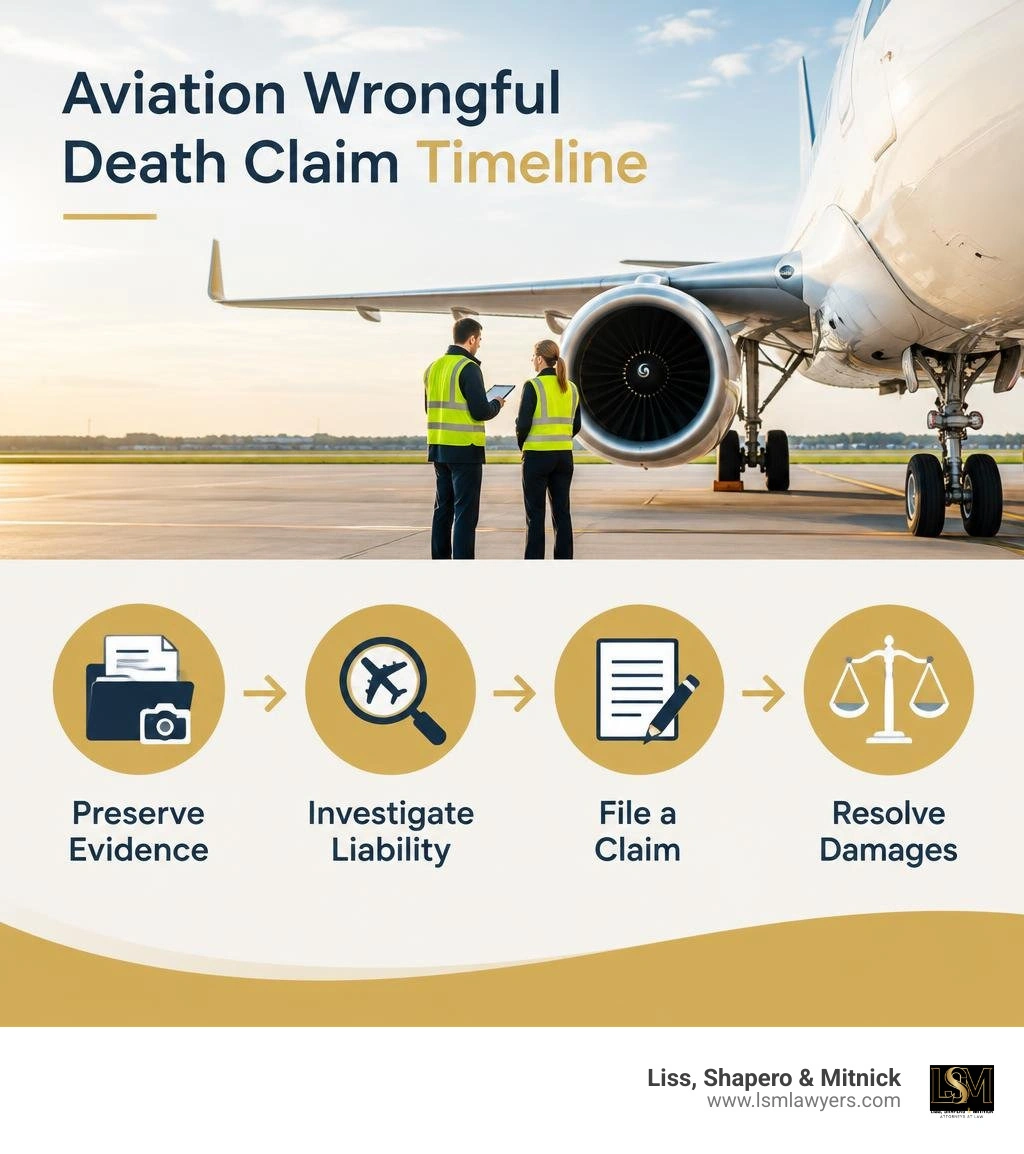
The first steps are to preserve records, identify who may be responsible, and check the filing deadline. The National Transportation Safety Board investigates the crash, but its final report may take years. Families do not always have to wait for that report to explore their legal options.
I’m Scott Mitnick, a partner at Liss, Shapero & Mitnick. My civil litigation and Michigan wrongful death experience informs how I approach the questions families face after a wrongful death aviation crash: what happened, who may be liable, and what losses the law allows them to claim.
Proving Liability After a Wrongful Death Aviation Crash

Aviation accidents are rarely simple. Unlike a standard car crash on I-75 where liability might rest on a single distracted driver, a plane crash usually results from a chain of failures. When an aircraft goes down, establishing who is legally at fault requires unraveling complex layers of human decisions, mechanical systems, weather data, and corporate oversight.
Fatal accidents happen across all sectors of aviation, from major commercial carriers and regional cargo flights to private charter planes and medical helicopters. Some of the most frequent contributing factors include:
- Pilot Error and Spatial Disorientation: Pilots can become overwhelmed by instrument failure, fatigue, or spatial disorientation during night flights or inclement weather. For instance, in severe cloud cover or dark conditions, a pilot without sufficient instrument training can lose track of the horizon and pitch the aircraft into a fatal dive.
- Operating in Severe Icing Conditions: Ice buildup on wings and control surfaces disrupts airflow, reduces lift, and dramatically increases drag. Operating an overloaded aircraft in known or forecast icing conditions introduces catastrophic stall risks.
- Improper Maintenance Procedures: Airlines and charter operators frequently contract maintenance to third parties. Overlooked service bulletins, failure to replace worn components, skipping mandatory inspections, or using improper repair techniques can cause structural failures mid-flight.
- Defective Aeronautical Components: Design or manufacturing flaws in critical engine parts, such as a fractured camshaft gear or faulty flight-control software, can disable an aircraft regardless of pilot skill.
- Runway Excursions: When planes land with excessive speed, fail to deploy deceleration mechanisms (like speed brakes or thrust reversers), or touch down past the intended landing zone, they can overrun the runway. This was demonstrated in recent wrongful death litigation following a commercial runway overrun, where an aircraft overshot its landing point by over 1,000 feet at 158 knots, colliding with ground personnel.
Investigating Evidence in a Wrongful Death Aviation Crash
Proving fault requires capturing and analyzing data before it is lost, altered, or overwritten. When an aviation disaster occurs, federal agencies step in immediately, but private litigation requires its own rigorous fact-finding process.
The National Transportation Safety Board (NTSB) and the Federal Aviation Administration (FAA) lead the official safety investigation. The NTSB secures the wreckage, releases preliminary reports, and eventually publishes a factual brief and probable cause finding. However, federal law restricts how NTSB reports can be used in civil courtrooms. While the underlying factual data collected by federal investigators is accessible, the agency's formal conclusions regarding liability are often inadmissible in civil trials.
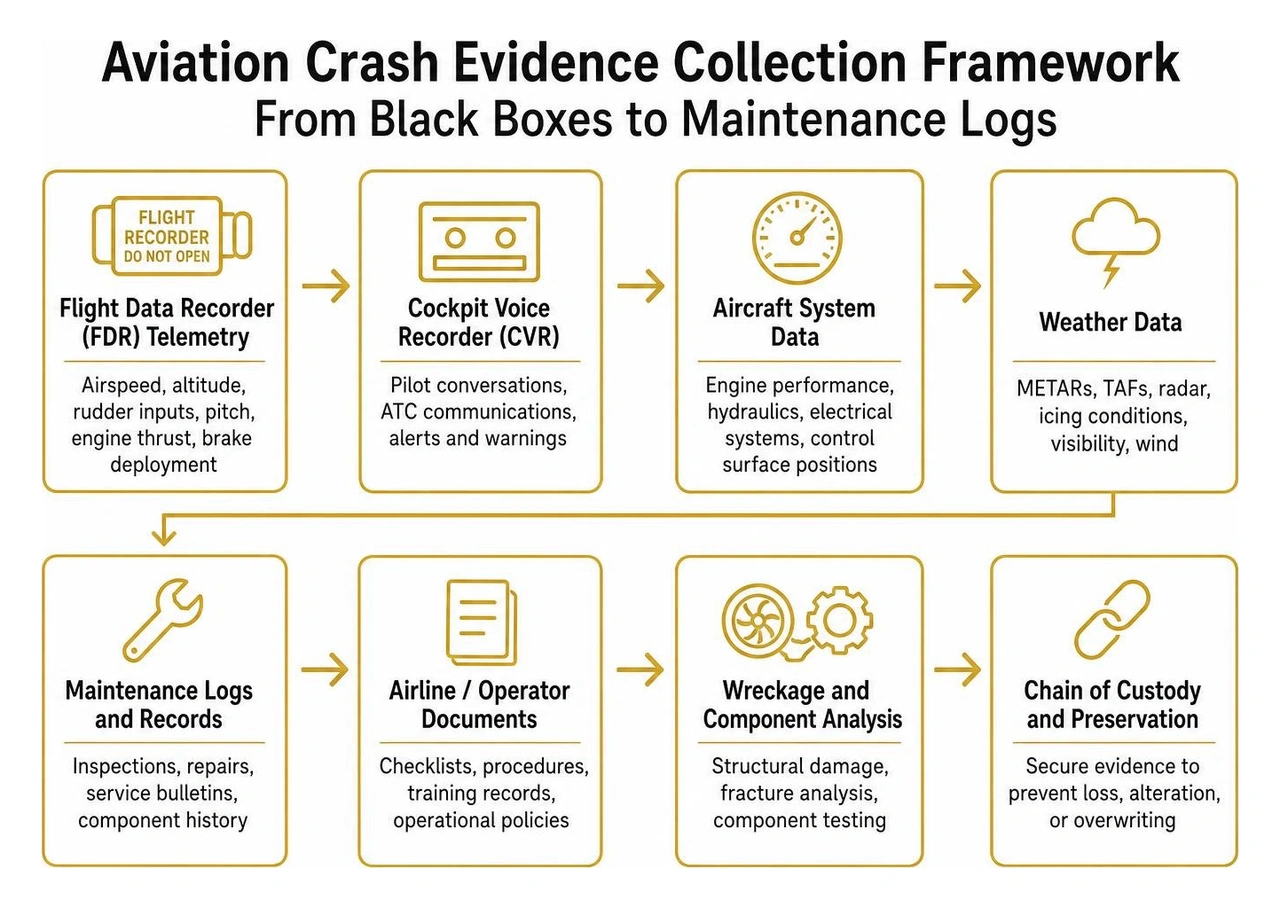
Because of this, an independent investigation is essential for holding negligent parties accountable for preventable incidents. Our team works alongside aerospace engineers, accident reconstructionists, and metallurgists to preserve and examine:
- Flight Data Recorder (FDR) Telemetry: Captures hundreds of physical parameters, including airspeed, altitude, rudder inputs, pitch, engine thrust, and brake deployment.
- Cockpit Voice Recorder (CVR) Audio: Records pilot communications, ambient cockpit sounds, warning alarms, and crew coordination during critical flight phases.
- Air Traffic Control (ATC) Transcripts: Verifies weather advisories, altitude clearances, routing instructions, and radar tracking data leading up to the impact.
- Aircraft Maintenance Logs: Details historical service records, deferred maintenance items, component replacement histories, and FAA airworthiness directive compliance.
Potential Defendants Across the Aviation Supply Chain
Liability in aviation litigation is rarely limited to the pilot seated at the controls. Modern air travel relies on a massive corporate supply chain, and multiple entities can share legal responsibility:
- Commercial Airlines and Logistics Carriers: Operators must properly train their flight crews, enforce strict safety limits, and prevent operational overreach.
- Corporate Shippers and Logistics Brands: When major corporations contract cargo services to third-party charter operators, they may still face liability for negligent selection, inadequate contractor oversight, or imposing unrealistic delivery schedules that compromise flight safety.
- Airframe and Component Manufacturers: Companies that design and build aircraft, engines, avionics, and navigation systems are subject to strict product liability if a defect causes a crash.
- Contract Maintenance Providers: Third-party repair stations that perform negligent overhauls, install counterfeit parts, or clear unairworthy planes for flight can be held accountable.
- Government Entities (FAA / Air Traffic Control): If air traffic controllers issue improper vectoring, fail to warn of severe weather hazards, or clear two aircraft onto colliding flight paths, the federal government may be named as a defendant.
- The Pilot’s Estate: When private or commercial pilot negligence causes a crash that also claims the pilot's life, families can bring civil claims directly against the deceased pilot's estate and their liability insurance coverage.
Recent wrongful death civil filings after commuter plane crashes demonstrate how corporate operators face direct negligence and gross negligence claims when they allow overloaded aircraft to take off in dangerous winter weather.
Comparing Commercial, Private, and International Plane Crash Claims
The legal rules governing an aviation wrongful death claim depend heavily on the type of flight, the purpose of the trip, and where the incident took place.
| Flight Category | Governing Law / Standard | Standard of Care & Liability Rules | Key Restrictions & Damage Rules |
|---|---|---|---|
| Commercial Domestic Airline | State Tort Law & FAA Regulations; Common Carrier Doctrine | Highest degree of care; liable for even slight negligence in passenger safety. | Full compensatory damages available; multi-district litigation consolidation common. |
| General Aviation / Private Aircraft | State Tort Law & General Aviation Revitalization Act (GARA) | Reasonable care; negligence required. Dangerous instrumentality rules may apply to owners. | Subject to private pilot insurance policy limits; 18-year statute of repose protects aircraft makers. |
| International Flights | The Montreal Convention (MC99) | Strict liability up to treaty limits; presumption of carrier liability for passenger injury/death. | Two-year strict treaty limitation; limits claims to physical injury and pecuniary losses. |
| Over Navigable Waters / Ocean | Death on the High Seas Act (DOHSA) / Maritime Law | Varies by carrier status; applies beyond 12 nautical miles from U.S. shores. | Recovery limited to financial loss and loss of support; bars pre-death pain and suffering. |
Aviation legal history is built on complex jurisdiction battles, such as landmark airline disaster liability rulings that established how federal courts manage multi-party liability, pilot checklist failures, and manufacturer cross-claims.
Commercial Cargo and Passenger Jet Disasters
Commercial passenger airlines and cargo operations function as common carriers. Under the law, common carriers owe passengers and the public the highest duty of vigilance and care.
When a commercial disaster occurs, families are often approached by corporate defense teams seeking quick, consolidated settlements. These cases frequently involve cargo jet fatal accident lawsuits or catastrophic runway overruns where third-party ground workers are struck outside the plane.
For local families navigating Detroit aviation accident claims, pursuing an individualized legal claim rather than joining a generic settlement pool ensures that your family's distinct economic losses, parental contributions, and emotional suffering are fully calculated and fought for.
General Aviation and Private Aircraft Liability
Unlike major airlines with tens of millions of dollars in commercial fleet coverage, private planes, unscheduled charters, and recreational aircraft operate under general aviation rules. These cases present unique legal challenges:
- The Dangerous Instrumentality Doctrine: In certain jurisdictions, the registered owner of an aircraft can be held vicariously liable for damages caused by a pilot operating the plane with their consent, regardless of whether the owner was on board.
- Insurance Coverage Gaps: Private pilots often carry policies with lower per-passenger liability limits. Skilled counsel must identify third-party defendants, such as maintenance facilities or fuel providers, to ensure adequate financial recovery.
- The General Aviation Revitalization Act (GARA): This federal statute of repose shields general aviation manufacturers from product liability lawsuits if the aircraft or faulty part was manufactured 18 or more years prior to the accident, with narrow exceptions for concealed safety data.
Families exploring their legal options after fatal aircraft accidents must evaluate these liability sources early to protect their rights.
Financial Compensation and Settlement Calculations for Families

No financial recovery can replace a lost family member. However, the civil justice system provides a mechanism to protect surviving dependents from financial devastation and hold negligent corporations accountable.
To build a compelling damages claim, we collaborate with forensic economists, vocational experts, and life-care planners. These professionals calculate the total lifetime economic footprint of the decedent, accounting for:
- Projected career advancement, salary growth, and promotional trajectories.
- Value of lost employment benefits, pension plans, 401(k) matches, and health coverage.
- The tangible economic value of household services, childcare, and family management.
Recoverable Damages in a Wrongful Death Aviation Crash Lawsuit
Under state law, when filing a wrongful death claim, surviving family members can pursue both economic and non-economic compensation, including:
- Pecuniary Financial Loss: Direct compensation for the loss of financial support the deceased would have provided to their spouse, children, and dependents.
- Loss of Society, Companionship, and Consortium: Compensation for the profound loss of love, companionship, protection, and parental guidance.
- Funeral and Burial Costs: Full reimbursement for reasonable expenses related to memorial and burial services.
- Conscious Pain and Suffering: Compensation for the terror and physical suffering experienced by the decedent between the onset of the emergency and the final impact. Understanding how these damages are structured requires distinguishing wrongful death from survival actions, ensuring that pre-impact emotional distress is properly claimed on behalf of the estate.
- Punitive Damages: When an air carrier or manufacturer acts with gross negligence, willful misconduct, or reckless disregard for human life (such as falsifying maintenance logs or forcing an overloaded plane into severe storms), punitive damages may be pursued to punish the wrongdoer.
Statutes of Limitations and Critical Filing Deadlines
Aviation claims are governed by strict statutory deadlines. If you miss these windows, your claim will be permanently barred:
- State Wrongful Death Statutes: Most states enforce a two-year or three-year statute of limitations from the date of death to file a civil lawsuit.
- Federal Tort Claims Act (FTCA): If negligence involves FAA air traffic controllers, claimants must submit an administrative Form 95 claim within two years, followed by strict litigation filing timelines once a final denial is issued.
- International Treaties: The Montreal Convention imposes an absolute two-year limitation period from the date of arrival or scheduled arrival.
- Probate Court Personal Representative Appointment: Under Michigan law and standard probate rules, wrongful death lawsuits must be filed by the court-appointed personal representative of the decedent's estate. Families should review the statutory rules for bringing a wrongful death claim to ensure an estate is opened and a representative is designated without delay.
Frequently Asked Questions About Aviation Wrongful Death Claims
How long does an aviation crash wrongful death investigation take?
A full NTSB investigation typically takes between 12 and 24 months to issue a final probable cause report. However, families do not need to wait for the federal government to conclude its work before initiating legal action. Civil claims can be filed using preliminary NTSB factual reports, public radar data, and findings from independent private investigations to preserve crucial physical and digital evidence before statutory deadlines expire.
Can families recover damages if the pilot responsible for the crash also died?
Yes. When a pilot’s negligence causes a fatal accident and the pilot also perishes, a wrongful death lawsuit can be filed directly against the deceased pilot’s estate. Compensation is typically paid through the pilot’s aircraft liability insurance policy, the aircraft owner's commercial policy, or additional third-party defendants like maintenance contractors and equipment manufacturers.
How do attorneys structure fees in plane crash wrongful death lawsuits?
Aviation wrongful death claims are handled on a contingency fee basis. Under this arrangement, families pay no upfront legal fees and zero out-of-pocket costs. The law firm funds the entire investigation, expert witness retainers, crash reconstruction costs, and litigation expenses. Legal fees and case expenses are only collected as an agreed-upon percentage if compensation is successfully recovered through a settlement or trial verdict.
Conclusion
Aviation disasters leave families facing overwhelming grief alongside complex legal, technical, and corporate hurdles. Commercial airlines, aerospace manufacturers, and insurance companies move quickly to limit their exposure and protect their bottom lines. Surviving families deserve an equally determined legal team on their side.
At Liss, Shapero & Mitnick, our legal team draws on deep civil litigation experience, including insights gained from past insurance-defense practice. We understand how corporate defense teams evaluate claims, and we use that knowledge to build strong, evidence-backed cases for families across Metro Detroit and throughout Michigan. If your family is dealing with the loss of a loved one after a fatal flight, consult an experienced Michigan wrongful death lawyer to protect your rights, preserve critical evidence, and secure the full compensation your family needs.
— Scott Mitnick, Partner at Liss, Shapero & Mitnick