.svg)
Understanding the Core Types of Auto Coverage
To find affordable auto coverage, start by comparing quotes from multiple licensed carriers using identical liability limits, PIP choices, and deductibles. Then optimize your deductibles, bundle your auto policy with homeowners or renters coverage, claim available discounts such as good student or defensive driving savings, and review your coverage needs annually. These steps help you lower premiums without leaving your household underinsured.
Navigating auto insurance options can feel overwhelming, but building the right policy comes down to matching your coverage limits with your real-world financial risk. While state laws establish basic mandates, a standard policy combines distinct components that protect you against damage you cause, damage to your own vehicle, and medical expenses resulting from a collision.
| Coverage Type | Primary Purpose | Required vs. Optional | Deductible Applied? |
|---|---|---|---|
| Bodily Injury Liability | Pays for severe injuries or death caused to others | Mandatory in Michigan | No |
| Property Damage Liability | Covers damage your car causes to another person’s property outside Michigan | Mandatory in Michigan | No |
| Personal Injury Protection (PIP) | Covers medical treatment, lost wages, and attendant care regardless of fault | Mandatory (choice of limits available) | Optional PIP Deductible |
| Property Protection Insurance (PPI) | Pays up to $1 million for damage your vehicle causes to parked cars or buildings in Michigan | Mandatory in Michigan | No |
| Collision Coverage | Repairs or replaces your vehicle after a crash or pothole impact | Optional (Required by lenders/lessors) | Yes |
| Comprehensive Coverage | Covers theft, vandalism, weather, windshield glass, and animal strikes | Optional (Required by lenders/lessors) | Yes |
| Uninsured/Underinsured Motorist (UM/UIM) | Protects you if an at-fault driver has no insurance or insufficient limits | Highly Recommended Optional Add-on | No |
Before buying a policy, review official Michigan auto insurance regulations to understand mandatory statutory requirements and ensure your coverage complies with current state law.
Liability, Collision, and Comprehensive Protection
Liability coverage serves as your financial shield if you cause an accident that harms other people or their property. In traditional tort contexts, bodily injury liability pays for medical costs, lost income, and pain and suffering awarded to third parties.
When it comes to fixing your own car, you need auto physical damage insurance, which consists of two distinct coverages:
- Collision Coverage: Pays to repair or replace your vehicle if you strike another car, a guardrail, a tree, or even damage your suspension in a severe pothole. In Michigan, insurers typically offer broad form collision (which waives your deductible if you are substantially not at fault), standard collision, and limited collision.
- Comprehensive Coverage: Protects your vehicle against non-collision hazards. This includes auto theft, vandalism, fire, hail damage, fallen tree branches, windshield cracks from road debris, and animal collisions such as hitting a deer.
Evaluating Full Auto Coverage vs. Minimum Requirements
"Full coverage" is not a formal legal contract; it is an industry term used to describe a package that bundles liability, collision, comprehensive, and essential injury endorsements. If you lease or finance your vehicle, your lender will almost certainly mandate full coverage alongside GAP insurance to protect their financial stake.
Carrying only state-mandated minimums exposes your personal assets—including your home equity, personal savings, and future earnings—to severe risk if you cause a multi-vehicle wreck. To safeguard your household, insurance professionals frequently recommend carrying at least 100/300/100 liability limits ($100,000 per person for bodily injury, $300,000 per incident, and $100,000 for property damage), or even 250/500/100 limits backed by an umbrella policy. You can evaluate your household's risk profile with an auto insurance coverage assessment to find an appropriate protection tier.
No-Fault PIP and Uninsured Motorist Endorsements
Michigan operates under a unique auto insurance framework. Under this system, your own insurer provides Michigan no-fault insurance benefits through Personal Injury Protection (PIP) regardless of who caused the collision. These benefits cover reasonable and necessary medical care, three years of wage replacement, household replacement services, and attendant care assistance.
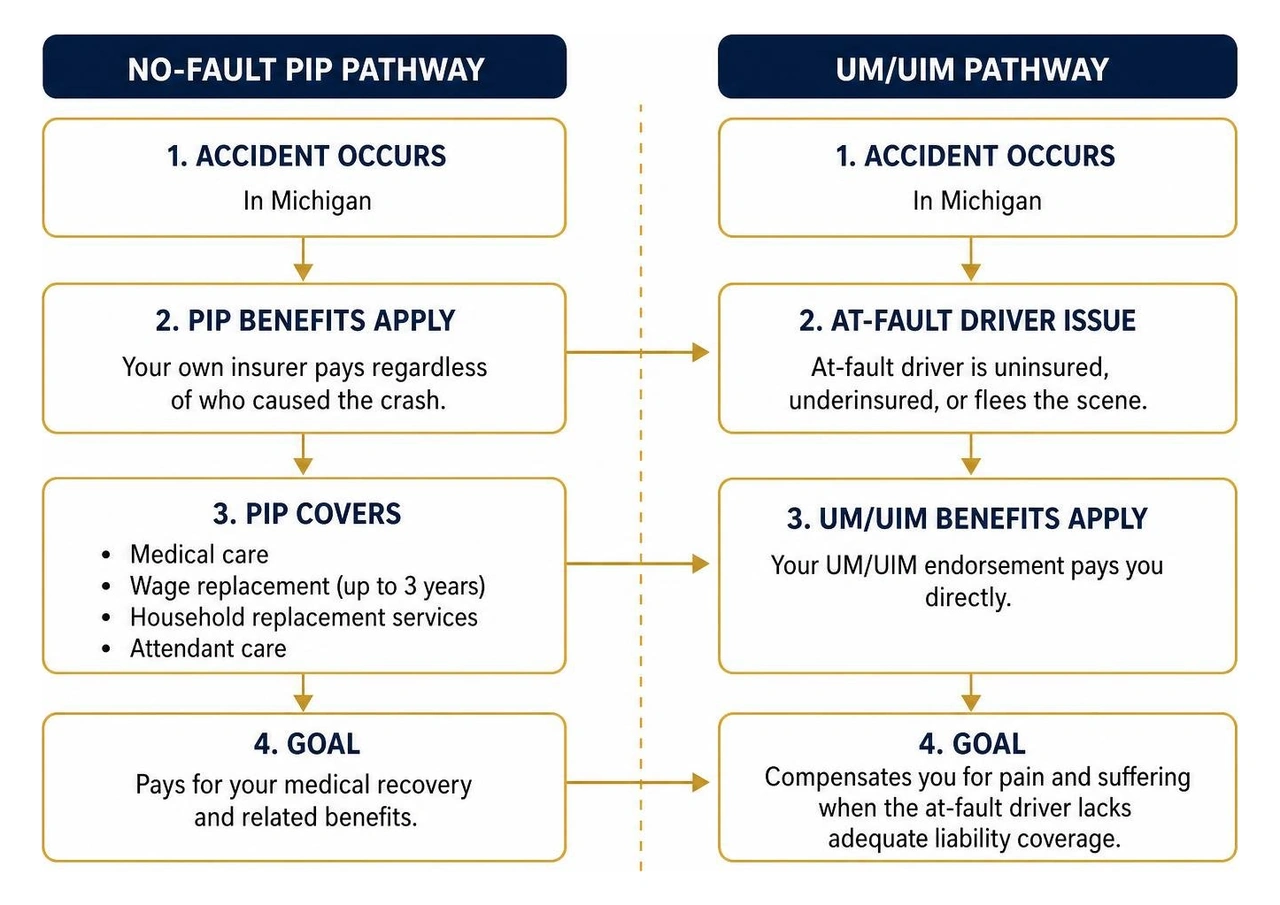
While PIP handles your medical recovery, what happens if an at-fault driver hits you and lacks adequate bodily injury coverage for your pain and suffering? Adding uninsured and underinsured motorist protection (UM/UIM) bridges this gap. UM/UIM is an inexpensive endorsement that pays you directly if the responsible driver flees the scene of a hit-and-run or carries inadequate liability limits to compensate your non-economic damages.
Key Factors That Determine Your Car Insurance Rates
Insurance carriers calculate your premium by running your profile through complex actuarial models designed to predict the likelihood and cost of future claims.
Underwriters analyze historical claim trends and behavioral indicators across large demographic datasets. Modern insurers use auto coverage verification and risk analytics to inspect past policy histories, coverage lapses, and loss reports over a multi-year timeline to assign your risk tier.
Driving Records and Credit-Based Insurance Scores
Your individual track record is one of the heaviest rating factors:
- Driving History: Speeding tickets, failure-to-yield citations, reckless driving charges, and at-fault collisions remain on your driving record for three to five years, directly raising your base premium.
- Continuous Coverage: Maintaining an unbroken insurance history proves reliability. Letting a policy lapse, even for a few weeks, can shift you into a high-risk rating category.
- Credit-Based Insurance Scores: Except where prohibited or restricted by statute, insurers frequently evaluate credit-based insurance scores. Actuarial data shows a statistical correlation between credit stability and claim frequency. Maintaining a strong credit profile by paying bills on time and keeping balances low helps reduce your annual premiums.
Vehicle Usage, Make, Model, and Location
The specific car you drive and where you park it overnight also dictate your rates:
- Vehicle Characteristics: High-performance sports cars, luxury imports with specialized sensors, and vehicles with low crash-test safety scores cost significantly more to insure. Conversely, vehicles equipped with advanced driver-assistance systems (ADAS) and high safety ratings qualify for lower rates.
- Annual Mileage: If you work remotely or have a short commute, lower annual mileage decreases your road exposure and reduces your risk profile.
- Garaging Address: Densely populated urban centers like Detroit and nearby Wayne, Oakland, and Macomb County communities typically see higher rates than rural areas due to higher traffic volume, increased collision frequency, and elevated rates of vehicle theft and vandalism.
How to Compare Quotes and Secure the Best Discounts
Shopping for auto insurance should never be a guessing game based on marketing promises. To secure true savings, request quotes from multiple licensed carriers using identical liability limits, matching PIP choices, and identical deductibles.

Proven Strategies to Lower Auto Coverage Premiums
- Optimize Your Deductibles: Raising your collision and comprehensive deductible from $500 to $1,000 can reduce your annual physical damage premium by 10% to 20%. Ensure you maintain enough cash in an emergency fund to cover the higher deductible if an accident occurs.
- Take a Defensive Driving Course: Drivers who complete an approved driver safety or accident prevention program can often secure premium reductions for up to three years.
- Leverage Good Student Discounts: High school and college students on your policy who maintain a "B" average (3.0 GPA) or higher frequently qualify for discounts between 7% and 15%.
- Conduct Annual Policy Audits: Review your policy declaration page every year. If your vehicle has depreciated significantly, your commute has shortened, or your credit score has improved, re-shop your policy to capture lower rates.
Multi-Policy Bundling and Telematics Savings
- Multi-Vehicle and Policy Bundling: Combining your auto policy with your homeowners, condo, or renters insurance under the same carrier typically delivers rate discounts between 10% and 25%. Insuring multiple household vehicles on a single policy yields similar multi-car savings.
- Usage-Based Telematics Programs: Many insurers offer voluntary programs that track your real-time driving habits via a mobile app or plug-in OBD-II device. Drivers who demonstrate smooth braking, avoid late-night driving, maintain safe speeds, and minimize phone usage while driving can earn double-digit percentage discounts.
What to Do After an Accident and Managing Policy Limits
The minutes and days following an auto collision can shape the outcome of both your insurance claims and any third-party legal recovery.

- Prioritize Safety: Check yourself and your passengers for injuries, move your vehicle out of active traffic if safe to do so, and call 911 immediately.
- Document the Scene Thoroughly: Take wide-angle and close-up photos of all vehicle damage, license plates, skid marks, traffic signals, road hazards, and visible physical injuries.
- Exchange Crucial Information: Collect the name, contact information, driver's license number, insurance carrier, and policy number from all involved motorists. Record names and phone numbers of any independent eyewitnesses.
- Seek Immediate Medical Evaluation: Even if you believe your injuries are minor, adrenaline can mask severe soft tissue damage, concussions, and internal trauma. Seeing a doctor right away creates an objective medical record linked directly to the crash.
- Notify Your Insurer Promptly: Report the incident to your carrier to start the claims process, but stick strictly to basic factual details regarding when and where the collision took place.
Handling Rental Cars and Borrowed Vehicles
When you lend your car to a friend or family member who has your permission to drive, your auto insurance policy acts as the primary coverage under the legal doctrine of permissive use. If they cause an accident, your liability and collision coverage respond first, while their personal auto policy acts as secondary coverage if damages exceed your policy limits.
When renting a vehicle for personal travel, your existing personal auto coverage—including liability, collision, and comprehensive—generally transfers to the rental vehicle within the United States. However, rental car companies may charge "loss of use" fees while a damaged rental is being repaired, which standard personal policies might not cover. Reviewing your policy endorsement details or using a credit card that provides primary rental car physical damage coverage can protect you from these extra fees.
Avoiding Common Pitfalls When Filing Claims
Insurance adjusters work to resolve claims while minimizing payouts for their companies. Understanding what to avoid saying to an insurance adjuster protects your legal rights:
- Never Give a Recorded Statement Without Legal Advice: You are not legally required to provide an on-the-spot recorded statement to the other driver’s insurance adjuster. Adjusters often ask leading questions designed to get you to minimize your injuries or admit partial fault.
- Do Not Speculate on Fault or Injuries: Avoid phrases like "I'm fine," "I didn't see them coming," or "I might have been looking down." Stick solely to verified facts.
- Watch Strict Notice Deadlines: Under Michigan no-fault law, you must submit an application for PIP benefits within one year of the accident date. Missing this statutory deadline forfeits your right to medical reimbursement and wage loss recovery.
- Address Claim Denials Early: If an insurer unreasonably denies your valid PIP benefits or refuses to offer a fair settlement on property damage, our team can step in to resolve insurance disputes after injury and recover what you are owed.
Frequently Asked Questions About Auto Insurance
How much liability insurance do I really need?
Carrying only the statutory minimum liability limits leaves you personally vulnerable to catastrophic financial loss if you cause an accident resulting in serious injury. A single severe crash involving surgery, intensive care, and long-term disability can result in hundreds of thousands of dollars in damages. Most drivers with personal assets, a home, or retirement savings should carry at least 100/300/100 or 250/500/100 bodily injury liability limits, supplemented by a personal umbrella policy for higher-limit asset protection.
When should I drop collision and comprehensive coverage?
A reliable rule of thumb is the 10% Rule: if the combined annual cost of your collision and comprehensive coverage exceeds 10% of your vehicle’s current market value (minus your deductible), dropping physical damage coverage may make financial sense. For example, if your older car is worth $3,500 and you have a $1,000 deductible, your maximum insurance payout after a total loss is only $2,500. If you are paying $400 a year for that physical damage coverage, saving that money in an emergency fund could be more economical, provided you own the vehicle free and clear.
Will filing an insurance claim automatically raise my rates?
Understanding rate increases after filing an insurance claim depends primarily on fault and coverage type. Filing a comprehensive claim for a chipped windshield or hail damage typically does not trigger a surcharge because the event was outside your control. Similarly, non-fault collisions generally do not lead to significant rate hikes. However, at-fault accidents that involve substantial liability or collision payouts often cause your premium to rise at policy renewal unless you have purchased an explicit accident forgiveness endorsement.
Conclusion
Finding affordable auto insurance requires balancing competitive pricing against the real risk of underinsurance. By auditing your declaration page annually, raising deductibles when you have sufficient savings, and securing essential endorsements like Uninsured/Underinsured Motorist protection, you can lower your monthly premium without exposing your personal assets to catastrophic liability.
At Liss, Shapero & Mitnick, our legal team draws upon decades of insurance-defense background to advocate for injured drivers across Berkley, Metro Detroit, and throughout Michigan. We know how insurers assess risk, interpret policy language, and evaluate injury claims. If you are updating your household coverage, explore your options for coordinating health insurance with Michigan no-fault policies to maximize your protection and secure the benefits you deserve.