
How Personal Injury Protection Helps After a Car Crash

After a crash, auto insurance personal injury protection (PIP) can help pay medical bills, lost wages, and certain household help costs regardless of who caused the crash. In Michigan, PIP is part of the no-fault insurance system, but the medical benefits available depend on the coverage chosen for the policy. PIP does not pay to repair your car.
If you are injured, report the crash to your auto insurer and keep copies of medical bills, work records, and receipts for help you need at home. Those records can make it easier to claim the benefits you are owed.
I'm Anthony Shapero, managing partner at Liss, Shapero & Mitnick. I represented insurers before focusing on injured people, and I use that experience to help Michigan drivers understand and pursue auto insurance personal injury protection benefits.
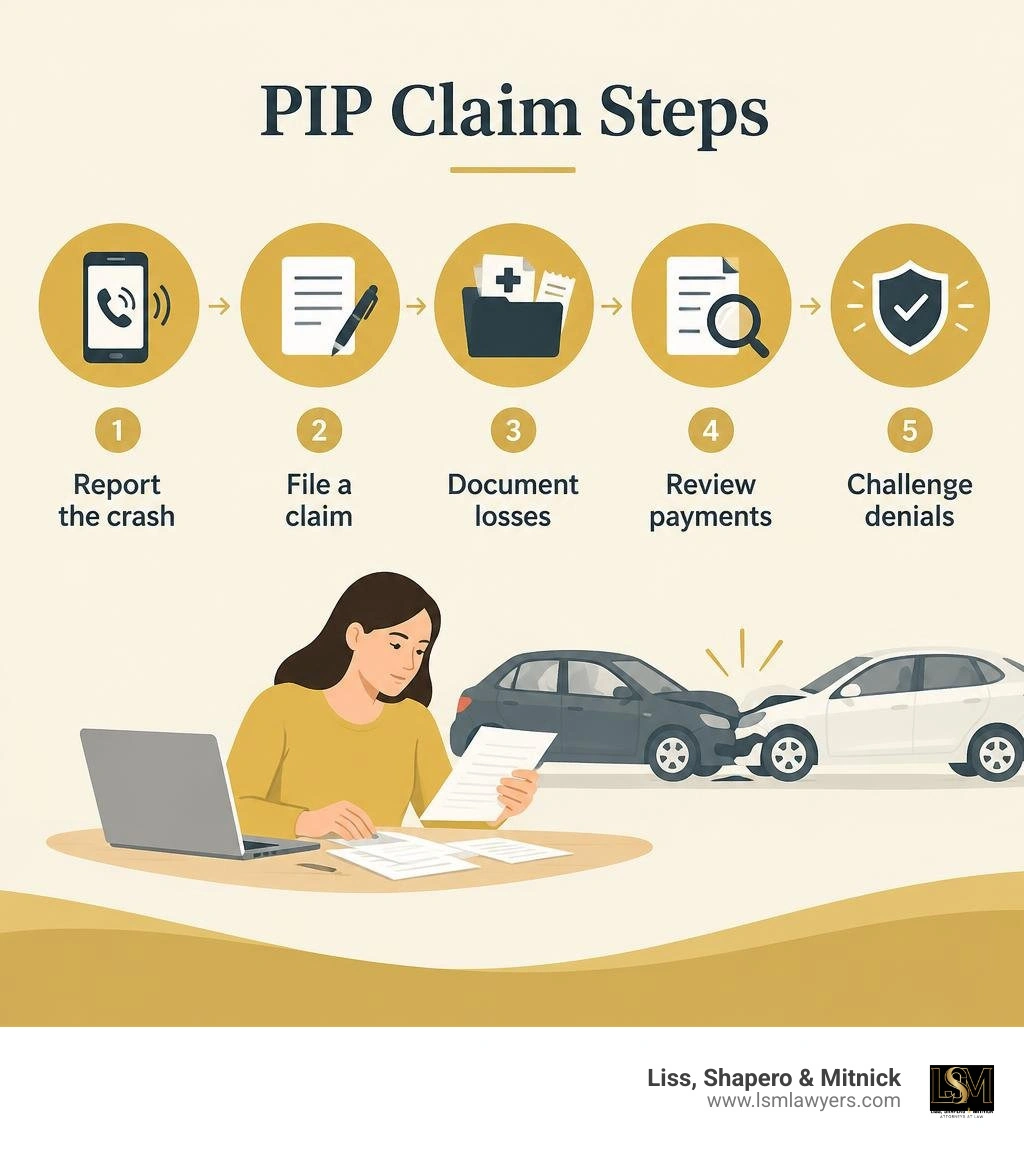
Key auto insurance personal injury protection vocabulary:
Understanding Auto Insurance Personal Injury Protection and How It Works
Personal injury protection operates as the cornerstone of first-party auto coverage in no-fault systems. When an accident happens, your insurer covers your necessary medical expenses and financial losses without requiring you to prove that another motorist acted negligently. According to an overview of personal-injury protection insurance, this framework was designed to remove drawn-out courtroom battles over fault before an injured person could access immediate medical care.
PIP coverage typically accounts for 15% to 20% of the total cost of an auto policy premium. While 12 states mandate PIP coverage by law, several other states offer it as an optional add-on that policyholders must reject in writing if they decline it.
| Mandatory PIP States | Optional PIP States / Jurisdictions |
|---|---|
| Michigan, New York, New Jersey, Florida, Massachusetts, Hawaii, Kansas, Minnesota, North Dakota, Utah, Delaware, Oregon | Washington, Texas, Virginia, South Dakota, Maryland, Kentucky, Pennsylvania, Arkansas, District of Columbia |
What Expenses Are Covered by Auto Insurance Personal Injury Protection?
PIP benefits extend far beyond immediate emergency room visits. Under comprehensive first-party protections, your benefits encompass:
- Hospital and Medical Treatment: Emergency care, surgical operations, prescription drugs, physical therapy, cognitive rehabilitation, and diagnostic scans.
- Lost Wage Reimbursement: Financial compensation for the income you would have earned had the crash not left you disabled.
- Replacement Household Services: Funds to pay for domestic assistance such as housekeeping, meal preparation, childcare, and yard care. It is essential to ensure you are documenting mileage and replacement services correctly to avoid insurer pushback.
- Attendant Care Services: Direct assistance with activities of daily living (bathing, dressing, medication management). In many instances, family attendant care compensation allows relatives to receive hourly reimbursement when caring for a recovering family member at home.
- Medical Transportation: Mileage reimbursement or medical transport costs for traveling to doctor appointments and therapy sessions.
- Funeral and Burial Costs: Reasonable expenses paid to surviving dependents if a motor vehicle crash leads to a tragic loss of life.
- Pedestrian and Cyclist Protections: First-party medical benefits apply if you are struck by a vehicle while walking or riding a bicycle.

Common Exclusions and Benefit Limitations
While PIP provides extensive financial security, it contains statutory exclusions:
- Vehicle and Property Damage: PIP does not cover damage to your vehicle, another person's car, or physical property (except under specific Delaware rules).
- Uninsured Owned Vehicles: If you own an uninsured vehicle involved in an accident, you are generally barred from collecting PIP benefits.
- Intentional Self-Injury: Any harm caused intentionally by the claimant is excluded.
- Commercial and Unauthorized Use: Using a personal vehicle for commercial delivery or taxi purposes without an endorsement, or operating a stolen vehicle, voids standard PIP coverage.
- Felony Commission: Injuries sustained while fleeing law enforcement or committing a felony are universally barred.
Comparing Auto Injury Coverages and Coordination Rules
Auto policies are built on distinct layers of protection. Understanding priority rules and how benefits coordinate prevents unexpected payment disputes. Reviewing policies on managing medical bills and payment priority while a claim is pending helps keep healthcare providers paid and protects credit ratings.
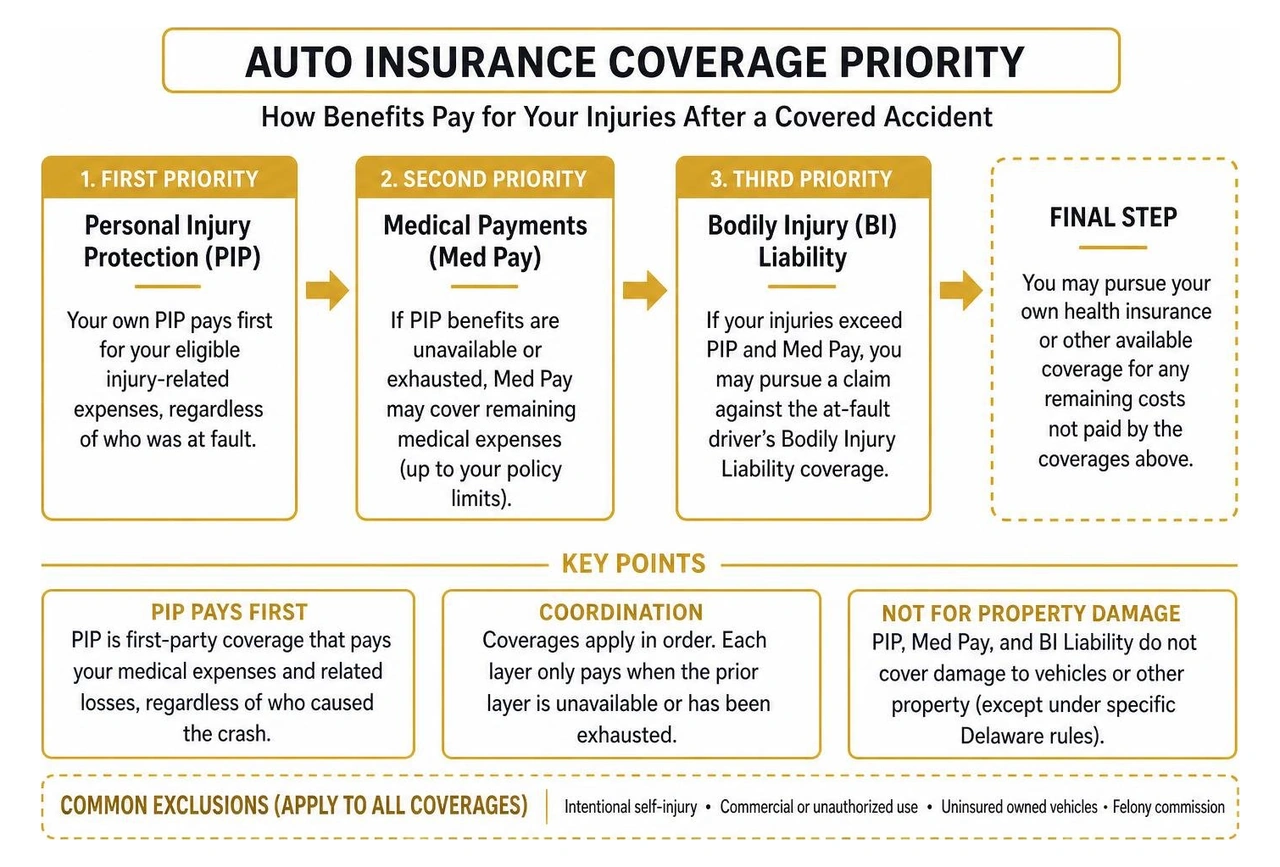
Key Differences: Auto Insurance Personal Injury Protection vs. Bodily Injury and Med Pay
Drivers often confuse PIP, Bodily Injury (BI) Liability, and Medical Payments (Med Pay). Understanding how they operate is crucial when distinguishing no-fault PIP benefits from third-party liability claims.
| Feature | Personal Injury Protection (PIP) | Medical Payments (Med Pay) | Bodily Injury (BI) Liability |
|---|---|---|---|
| Payer Classification | First-Party (Your Insurer) | First-Party (Your Insurer) | Third-Party (At-Fault Driver's Insurer) |
| Fault Required? | No (Strictly No-Fault) | No | Yes (Must prove driver was negligent) |
| Lost Wage Benefits | Yes | No | Yes (Through a settlement/verdict) |
| Attendant / Household Care | Yes | No | No (Calculated as general damages) |
| Pain and Suffering | No | No | Yes |
| Typical Policy Limits | $50,000 to Unlimited | $1,000 to $10,000 | Statutory minimums up to umbrella limits |
Med Pay functions purely as a medical-bill reimbursement tool with lower policy caps and no wage-loss protection. In contrast, Bodily Injury Liability requires proving negligence and covers third-party physical harm and pain and suffering.
Coordinating PIP with Private Health Insurance, Medicare, and Medicaid
When purchasing auto coverage, policyholders often choose between coordinated and uncoordinated PIP. Under a coordinated policy, your private health insurance pays first, and PIP acts as a secondary safety net to cover copays, deductibles, and services excluded by your health plan.
Coordination provides premium discounts, but requires caution:
- Qualified Health Coverage (QHC): For private health plans to coordinate properly, the policy cannot exclude auto accident injuries and must feature an individual deductible below statutory thresholds (such as under $6,579 in Michigan).
- Coordination Penalties: If you select health coverage as primary but let your policy lapse, insurers can impose significant penalty deductibles (for instance, the $750 gap penalty outlined in the New Jersey health insurer PIP coordination guide).
- Medicare and Medicaid Limits: Federal regulations prevent Medicare and Medicaid from acting as primary payers for motor vehicle collision injuries, though they can provide secondary coverage once auto PIP limits are exhausted.
State-Specific PIP Frameworks: Michigan and Beyond
Each jurisdiction sets distinct minimums, fee schedules, and coverage caps. Examining statutory Michigan no-fault insurance benefits reveals a robust system, whereas other jurisdictions establish lower caps. For example, Washington State PIP regulations and baseline caps include a baseline $10,000 medical cap over three years, $2,000 in funeral expenses, and up to $200 per week for lost wages.
Navigating Michigan's PIP Medical Tiers and Reform Laws
In Michigan, comprehensive reforms established six distinct coverage tiers. Understanding the State of Michigan PIP medical coverage choice rules is essential for every motorist:
- Unlimited Lifetime Medical: Provides comprehensive, lifelong medical care, rehabilitation, and attendant care without monetary caps.
- $500,000 Medical Limit: Caps medical payouts at half a million dollars per person per crash.
- $250,000 Medical Limit: Covers up to $250,000 in injury-related medical treatment.
- $250,000 with Exclusions: Allows household members with qualifying commercial health insurance to exclude themselves from PIP medical coverage to reduce premiums.
- $50,000 Medicaid Tier: Available only if the named insured is enrolled in Medicaid and all household members maintain qualifying health coverage.
- Complete Medicare Opt-Out: Available to drivers enrolled in Medicare Parts A and B whose household members maintain qualifying insurance.
To encourage consumer choice, Michigan law established statewide average PIP premium reductions across these tiers (such as a 45% or greater reduction for the $50,000 limit, 35% for $250,000, 20% for $500,000, and 10% for the unlimited tier).
Critical Deadlines and Avoiding the One-Year Back Rule
Failing to meet statutory deadlines can permanently extinguish your right to claim benefits. You must submit written notice of your injury to your auto insurer within one year from the date of the crash.
Furthermore, to protect against claim forfeiture, avoiding the one-year back trap in PIP claims is vital. Under this rule, a lawsuit to recover unpaid PIP benefits cannot seek payment for any expense incurred more than one year before the date the lawsuit is formally filed in court.
Managing Denials, Cut-Offs, and Independent Medical Exams
Insurance companies are profit-driven entities. Even when you pay your premiums on time, adjusters often scrutinize claims, audit provider invoices, or issue outright claim rejections. Recognizing common no-fault PIP claim denials and solutions can help protect your financial stability.
Handling IME Cut-Offs and Terminated Benefits
Insurers regularly require injured claimants to attend an "Independent Medical Evaluation" (IME). Despite the name, these examinations are conducted by defense-hired physicians who frequently conclude that your injuries have resolved or that ongoing symptoms are related to pre-existing conditions.
If you receive a termination notice, knowing your legal options when benefits are cut off after an IME is critical. Treating physicians can provide detailed rebuttal reports, objective diagnostic imaging, and clinical treatment notes. When insurers refuse to pay legitimate claims, resolving complex insurance disputes through targeted legal intervention helps restore necessary medical and wage loss benefits.
Filing Third-Party Lawsuits for Pain and Suffering
First-party PIP coverage pays for your direct economic losses, but it does not compensate you for pain, emotional distress, or reduced quality of life. Understanding the differences between no-fault benefits and a personal injury lawsuit allows you to seek full compensation from an at-fault driver.
To pursue a third-party claim in Michigan, an injured victim must establish that the at-fault motorist was negligent and that their injuries satisfy the statutory threshold:
- Serious Impairment of Body Function: An objectively manifested impairment of an important body function that affects the person's general ability to lead their normal life.
- Permanent Serious Disfigurement: Significant scarring or physical alterations resulting from the collision.
- Death.
When lower PIP coverage limits are exhausted, an injured individual can also sue the at-fault driver for excess economic damages, including medical bills and wage losses that exceed policy caps. Securing dedicated no-fault legal representation helps protect your rights on both fronts.
Frequently Asked Questions About Personal Injury Protection
Do I need PIP if I already have comprehensive health insurance?
Yes. Private health plans generally do not cover non-medical economic losses such as lost wages, replacement household services, or in-home attendant care. Furthermore, health insurance policies frequently include high deductibles, limited therapy visit caps, and co-pays that PIP can reimburse.
Who pays my medical bills if I was hit as a pedestrian or bicyclist?
When injured as a pedestrian, specific order-of-priority statutes determine which insurer covers your losses. Learn more about pedestrian and bicycle crash medical coverage. In most cases, you claim benefits through your own auto insurer, your spouse's insurer, a resident relative's policy, or the Michigan Assigned Claims Plan (MACP).
How much PIP coverage should I purchase on my auto policy?
Opting for unlimited lifetime medical coverage provides the highest degree of security against catastrophic, life-altering injuries. While capped options ($250,000 or $500,000) offer lower monthly premiums, a single severe collision can quickly exceed those limits, leaving you exposed to personal financial liability.
Conclusion
Securing the full benefits you are entitled to requires understanding how first-party no-fault protections and third-party claims interact. Navigating medical records, IME challenges, and claim coordination demands clear strategy and thorough documentation.
At Liss, Shapero & Mitnick, our team draws on decades of insurance defense insight to level the playing field for car crash victims across Metro Detroit and Michigan. To ensure your coverage coordinates properly with your healthcare, read our guide on coordinating health insurance with auto no-fault benefits. If an insurance company is delaying, underpaying, or wrongfully denying your valid PIP benefits, reach out to Anthony Shapero and the team at Liss, Shapero & Mitnick to protect your recovery and maximize your compensation.