
Finding a Lawyer for a Pedestrian Accident in Michigan

A lawyer for pedestrian accident claims can help you preserve evidence, find available insurance coverage, and push back if an insurer unfairly blames you. First, get medical care and call the police. If you can, save photos and witness contact details. Then speak with a Michigan personal injury lawyer before giving the driver's insurer a recorded statement or accepting a settlement.
I'm Anthony Shapero, managing partner at Liss, Shapero & Mitnick and a lawyer for pedestrian accident claims. I once defended insurers; now I use that experience to help injured people understand their rights and pursue the compensation they need.
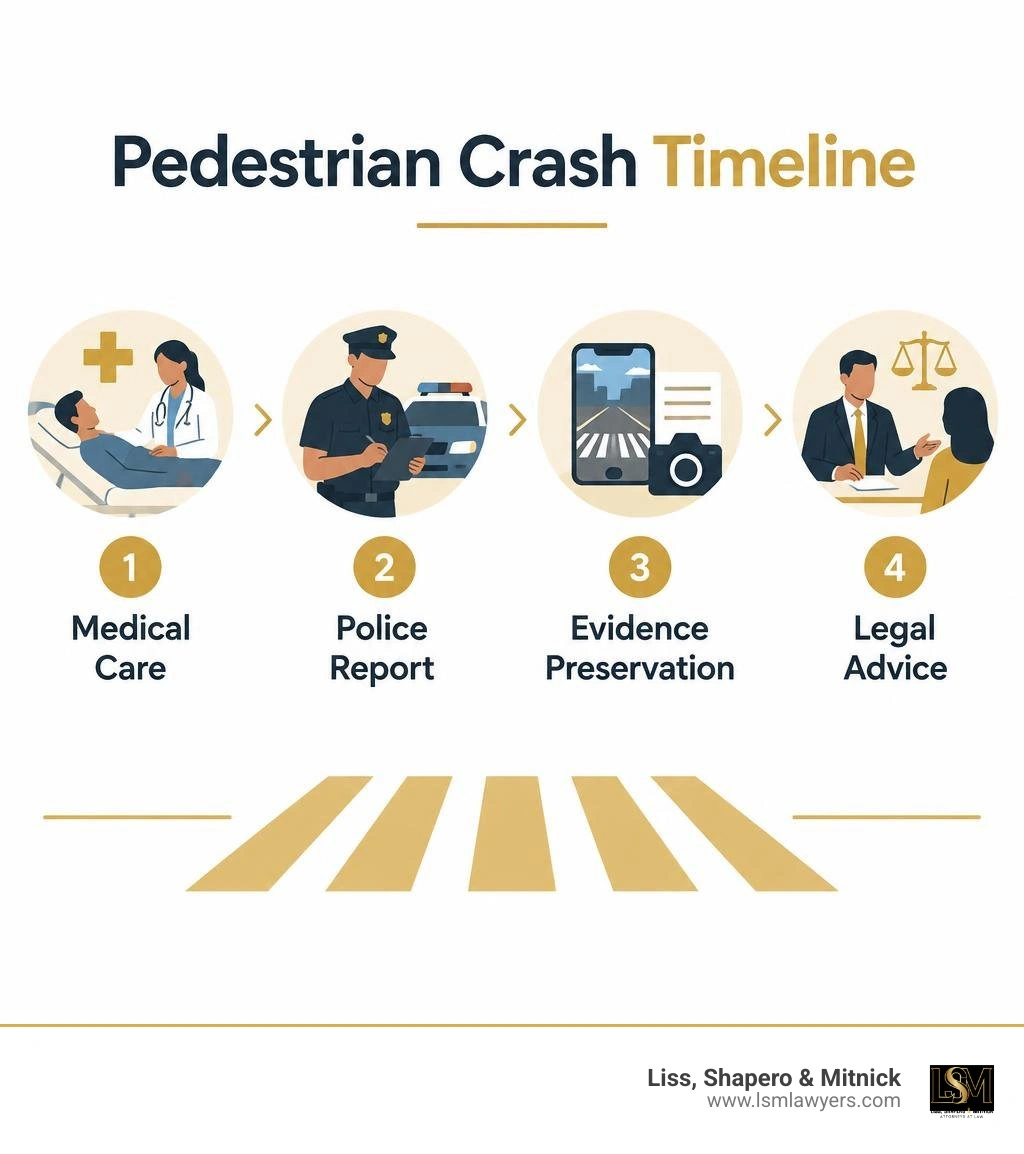
Lawyer for pedestrian accident terms to remember:
Each year, over 100,000 pedestrians across the United States are injured or killed in traffic-related incidents. When a 4,000-pound motor vehicle strikes an unprotected human body, the physics are completely one-sided. While pedestrian crashes account for only about eight percent of total traffic crashes statewide, they represent a vastly disproportionate share of severe injuries and fatalities.
If you or a loved one was struck by a vehicle in Berkley, Wayne County, or anywhere across Metro Detroit, knowing your immediate rights can protect your physical recovery and your financial future.
Immediate Steps and Critical Evidence After a Pedestrian Crash
The moments following a pedestrian collision are chaotic and overwhelming. However, the actions taken in the first minutes and hours set the foundation for both your medical recovery and any future legal claims.
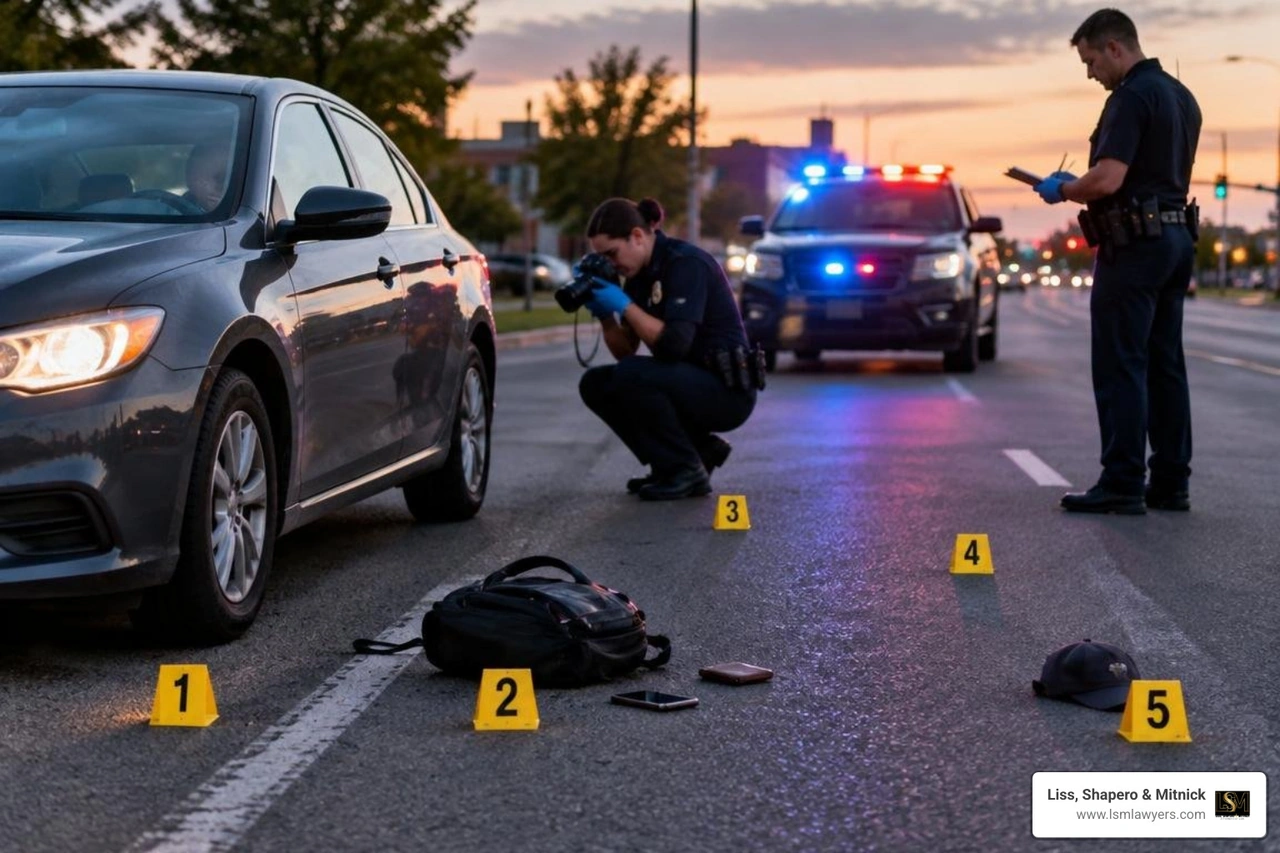
Your health is the absolute priority. Even if you believe your injuries are minor or you are running on adrenaline, you must seek emergency medical treatment right away. Pedestrian collisions frequently cause internal organ damage, subtle spinal trauma, or closed-head traumatic brain injuries (TBIs) that do not immediately present obvious symptoms.
To protect your legal rights, follow these essential steps:
- Call 911 Immediately: Ensure law enforcement officers and emergency medical personnel respond to the scene. An official police crash report provides objective documentation of the time, date, weather conditions, initial vehicle resting positions, and responding officer observations.
- Collect Driver Information: Get the driver's full name, phone number, address, driver's license number, license plate, and auto insurance provider and policy details.
- Gather Eyewitness Details: Bystanders, other motorists, and nearby business patrons often provide critical neutral accounts. Secure their names and phone numbers before they leave the scene.
- Preserve Tangible Evidence: Do not wash or discard the clothing or shoes you were wearing. Bloodstains, torn fabric, rubber transfer marks, and cracked mobile phone screens serve as vital physical proof demonstrating the point of impact and force.
Why You Need a Lawyer for a Pedestrian Accident Within the First 96 Hours
Many people assume they can wait weeks or months before contacting an attorney. In reality, the first 96 hours post-crash represent a critical evidentiary window.
Spoliation of evidence—the destruction or loss of vital records—happens quickly. Nearby commercial businesses often overwrite private surveillance camera feeds within 7 to 14 days. Municipal traffic camera feeds may have limited retention periods as well.
Modern vehicles contain Event Data Recorders (EDRs), often referred to as "black boxes." These modules record crucial pre-crash metrics, including vehicle speed, throttle position, steering angles, and whether the driver applied the brakes before impact. If the vehicle is repaired or salvaged before that data is downloaded, crucial proof of driver negligence vanishes.
Knowing what evidence to save after a pedestrian accident enables legal counsel to issue formal spoliation letters immediately, legally requiring insurance carriers and property owners to preserve footage, electronic logging data, and physical vehicle components.
Key Evidence to Secure Before It Disappears
Building a winning case requires reconstructing the crash down to the millisecond. In addition to vehicle black boxes and store security cameras, an experienced attorney moves fast to secure:
- Dashcam Footage: Video recordings from the striking vehicle, surrounding motorists, or transit buses that captured the incident.
- Physical Roadway Marks: Skid marks, yaw marks, gouge marks in the asphalt, and debris fields (such as broken headlight glass or paint chips) that reveal vehicle speed and trajectory.
- Driver Mobile Phone Records: Time-stamped carrier records to demonstrate whether the motorist was texting, browsing, or talking at the exact moment of the collision.
- 911 Audio Logs and Dispatch Tapes: Contemporaneous audio of eyewitness calls to emergency dispatchers, which often contain unfiltered observations of driver impairment or reckless speed.
Deploying pedestrian accident evidence strategies early ensures no critical detail is lost to time or weather.
Proving Fault and Navigating Complex Liability Scenarios
Every motorist on the road owes a fundamental legal duty of care to operate their vehicle safely and remain vigilant for pedestrians. Establishing fault requires proving that the driver breached this duty through negligent conduct, directly causing the pedestrian's injuries.
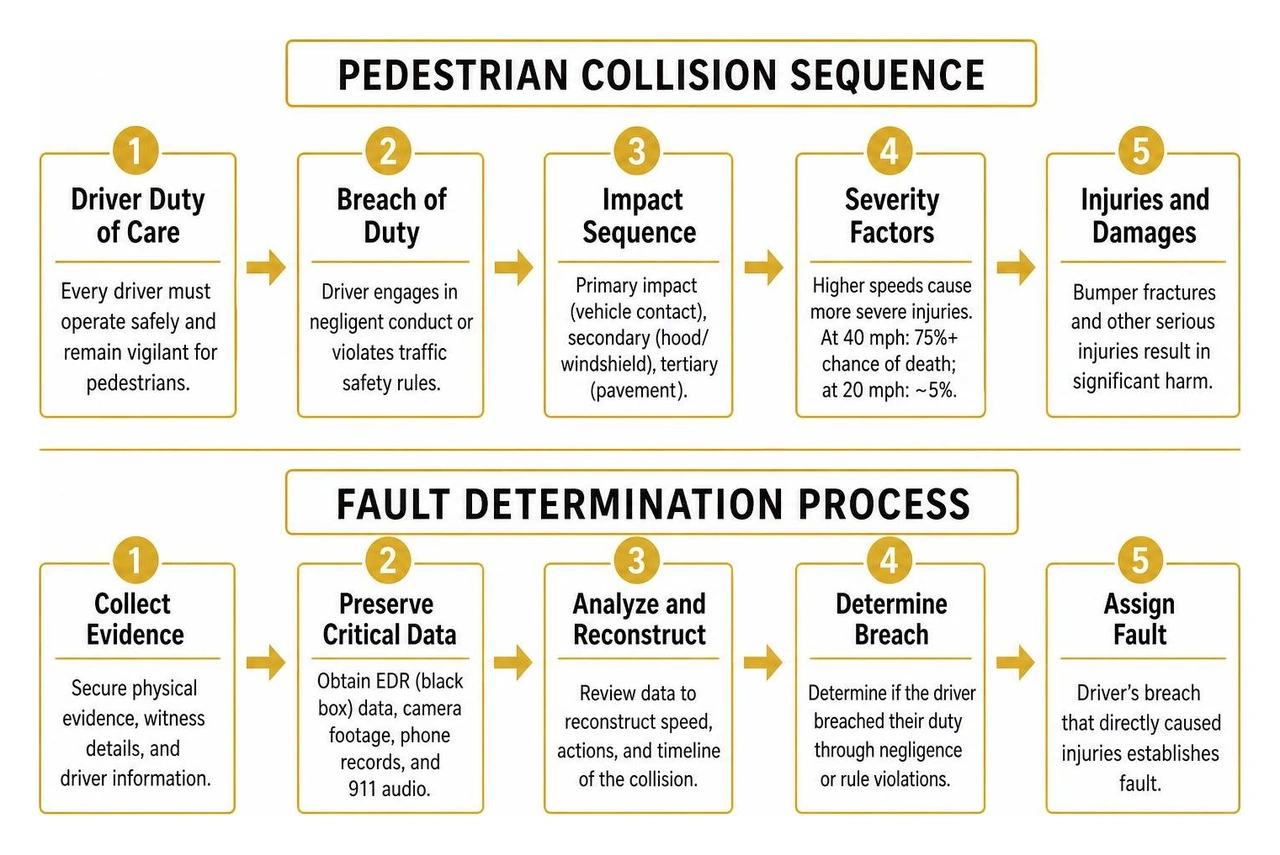
Speed plays a decisive role in the severity of these crashes. For example, national traffic safety research shows that a pedestrian struck at 40 mph has a 75 percent or greater chance of dying, compared to an approximate 5 percent mortality rate when struck at 20 mph.
Higher impact speeds also cause distinct "bumper fractures"—severe compound fractures of the tibia, fibula, and pelvis from initial contact—followed by secondary impacts where the pedestrian is thrown onto the hood or windshield, and tertiary impacts when they strike the pavement.
Proving that a driver violated basic traffic safety rules is key. For a deeper look at the legal mechanics, review our guide on proving a driver failed to yield.
Common Driver Negligence and Jaywalking Disputes
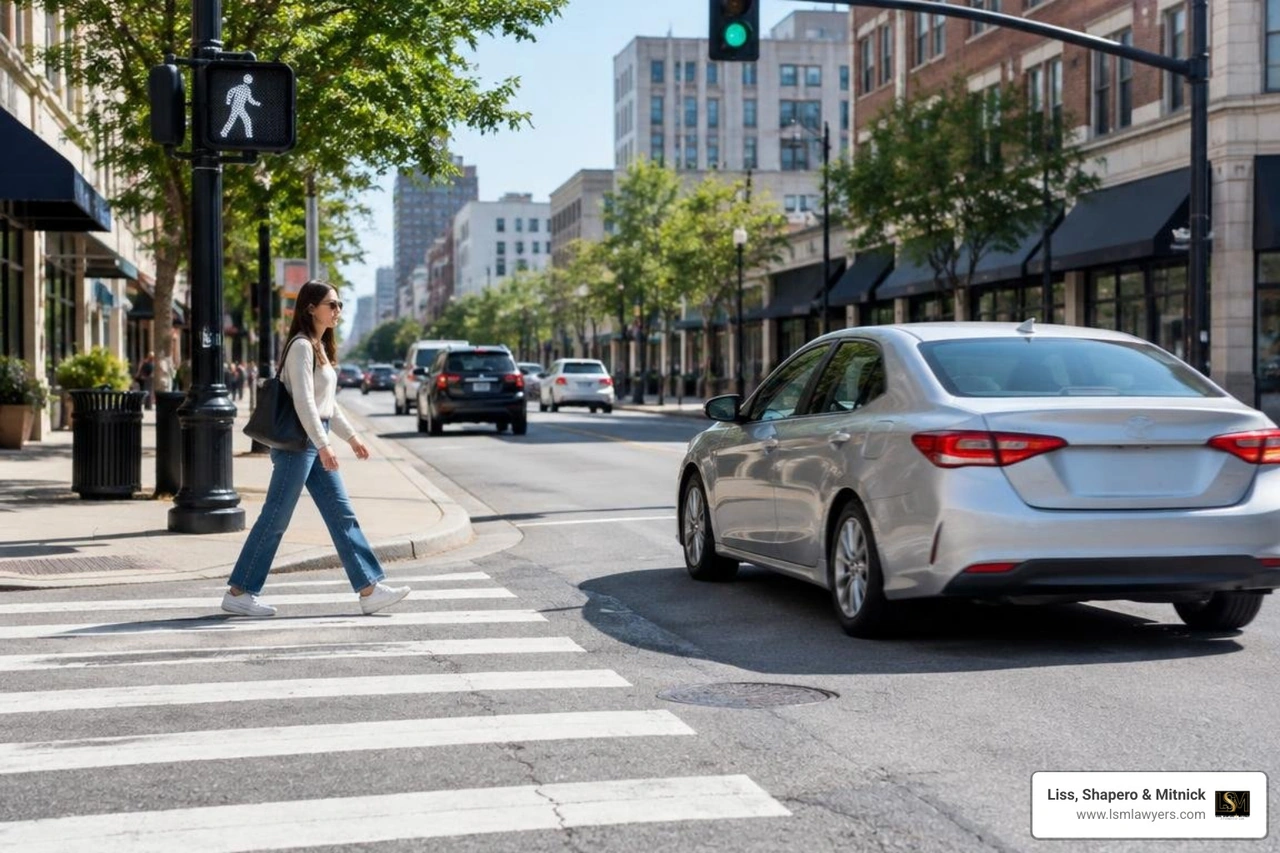
Driver negligence takes many forms, but the most common scenarios include:
- Left-Turn and Right-on-Red Collisions: Drivers looking left for oncoming traffic while making a right-hand turn frequently accelerate directly into pedestrians crossing on their right.
- Distracted Driving: Motorists glancing at mobile phones, navigation screens, or infotainment systems. At 30 mph, looking away for just 5 seconds means traveling the length of an entire football field blindly.
- School Zone Hazards: Speeding or failing to obey crossing guards during peak pickup and dismissal hours. In fact, nearly half of all child pedestrian fatalities in the United States occur during the hour immediately following weekday school dismissals. Protecting children in these areas requires aggressive enforcement of school zone safety and liability.
Insurers frequently try to deny claims by arguing the pedestrian was "jaywalking" or crossing outside a designated crosswalk. However, crossing mid-block does not give a driver a free pass to hit someone.
Under Michigan's modified comparative fault rules, an injured pedestrian can still recover compensation as long as their share of fault is not greater than 50 percent. If you are found partially at fault, your economic damages are fully protected, while your non-economic damages (pain and suffering) are reduced proportionally by your percentage of fault.
Adjusters frequently misunderstand these principles; learn more about what insurers get wrong about crosswalk injuries.
Collisions Involving Hit-and-Run, Uninsured Drivers, or Transit Vehicles
When a driver flees the scene of a crash, injured victims often fear they have no financial recourse. Fortunately, options exist:
- Uninsured Motorist (UM) Coverage: If you or a resident family member owns an auto insurance policy with UM coverage, that policy acts as a safety net, stepping in to pay for damages caused by an unidentified or uninsured driver.
- Commercial Delivery & Rideshare Platforms: Collisions involving food delivery drivers or rideshare operators (like Uber or Lyft) involve complex multi-tiered insurance policies that provide up to $1 million in liability coverage depending on whether the driver was logged into the app, waiting for a request, or actively transporting a passenger.
- Municipal Buses & Public Transit: If you were struck by a public transit bus or municipal vehicle, specific statutory rules apply. Claims against government entities involve strict notice deadlines that are far shorter than standard injury claims.
How a Lawyer for Pedestrian Accident Claims Deals with Insurance Companies
Having spent years working in insurance defense before representing injured victims, our team at Liss, Shapero & Mitnick understands the exact playbook adjusters use.
Insurance companies are profit-driven corporations. Their adjusters are trained to minimize claim payouts using specific strategies:
- Recorded Statement Traps: Requesting an early recorded statement while you are medicated or in shock, using leading questions to get you to admit partial fault.
- Pre-Existing Condition Defenses: Combing through your past medical records to claim your spinal trauma, shoulder tears, or joint injuries were caused by age or prior conditions rather than the impact.
- Premature Lowball Settlements: Offering a quick cash settlement within weeks of the crash before the true extent of your permanent injuries or future medical costs is known.

When insurance carriers know your legal team is fully prepared to take a case through trial, their settlement calculations shift dramatically. Approximately 95 percent of personal injury cases resolve out of court, but maximum value is achieved only by preparing every case as if it will be presented to a jury.
Handling Insurance Adjusters and PIP Coverage
Michigan operates under a unique auto insurance framework. When a pedestrian is struck by a motor vehicle in Michigan, their medical expenses, lost wages, and replacement services are governed primarily by Michigan No-Fault Personal Injury Protection (PIP) benefits.
Under Michigan's statutory order of priority, an injured pedestrian seeks PIP benefits in the following sequence:
- Their own personal auto No-Fault policy.
- The auto No-Fault policy of a spouse or resident relative.
- If no coverage exists in the household, benefits are claimed through the Michigan Assigned Claims Plan (MACP).
These benefits cover essential needs, including lifetime reasonable and necessary medical care, three years of wage loss reimbursement, and daily attendant care services. Understanding who pays medical bills after a pedestrian crash is vital to preventing medical debt.
When young family members are involved, specialized child pedestrian injury protections ensure their long-term developmental needs are fully accounted for.
What a Lawyer for Pedestrian Accident Cases Does on a Contingency Fee Basis
Hiring experienced legal counsel should never depend on your current bank account balance. At Liss, Shapero & Mitnick, we represent pedestrian crash victims on a contingency fee basis.
Under a contingency fee agreement:
- Zero Upfront Costs: You pay no retainer fees, out-of-pocket costs, or hourly rates.
- Firm-Funded Litigation: We advance all expenses required to thoroughly investigate and build your claim, including hiring accident reconstructionists, biomechanical engineers, lifecare planners, and medical specialists.
- No Fee Unless We Win: We only receive payment as an agreed-upon percentage of the financial settlement or trial verdict we secure on your behalf. If we do not recover compensation for you, you owe us nothing in attorney fees.
Choosing to work with dedicated pedestrian accident attorneys gives you the resources needed to stand on equal footing against multi-billion-dollar insurance corporations.
Available Compensation and Statutory Deadlines for Filing a Lawsuit
In a pedestrian injury claim, compensation is divided into two primary categories: economic damages and non-economic damages. When reckless conduct or severe negligence causes catastrophic harm, securing full compensation across both categories is vital to rebuilding your life.
Calculating Economic and Non-Economic Damages
| Damage Category | Description & Examples | Recovery Source |
|---|---|---|
| Economic Damages | Measurable financial losses including past/future medical bills, prescription costs, physical therapy, lost income, diminished earning capacity, and medical equipment. | First-Party PIP & Third-Party At-Fault Driver Lawsuit |
| Non-Economic Damages | Intangible physical and emotional harm including physical pain, mental anguish, loss of enjoyment of life, physical impairment, and permanent disfigurement. | Third-Party Lawsuit against the At-Fault Driver |
| Wrongful Death Damages | Funeral expenses, loss of financial support, and loss of companionship suffered by surviving family members when a crash is fatal. | Third-Party Lawsuit against the Liable Parties |
Traumatic brain injuries, spinal cord paralysis, and multi-bone compound fractures frequently require decades of ongoing therapy, home modifications, and specialized care.
Our firm works alongside forensic economists and medical planners to construct comprehensive lifecare plans that capture the true, lifetime cost of your care. For residents in the Detroit area, pursuing Wayne County pedestrian accident claims requires deep familiarity with local court procedures and valuation trends.
Statute of Limitations and Municipal Notice Requirements
Under Michigan law, you generally have three years from the date of the pedestrian collision to file a third-party personal injury lawsuit against the at-fault driver for non-economic damages (pain and suffering). For first-party No-Fault PIP benefit claims, written notice of injury must be submitted to the responsible auto insurer within one year of the accident date.
However, if your collision involved a government vehicle (such as a city bus) or was caused by a dangerous highway condition or defective road maintenance, statutory notice periods are significantly shorter.
In many municipal claims, you must file a formal written Notice of Claim within 60 to 120 days of the incident, or your claim will be permanently barred. If an improperly marked crosswalk or signal defect contributed to your injury, exploring Metro Detroit crosswalk injury litigation quickly is essential to protect your rights before municipal deadlines expire.
Frequently Asked Questions About Pedestrian Accident Claims
Can I recover compensation if I was hit outside a marked crosswalk?
Yes. Crossing outside a marked crosswalk or mid-block does not automatically eliminate a driver's legal responsibility. Motorists must maintain a proper lookout and exercise due care at all times.
Under Michigan's modified comparative negligence framework, you can recover damages as long as you are not more than 50 percent at fault for the incident. Your non-economic damages will simply be reduced by whatever percentage of fault a jury assigns to you.
Who pays my medical bills if the at-fault driver fled the scene?
If you are the victim of a hit-and-run, your medical expenses are covered through Michigan No-Fault PIP insurance. You look first to your own auto insurance policy, followed by a household relative's policy.
If neither applies, you can file a claim through the Michigan Assigned Claims Plan (MACP). Furthermore, compensation for pain and suffering can often be pursued under the Uninsured Motorist (UM) provisions of your personal auto insurance policy.
How long does it take to settle a pedestrian accident case?
Settling a pedestrian accident claim typically takes between 9 and 24 months, though timelines vary based on injury severity.
It is vital to wait until you have reached Maximum Medical Improvement (MMI)—the point where your medical prognosis and future treatment needs are clearly established. Settling too early before understanding long-term complications or permanent disability almost always results in a drastically undervalued payout.
Conclusion
A serious pedestrian collision changes your life in an instant. The physical rehabilitation, mounting medical bills, and insurance company pressure can quickly feel overwhelming. You do not have to carry this burden alone.
At Liss, Shapero & Mitnick, our unique background in former insurance defense gives our clients a distinct edge. We know how adjusters evaluate claims, and we know how to dismantle their arguments to recover the full compensation you deserve.
If you or someone you love was injured while walking in Berkley, Detroit, or anywhere across Southeast Michigan, take action today. Contact our office to schedule a free consultation with our pedestrian accident team. Let Anthony Shapero and our experienced legal team protect your rights, stand up to the insurance companies, and fight for your future.