
How a Slip and Fall Attorney Can Protect Your Claim

A slip and fall attorney can investigate what caused your fall, preserve video and maintenance records, identify who may be responsible, and deal with the insurer. If you were hurt, get medical care, photograph the hazard, report the fall, and collect witness contact details. Speak with a Michigan attorney soon: the condition may change, video may be erased, and filing deadlines apply.
A fall alone does not prove a legal claim. The key question is whether an unsafe condition caused your injury and someone responsible for the property failed to take reasonable care.
I'm Anthony Shapero, managing partner at Liss, Shapero & Mitnick and a slip and fall attorney with premises liability experience. I began my career defending insurers, and I now use that insight to build claims for injured people in Michigan.

Easy slip and fall attorney word list:
Falls are not minor embarrassments. According to data from the Centers for Disease Control and Prevention (CDC), falls lead to roughly 3 million emergency department visits and over 1 million hospitalizations each year across the United States. They serve as the leading cause of traumatic brain injury (TBI) and account for severe orthopedic fractures that require surgery and months of rehabilitation. Furthermore, OSHA ranks falls as one of the "Fatal Four" leading workplace hazards. When you are severely hurt, pursuing full financial recovery is critical to keeping your life and household intact.
Understanding Premises Liability and Fall Accident Claims
Premises liability is the area of personal injury law governing situations where an unsafe condition on someone else's land or inside a building causes an injury. A property owner does not automatically owe every person the exact same level of legal protection. Instead, the duty owed depends heavily on the visitor's legal status at the time of the incident:
- Invitees: Customers at a grocery store, diners in a restaurant, or patrons at a service station. Property owners owe invitees the highest standard of care, requiring them to actively inspect the property, fix hazards, or post clear warnings.
- Licensees: Social guests or casual visitors entering with permission. Owners must warn licensees of hidden dangers they know about, but they generally do not have an affirmative duty to inspect the property for unknown hazards.
- Trespassers: Individuals entering without permission. Property owners generally owe no duty other than refraining from intentional or reckless harm.
To establish negligence, an injured claimant must demonstrate that the owner or maintainer breached their standard of care. Under established premises liability principles—detailed further in our guide to slip and fall law in Michigan—liability requires proving one of three legal notice theories:
- Actual Notice: The owner or staff knew about the specific hazard (e.g., an employee noticed a puddle and walked past it without cleaning or marking it).
- Constructive Notice: The hazard was present long enough that a reasonable inspection would have uncovered and resolved it.
- Cause and Create: The property owner or an employee directly created the dangerous condition (e.g., mopping without warning signs or improperly applying wax or sealants).
Understanding these baseline standards helps establish whether a valid legal claim exists.
Common Hazardous Conditions and Property Defects
Property hazards can appear in seconds or develop over months of deferred maintenance. Some of the most frequent conditions we encounter include:
- Liquid Spills and Smashed Produce: Uncleaned water in retail entryways, leaking refrigeration units, or dropped grocery items left unmonitored in aisles.
- Fresh Paint and Wax: Smooth surfaces coated in wet finishes without safety cones or physical barricades.
- Structural Collapses and Stair Defects: Decayed decking or missing steps requiring a seasoned porch or stair collapse lawyer in Metro Detroit to evaluate non-compliance with local building codes.
- Handrail Violations: Missing, broken, or improperly installed handrails that prevent someone from catching their balance during a minor slip.
- Inadequate Lighting: Dark stairwells, unlit parking structures, or dim exterior pathways that obscure sudden elevation changes.
- Winter Weather Hazards: Untreated black ice or heavy snow drifts where an icy sidewalk fall lawyer in Oakland County is needed to hold negligent property managers accountable.
- Flooring Transition Hazards: Torn carpets, uneven transitions between tile and wood, or raised doorway thresholds.
Identifying Liable Parties in Slip and Fall Accidents
Pinpointing who is legally responsible requires looking beyond the physical building. A single property often involves multiple overlapping entities, each with distinct contractual or legal duties:
- Commercial Businesses: Retail stores, supermarkets, and restaurants that control the interior shopping floor.
- Multi-Family Landlords and Property Managers: Apartment building owners responsible for keeping common hallways, entry foyers, and stairwells safe.
- Condominium Associations: HOAs tasked with maintaining shared exterior walkways, clubhouse areas, and parking facilities.
- Third-Party Maintenance and Snow Removal Contractors: Independent vendors hired for janitorial services or winter maintenance. Local rules regarding sidewalk snow removal liability in Michigan dictate whether a contractor, landlord, or business tenant breached their snow clearing duties.
- Commercial Tenants: Leaseholders operating retail spaces who bear primary responsibility for maintaining the interior premises under commercial lease agreements.
How a Dedicated Slip and Fall Attorney Builds a Winning Case

Proving a premises liability case requires prompt, strategic investigation. Having represented insurance companies earlier in my career, I know that defense teams immediately search for ways to dispute notice, claim the hazard was open and obvious, or blame the victim. A knowledgeable premises liability lawyer in Berkley, MI moves quickly to secure crucial evidence before it vanishes.
Our investigative process includes:
- Sending Spoliation Letters: Formal legal demands sent to property owners and commercial entities demanding the immediate preservation of electronic records and video files before routine security overwrites occur.
- Securing Surveillance Footage: Analyzing camera timestamps to prove exactly how long a hazard sat on the floor before anyone addressed it.
- Auditing Maintenance Logs: Reviewing inspection checklists, janitorial sweep sheets, and employee shift records to establish whether mandatory safety sweeps were skipped.
- Reviewing Incident Reports: Obtaining official store reports and statements taken immediately after the injury occurred.
- Conducting Eyewitness Depositions: Interviewing patrons, vendors, and staff who saw the fall or observed the hazardous condition beforehand.
- Engaging Safety and Engineering Experts: Collaborating with architectural safety engineers to measure surface friction coefficients, analyze structural defects, and verify building code violations.
Proving Notice and Overcoming Property Owner Defenses
The centerpiece of almost every fall claim is proving actual or constructive notice. Did the store manager know a freezer was leaking water onto the floor? Or did the puddle sit on the floor for 45 minutes across three missed employee inspection cycles? Digital surveillance time stamps and computerized cleaning logs provide the concrete evidence needed to satisfy the constructive notice test.
Furthermore, we routinely dismantle common defense strategies:
- The Open and Obvious Defense: Property owners frequently argue that a hazard was so visible the victim should have spotted and avoided it. Following landmark rulings in Michigan premises liability jurisprudence, the open and obvious nature of a condition is no longer an absolute bar to a claim; it is evaluated within the context of comparative fault and the landlord's general standard of care.
- Victim-Blaming Arguments: Insurers often claim the injured party was distracted by a phone, wearing improper footwear, or moving too quickly. We counter these claims with forensic evidence, clear site lines, and witness testimony confirming the hazard was unreasonably dangerous under the circumstances.
When to Hire a Slip and Fall Attorney for Complex Claims
Not every minor scrape demands litigation, but serious injuries require experienced legal advocacy. You should consult a slip and fall attorney in Berkley, Michigan immediately when:
- You suffer severe fractures requiring surgical pins, rods, or plates.
- You sustain head trauma, concussions, or long-term cognitive complications.
- You experience torn ligaments, spinal disc herniations, or joint trauma.
- The property owner flatly denies liability or claims no hazard existed.
- An insurance adjuster makes an initial "zero-dollar" denial or an insulting lowball settlement offer.
- Multiple potential defendants (landlord, commercial tenant, third-party maintenance company) are blaming each other for the condition.
Comparative Negligence, Government Claims, and Legal Deadlines

Every premises liability claim is subject to strict statutory deadlines and legal frameworks. Missing a statutory filing window permanently strips you of your right to seek financial recovery. Reviewing our Michigan slip fall guide for 2026 offers a clear roadmap of how these legal frameworks operate in practice.
How Comparative Negligence Affects Your Compensation
Under comparative fault principles, a defendant will try to argue that you contributed to your own injury. In Michigan, modified comparative fault rules apply to personal injury claims:
- If you are found to be partially at fault, your financial recovery is reduced in direct proportion to your assigned percentage of fault. For example, if a jury awards $100,000 in damages but determines you were 20% at fault for failing to see an unmarked spill, your net recovery is $80,000.
- If your share of fault exceeds 50%, you are barred from recovering non-economic damages (such as pain and suffering), though you may still recover your proportional share of economic damages.
Our former insurance-defense background allows us to anticipate these cross-examination strategies and insulate your claim from unfair fault allocations.
Special Rules and Deadlines for Municipal and Government Property Falls
Filing a claim against a public or governmental entity (such as a municipality, county road commission, or public transit authority) is fundamentally different from suing a private commercial business.
Governments are shielded by broad sovereign and governmental immunity doctrines, with very narrow exceptions (such as the public highway or public building exceptions). When an injury occurs on a municipal sidewalk or in a government building:
- You must serve a formal written Notice of Claim within an extremely short administrative window—often within 90 to 120 days of the fall, depending on the specific public body involved.
- The written notice must specify the exact location, the nature of the defect, the names of known witnesses, and the injuries sustained.
- Failure to comply with the technical requirements of this early notice will result in the immediate dismissal of your lawsuit, regardless of how severe your injuries are.
| Claim Feature | Private Property Claims | Municipal / Government Property Claims |
|---|---|---|
| Primary Standard | Standard Premises Liability Negligence | Governmental Immunity with Strict Statutory Exceptions |
| Notice Requirement | General notification to insurance carrier | Formal written administrative Notice of Claim within 90–120 days |
| Statute of Limitations | Generally 3 years for personal injury | Strict administrative notice plus expedited lawsuit filing windows |
| Proof Standard | Actual or Constructive Notice | Strict statutory defect criteria (e.g., specific sidewalk elevation rules) |
Recoverable Damages and Steps to Protect Your Claim
When property owner negligence causes an injury, the law allows you to seek both economic and non-economic damages to make you whole. Working alongside a dedicated Michigan slip and fall attorney ensures every category of loss is calculated accurately:
Economic Damages (Tangible Financial Losses):
- Past and future medical expenses (hospitalization, surgery, physical therapy, prescription medication)
- Past lost wages for missed work
- Diminished future earning capacity if injuries prevent you from returning to your former trade
- Out-of-pocket costs for household assistance and medical mobility devices
Non-Economic Damages (Intangible Losses):
- Physical pain and suffering
- Emotional distress, anxiety, and sleep disruption
- Loss of enjoyment of life and daily recreational activities
- Permanent physical impairment, scarring, or disfigurement
Most reputable personal injury attorneys handle these claims on a contingency fee basis (often between 33.3% and 40%), meaning you pay no upfront legal fees, and your attorney is only compensated if a financial settlement or trial verdict is secured on your behalf.
What to Do Immediately After a Slip and Fall Injury
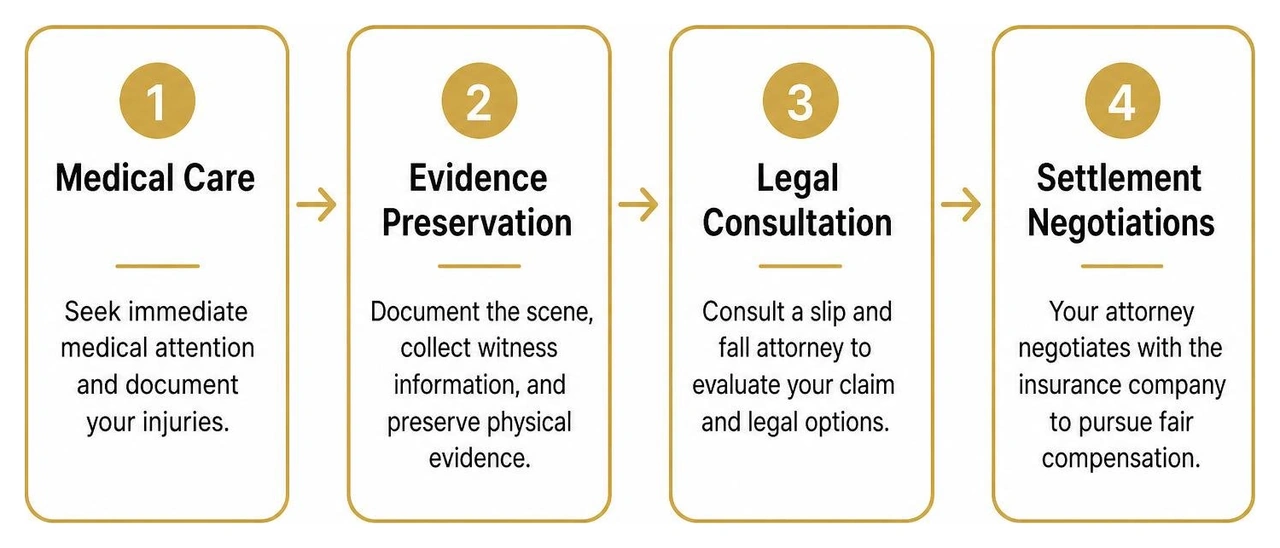
The actions you take immediately following a fall set the foundation for your legal claim:
- Seek Immediate Medical Care: Visit an emergency room or urgent care clinic right away. Hidden injuries, such as concussions or hairline fractures, must be diagnosed and documented in official medical records immediately.
- Photograph the Scene and Hazard: Take wide-angle photos showing the general layout and lighting, as well as macro, close-up photos of the specific liquid, ice patch, broken tile, or stair tread defect.
- Report the Fall: Notify the store manager, landlord, or security team. Request a copy of the written incident report before you leave, and never sign a statement admitting fault.
- Collect Witness Information: Obtain names, phone numbers, and addresses of any customers, passersby, or staff members who saw the incident or commented on the hazard.
- Preserve Your Shoes and Clothing: Do not wash or alter the clothes you were wearing. Place your footwear in a safe container to preserve physical evidence of tread condition and any chemical or liquid residues.
How to Choose the Best Slip and Fall Attorney for Your Lawsuit
Selecting the right legal advocate is vital to securing full compensation. When evaluating legal counsel, keep these criteria in mind:
- Premises Liability Experience: Look for a legal team that routinely litigates complex premises cases and understands the shifting nuances of premises liability standards. Resources such as Forbes Advisor's guide to choosing a slip-and-fall lawyer highlight the value of focused personal injury experience over general practice law.
- Former Defense Insight: An attorney who understands how insurance adjusters evaluate risk and calculate reserve amounts brings an invaluable edge to settlement negotiations.
- Trial-Ready Reputation: Insurance companies pay maximum value only when they know your lawyer is prepared to take a case through jury selection and trial.
- Transparent Fee Structures: Demand a clear, straightforward contingency agreement without surprise upfront retainer costs or hidden administrative charges.
Frequently Asked Questions About Slip and Fall Claims
What is the statute of limitations for filing a slip and fall lawsuit?
In Michigan, the standard statute of limitations for personal injury claims on private property is three years from the date of the accident. For wrongful death claims arising from fatal fall injuries, the timeline is generally three years from the date of injury or two years from the issuance of letters of authority to the personal representative. However, claims involving municipal or government-owned properties require formal written notices within 90 to 120 days.
Can I recover compensation if I was partially at fault for my fall?
Yes. Under Michigan's comparative fault rules, your compensation is reduced in proportion to your percentage of fault. If you were 15% at fault for looking at a store display, you can still collect 85% of your total awarded damages. As long as your fault does not exceed 50%, you remain eligible to collect non-economic damages for pain and suffering.
What evidence is most critical for proving a slip and fall case?
The most critical pieces of evidence include time-stamped digital surveillance video footage, detailed photographs of the defect taken immediately following the fall, official written incident reports, internal janitorial sweep sheets, and comprehensive medical records documenting the exact onset of your injuries.
Conclusion: Protect Your Rights with Experienced Legal Advocacy
When you suffer a serious injury due to poorly maintained premises, the property owner's insurance company will immediately attempt to minimize their payout. At Liss, Shapero & Mitnick, we leverage our former insurance-defense experience to anticipate the defense's strategy, protect our clients from unfair blame, and pursue maximum financial compensation.
Do not let critical video evidence get deleted or miss short municipal filing deadlines. If you or a loved one has suffered an injury, connect with our skilled Michigan slip trip fall lawyers today.
Contact Anthony Shapero at Liss, Shapero & Mitnick for a free, no-obligation case evaluation, and let our team protect your claim.