
What Bodily Injury and Property Damage Liability Protect

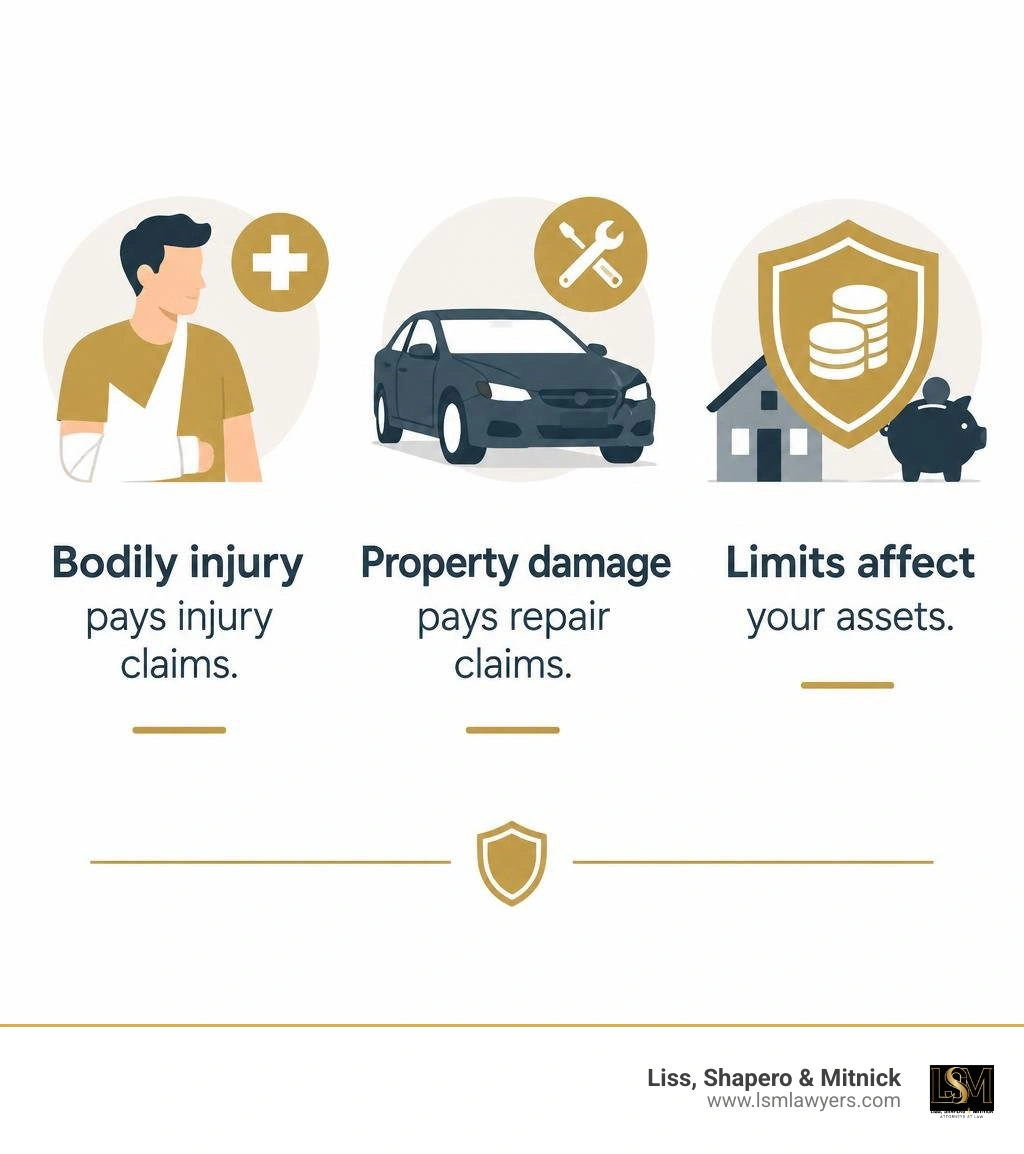
Bodily injury and property damage liability insurance helps pay for harm you cause to others in a crash. Bodily injury liability covers claims for injuries, such as medical bills and lost income. Property damage liability covers damage to someone else's car or other property. Both have payment limits, and neither pays to repair your own car.
In Michigan, your no-fault PIP coverage serves a different purpose: it helps pay your own covered medical costs after a crash. Knowing which coverage applies matters when bills arrive or an insurer disputes a claim.
I'm Anthony Shapero, Managing Partner at Liss, Shapero & Mitnick. I represented insurers before I began fighting for injured people, and I use that experience to help clients understand bodily injury and property damage liability claims.
Key bodily injury and property damage liability vocabulary:
What Is Bodily Injury and Property Damage Liability Insurance?
At its core, bodily injury and property damage liability insurance is third-party financial protection. In insurance terms, you are the first party, your insurance carrier is the second party, and anyone harmed by your actions is the third party. If you cause a crash, this coverage shields you from paying out of pocket for the harm inflicted on someone else.
Liability insurance does not fix your car or pay for your own hospital stay. Instead, it fulfills your statutory financial responsibility to the public. If you are at fault in a collision, the injured parties or property owners will file claims against your liability policy.
When purchasing a policy, liability coverage is typically structured as split limits (separate maximum caps for individual injuries, total accident injuries, and property destruction) or, less commonly, as a combined single limit (one overarching dollar cap that applies to all injury and property claims arising from a single event). Reviewing a comprehensive auto coverage guide helps clarify how these foundational policies integrate with optional riders.
Scope of Bodily Injury and Property Damage Liability Coverage
Liability insurance steps in to handle several distinct types of financial damages when an at-fault policyholder causes harm:
- Medical Expenses: Hospitalization, surgeries, emergency transport, physical therapy, and ongoing medical care required by third parties.
- Lost Wages: Compensation for income the injured parties lost while recovering from their injuries.
- Pain and Suffering: Non-economic damages awarded for severe physical pain, emotional distress, impairment, and reduced quality of life.
- Vehicle Repair and Replacement: The cost to repair or replace another person's car up to its actual cash value.
- Stationary Structures and Physical Property: Repairs to mailboxes, fences, utility poles, guardrails, commercial storefronts, or personal items inside the damaged vehicle.
- Legal Defense Costs: If the injured party files a lawsuit against you, your auto insurer is legally obligated to provide and pay for your legal defense, including attorney fees and court costs, independent of your stated policy limits.
Key Differences Between Bodily Injury and Property Damage Coverage
While both components fall under the broader umbrella of auto liability, they address entirely different losses:
| Feature | Bodily Injury (BI) Liability | Property Damage (PD) Liability |
|---|---|---|
| What It Covers | Physical injuries, medical care, lost wages, pain and suffering, and funeral costs of third parties. | Repair or replacement of vehicles, buildings, fences, guardrails, and personal property belonging to others. |
| Whom It Protects | Other drivers, vehicle passengers, pedestrians, and cyclists harmed by your vehicle. | Property owners, municipalities, and other vehicle owners. |
| Exclusions | Your own injuries, injuries to listed drivers on your policy, and household members covered by PIP. | Damage to your own vehicle (which requires collision coverage) or personal items inside your car. |
| Payout Caps | Usually split into two limits: maximum per person and maximum per accident. | Usually structured as a single aggregate limit per accident. |
| Financial Exposure | Uncapped potential medical damages that can quickly exceed minimum policies and risk your savings. | High exposure when high-end vehicles or municipal fixtures are damaged. |
How Policy Limits and Split Limits Function After an Accident
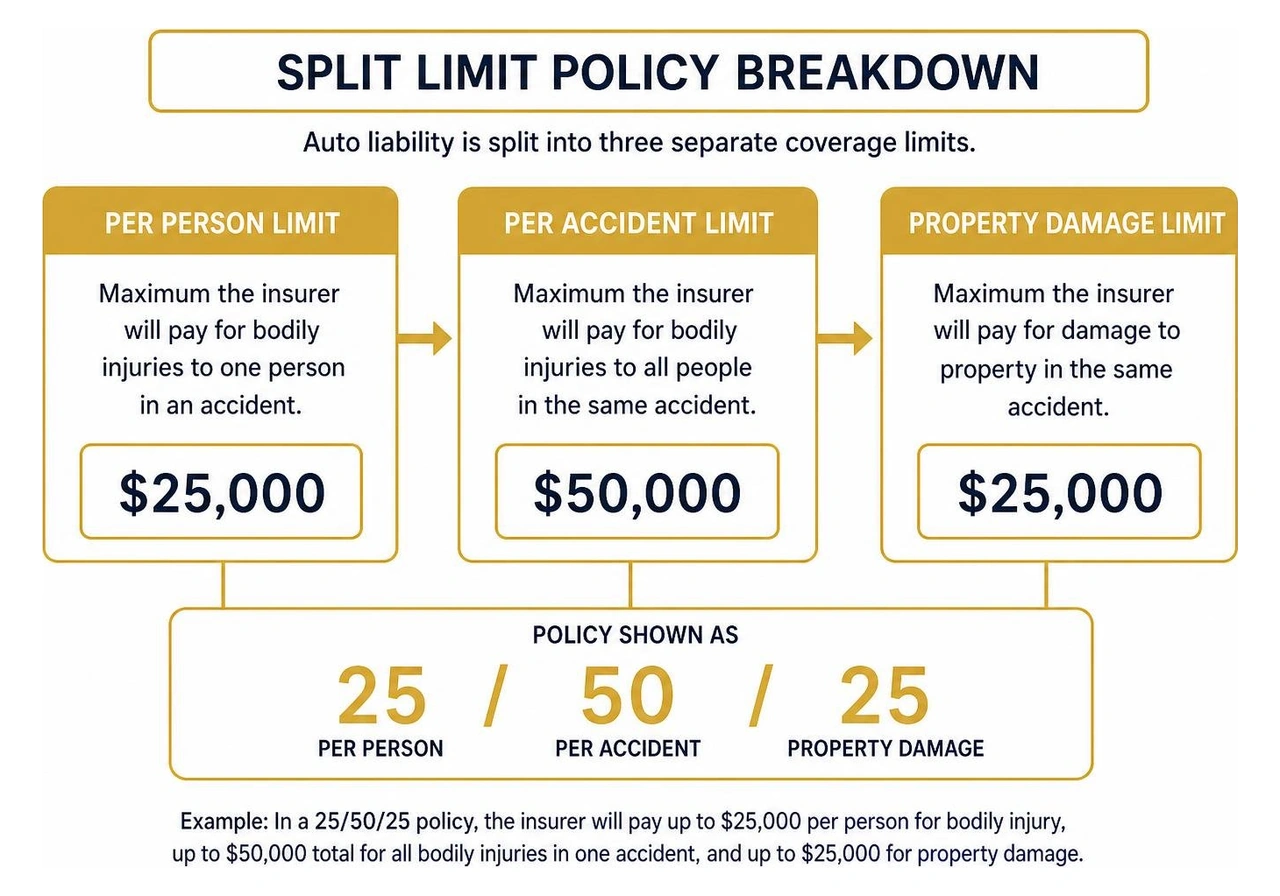
When evaluating motor vehicle accidents, insurers look directly at the declarations page of the at-fault driver's policy. Most auto liability policies use a split-limit format, expressed as three sequential numbers (for example, 50/100/50 or 250/500/10).
Decoding 25/50/25 and Split Limit Numbers
Understanding how these numbers operate prevents unpleasant surprises when an insurer assesses a claim:
- The First Number (Per-Person BI Limit): The maximum dollar amount the insurer will pay for bodily injuries sustained by any single person in an accident. In a 25/50/25 policy, this cap is $25,000.
- The Second Number (Per-Accident BI Limit): The absolute maximum the insurer will pay for all bodily injuries combined across the entire accident, regardless of how many people are hurt. In a 25/50/25 policy, this cap is $50,000.
- The Third Number (Per-Accident PD Limit): The maximum amount available to cover all physical property damage caused in that collision. In a 25/50/25 policy, this cap is $25,000.
Claim Payout Mechanics in Action
Imagine you cause a crash involving a sedan carrying three people:
- Passenger A suffers $30,000 in medical bills.
- Passenger B incurs $15,000 in medical bills.
- Passenger C incurs $15,000 in medical bills.
- Total bodily injury damages: $60,000.
Under a 25/50/25 policy:
- Passenger A receives only $25,000 (capped by the per-person limit), leaving $5,000 unpaid.
- Passenger B receives $15,000 (within the individual limit).
- Passenger C receives $10,000 because the total payout reaches the $50,000 per-accident cap ($25,000 + $15,000 + $10,000 = $50,000), leaving Passenger C with $5,000 unpaid.
Even though the insurer disbursed its full $50,000 commitment, $10,000 in medical damages remains unpaid.
What Happens When Damages Exceed Your Policy Limits?
When accident damages exceed your policy limits, your insurance company pays its maximum obligation and requires the claimant to sign a release—or the claimant files a personal injury lawsuit against you for the balance.
If an injured party secures a judgment against you exceeding your insurance coverage, you face direct personal liability. The court can enforce this judgment through:
- Asset Seizure: Liquidating non-exempt savings accounts, investment portfolios, second properties, and personal assets.
- Wage Garnishment: Seizing a portion of your future earned income until the debt is satisfied.
- Property Liens: Placing liens against real estate, preventing you from refinancing or selling without paying the balance.
When dealing with a significant motor vehicle collision claim for damages, lacking sufficient underlying liability coverage can disrupt your financial stability. An umbrella insurance policy provides excess liability coverage—typically starting at $1,000,000—that activates once your primary auto liability limits are fully exhausted.
State Minimums vs. Recommended Coverage Levels
Every state establishes baseline auto liability requirements to ensure motorists carry a minimum level of financial responsibility. However, statutory minimums were often established decades ago and fail to account for modern vehicle repair costs and medical inflation.
State-by-State Minimum Requirements
State requirements vary significantly across jurisdictions:
| Jurisdiction | Bodily Injury Per Person | Bodily Injury Per Accident | Property Damage Per Accident | Statutory Notes & Framework |
|---|---|---|---|---|
| Michigan | $250,000 (Default) $50,000 (Min. opt-down) | $500,000 (Default) $100,000 (Min. opt-down) | $10,000 (Out-of-state limit) $1M (In-state PPI) | Defaults were established under no-fault reform. Drivers can sign a waiver to reduce limits down to $50,000/$100,000. Out-of-state PD remains capped at $10,000. |
| New Jersey | $15,000 | $30,000 | $5,000 | Standard policies require 15/30/5, though higher limits are widely encouraged in state consumer resources like the Everything Auto NJ Guide. |
| Florida | $10,000 | $20,000 | $10,000 | Requires $10,000 in PIP and $10,000 in PD under financial responsibility laws. BI limits increase to $100k/$300k following DUI offenses. |
| Colorado | $25,000 | $50,000 | $15,000 | Standard 25/50/15 minimum split limit. |
| Illinois | $25,000 | $50,000 | $20,000 | Minimum statutory thresholds set at 25/50/20. |
In Michigan, state law emphasizes asset preservation. Drivers are automatically given default bodily injury limits of $250,000 per person and $500,000 per accident unless they specifically choose lower limits by submitting a formal waiver. For comprehensive guidance on these statutory tiers, review the state resources on choosing bodily injury coverage.
Calculating How Much Bodily Injury and Property Damage Liability You Need
Buying the minimum auto insurance required by law fulfills your legal obligation to register a vehicle, but it rarely shields your personal finances. If you carry only $25,000 in property damage liability and total a modern $65,000 electric vehicle, you remain on the hook for the remaining $40,000.

When determining your liability coverage limits, follow these practical steps:
- Calculate Your Net Worth: Add up your home equity, liquid savings, investment accounts, retirement funds, and valuable personal property.
- Match Your Total Limits to Your Exposed Assets: If your net worth exceeds $300,000, your baseline auto liability coverage should be at least 250/500/100.
- Evaluate Umbrella Protection: If your net worth exceeds $500,000, an umbrella policy ($1M to $5M in coverage) provides affordable excess protection.
- Balance with Uninsured/Underinsured Motorist Coverage: The Insurance Research Council reported that in 2023, New Mexico had an estimated uninsured driver rate of 24.1%. Carrying strong liability limits allows you to match higher underinsured motorist limits, ensuring you are protecting yourself when the other driver has minimum limits.
How Liability Differs from PIP, MedPay, and Physical Damage
Auto insurance policies consist of multiple distinct coverage types. Disputing claim denials or evaluating post-accident recovery requires understanding first-party vs. third-party coverages.
Liability Insurance vs. Personal Injury Protection (PIP) and MedPay
The primary difference lies in who receives the benefit:
- Bodily Injury Liability: A third-party coverage that pays other people when you are at fault for a crash.
- Personal Injury Protection (PIP): A first-party no-fault coverage that pays your own reasonable medical expenses, replacement services, and lost wages regardless of who caused the collision.
In our practice handling Michigan no-fault claims, we frequently see confusion over whether medical expenses should go through PIP or a liability claim. If you are injured in an accident, your initial healthcare expenses are submitted to your own no-fault PIP carrier. A third-party bodily injury liability claim is pursued against the at-fault driver for excess economic losses and non-economic damages (pain and suffering). Understanding the difference between no-fault PIP benefits and a liability claim helps you manage medical bills effectively while preserving your rights.
Medical Payments (MedPay) operates similarly to PIP in traditional fault states, covering immediate out-of-pocket medical expenses and health insurance deductibles for you and your passengers, but without covering wage loss or replacement services.
Liability Insurance vs. Collision and Comprehensive
Property damage liability pays for damage you cause to other people's property. It never covers damage to your own vehicle.
To protect your own car, you need first-party auto physical damage insurance:
- Collision Coverage: Pays to repair or replace your vehicle if you strike another car, hit a stationary object (like a tree or guardrail), or are involved in a rollover crash, subject to your chosen deductible. Industry data from carriers like Progressive indicates that collision coverage averages around $45 per month on a six-month policy.
- Comprehensive Coverage: Covers non-collision incidents beyond your control, including vehicle theft, vandalism, hail, fire, windshield damage, and animal strikes. Progressive data shows comprehensive coverage averages approximately $19 per month on a six-month policy.
- Uninsured/Underinsured Motorist Property Damage (UMPD): In states where it is available, an uninsured & underinsured motorist lawyer can help you recover vehicle repair costs if an uninsured driver damages your car and you lack collision coverage.
Frequently Asked Questions About Auto Liability Insurance
Does bodily injury liability cover my own medical bills?
No. Bodily injury liability is strictly a third-party coverage designed to compensate individuals you injure in a crash. It does not pay for your hospital bills, rehabilitation, or lost income. To cover your own accident-related medical expenses, you must rely on your auto policy's Personal Injury Protection (PIP), Medical Payments (MedPay) coverage, or your primary health insurance.
What key factors determine the cost of BI and PD liability insurance?
Insurance carriers determine liability premiums by evaluating several core actuarial risk factors:
- Driving Record: Past speeding tickets, at-fault collisions, and DUI convictions significantly raise premiums.
- Geographic Location: Drivers in densely populated urban centers with higher traffic congestion and claim frequency pay higher rates than rural motorists.
- Demographic Accident Statistics: Actuarial data shows that males suffer more than twice as many fatal accidents as females. Age is also a major factor; in states like Florida, drivers younger than 25 and older than 65 represent a disproportionately large share of accident claims.
- Vehicle Specifications: Vehicles with larger engines or heavier curb weights can inflict more damage on third parties, impacting liability rates.
- Credit Profile: In states where legally permitted, insurance scores derived from credit history are used to assess policyholder risk.
How can I lower my liability insurance premiums without sacrificing protection?
You can lower auto insurance costs without reducing your essential bodily injury and property damage limits by using these practical strategies:
- Bundle Policies: Combine your auto policy with homeowners, condo, or renters insurance under the same carrier to receive multi-policy discounts of 10% to 25%.
- Maintain a Good Driving History: Avoiding moving violations and preventable collisions keeps you eligible for preferred tier pricing and safe-driver discounts.
- Complete a Defensive Driving Course: Many insurers offer premium discounts to drivers who complete state-approved defensive driving programs.
- Manage Physical Damage Deductibles: If you carry collision and comprehensive coverage, raising your deductibles from $250 to $1,000 can lower your overall premium while keeping your high liability limits intact.
- Ask About Group or Low-Mileage Discounts: Inquire about affiliations with professional associations, alumni networks, or discounts for driving fewer miles each year.
Conclusion
Carrying state minimum liability limits might keep your vehicle street-legal, but it leaves your hard-earned assets exposed if a serious crash occurs. Given rising vehicle repair costs and medical inflation, a single collision can exceed baseline coverage within days.
Taking a proactive approach to your auto insurance policy—evaluating your limits, considering umbrella protection, and coordinating health insurance with Michigan no-fault coverage—ensures your family and your assets are fully protected.
If you or a loved one has been injured in a collision and you are dealing with complex insurance claims, disputed liability, or severe injuries, contact our team at Liss, Shapero & Mitnick. We leverage our inside knowledge of the insurance industry to protect your rights and fight for the compensation you deserve.
— Anthony Shapero, Managing Partner at Liss, Shapero & Mitnick