
Michigan's One-Bite Rule: Why Owners Do Not Get a Free Pass
The phrase "one bite rule Michigan" is misleading. Michigan does not give dog owners one free bite. Under MCL 287.351, an owner can be liable even if the dog has never bitten anyone before. The bite must happen without provocation while the injured person is on public property or lawfully on private property.
A bite can leave more than a wound. Get medical care, especially if you notice redness, swelling, or other signs of infection. Keep photos and medical records, and note where the bite happened. Those details matter when an insurer reviews a claim.
I'm Anthony Shapero, managing partner at Liss, Shapero & Mitnick, and my past work defending insurers helps me understand how they assess injury claims. I use that experience to help injured people see why the one bite rule Michigan myth does not decide their rights.
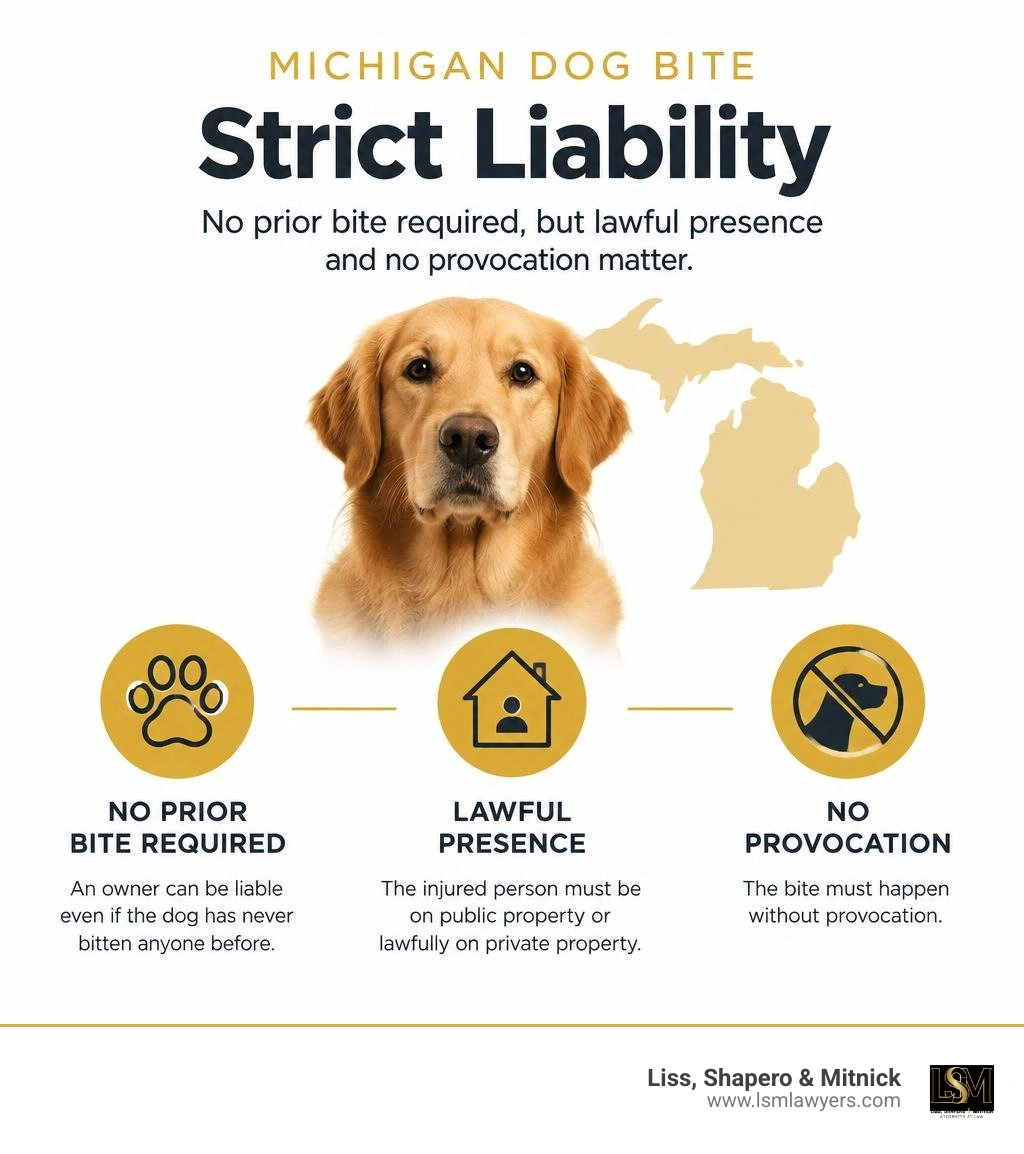
One bite rule Michigan vocab to learn:
Understanding the One Bite Rule Michigan Replaced with Strict Liability
For centuries, common law jurisdictions relied on what legal scholars call the "one-bite rule." Under that traditional doctrine, an animal owner could only be held liable for an attack if the victim proved "scienter"—a fancy legal term meaning the owner already knew, or had reason to know, that their pet had dangerous or vicious propensities. In practice, this meant an animal essentially got one "free" bite before its owner faced civil accountability. If an otherwise gentle family retriever suddenly snapped and bit a neighbor, the owner would shrug, claim total surprise, and walk away without legal liability.
Michigan firmly rejected this outdated concept. The Michigan Legislature recognized that innocent pedestrians, children, and visitors should not bear the physical and financial devastation of an animal attack merely because a dog had not yet established a formal track record of violence.
By enacting statutory strict liability under MCL 287.351, Michigan wiped out the need to prove prior viciousness in bite cases. If an owner's dog bites someone who is lawfully present and did not provoke the animal, the owner is liable—period.
| Legal Concept | Traditional One-Bite Rule | Michigan Strict Liability (MCL 287.351) |
|---|---|---|
| Owner Knowledge Required? | Yes. Must prove the owner knew of prior viciousness (scienter). | No. Prior behavior or lack of knowledge is completely irrelevant. |
| First-Time Bites Covered? | Rarely. The first bite historically established the owner's warning. | Yes. The owner is liable from the very first bite. |
| Standard of Proof | Proof of negligence or intentional harboring of a known dangerous animal. | Proof of ownership, lawful presence, lack of provocation, and resulting bite injury. |
| Applicable Injuries | Bites, scratches, knock-downs, and other animal-inflicted trauma. | Direct dog bites. (Non-bite injuries proceed under separate common-law rules). |
How the One Bite Rule Michigan Common Law Compares to MCL 287.351
Michigan first codified strict liability for dog bites through Act 73 of 1939, later reinforcing and refining the statute through Act 142 of 1988 (effective March 1989). Today, MCL 287.351 clearly states that if a dog bites a person without provocation while the person is on public property or lawfully on private property—including the property of the dog owner—the owner is liable for any damages suffered by the bitten person.
This statutory framework creates zero free bites. As we explain in our comprehensive dog bite injury guide, victims do not have to conduct neighborhood investigations to uncover whether a dog growled at a mail carrier six months prior. The law holds owners automatically accountable for the direct physical harm their dogs inflict via bites, establishing a direct standard for recovery.
When Does Common Law Negligence Apply Instead of Strict Liability?
While MCL 287.351 provides a clear strict liability avenue, its statutory language specifically applies to a person who is bitten by a dog. What happens if an overexcited, unrestrained 90-pound Mastiff charges across a lawn and knocks you onto a concrete sidewalk, causing a fractured hip or a hematoma after a dog bite or fall, without ever clamping its teeth onto your skin?
For non-bite injuries, Michigan courts apply a dual-track liability framework established in cases like Hiner v. Mojica (2006):
- Common Law Strict Liability (Scienter Track): If the victim can establish that the owner knew the dog had abnormal or dangerous propensities (such as repeatedly jumping violently on strangers or charging fences), the owner is held strictly liable under common law.
- Standard Negligence Track: If the owner had no prior knowledge of dangerous propensities, the injured person must prove the owner failed to exercise reasonable care under the circumstances—such as violating local leash ordinances or failing to close a gate.
When clients consult our firm for dog attack legal help, our team evaluates both statutory strict liability and traditional negligence theories to ensure every avenue of compensation is preserved.
Statutory Defenses and Exceptions Under Michigan Dog Bite Law

Because Michigan's statute imposes strict liability for dog bites, an owner cannot defend themselves by claiming, "My dog is always friendly," or "I had no idea he could do that." Instead, defense counsel and insurance adjusters focus almost exclusively on statutory exceptions. To understand how insurance companies evaluate claims, it helps to review Michigan Dog-Bite Laws and Personal Liability Rules.
Under the law, an owner escapes strict liability only if they prove one of two core statutory defenses:
- The victim provoked the dog.
- The victim was trespassing (not lawfully on the property).
Provocation Defense and Accidental Triggers
Under MCL 287.351, the bite must occur "without provocation." In Michigan, provocation is an absolute defense against strict liability. If an owner proves you provoked the dog, your statutory claim fails.
Critically, Michigan case law interprets provocation broadly. In Brans v. Extrom, the Michigan Court of Appeals held that provocation does not have to be malicious or intentional. Even an accidental or unintentional movement—such as inadvertently stepping on a sleeping dog's tail, startling a dog while it eats, or stumbling over an animal in a crowded hallway—can legally constitute provocation if it causes the dog to react defensively.
This defense frequently arises in social settings, such as bites occurring during summer gatherings and backyard events. When someone pets a dog at a barbecue, insurance defense attorneys often argue the guest moved too quickly or engaged in rough play, attempting to frame normal interaction as legal provocation.
Trespassing and Lawful Presence on Private Property
To benefit from strict liability, an injured victim must be on public property or lawfully on private property. The statute specifically defines lawful presence to include:
- Individuals performing duties imposed by the laws of Michigan or federal postal regulations (e.g., mail carriers and meter readers).
- Express or implied invitees (social guests, invited family members, customers at a commercial establishment).
- Licensees (individuals with permission to be on the premises).
This distinction is relevant to workers, such as when addressing a delivery driver bitten on a porch. Delivery workers delivering packages have an implied license to enter driveways and front walkways, placing them within lawful presence protections.
Conversely, an unlawful trespasser who sneaks onto private property to commit a crime or wander uninvited cannot leverage strict liability if confronted and bitten by the homeowner's dog. In these cases, injury claims typically involve homeowners insurance dog bite coverage, where insurers review property boundaries, posted warnings, and entry permissions.
Comparative Negligence and Financial Recovery Limits
In cases involving shared responsibility or common-law negligence claims, Michigan applies a modified comparative fault rule under MCL 600.2959.
Under this rule, if an injured party's own negligence contributed to the incident:
- Their financial recovery is reduced in direct proportion to their percentage of fault. For example, if total damages equal $100,000 but the plaintiff is found 20% responsible for their actions leading up to the attack, they receive $80,000.
- The 50% Bar: If the injured person is found to be greater than 50% at fault for the incident, Michigan law bars them from recovering any noneconomic damages (such as pain, suffering, and mental anguish). They may only recover remaining economic losses, such as outstanding medical bills and lost wages.
Understanding how fault allocation impacts total recovery is essential when analyzing dog bite claim valuation drivers across Metro Detroit and Oakland County courts.
Criminal Penalties and Dangerous Dog Regulations in Michigan
Civil compensation is only one side of Michigan's animal jurisprudence. The state also maintains strict criminal statutes to address dangerous animals and protect communities from irresponsible owners through Act 426 of 1988 (codified at MCL 287.321 through MCL 287.323).
Under MCL 287.321, a "dangerous animal" is defined as a dog or other animal that bites or attacks a person, or a dog that bites or attacks and causes serious injury or death to another dog while the other dog is on the property or under the control of its owner.
The statute specifically exempts animals if:
- The victim was knowingly trespassing.
- The victim provoked or tormented the animal.
- The animal was protecting a human being engaged in lawful activity from an attack or assault.
Misdemeanor and Felony Penalties for Dangerous Animal Owners
When an owner fails to control an aggressive animal, the state can bring formal criminal charges under MCL 287.323:
- Fatal Attacks (Involuntary Manslaughter): If an animal previously adjudicated as dangerous, or an animal known to have dangerous propensities, attacks and kills a human being, the owner can be prosecuted for involuntary manslaughter under MCL 750.321, carrying severe multi-year prison terms.
- Attacks Causing Serious Injury (Felony): If a previously adjudicated dangerous animal attacks a person and causes a "serious injury" (defined under MCL 287.321 as permanent, serious disfigurement, serious impairment of health, or serious impairment of a bodily function), the owner is guilty of a felony punishable by up to 4 years imprisonment, a fine of not less than $2,000, or mandatory community service of not less than 500 hours (MCL 287.323(2)).
- Non-Serious Bites by Adjudicated Animals (Misdemeanor): If a previously adjudicated dangerous animal attacks and causes non-serious injury or is found running at large, the owner faces misdemeanor penalties including up to 90 days in jail, fines between $250 and $500, and up to 240 hours of community service (MCL 287.323(3)).
Court-Ordered Confinement, Restraints, and Restitution
When a sworn complaint is filed in a Michigan district or municipal court alleging that an animal is dangerous, the court issues a summons to the owner and holds a formal evidentiary hearing under MCL 287.322.
If the court finds that the animal caused serious injury or death to a person or another dog, it can order the animal destroyed at the owner's expense. If the animal caused lesser harm but remains dangerous, the court can order comprehensive containment mandates, including:
- Requiring the owner to keep the dog in an escape-proof, secure enclosure with a locked roof and concrete or secured floor.
- Requiring the dog to be muzzled and leashed whenever it leaves the secure enclosure.
- Ordering the animal tattooed or microchipped with a permanent state identification number.
- Ordering mandatory surgical sterilization.
- Requiring the owner to purchase and maintain liability insurance coverage (frequently $100,000 or more) to protect the public.
These civil and criminal safety measures provide an important backdrop when our legal team evaluates long-term trauma, such as managing severe dog bite scarring and disfigurement for injured adults and children.
Legal Deadlines and Practical Steps for Filing a Claim
If you or your child suffered an animal attack in Michigan, understanding your rights is only the first step. You must also abide by statutory filing deadlines.
Under Mich. Comp. Laws § 600.5805(2), the statute of limitations for personal injury lawsuits—including dog bite claims—is three years from the exact date the injury occurred. If you fail to file a formal complaint in a court of competent jurisdiction before this three-year window closes, you lose your legal right to seek financial recovery forever.
While three years may sound like plenty of time, delaying legal action compromises your claim. Evidence disappears, witnesses move, and physical conditions change. Following a clear dog bite lawsuit timeline ensures crucial evidence is preserved from day one.
Why the One Bite Rule Michigan Defense Fails in Civil Court
Insurance adjusters regularly rely on early claimant confusion to settle claims for pennies on the dollar. When an unrepresented victim calls an insurer, an adjuster might say: "Our policyholder’s dog has never done this before, so we aren't liable under the one-bite rule."
As we have established, this defense has no standing under Michigan statutory law. An owner's clean history does not shield them from civil responsibility for a bite. To counter insurer tactics, follow these steps immediately after an incident:
- Obtain Immediate Medical Attention: Animal bites carry high risks of bacterial infection (including Capnocytophaga, Pasteurella, and rabies). Immediate emergency or urgent care documentation links your wounds directly to the attack.
- Report the Incident to Animal Control: Contact municipal or county animal control (e.g., in Oakland, Wayne, or Macomb County) so officers can quarantine the animal, verify vaccination records, and generate an official bite report.
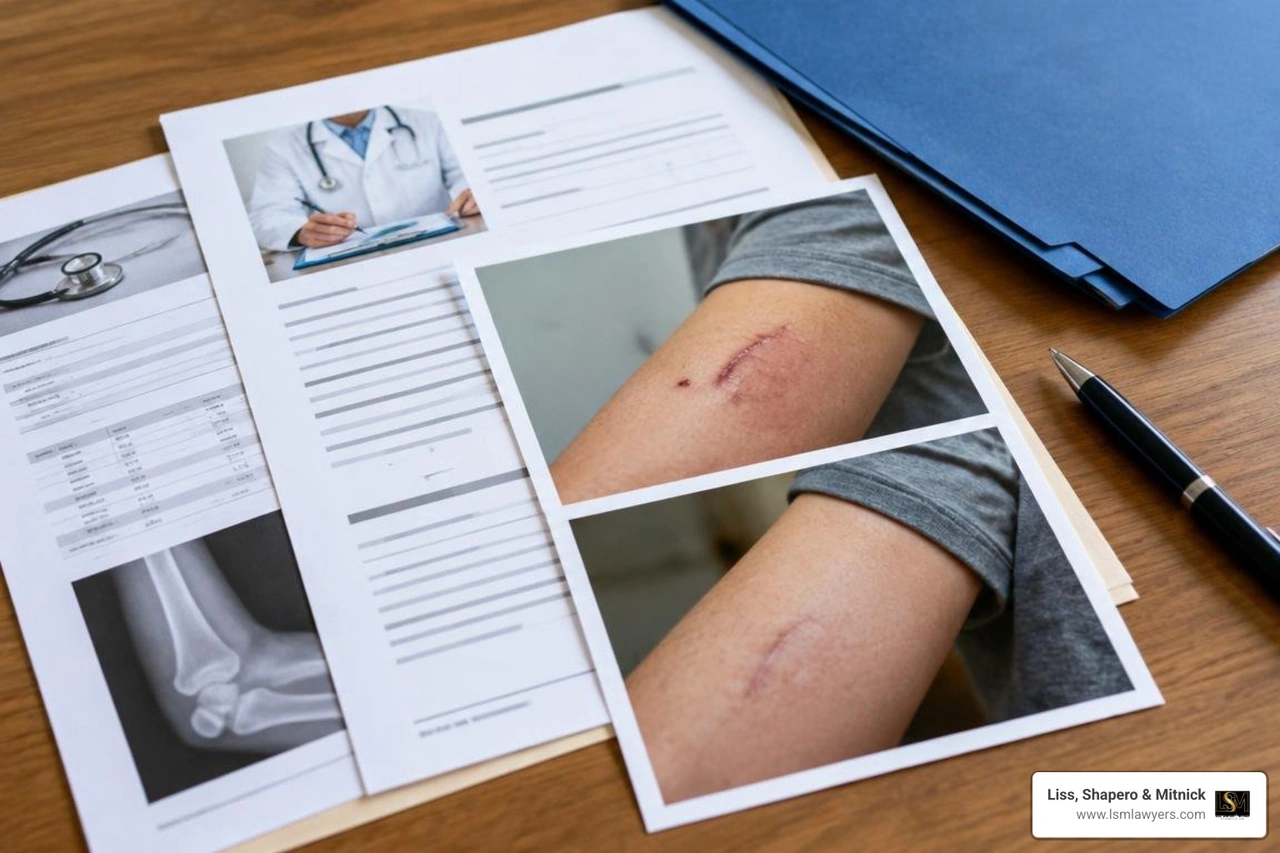
- Preserve Physical Evidence and Photographs: Follow our guidance on photographing dog bite injuries and preserving evidence. Photograph your initial wounds, torn clothing, the location of the attack, and visible scar progression over time.
- Do Not Give Recorded Statements to Insurers: The owner's homeowners insurance company will contact you asking for a recorded statement, specifically listening for words they can twist into "provocation." Decline these interviews until you consult an attorney.
Frequently Asked Questions About Michigan Dog Bite Laws
Does Michigan have a one bite rule for dog bites?
No. Michigan does not follow the common-law "one bite rule." Under MCL 287.351, dog owners are held strictly liable for bite injuries regardless of whether the dog has ever shown aggression in the past or whether the owner had prior knowledge of vicious tendencies. The victim only needs to prove ownership, that the bite occurred without provocation, and that they were on public property or lawfully on private property.
What is the statute of limitations for dog bite injuries in Michigan?
Under Mich. Comp. Laws § 600.5805(2), the statute of limitations for filing a dog bite lawsuit in Michigan is three years from the date of the incident. For minors injured by a dog attack, Michigan law generally tolls (pauses) the statute of limitations until their 18th birthday, giving them until their 19th birthday to file suit. However, consulting counsel early is critical to preserve evidence.
Can an owner be held liable if their dog caused an injury without biting?
Yes. If an unrestrained or jumping dog knocks someone down, scratches them, or causes a bicycle or pedestrian crash without biting, the victim can still recover damages. These non-bite claims proceed under traditional common-law negligence (proving the owner failed to exercise reasonable care) or common-law strict liability (if the victim proves the owner already knew of the dog's dangerous or overly aggressive propensities, pursuant to Hiner v. Mojica).
Conclusion
Michigan's strict liability framework exists to protect innocent people from preventable, life-altering animal attacks. Dog owners in Michigan do not get a free pass, an excuse of ignorance, or a "first free bite" when their animal attacks a lawful visitor or pedestrian.
When you suffer a severe bite wound, nerve laceration, or permanent scarring, you are not just dealing with physical healing—you are facing insurance adjusters trained to shift blame and minimize payouts. At Liss, Shapero & Mitnick, our legal team brings decades of experience, including valuable insight gained from past insurance-defense practice. We understand how insurers value claims, the defenses they attempt to mount, and how to hold negligent animal owners accountable under Michigan law.
If you or a loved one has suffered an animal attack in Berkley, Metro Detroit, or anywhere across Southeast Michigan, do not let an insurance company tell you that the owner wasn't warned. Reach out to our team for dedicated legal help from Michigan dog bite injury attorneys, and let Anthony Shapero and the team at Liss, Shapero & Mitnick fight for the compensation you deserve.